
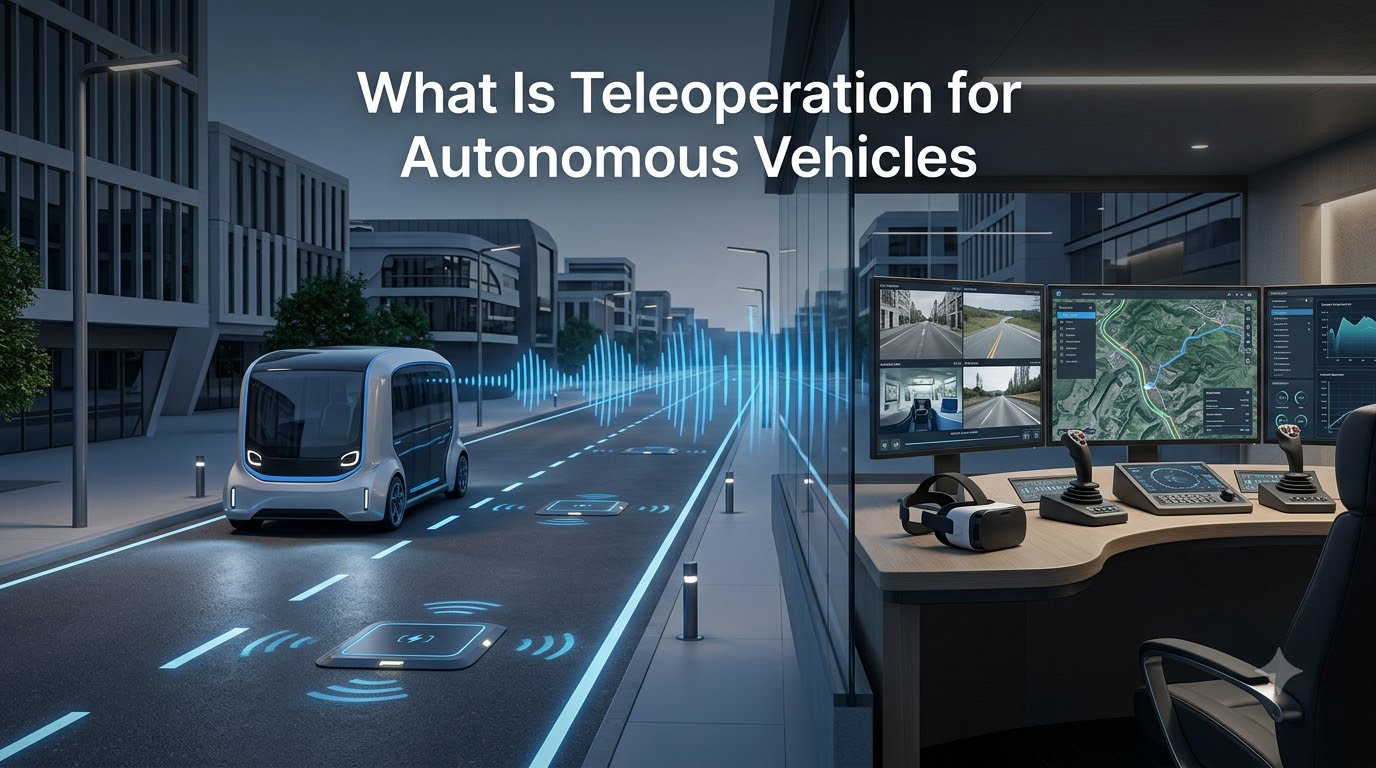
Teleoperation for autonomous vehicles is the technology that lets a remote human operator monitor, assist, and take over a self-driving car when the onboard system cannot handle a situation on its own. I have spent the last several months reading NIST forum transcripts, talking with teleoperators, and reviewing papers from teams at Synopsys and arXiv to put together a clear picture of what this technology actually is, how it works, and where it fits in the path to full autonomy.
If you have ever wondered whether a cop can pull over a Waymo, or what happens when a robotaxi gets stuck in a construction zone, this article is for you. I will cover the core definition, the data flow behind remote driving, the difference between remote monitoring and remote control, the key technologies (especially 5G), safety and cybersecurity considerations, and the companies actively deploying teleoperation in 2026.
Table of Contents
What Is Teleoperation for Autonomous Vehicles
Teleoperation for autonomous vehicles is a human-in-the-loop control system that connects a self-driving car to a remote operator over a wireless network, allowing that person to supervise, assist, or directly drive the vehicle when its AI cannot. The remote human is the safety net for the autonomy stack, and without them most current self-driving systems cannot legally operate on public roads.
You will also hear this called remote operations, tele-assist, remote driving, or human-in-the-loop control. All of these terms describe the same basic idea: a person is sitting somewhere off-vehicle, watching live sensor data, and ready to step in.
Three roles typically fall under the teleoperation umbrella:
Remote monitoring — the operator watches many vehicles at once and flags problems.
Tele-assist — the operator gives high-level guidance, like telling a stuck car which lane to take.
Remote driving — the operator takes direct control of steering, throttle, and brake.
This layering matters because most robotaxi companies lean heavily on monitoring and tele-assist. Full remote driving is reserved for rare edge cases. Reddit users in r/SelfDrivingCars often point this out: the marketing term “driverless” usually means a human is still involved, just from a different building.
How Teleoperation Works in Self-Driving Cars
The data flow for teleoperation runs in a tight loop between the vehicle and an operations center. Here is the step-by-step sequence I have seen in deployment writeups from Phantom Auto, Zoox, and academic demos.
Step 1: The vehicle’s onboard AI hits a confidence threshold it cannot resolve. The driving system might see an unfamiliar construction setup, a fallen tree, or a traffic officer giving hand signals it does not understand. At that point, instead of just stopping in the lane, the car pings the operations center.
Step 2: Sensor data is streamed to a remote operator in real time. Live video from the windshield, rear, and side cameras, plus LiDAR point clouds and HD map context, is encoded and sent over the network. A typical stream needs 5 to 25 Mbps of uplink bandwidth per vehicle.
Step 3: The operator interprets the scene using a custom interface. Most setups use multiple monitors, a steering wheel and pedals (or a gamepad), and a heads-up display of the vehicle’s planned trajectory. Zoox calls their version “TeleGuidance.”
Step 4: A control signal travels back to the car. The operator either issues a high-level command (turn right at the next intersection) or low-level inputs (turn the wheel 15 degrees). The vehicle’s drive-by-wire system applies them.
Step 5: The onboard AI resumes control when the situation is resolved. The handoff back to autonomy is just as important as the handoff out of it, and a clean transition is a major engineering challenge.
For the round trip, end-to-end latency must stay under about 100 milliseconds for safety-critical interventions, and ideally under 50 ms. 5G networks, especially with network slicing, are what make this practical. Older 4G LTE typically introduces 80 to 150 ms of latency, which is too slow for anything beyond simple monitoring.
Remote Monitoring vs Remote Control: Key Differences
Remote monitoring is watching; remote control is driving. That one-line distinction is what most readers get wrong, and it is the same point the Car and Driver featured snippet and Synopsys both hammer on. Here is a side-by-side breakdown.
| Aspect | Remote Monitoring | Remote Control |
|---|---|---|
| Operator input | None, or high-level only | Direct steering, throttle, brake |
| Operator-to-vehicle ratio | 1 operator can watch 5 to 30 vehicles | 1 operator per active vehicle |
| Latency tolerance | Up to 1 to 2 seconds | Under 100 ms |
| Use case | Routine supervision, anomaly flagging | Stuck vehicle, complex maneuver |
| Regulatory status | Widely approved | Restricted or pilot-stage in most U.S. states |
Most commercial teleoperation in 2026 is monitoring-heavy. A single operator might supervise a fleet of 20 robotaxis running errands, only escalating to direct control when the AI raises its hand. This ratio is what makes the economics work. Without it, you would need a remote driver for every car, which defeats the purpose of going driverless.
Reddit threads about Tesla’s teleoperator job postings often confuse the two. Tesla’s listing describes a “vehicle operator” role focused on monitoring and labeling, not remote driving. That is the industry default.
Key Technologies Behind AV Teleoperation
Several technology layers have to work together for teleoperation to feel seamless. I have grouped them into the stack I see referenced most in the technical literature.
5G and Low-Latency Networking
5G is the foundation. Sub-6 GHz 5G delivers 20 to 50 ms latency in good coverage, and millimeter-wave 5G can hit single-digit milliseconds. Network slicing lets a teleoperation provider reserve a guaranteed slice of bandwidth so a stadium full of fans uploading videos does not slow down a fleet of delivery robots.
Sensor Fusion and V2X
The vehicle combines camera, LiDAR, radar, and (where deployed) vehicle-to-everything (V2X) messages from traffic infrastructure. The remote operator sees a synthesized view, not raw sensor dumps. Modern interfaces use 3D point cloud renders overlaid with the planned path.
Real-Time Communication Protocols
WebRTC handles the video and audio streaming, while custom UDP-based protocols carry control signals. ROS 2 (Robot Operating System 2) is the de facto backbone inside many teleoperation stacks because it was built for time-sensitive robotics. Older HTTP-based control loops are too slow and too unreliable.
Edge Computing and Redundancy
If the primary network drops, the vehicle has to fall back safely. Onboard edge compute runs a “minimum risk maneuver” (MRM), which usually means pulling over to the side of the road and stopping. Some setups have a secondary cellular modem on a different carrier as a backup link.
Safety Mechanisms and Cybersecurity for Teleoperation
Safety is the reason teleoperation exists, but the teleoperation channel itself is a new attack surface. I want to spend some time on both halves, because most coverage I have read skips the cybersecurity side.
Latency failsafes. If the round-trip time between car and operator crosses a threshold (often 200 ms), the system assumes the link is degraded. The vehicle stops sending control requests and either hands control back to its onboard AI or executes an MRM.
Operator training and certification. A trained teleoperator needs hundreds of hours of practice before they touch a live fleet. Programs cover defensive driving, regional traffic law, and the specific UI of the platform. NIST’s Vehicle Teleoperation Forum has been pushing for a national certification standard, but adoption is still uneven in 2026.
Cybersecurity threats. A teleoperation link is a high-value target. Attackers who hijack the channel could send malicious control inputs, or they could simply jam the link and trigger a fleet-wide stoppage. Mitigations include end-to-end encryption (TLS 1.3 over the control channel), mutual authentication between vehicle and operator console, certificate rotation, and intrusion detection systems that monitor for anomalous command patterns.
Operator fatigue and ergonomics. Watching 20 vehicles at once is mentally exhausting, and a tired operator makes slow decisions. Best-in-class setups rotate operators every 2 hours, use eye-tracking to detect drowsiness, and cap how many vehicles one person can supervise during high-traffic periods.
Regulatory oversight. In the U.S., the California DMV, Arizona DOT, and NHTSA all have rules covering when a remote operator can take control. The rules differ by state, and the patchwork is one of the biggest scaling headaches for robotaxi operators.
Industry Applications: Who Uses Teleoperation Today
Several well-known companies have built or deployed teleoperation systems. Here is what I have found across public sources, news reports, and Reddit discussions.
Waymo. Waymo’s robotaxi service in Phoenix, San Francisco, and Los Angeles uses a fleet assistance team that monitors rides and can send path guidance to a vehicle. The company does not market this as “teleoperation” publicly, but it functions the same way.
Zoox (Amazon). Zoox developed an in-house “TeleGuidance” system. Operators do not drive the vehicle directly. They give high-level instructions, and the vehicle’s autonomy handles the low-level motion. This is a middle-ground design that the company says reduces latency requirements.
Coco Delivery. Coco’s sidewalk delivery robots in Los Angeles and Pittsburgh rely on remote operators for any street crossing or complex intersection. The robots are small enough that the operator can supervise many at once.
Halo. Halo’s teleride service in Palo Alto and Las Vegas uses teleoperators to deliver cars between customers without anyone physically in the driver’s seat. The cars are electric and drive themselves between hand-offs.
Phantom Auto (now shut down). Phantom Auto was once the best-known pure-play teleoperation vendor. The company shut down in 2024, which Reddit users often cite when arguing that teleoperation as a standalone business is not viable. The general consensus in those threads is that teleoperation works best when it is built and operated in-house by the AV company itself.
Tesla. Tesla job postings for “vehicle operators” suggest the company is preparing a monitoring layer for its robotaxi and Cybercab plans, even as Elon Musk publicly downplays teleoperation.
Outside of passenger cars, teleoperation is common in autonomous trucking (TuSimple, Aurora), mining trucks, port logistics, and agricultural robots. The principles are the same; the vehicles just move more slowly and the stakes of a glitch are lower.
Frequently Asked Questions
Can a cop pull over a Waymo?
Yes. Police can stop a Waymo just like any other vehicle, and Waymo has a protocol for pulling over safely when emergency lights are detected. The remote operations team can also receive a notification and assist if the car fails to yield properly.
Can you give me an example of a teleoperated robot?
A common example is the Coco sidewalk delivery robot in Los Angeles. When a robot reaches a complex intersection, a remote operator takes over to guide it across, then hands control back to the onboard autonomy once the crossing is complete.
How close are we to fully autonomous cars?
Fully autonomous cars (Level 5) that need no human oversight at all are still years away. Most industry experts, including those at Waymo and Zoox, expect teleoperation and human supervision to remain part of the stack for the rest of this decade.
Is Waymo safer than human drivers?
Waymo has published data showing its robotaxis have lower crash rates per mile than the average human driver in its operating areas. Independent reviews and IIHS-style studies are still in progress, so the safest answer is that early data is promising but not yet conclusive.
Conclusion
Teleoperation for autonomous vehicles is the practical bridge between today’s AI drivers and tomorrow’s fully self-driving cars. I have walked through what it is, how the data flows, the difference between monitoring and control, the 5G and sensor stack that powers it, the safety and cybersecurity layers that protect it, and the companies already running it on public roads. As the technology matures through 2026 and beyond, expect teleoperation to fade into the background of robotaxi service, invisible but essential.