
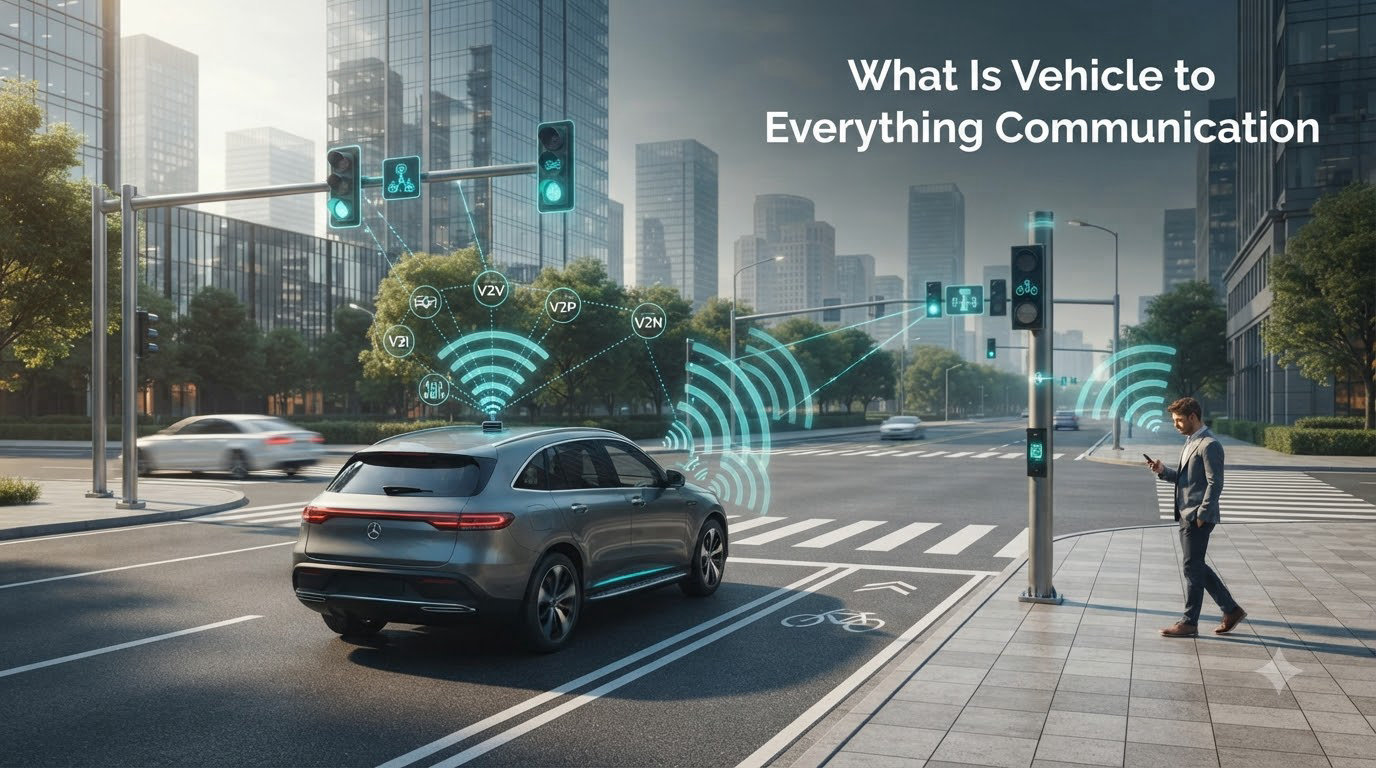
Vehicle to everything communication (V2X) is a wireless technology that lets a vehicle share data with any entity that may affect, or be affected by, it — including other cars, roadside infrastructure, pedestrians, cellular networks, and the power grid. I think of V2X as the connective tissue of an intelligent transportation system: it gives cars a voice to warn each other about hazards, talk to traffic signals, and even coordinate with cyclists and pedestrians carrying smartphones.
Over the past decade I have followed V2X from a niche research topic into a genuine deployment story. Toyota launched the first production V2X cars in Japan in 2016, Volvo added slippery-road warnings in Denmark the same year, and GM shipped DSRC to Cadillac in 2017. In 2026, the technology is at a turning point: 5G has matured, regulators are rewriting spectrum rules, and the automotive industry is racing to decide whether the future belongs to Wi-Fi-based DSRC or cellular C-V2X.
This guide explains exactly what vehicle to everything communication is, how it works under the hood, the differences between V2V, V2I, V2P, V2N, V2G and V2D, the standards war between DSRC and C-V2X, and the real-world deployments already saving lives. By the end you will understand the technology, the players, and where it is going.
Table of Contents
How Does Vehicle to Everything Communication Work?
Vehicle to everything communication works by letting a vehicle broadcast short, standardized messages over a wireless link while receiving the same kind of messages from other vehicles, infrastructure, and the network. Each message is small — usually under a few hundred bytes — but contains critical data such as position, speed, heading, acceleration, brake status, and road hazard flags. Other vehicles or receivers within roughly 300 meters can decode the message in milliseconds, even if they are out of sight, around a corner, or hidden by another truck.
There are two main technology stacks in use today, and they both work in roughly the same way at a high level:
- WLAN-based V2X — uses IEEE 802.11p (an amendment of Wi-Fi tuned for fast-moving vehicles) operating in the 5.9 GHz band. It is the basis of Dedicated Short-Range Communications (DSRC) in the US and ITS-G5 in Europe.
- Cellular V2X (C-V2X) — defined by 3GPP, the same body that standardizes 4G and 5G. C-V2X uses two interfaces: PC5 for direct short-range vehicle-to-vehicle messages (called sidelink) and Uu for longer-range communication through cellular towers.
Inside each stack, vehicles exchange a small set of standardized message types that any compliant vehicle or roadside unit can understand:
- Basic Safety Message (BSM) — the US standard; sent roughly 10 times per second by every equipped car. Contains GPS position, speed, heading, and brake status.
- Cooperative Awareness Message (CAM) — the European equivalent of BSM, defined by ETSI.
- Decentralized Environmental Notification Message (DENM) — used to flag sudden events such as a hard brake, roadworks, or an emergency vehicle approaching.
- Signal Phase and Timing (SPaT) — broadcast by traffic lights so cars know exactly how many seconds of green or red remain.
The magic is that all of this happens without depending on a cellular network for the safety-critical parts. C-V2X in PC5 mode and DSRC in 802.11p mode work peer-to-peer, so two cars can warn each other of an icy patch even if cellular coverage is dead. The network-based Uu mode is used for non-time-sensitive traffic, map updates, and software downloads.
From a hardware standpoint, a V2X-equipped car carries a V2X modem (often integrated into the telematics control unit), an antenna on the roof, and a connection to the vehicle’s CAN bus. The safety algorithms that turn incoming messages into driver warnings — forward collision alert, blind spot warning, do-not-pass warning — run on the same ADAS processors used for camera and radar fusion.
What Are the Types of V2X Communication?
The “everything” in vehicle to everything communication covers six main communication partners, each with a different role. Together they form the full V2X ecosystem:
V2V (Vehicle-to-Vehicle)
Vehicle-to-vehicle communication lets cars broadcast their own state and receive the state of nearby cars. A typical V2V safety message includes position, speed, heading, acceleration, brake status, and vehicle size. The receiving car runs software that looks seconds into the future — if your car and the car ahead are on a collision course, it warns the driver or pre-tensions the brakes.
V2V also enables truck platooning, where several trucks drive in a tight convoy. Only the lead truck is driven by a human; the followers use V2V to maintain a tight, fuel-saving gap. The NHTSA estimates that V2V alone could prevent or reduce the severity of up to 13 percent of crashes — roughly 439,000 per year in the United States.
V2I (Vehicle-to-Infrastructure)
Vehicle-to-infrastructure communication links cars with roadside units mounted on traffic signals, highway gantries, toll booths, and streetlights. A traffic light that broadcasts its SPaT message lets an approaching car pace itself to hit a green, saving fuel. A roadworks zone can broadcast a DENM that flashes a warning inside every car 500 meters before it is visible.
V2I is also how cities run smart intersections. Sensors at the corner detect a pedestrian stepping into the crosswalk and immediately push a warning to every car that has line of sight blocked by a building.
V2P (Vehicle-to-Pedestrian)
Vehicle-to-pedestrian communication protects vulnerable road users — pedestrians, cyclists, scooter riders, and wheelchair users. The simplest form uses a smartphone app that broadcasts a pedestrian’s position over V2X. An approaching car receives the broadcast, calculates a collision risk, and warns the driver.
This is a major area of investment because modern cars already have automatic emergency braking for other cars, but cyclists and pedestrians are far more fragile. The US DOT has spent hundreds of millions on V2P pilots in New York, Tampa, and Wyoming.
V2N (Vehicle-to-Network)
Vehicle-to-network communication uses cellular links to connect the car to cloud services. This is where over-the-air software updates, real-time traffic, weather, parking availability, and HD map downloads live. V2N is not used for time-critical safety warnings because the latency through a cellular tower is too high, but it is ideal for the non-urgent data streams that make a car feel modern.
V2G (Vehicle-to-Grid)
Vehicle-to-grid communication turns the parked electric car into a distributed energy resource. When the grid is stressed, an aggregated fleet of EVs can discharge a few kilowatt-hours back to absorb peaks; when renewable generation is high, cars can soak up the surplus. Standards such as ISO 15118 define the Plug & Charge and bidirectional power flow that V2G depends on. A new variant, V2H (vehicle-to-home) and V2B (vehicle-to-building), use the same protocols to power a house or a commercial site during an outage.
V2D (Vehicle-to-Device)
Vehicle-to-device communication connects a car to any device the driver or passenger carries — a phone, a laptop, a wearable. It overlaps with V2P and V2N but is its own category in 3GPP specifications. Practical uses include sending a route from a phone to the car, streaming a movie to rear-seat screens, and remote diagnostics.
DSRC vs C-V2X: Comparing the Two Standards
The single most important technical question in vehicle to everything communication is which radio standard a car uses. There are two competing families, and most countries have chosen sides.
IEEE 802.11p and DSRC
DSRC (Dedicated Short-Range Communications) is based on IEEE 802.11p, a 2009 amendment to Wi-Fi designed for vehicular use. The full stack — 802.11p plus IEEE 1609 — is called WAVE in the US (Wireless Access in Vehicular Environments) and ITS-G5 in Europe. DSRC runs in a 75 MHz slice of the 5.9 GHz band, uses 10 MHz channels, and reaches roughly 300 meters. Latency is below 5 milliseconds, which is more than fast enough for collision warnings.
DSRC was the first standard to reach production. Toyota shipped DSRC in Japan starting in 2016, and GM made it available in the Cadillac CTS in 2017. The technology works, but it is locked to one purpose: short-range safety messaging.
C-V2X and the 3GPP Roadmap
C-V2X was introduced by 3GPP in Release 14 in 2017. It uses LTE radio technology for direct device-to-device communication on the PC5 interface (sidelink) and standard cellular for the Uu interface. Release 16 added 5G NR support, enabling higher throughput and lower latency. Release 17 and beyond are tuning C-V2X specifically for platooning, advanced driving, and extended sensor sharing.
C-V2X is backed by the 5G Automotive Association (5GAA), whose members include most major automakers, chip makers, and mobile operators. Ford, BMW, Audi, and Qualcomm have publicly committed to C-V2X, and the technology is the de facto choice in China.
Side-by-Side Comparison
The table below highlights the differences that matter for deployment:
- Radio basis: DSRC uses IEEE 802.11p; C-V2X uses LTE sidelink (PC5) and 5G NR.
- Latency: Both are sub-10 ms for direct messages; C-V2X improves as 5G NR matures.
- Range: Both reach roughly 300 meters direct, but C-V2X also has the Uu path to towers for longer reach.
- Spectrum: DSRC uses dedicated 5.9 GHz in the US and EU; C-V2X can use 5.9 GHz sidelink plus licensed cellular bands.
- Forward path: DSRC is essentially frozen at 802.11p; C-V2X follows 3GPP releases into 5G-Advanced and 6G.
- Ecosystem: DSRC is favored by older US deployments and some EU member states; C-V2X is favored by most global automakers and the entire Chinese market.
The 2020 decision by the US FCC to reallocate the lower 45 MHz of the 5.9 GHz band to Wi-Fi effectively sidelined DSRC in the United States. The upper 30 MHz was preserved for V2X and is now expected to host C-V2X, with the FCC formally transitioning to C-V2X in 2026. Europe, in contrast, has kept both options open and continues to test ITS-G5 alongside C-V2X.
Real-World V2X Use Cases and Applications
Theory matters, but what vehicle to everything communication actually does on the road is what counts. Here are the applications that are already live, in trials, or firmly on the near-term roadmap.
Safety Warnings
The headline V2X use cases are cooperative safety applications. The most common ones in pilots and production cars include:
- Forward collision warning — alerts the driver when a V2X-equipped car ahead brakes hard, even before the radar sees it.
- Emergency electronic brake light warning — flashes a warning in your car when a vehicle several cars ahead slams the brakes.
- Intersection movement assist — warns drivers approaching a blind intersection that another car is on a collision course.
- Blind spot warning and lane change warning — uses V2V to spot motorcycles or cars in adjacent lanes that the camera misses.
- Red light running warning — combines V2I SPaT data with the car’s position to alert the driver before running a light.
Traffic Efficiency and Smart Cities
At a city scale, vehicle to everything communication becomes a real-time traffic control system. Signal phase and timing data lets adaptive cruise control glide through green waves. Roadside units aggregate V2X data from thousands of cars to detect congestion and retiming signals. Pioneering work here is happening through infrastructure investment like the recent Moove autonomous vehicle infrastructure funding, which is helping to lay the physical and digital foundations for smart cities.
Platooning and Commercial Fleets
Platooning is the killer use case for freight. European truck trials led by Daimler and Volvo have shown fuel savings of 7 to 10 percent when trucks drive in coordinated convoys using V2V. The lead truck controls acceleration; the followers react in milliseconds via V2X. The same approach works for urban delivery fleets and port logistics.
Autonomous Driving Support
Even the most advanced self-driving cars are limited to what their onboard sensors can see. V2X extends perception beyond line of sight, around corners, and through obstacles. An autonomous car receiving V2I data from a smart intersection can drive through without ever needing to “see” the cross traffic — the intersection tells it what is coming. This is the bridge from Level 2 driver assistance to Level 4 and beyond.
Benefits of Vehicle to Everything Communication
The benefits of vehicle to everything communication fall into four buckets: safety, efficiency, environment, and autonomy. Together they explain why governments are willing to fund deployments and why automakers are willing to ship the hardware even before every car on the road has it.
Safety Benefits
NHTSA’s analysis of V2V estimated that just two safety applications — forward collision warning and lane change warning — could prevent or mitigate up to 13 percent of all police-reported crashes. Add intersection movement assist and blind spot warning, and the reduction rises further. Every V2X pilot I have followed has reported a measurable drop in dangerous events. The US DOT’s current V2X deployment plan estimates that full deployment could prevent roughly 615,000 crashes over a 30-year horizon.
Traffic Efficiency
Coordinated traffic flow reduces stop-and-go waves. Studies on European C-ITS corridors have shown travel time reductions of 5 to 15 percent and fuel savings of 5 to 10 percent when V2I is combined with adaptive cruise control. Platooning multiplies those savings for freight.
Environmental Impact
Smoother traffic means less idling, fewer accelerations, and lower emissions. The International Transport Forum estimates that connected and automated driving could cut CO2 from road transport by up to 30 percent when fully deployed. Vehicle-to-grid (V2G) adds a second environmental win by absorbing renewable energy that would otherwise be curtailed.
Autonomy and Robotics Synergy
For a robotics-focused audience like ours at Smashing Robotics, the most interesting benefit is perception. V2X is essentially a wireless sensor — a way for an autonomous car, delivery robot, or drone to receive data from sources its own cameras and lidar cannot reach. In a future where robots share streets with human drivers, V2X will be the channel that keeps them from colliding with one another.
Challenges and Limitations of V2X
Vehicle to everything communication is not a quiet success story — it is a technology that has been “almost here” for more than a decade. Understanding why helps explain where it goes next.
Spectrum and Regulatory Issues
For years, the 5.9 GHz band was reserved for V2X in the US. The FCC’s 2020 decision to give the lower 45 MHz to Wi-Fi was a major setback for DSRC, but it also accelerated the move to C-V2X. In Europe, ITS-G5 is protected, but member states are still aligning on harmonized rules. China has dedicated spectrum for LTE-V2X. The patchwork of spectrum rules is a deployment headache for any global automaker.
Security and Privacy
A car that broadcasts its position 10 times per second is a privacy problem if the messages are not anonymized, and a safety problem if the messages can be forged. The V2X ecosystem defends itself with Public Key Infrastructure (PKI): every message is signed by a certificate authority, and misbehaving devices can be revoked. The US DOT’s SCMS (Security Credential Management System) was the original blueprint; the EU has its own PKI, and C-V2X implementations use similar certificate-based schemes. There is no perfect defense, and penetration testing of V2X is now a standard part of any new deployment.
Network Effect Problem
V2X is only as good as the number of equipped cars. A single V2X car in a sea of unconnected cars is a sensor that nobody talks back to. This is the classic chicken-and-egg problem, and it is why every V2X deployment so far has been paired with either regulation (new cars must include V2X) or fleet programs (taxis, buses, government vehicles lead the way).
Cost Concerns
V2V technology is not as expensive as it once was. A V2X modem plus antenna adds roughly $100 to $200 to the bill of materials of a new car in 2026, and that figure keeps falling as the chip vendors — Qualcomm, NXP, Autotalks, MediaTek — push for higher integration. The real cost is not in the hardware but in the PKI, the map data, and the software stack that turns messages into driver warnings. For consumers, V2X safety features will likely be bundled into existing ADAS packages rather than sold as a standalone option.
Interference and Coexistence
In some European countries, road tolling systems operate in bands adjacent to the 5.9 GHz safety spectrum. Filters and guard bands help, but the coexistence has been a persistent engineering challenge and a reason some member states delayed deployment.
Frequently Asked Questions
How does V2X work?
V2X works by letting a vehicle broadcast short, standardized messages over a wireless link. Each message carries data such as position, speed, heading, and brake status. Other vehicles and roadside units within roughly 300 meters receive the message and run safety algorithms to warn the driver. The two main technologies are IEEE 802.11p / DSRC, which uses Wi-Fi-style radio, and C-V2X, which is defined by 3GPP and uses cellular sidelink plus 5G.
Is V2V technology expensive?
V2V technology adds roughly $100 to $200 to the cost of a new car, depending on integration. That figure has fallen sharply as chip vendors integrate the modem with other telematics. Consumers typically receive V2V features as part of an ADAS package rather than as a paid add-on. The bigger cost is the system-level investment: PKI certificates, map data, and the software that turns messages into driver warnings.
What is the difference between V2X and V2V communication?
V2V, or vehicle-to-vehicle, is one type of V2X communication. It refers specifically to direct data exchange between cars. V2X, or vehicle-to-everything, is the umbrella term that includes V2V plus every other kind of communication: V2I (infrastructure), V2P (pedestrians), V2N (networks), V2G (grid), and V2D (devices). In short, V2V is a subset of V2X.
What are some examples of V2V communication?
Real-world V2V examples include forward collision warning, where a car ahead broadcasts a hard-brake event; emergency electronic brake light warning, which flashes a warning several cars back; intersection movement assist, which warns of cross-traffic at blind intersections; blind spot and lane change warnings; and truck platooning, where following trucks maintain a tight, fuel-saving gap using V2V data. Volvo has used V2V in Denmark since 2016 to alert nearby Volvos of slippery roads.
Conclusion: The Road Ahead for V2X
Vehicle to everything communication is one of those rare technologies that almost everyone agrees is a good idea, yet which has taken more than a decade to start arriving in volume. The combination of clearer spectrum rules, the maturity of 5G, falling hardware costs, and the safety case built by NHTSA and the US DOT is finally moving V2X from research papers to road reality. Toyota, GM, and Volvo have shipped production V2X; the US DOT has committed $60 million in deployment grants; and the FCC’s transition to C-V2X is now policy in 2026.
The next five years will be the inflection point. As more new cars ship with C-V2X sidelink and roadside units multiply along highways and smart intersections, the network effect that limited earlier pilots will start to kick in. For robotics and autonomous systems in particular, V2X will be the communication channel that lets a self-driving car, a delivery robot, and a traffic signal cooperate in real time. If you build, study, or follow this space, keep an eye on the 3GPP Release 18 work, the SCMS successor PKIs, and the first commercial V2G rollouts in Europe and California. Vehicle to everything communication is no longer a question of if — it is a question of how fast.