
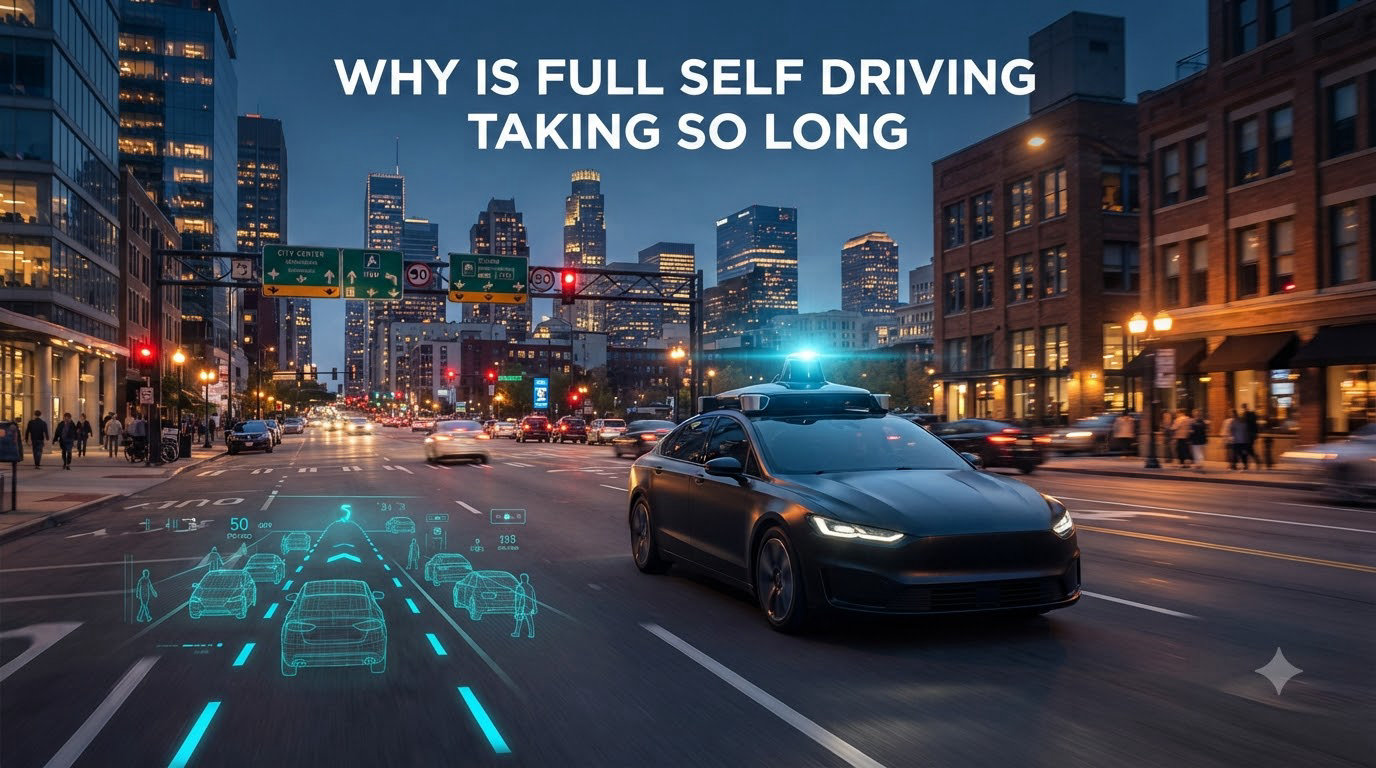
Tesla promised us robotaxis by 2026, and instead, millions of FSD-equipped cars still need a human hand hovering over the wheel. I have been following this story for nearly a decade, and the gap between the marketing and the road has never been wider. So the question why is full self driving taking so long is not just a Tesla question. It is a question about what we thought AI could do versus what it actually can do.
The honest answer is that the last 1% of driving turns out to be 99% of the problem. Humans navigate rare, weird, and dangerous situations by using common sense, social negotiation, and millions of years of evolution. Software does not. In this guide, I will walk through the technical, regulatory, and human reasons that full self driving keeps slipping, and what experts think the real timeline looks like.
Table of Contents
Why Is Full Self Driving Taking So Long? The Short Answer
Full self driving is taking so long because the long tail of rare driving scenarios is far harder to solve than early engineers predicted. Modern AI can handle 99% of routine driving, but that last fraction of a percent includes construction zones, emergency vehicles, ambiguous traffic signals, and unpredictable humans.
To be truly unsupervised, a self-driving system must be statistically safer than a human across billions of miles. Tesla, Waymo, and every other team chasing Level 4 and Level 5 autonomy are stuck on the same bottleneck: edge cases that humans resolve with intuition but that neural networks still cannot reliably interpret.
There are also secondary reasons layered on top of that core problem:
- Hardware and sensor debates remain unresolved (cameras vs LIDAR vs radar).
- Regulation has not caught up to the technology.
- Liability frameworks still assume a human driver is responsible.
- Public trust drops sharply after every high-profile crash.
None of these are excuses. They are real engineering and policy problems that take years to solve.
The Long Tail Problem: Why 99% Accuracy Is Not Enough
Imagine you build a self-driving car that handles 99% of miles perfectly. Sounds great, right? The average American drives about 13,500 miles per year, so 1% failure means roughly 135 miles of problems annually. That is unacceptable when each mile is supervised by a person who has learned to tune the system out.
The trouble is that failures do not distribute evenly. They cluster in edge cases, corner cases, and rare interactions. A baby stroller being pushed down a suburban street. A mattress falling off a pickup truck on the highway. A police officer waving traffic through a red light. A crosswalk painted over by roadworks.
Researchers call this the long tail problem. The bulk of common scenarios is easy to model, but the long, thin tail of weird events stretches out almost infinitely. A human driver navigates these situations using context, social cues, and rules of thumb. An AI has to learn each one from labeled data, and many never appear in training sets at all.
Reddit’s r/TeslaFSD community captures this frustration well. Long-time FSD Beta testers routinely say the system feels 95% there, but that final stretch is where the bugs hide, and those bugs can kill.
Core Technical Challenges Blocking Autonomous Driving
Beyond edge cases, full self driving runs into several layers of technical difficulty that no one has fully solved.
Perception: Teaching Cameras to Understand the World
Tesla’s FSD relies on eight cameras and a neural network called HydraNet to perceive the world. The system has to detect lanes, vehicles, pedestrians, signs, and traffic lights in real time, under rain, glare, fog, and darkness. Modern computer vision is shockingly good, but it still confabulates. It sees shadows as obstacles, misses objects partially hidden behind others, and gets confused by bright sun or heavy rain.
Users on Tesla forums have reported FSD misidentifying a passing train as a line of semi-trucks, hesitating through unprotected left turns, and freezing at construction zones. Each error is a perception failure dressed up as a driving failure.
Prediction: Modeling What Other Drivers Will Do Next
Driving is mostly social. You make eye contact with another driver, you watch a cyclist’s shoulder for hints of a turn, you leave space because the car ahead is behaving erratically. Predicting human behavior in a structured rules-based system is one of the hardest problems in AI today. Other drivers break rules constantly, and FSD has to assume everyone else is a competent, attentive driver, even when they are not.
Path Planning and Real-Time Decision Making
Once the system perceives its environment, it must plan a smooth, safe path, and replan it multiple times per second as conditions change. This includes merging into tight gaps, yielding to emergency vehicles, and choosing between two legal but awkward options. The compute required for safe real-time planning is enormous, which is why Tesla designed its own inference chips and why Waymo’s Chrysler Pacifica minivans have trunks full of computing hardware.
Mapping and Localization
Waymo’s approach leans heavily on high-definition 3D maps. Every curb, sign, and lane stripe is pre-recorded. This dramatically reduces the perception problem, but it limits the system to geofenced areas where maps exist. Tesla’s approach avoids HD maps, which is more flexible, but the system has to construct its own understanding of the road in real time, which is harder.
Tesla’s Vision-Only Approach: Bold Bet or Design Flaw?
Tesla’s boldest bet is that cameras alone are enough. Elon Musk has called LIDAR a “crutch” and removed radar from production vehicles in 2021, betting that a vision-only system with enough training data can outperform sensor-fusion rivals. The argument is biologically inspired. Humans drive with two eyes and a brain, not laser rangefinders, so cars should be able to as well.
The counterargument, championed by Waymo, Cruise, and most academic researchers, is that cameras fail in conditions where other sensors do not. LIDAR works in pitch darkness. Radar cuts through fog. Cameras struggle with sun glare, faded lane lines, and low-contrast scenes. Fusing multiple sensor types produces a more reliable picture than any single modality.
So far, neither side has definitively won. Tesla’s vision-only stack has scaled impressively across millions of cars, but it has not crossed the threshold to unsupervised operation. Waymo’s multi-sensor approach runs commercially in a few cities, but it does not scale easily because every new city requires detailed remapping.
The truth is probably that vision alone is not enough, but neither is LIDAR alone. The industry is heading toward sensor fusion with smarter AI on top.
Tesla vs Waymo: Two Roads to Self-Driving
The contrast between Tesla and Waymo illustrates two opposite philosophies. Tesla distributes FSD to a million-plus consumer vehicles, gathering driving data at massive scale and improving the system through over-the-air updates. Waymo runs a smaller fleet of sensor-heavy vehicles in tightly mapped urban zones, with safety drivers and remote operators standing by.
Tesla’s path is faster to scale and cheaper to deploy, but harder to validate. Waymo’s path is slower and more expensive, but easier to certify as safe. As of 2026, only Waymo operates an unsupervised robotaxi service open to the public, and only in Phoenix, San Francisco, Los Angeles, and a handful of other cities. Tesla’s robotaxi ambitions are still in early pilot stages despite years of promises.
Neither approach has cracked the general full self driving problem. Both have learned that the hard part is not driving. It is dealing with everything that is not driving.
Regulatory and Legal Barriers to Full Autonomy
Even if Tesla solved the technical problem tomorrow, regulators would not immediately approve unsupervised FSD nationwide. The current legal framework in the US, EU, and most other regions assumes a human is legally responsible for the vehicle. Without a clear liability chain, no insurance company will underwrite a robotaxi fleet and no government will let one operate on public roads.
Regulators want proof, not promises. They want disengagement data, simulation results, accident reconstruction, and a clear answer to the question, what happens when the system fails. Tesla has not published the kind of detailed safety case that Waymo submits to California’s DMV and the Arizona Department of Transportation. Until it does, Level 3 and Level 4 approval will remain out of reach.
Internationally, the picture is even murkier. China’s Baidu and WeRide have approval to run robotaxis in designated zones. Germany has a Level 3 law, but it is narrowly defined. The UK’s Automated Vehicles Act 2024 created a legal framework for self-driving cars, but the implementation regulations are still being drafted. Self-driving is held back not just by what AI can do, but by what laws allow.
Safety Validation: The Billion-Mile Testing Problem
To prove that a self-driving system is safer than a human, you need to drive a statistically significant number of miles. If human drivers crash roughly once per 500,000 miles, you need hundreds of millions of autonomous miles to demonstrate even a small improvement. Tesla has accumulated billions of miles in shadow mode and FSD Beta, but most of that data is under human supervision, which changes how the system behaves.
Waymo has driven tens of millions of fully autonomous miles, and the safety record is strong, but not perfect. Each incident, including a 2023 pedestrian drag case in San Francisco, gets magnified in the press. The asymmetry of public attention means the bar for safety is essentially perfection, which is why every deployment is slow, cautious, and limited.
Simulation helps, but only up to a point. You can run a billion simulated miles overnight, but the simulator is only as good as the scenarios you put into it. If you forget to model a toddler on a bicycle, your billion miles prove nothing about that scenario.
Promises vs Reality: The FSD Timeline
Elon Musk has been promising fully autonomous Teslas since 2016. The original Autopilot 2.0 hardware launch in 2016 came with a presentation showing a Tesla driving itself across the country by 2017. That trip never happened. In 2019, Musk said there would be a million robotaxis on the road by 2020. In 2022, he predicted FSD would reach full autonomy by 2023. As of mid-2026, the system still requires a human driver ready to take over at any moment.
The pattern is not unique to Tesla. The whole autonomous vehicle industry has repeatedly missed its own deadlines. The DARPA Grand Challenge in 2004 and 2005 inspired a generation of startups that all promised self-driving by 2020. None of them delivered on the original timeline.
The reason for the consistent over-promising is partly optimism, partly marketing, and partly a failure to grasp how much harder the long tail really is. Every milestone that should have been the last turns out to be one of many.
Public Trust and Driver Complacency
Even if the technology were perfect today, public trust would still be a barrier. Surveys consistently show that while people are excited about self-driving cars in the abstract, they do not want to be in one. Every high-profile crash becomes a national news story, and every near-miss shared on social media sets public opinion back months.
Driver complacency is the flip side of that coin. FSD Beta drivers frequently report that they zone out during long highway stretches and miss the moment when the system needs help. Chuck Cook, one of the most prominent FSD testers, said it best, until FSD is unsupervised and the driver is no longer liable, the driver is still responsible. The legal and psychological weight of supervising a system you do not fully understand is exhausting, and it is a real safety risk.
Until both halves of that equation change, public adoption will lag technical progress.
Frequently Asked Questions
Is FSD worth $8000?
Whether FSD is worth $8000 depends on how much you value driver-assist features today. FSD adds Navigate on Autopilot, automatic lane changes, traffic light and stop sign recognition, and the Summon feature. However, it still requires constant supervision and does not deliver unsupervised autonomy. If you are buying it for the promise of future robotaxi income, that promise has no guaranteed timeline. Most owners report it is fun to use in good weather but not stress-free enough for daily commuting in dense cities.
Why do Waymos take so long?
Waymo One rides can take longer than Uber or Lyft because the system operates in geofenced areas and conservatively avoids complex maneuvers like unprotected left turns and certain merging situations. Waymo’s safety policy errs on the side of caution, which adds minutes to many trips. The vehicles also drive slower than human drivers in many scenarios, and pickup or drop-off points can be limited. The trade-off is fewer accidents and a more predictable trip.
Will Tesla stop selling FSD?
There is no public indication that Tesla plans to stop selling FSD. The company continues to push FSD as a major revenue driver and a stepping stone to a future robotaxi business. Prices have actually risen several times, and FSD is now also offered on a subscription basis. Stopping sales would be a major strategic shift, and Tesla has shown no sign of moving in that direction as of 2026.
Why isn’t Full Self-Driving working?
Full Self-Driving is not working as a fully autonomous system for several reasons. The long tail of rare edge cases still trips up the neural network. Vision-only perception struggles in glare, fog, and faded lane markings. Prediction of other drivers’ behavior is unreliable. The system is not yet certified for unsupervised operation by any major regulator. It performs impressively in routine driving but degrades sharply in unusual conditions, which is why a human driver is still required.
What is the failure rate of Tesla Autopilot?
Tesla has not published a comprehensive failure rate for Autopilot or FSD. Independent estimates based on NHTSA data suggest Autopilot is involved in significantly fewer crashes per mile than the US average, but those numbers are not directly comparable because of selection bias. For FSD Beta, Tesla’s quarterly safety reports show one crash per several million miles, though these figures cover mostly highway driving under supervision. The real failure rate in unsupervised city driving is unknown because unsupervised operation is not yet allowed.
Can you trust Tesla Full Self-Driving?
You can trust FSD to handle long stretches of highway driving well, especially in clear weather with good lane markings. You cannot trust it to drive your children to school unsupervised. Every FSD page in the car explicitly says the driver must remain attentive and ready to take over. Treat FSD as a sophisticated driver-assist system, not as autonomy. If that is the mental model you drive with, the system is genuinely useful. If you expect it to be a robotaxi, you will be disappointed and possibly endangered.
What did Elon Musk say about self-driving cars?
Elon Musk has made several bold predictions about self-driving cars over the past decade. In 2016 he predicted a cross-country Tesla Autopilot demo by 2017. In 2019 he forecast one million Tesla robotaxis by 2020. In 2022 he said FSD would reach full autonomy by 2023. None of those deadlines have been met. Musk continues to claim that unsupervised FSD is imminent, but the actual capability of the system continues to lag his timeline, and the gap between prediction and reality is now widely cited as a cautionary tale about AI overpromising.
The Real Answer Behind Why Full Self Driving Is Taking So Long
So why is full self driving taking so long? Because the field ran out of easy problems. The first 80% was perception and lane keeping. The next 15% was highway driving and basic city navigation. The last 5%, the part that includes police hand signals, emergency vehicles, unmapped construction, and unpredictable humans, is turning out to be the hardest part of the whole project.
Tesla, Waymo, and every other team chasing full autonomy are converging on the same conclusion. Self driving is not one big AI breakthrough away. It is a slow grind of better data, better sensors, better simulation, and clearer regulation. Anyone who promises you a robotaxi next year is selling you a story, not a schedule.
What should you do if you are considering FSD? Treat it as a driver-assist feature, not a chauffeur. Drive it on familiar roads in good weather. Stay engaged. Watch the road the way you would if a new teenage driver were at the wheel. The technology is real, and it is improving every month. But the gap between a useful driver assist and a true self-driving car is larger than any CEO has been willing to admit, and that is the real reason why is full self driving taking so long continues to be one of the most important questions in robotics today.