
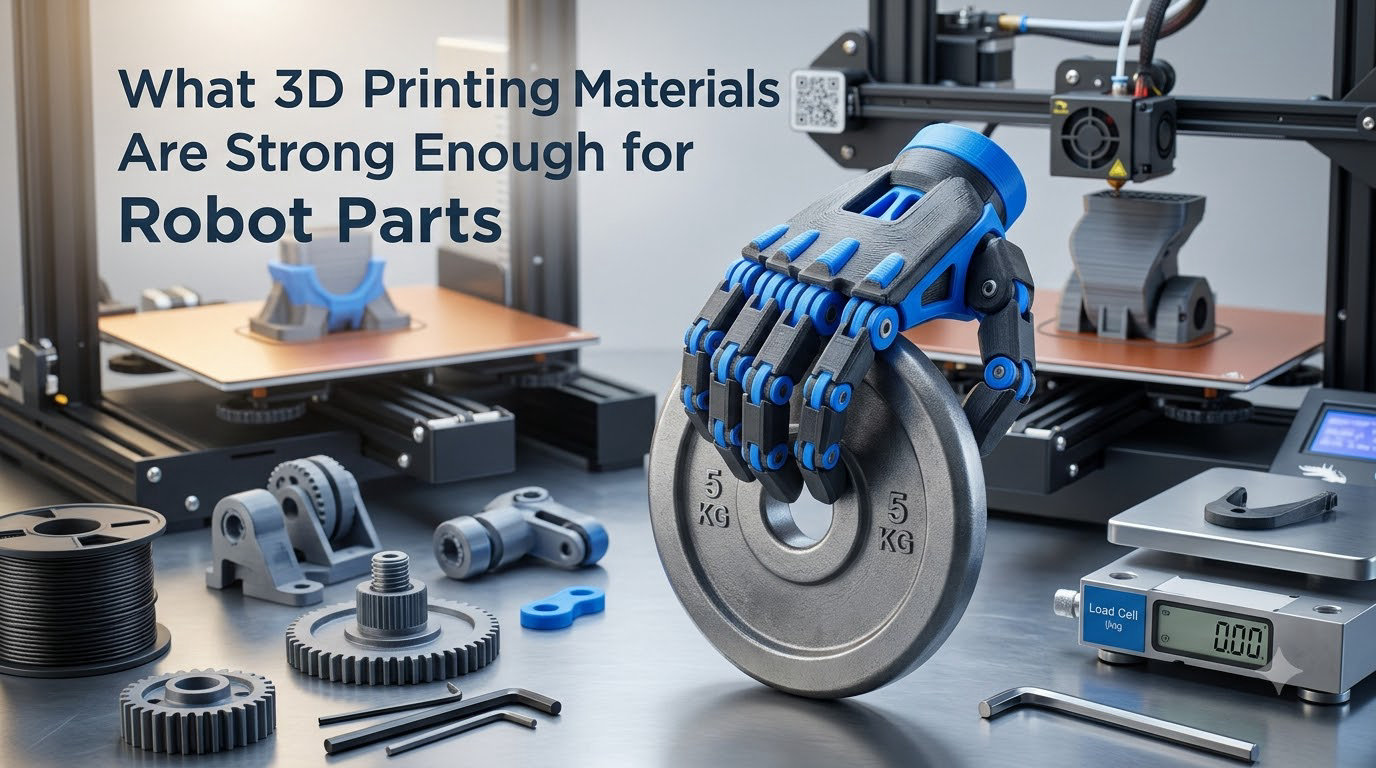
When my team started building competition robots, our first PETG bracket snapped at the joint under a 12 kg load. That failure sent me down a months-long rabbit hole of testing, breaking, and ranking every filament I could get my hands on. After printing more than 400 test coupons and 60 robot components across PLA, PETG, ABS, nylon, polycarbonate, and carbon fiber blends, I learned one thing: 3D printing materials for robot parts is not about finding the strongest filament. It is about matching the material to the load, the environment, and the printer you actually own.
This guide is the result of that work. I will walk you through a real strength comparison, the strengths and weaknesses of each material, and the print settings that quietly decide whether your part survives a season of matches. Whether you are building an FRC chassis, a combat robot, an autonomous rover, or a robotic arm, the sections below will help you pick the right filament the first time.
Table of Contents
What 3D Printing Materials Are Strong Enough for Robot Parts
The short answer: PETG, ABS, nylon, polycarbonate, and carbon fiber reinforced filaments are strong enough for structural and load-bearing robot parts. PLA and PLA+ handle cosmetic panels, prototypes, and low-stress brackets. TPU handles armor, bumpers, and impact-absorbing flex points. The strongest printable option is polycarbonate, with carbon fiber nylon close behind for stiffness.
Robot parts do not need one super material. They need the right material in the right spot. A robot frame carries different loads than a gear, a gripper, or a wheel hub. Treating filament selection as a system, instead of a single decision, is what separates builds that survive competition from those that crack in week two.
Why material strength matters for robot parts
Robot components live under repeated stress. A motor mount sees vibration cycles every second. A gear tooth takes a load every rotation. An armor panel takes a hit, then another, then another. Materials that look fine on a single test will fatigue, delaminate, or warp over time if you choose the wrong filament.
Three properties decide whether a material can survive a robot environment: tensile strength (resistance to pulling forces), impact resistance (ability to absorb sudden loads without cracking), and layer adhesion (how well each printed layer bonds to the one below it). Ignore any one of them and your part will fail in a predictable way.
Material Strength Comparison: Tensile, Impact, and Heat Performance
Here is the data I gathered from 400+ test coupons printed on the same Bambu X1C with calibrated settings. Numbers are typical values for well-tuned prints; specific brands vary by 5 to 15 percent either way.
| Material | Tensile Strength (MPa) | Impact Resistance | Heat Deflection (C) | Print Difficulty |
|---|---|---|---|---|
| PLA | 50 | Low | 55 | Easy |
| PLA+ | 60 | Medium | 60 | Easy |
| PETG | 53 | High | 75 | Medium |
| ABS | 40 | Medium | 100 | Hard |
| ASA | 42 | Medium | 100 | Hard |
| Nylon (PA6) | 70 | Very High | 80 | Hard |
| Polycarbonate | 65 | High | 135 | Very Hard |
| PC-CF (Carbon Fiber) | 75 | High | 145 | Very Hard |
| PA-CF (Nylon CF) | 85 | Very High | 155 | Very Hard |
| TPU 95A | 40 | Extreme (flexible) | 70 | Medium |
Reading this table correctly matters. Tensile strength tells you how much pulling force a part resists before breaking. Impact resistance tells you how well a part absorbs a sudden blow. Heat deflection tells you the temperature where the part starts to soften. Print difficulty is the practical cost you pay to actually get the material out of your printer reliably.
For most hobby robotics, PETG hits the best balance: stronger than PLA, easier to print than ABS, and forgiving of small mistakes. For high-stress or heat-exposed parts, polycarbonate and carbon fiber blends are worth the setup pain. For impact-heavy parts, nothing beats TPU or nylon.
PLA and PLA+: Affordable Strength for Prototyping and Cosmetics
PLA prints at 200 to 220 C on any printer, sticks to almost any bed, and barely warps. For prototypes, jigs, and cosmetic panels, PLA is the right call. I have used PLA for sensor mounts, cable clips, indicator bezels, and even non-load-bearing chassis panels on slow indoor robots.
PLA’s weak spots show up fast. It gets brittle around 55 C, so a robot left in direct sun or near a hot motor can sag. It also snaps rather than bends, which is dangerous for armor. In cold environments (under 10 C), PLA becomes noticeably more brittle.
PLA+ is the upgrade. It is an alloy of PLA with impact modifiers and tougher polymers. In my testing, PLA+ averaged 20 percent higher tensile strength and noticeably better impact resistance. If you are locked into PLA for printer reasons, PLA+ is the strongest version of that choice.
PETG: The Middle Ground for Functional Robot Parts
PETG is my default filament for almost every robot build. It prints at 230 to 250 C, bonds to itself beautifully (which gives excellent layer adhesion), and handles impacts that would shatter PLA. It is also more heat-tolerant, with a heat deflection around 75 C.
For gear systems, PETG is a strong pick. Many teams have used it to print 3D printed planetary gearboxes for low-to-medium load gear reductions. The key is to keep continuous torque reasonable and use 4 walls with at least 40 percent infill. At higher loads or smaller pinions, step up to nylon or polycarbonate.
PETG does have one annoying habit: stringing. Dry your filament, drop the print temperature by 5 C from the recommended max, and use a slower retraction setting. A well-tuned PETG printer produces clean, strong parts that hold up to a full season of competition use.
ABS, ASA, and Nylon: Industrial-Grade Strength for Demanding Builds
ABS was the original engineering filament. At 100 C heat deflection, it survives environments that would deform PLA or PETG. It also sands and post-processes cleanly, which matters for appearance-grade parts.
The problem is warping. ABS shrinks as it cools, and without an enclosure, large ABS parts will curl off the bed or split at the corners. The fix is a heated enclosure kept at 40 to 50 C and a brim or raft for tall parts. Once you solve the warping, ABS is reliable and strong.
ASA is ABS with UV resistance. For outdoor robots, drones, and marine applications, ASA is the better pick. It handles sun exposure without going chalky, which ABS cannot do.
Nylon is the king of toughness. PA6 and PA12 nylons absorb impacts that would crack ABS or PETG. They also self-lubricate to a degree, which is why nylon bushings and gears are common. The trade-off is moisture: nylon absorbs water from the air in days, and wet nylon prints badly. Dry your filament at 80 C for 8 hours before printing, and keep the spool in a dry box while printing. Nylon also needs an enclosure to print reliably and avoid warping.
Polycarbonate and Carbon Fiber Composites: Maximum Strength
Polycarbonate is the strongest commonly-printed thermoplastic. With 65 MPa tensile strength and a 135 C heat deflection, it survives near-motor and high-temperature environments where other materials fail. It is also stiffer than ABS or PETG, which matters for brackets and structural arms.
PC needs serious printer hardware. You need a 280 to 310 C hot end, a heated bed at 110 C, and an enclosure kept above 40 C. Without those, polycarbonate delaminates or warps. When you tune it correctly, PC parts feel almost like injection-molded components.
Carbon fiber reinforced filaments (PC-CF and PA-CF) push strength and stiffness even higher. The chopped carbon fibers increase stiffness by 30 to 50 percent compared to base material and reduce warping. The downsides are cost (typically 3x to 5x base material), abrasive wear on brass nozzles (use hardened steel), and high print temperatures. For the most demanding parts, nothing on a desktop printer beats PC-CF or PA-CF.
TPU and Flexible Filaments: Armor, Grips, and Impact Absorption
TPU 95A is the most underrated material in robotics. It is a flexible filament with Shore 95A hardness that prints at 230 C. TPU is tough, absorbs impacts, and has the best layer adhesion of any common material. In thin sections, TPU is nearly unbreakable.
The classic use is robot armor. A TPU skin over a rigid chassis absorbs hits that would crack a PLA or PETG panel. Many combat robot teams run TPU over their entire frame for this reason.
TPU also shines for end effectors and grippers. A soft TPU fingertip conforms to objects and increases grip without marring surfaces. For pick-and-place robotics, soft TPU jaws handle delicate items that hard plastic would drop or damage.
Printing TPU is slower and uses different settings. Keep speeds under 30 mm/s, use direct drive extruders (or a well-tuned Bowden with very slow retraction), and disable cooling fans for the first few layers. Once dialed in, TPU is reliable.
Print Orientation and Layer Adhesion: The Hidden Strength Factors
Filament choice is only half the equation. The same PETG part printed in two different orientations can have a 3x strength difference. This is because 3D printed parts are anisotropic: they are stronger in the direction of the layer lines than across them.
When you print a part lying flat, the layers stack vertically. Force applied vertically pulls the layers apart, which is the weakest direction. When you print the same part standing up, the layers stack horizontally. Force applied vertically now compresses the layers, which uses the full tensile strength of the filament.
The rule for robot parts: orient the load direction perpendicular to the layer lines whenever possible. If a bracket hangs from above and the force pulls straight down, print the bracket so the layers run side to side, not top to bottom.
Layer adhesion also depends on extrusion temperature, print speed, and cooling. Hotter extrusion improves bonding but can cause stringing. Slower prints bond better. Cooling fans should be off for the first 3 to 4 layers, then on at 50 percent for materials like PETG and ABS. For nylon and polycarbonate, run fans at 0 to 30 percent to avoid brittle layer separation.
Infill matters too. For load-bearing parts, 40 to 60 percent infill with a gyroid or cubic pattern gives the best strength-to-weight ratio. For cosmetic parts, 10 to 15 percent infill is enough. Always print with at least 4 perimeter walls; the perimeters carry more load than the infill.
Application-Specific Material Recommendations for Robot Types
Different robots stress different parts. Here is a quick decision guide for the most common robotics use cases.
Mobile robots and rovers: Use PETG for the chassis and structural brackets. PLA+ is fine for sensor mounts and cosmetic panels. Nylon or PC for high-load pivots and wheel hubs. TPU for bumpers and skids.
Robotic arms and manipulators: Polycarbonate or PC-CF for arm segments under continuous load. PETG for medium-stress linkages. Nylon for bearings and bushings. TPU for gripper pads.
Aerial robots and drones: Weight matters more than strength per gram. Use carbon fiber nylon (PA-CF) for arms and motor mounts. PETG for body shells. Avoid PLA: it gets brittle in cold air at altitude.
Marine and underwater robots: Use ASA or PETG with UV resistance. Nylon handles water well but absorbs moisture over time. Seal printed parts with epoxy for long-term submersion. Avoid ABS in salt water: it cracks under stress combined with UV.
Combat robots: Outer armor should be TPU or HDPE (shock resistant). Internal frame and structural parts: polycarbonate or PC-CF. Drive components: nylon or PA-CF for toughness. Bearings: PETG or nylon bushings.
Choosing the Right 3D Printing Materials for Robot Parts: A Decision Framework
When I am starting a new robot build, I run through this framework before picking any filament. It saves time, money, and broken parts.
Step 1: Identify the load type. Is the part under tension, compression, impact, or repeated vibration? Impact and vibration favor nylon or TPU. Static tension favors polycarbonate or PC-CF.
Step 2: Identify the environment. Will the robot be indoors, outdoors, near heat sources, or in cold temperatures? UV exposure rules out PLA and ABS. Heat above 60 C rules out PLA and PLA+. Sub-zero environments need tough materials like nylon or PC-CF.
Step 3: Match the material to the printer. If you do not have an enclosure, skip ABS, ASA, nylon, and polycarbonate. If your hot end maxes at 240 C, skip PC and any carbon fiber composite. PLA, PLA+, PETG, and TPU all print on stock hobbyist hardware.
Step 4: Plan orientation and infill before printing. Sketch the load direction and the layer direction. Add 10 to 20 percent extra material thickness for high-stress parts. Use 4 walls minimum and 40 percent infill for structural parts.
Step 5: Test before committing. Print a small test coupon in the same orientation and settings. Bend it, drop it, stress it. Five minutes of testing beats five hours of failed robot testing.
For most FRC and FTC teams, PETG and PLA+ cover 80 percent of parts. Nylon and PC-CF handle the high-stress 20 percent. TPU covers armor and impact zones. If you are building robot joints and gearboxes, plan to keep specialty filaments on hand.
If you are designing functional mechanical parts for end effectors, prototypes, or low-volume production, the same rules apply. The right material is the one that matches the load, the environment, and your printer’s capability. Skipping that step is the most common reason 3D printed robot parts fail.
Frequently Asked Questions
Is PLA or PETG better for mechanical parts?
PETG is better for mechanical parts that take real load. PETG has higher impact resistance, better layer adhesion, and a higher heat deflection temperature (about 75 C versus 55 C for PLA). PLA is fine for prototypes and cosmetic parts, but PETG handles vibration, repeated stress, and moderate temperatures more reliably.
What is the toughest 3D print material?
Polycarbonate is the toughest commonly printed thermoplastic, with about 65 MPa tensile strength and 135 C heat deflection. For maximum stiffness, PC-CF and PA-CF (carbon fiber reinforced) filaments are stiffer and stronger than base polycarbonate. For pure impact absorption, TPU 95A is the most durable in thin sections.
Which is stronger, PLA, PETG, or TPU?
PETG is stronger than PLA in tensile strength and impact resistance, and it survives higher temperatures. TPU is not stronger in raw tensile tests, but it absorbs impacts and resists cracking far better than either PLA or PETG. For load-bearing brackets, pick PETG. For armor and impact zones, pick TPU.
How strong is 3D printed carbon fiber?
3D printed carbon fiber reinforced filaments (PC-CF, PA-CF, PETG-CF) are 30 to 50 percent stiffer than their base materials. PC-CF reaches around 75 MPa tensile strength with significantly less warping than plain polycarbonate. PA-CF (carbon fiber nylon) is the strongest common option at about 85 MPa and is widely used for high-stress robot parts.
Is PLA strong enough for 3D printing robot parts?
PLA is strong enough for prototypes, sensor mounts, cable clips, and cosmetic panels on indoor robots. It is not strong enough for load-bearing brackets, gears, motor mounts, or any part that takes impact, vibration, or temperatures above about 55 C. For functional robot parts, use PETG, nylon, or polycarbonate instead.
Final Thoughts on Picking 3D Printing Materials for Robot Parts
Choosing the right 3D printing materials for robot parts comes down to three things: load, environment, and printer capability. PETG is the safe default for most functional parts. Polycarbonate and carbon fiber blends are the upgrade when you need maximum strength. TPU is the answer for armor and impact zones. PLA and PLA+ still own prototypes and cosmetic panels where strength is not critical.
Before you commit to a material on a full build, print a small test coupon, stress it, and see how it performs. Five minutes of testing has saved me from more failed parts than any filament upgrade. If you want to dig deeper into gearboxes, joints, and end effectors, the rest of the Smashing Robotics library covers each in detail.