
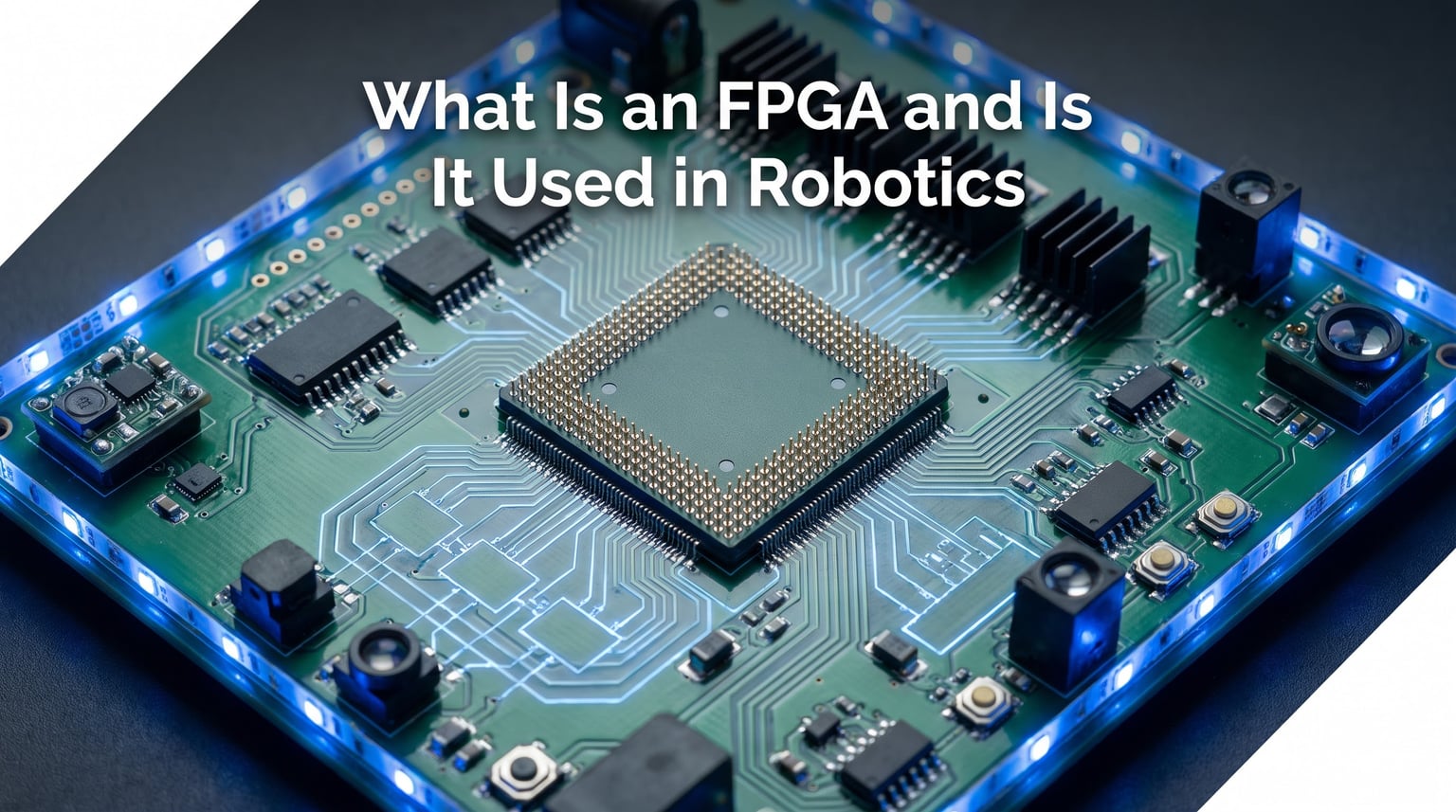
If you have spent any time around robotics engineering, you have probably heard the term FPGA thrown around in conversations about motor controllers, sensor fusion, and real-time processing. But what exactly is an FPGA, and does it actually matter for building robots?
An FPGA, or Field-Programmable Gate Array, is a type of integrated circuit that you can reconfigure after manufacturing to perform specific hardware-level tasks. In robotics, FPGAs handle jobs that demand microsecond-level latency, deterministic timing, and true parallel processing — things that traditional CPUs and microcontrollers struggle to deliver reliably.
Yes, FPGAs are absolutely used in robotics. From industrial robot arms on factory floors to autonomous mobile robots navigating warehouses, surgical robots in operating rooms, and drones streaming high-speed sensor data, FPGAs are the silent workhorse behind many real-time control systems. Companies like Universal Robots use FPGA technology for precise motor clocking, and major chipmakers like Xilinx, Intel, and Microchip build FPGA product lines specifically targeted at robotics applications.
In this guide, I will break down exactly what an FPGA is, how it works inside a robot, where it shines, and where it might be overkill for your project. Whether you are an engineer deciding between an FPGA and a microcontroller or a robotics student curious about hardware options, this article will give you a clear, honest picture — including the challenges that most other resources skip.
We will also explore how FPGAs fit into the broader AI infrastructure platforms shaping robotics in 2026, and why their role in power architecture for logic and motor control matters more than most people realize.
Table of Contents
What Is an FPGA?
An FPGA (Field-Programmable Gate Array) is a reconfigurable semiconductor chip that lets you build custom digital hardware circuits without designing and manufacturing a new physical chip. Unlike a CPU, which runs sequential software instructions, an FPGA physically rewires its internal logic to become the circuit you need — whether that is a motor controller, a signal processor, or a neural network accelerator.
That reconfigurability is the core distinction. You write code in a hardware description language, compile it into a bitstream file, and load it onto the chip. The FPGA then physically reorganizes its internal logic blocks and routing to match your design. Change the code, reload the bitstream, and the hardware becomes something entirely different.
This is fundamentally different from a microcontroller running C code. A microcontroller executes instructions one at a time on a fixed processor architecture. An FPGA builds a dedicated hardware circuit tailored to your exact task, running it in silicon with no instruction overhead.
How FPGAs Work: Logic Blocks and Interconnects
Inside every FPGA is a grid of configurable logic blocks (CLBs) connected by a programmable interconnect matrix. Each logic block contains lookup tables (LUTs), flip-flops, and multiplexers that can implement any Boolean logic function you need.
The interconnect matrix is a massive network of programmable routing paths. When you load your bitstream, the FPGA configures these paths to wire logic blocks together into the exact circuit topology your design requires. Want a dedicated PWM generator for six motor phases? You wire logic blocks together to create six independent hardware PWM channels that all run simultaneously.
Modern FPGAs also include dedicated hard blocks — built-in silicon for specific tasks like DSP slices for math operations, block RAM for fast data storage, high-speed transceivers for serial communication, and even embedded ARM processor cores in hybrid FPGA-SoC devices like the Xilinx Zynq family.
This mix of configurable logic and dedicated hardware makes FPGAs incredibly flexible. You can build anything from a simple SPI interface to a complete video processing pipeline on the same chip, all running in parallel at hardware speed.
Programming FPGAs: VHDL and Verilog
FPGAs are programmed using hardware description languages (HDLs), with VHDL and Verilog being the two dominant choices. These languages look like programming languages, but they work fundamentally differently. Instead of describing sequential steps, HDL code describes hardware structure and behavior that gets synthesized into physical logic circuits.
This is where the learning curve gets steep. Writing HDL requires thinking at the hardware level — understanding clock domains, flip-flops, timing constraints, and signal propagation. You are not writing software. You are designing hardware.
Engineers on robotics forums consistently flag this as the biggest barrier to FPGA adoption. One developer on the Robotics Stack Exchange put it plainly: you need to think at a very low level with flip-flops, and that mental shift takes time. Most modern FPGA vendors offer high-level synthesis (HLS) tools that let you write C or C++ and generate HDL, but the underlying complexity does not disappear — it just shifts.
Despite the learning curve, major FPGA vendors provide extensive IP cores — pre-built, tested hardware modules for common tasks like motor control, PCIe interfaces, and Ethernet. These let robotics engineers integrate proven functionality without designing every block from scratch.
Is FPGA Used in Robotics?
Yes, FPGAs are widely used in robotics, particularly in applications that demand deterministic real-time control, high-speed sensor processing, or custom hardware interfaces. They occupy a specific niche: tasks where a CPU is too slow or unpredictable, a microcontroller lacks the processing power, and a GPU is too power-hungry or lacks timing guarantees.
Here is where you will find FPGAs actually running inside robots today. Industrial robot arms from manufacturers like Universal Robots use FPGAs for precise motor clocking and multi-axis coordination. Autonomous mobile robots (AMRs) rely on FPGAs for sensor fusion, combining LiDAR, camera, and IMU data streams simultaneously. Surgical robots use them for haptic feedback systems that require sub-millisecond response times. Drones use FPGAs for real-time flight control and image processing on board.
The pattern is consistent. Whenever a robot needs guaranteed timing, parallel sensor handling, or a custom hardware interface that off-the-shelf controllers cannot provide, an FPGA is usually in the design.
This connects directly to practical robotics subsystems. FPGAs drive robotic gripper actuation and control, providing the real-time feedback loops needed for delicate object manipulation. They also coordinate complex multi-DOF robotic arm movements, where multiple joints must move in precise synchronization.
Key Advantages of FPGAs in Robotics
FPGAs bring several properties to robotics that no other single hardware platform can match. Here are the advantages that matter most for real-world robot design.
Real-Time Processing and Deterministic Control
The single biggest reason engineers choose FPGAs for robotics is deterministic timing. When a CPU runs a control loop, the operating system can interrupt it at any moment — a garbage collection cycle, a context switch, or a background process can introduce unpredictable delays measured in milliseconds. For a robot arm moving at high speed, that delay can mean missed positions, motor instability, or collisions.
An FPGA eliminates this problem entirely. Because the control logic is hardwired into the silicon, it executes with guaranteed timing every single cycle. There is no operating system, no instruction scheduler, no shared bus arbitration. A motor control loop running on an FPGA will complete in the same number of clock cycles every time — typically at microsecond-level latency.
This is why FPGAs dominate high-precision motor control applications. A six-axis industrial robot arm might need to coordinate PWM signals to 18 or more motor windings simultaneously, with timing accuracy measured in nanoseconds. Only an FPGA can guarantee that level of deterministic, jitter-free performance.
True Hardware Parallelism
A multi-core CPU can run a few threads in parallel. A GPU can run thousands of threads, but they are all executing the same instruction set. An FPGA does something different: it physically instantiates multiple independent hardware circuits that all run at the same time with zero interference.
For robotics, this means you can build a dedicated hardware block for each task and run them all simultaneously. One block handles motor PWM generation. Another processes camera data. A third runs a Kalman filter for sensor fusion. A fourth manages communication over EtherCAT or TSN-Ethernet. All of these execute in true parallel hardware, not time-sliced software threads.
Sensor fusion is the textbook example. An autonomous robot pulling data from a LiDAR unit, multiple cameras, wheel encoders, and an IMU needs to process all those streams simultaneously to build a coherent world model. On an FPGA, each sensor gets its own dedicated processing pipeline — all running at full hardware speed with no resource contention.
Power Efficiency for Mobile Robots
Battery-powered robots face a constant tension between processing power and energy budget. GPUs deliver massive compute but draw significant power. CPUs are flexible but waste cycles on instruction overhead. FPGAs strike a balance that is uniquely suited to mobile robotics.
Because FPGAs build dedicated hardware circuits for each task, they do not waste energy on instruction fetching, decoding, or context switching. A motor control loop implemented in FPGA fabric consumes a fraction of the power of the same loop running on a CPU. Modern low-power FPGA families like the Lattice iCE40 and CrossLink-NX operate at under 5 watts while delivering real-time processing that would require a much hungrier processor.
This matters enormously when you are sizing batteries for mobile robotics. Every watt saved on processing extends mission time. FPGAs also enable edge AI — running neural network inference directly on the device without cloud connectivity, which dramatically reduces power-hungry data transmission.
FPGA vs CPU vs GPU vs Microcontroller in Robotics
Choosing the right hardware platform for a robotics project means understanding what each option does well. Here is how FPGAs stack up against the alternatives.
CPU: General-purpose, flexible, easy to program. CPUs run operating systems, handle complex logic, and support massive software ecosystems like ROS2. But they suffer from OS jitter, limited parallelism, and millisecond-level latency at best. Use a CPU for high-level decision-making, path planning, and system orchestration.
GPU: Massive parallel compute for AI workloads. GPUs excel at matrix operations, making them ideal for neural network inference and computer vision. However, they are power-hungry, expensive, and lack deterministic timing guarantees. Use a GPU when you need heavy AI processing and have the power budget for it.
Microcontroller: Cheap, simple, and sufficient for many tasks. Microcontrollers like the STM32 or ESP32 handle basic motor control, sensor reading, and communication perfectly well for low-speed robots. They lack the processing power and parallelism for complex real-time tasks, but for many hobby and educational projects, they are exactly the right tool.
FPGA: Deterministic, parallel, and reconfigurable. FPGAs fill the gap where microcontrollers are too weak and CPUs are too unpredictable. They are the right choice when you need guaranteed microsecond timing, true hardware parallelism, custom interfaces, or edge AI acceleration within a tight power budget.
Many real-world robots use a combination. A common architecture pairs an FPGA with a CPU — the FPGA handles real-time motor control and sensor processing while the CPU runs higher-level software like ROS2 for navigation and decision-making. This hybrid approach gives you the best of both worlds, and it is why FPGAs can also play a role in power management and brownout prevention by monitoring power delivery in real time.
Real-World Robotics Applications Using FPGAs
FPGAs appear across nearly every category of advanced robotics. Here are the specific applications where they make the biggest difference.
Industrial automation: Multi-axis robot arms, conveyor systems, and pick-and-place machines all rely on FPGAs for deterministic motor control and real-time communication over industrial protocols like EtherCAT and TSN-Ethernet.
Autonomous vehicles and mobile robots: Self-driving cars and warehouse AMRs use FPGAs for LiDAR processing, sensor fusion, and real-time obstacle detection. The ability to process 10Gbps sensor streams with sub-microsecond latency is critical for safe navigation.
Surgical and medical robotics: Systems like the da Vinci surgical robot use FPGAs for haptic feedback and precision actuator control where sub-millisecond response times are a safety requirement, not a nice-to-have.
Drones and aerospace: Flight controllers, gimbal stabilization, and real-time image processing all benefit from FPGA parallelism. Radiation-tolerant FPGAs are also used in space robotics where reliability is non-negotiable.
Collaborative robots: Cobots use FPGAs for real-time torque sensing and collision detection, enabling safe human-robot interaction at hardware speeds.
Challenges and Limitations of FPGAs in Robotics
Most articles about FPGAs in robotics list only the advantages. That paints an incomplete picture. FPGAs have real drawbacks, and understanding them is essential for making smart hardware decisions.
Steep learning curve: HDL programming is fundamentally different from software development. Engineers must understand digital logic, clock domain crossing, timing analysis, and synthesis constraints. Robotics developers on Reddit consistently cite this as the top barrier. The mental model shift from sequential code to parallel hardware takes months, not weeks.
Development time and cost: FPGA development cycles are longer than software development. Synthesis, place-and-route, and timing closure can take hours per iteration. Development boards and toolchain licenses are expensive — professional FPGA tools from Xilinx or Intel can cost thousands of dollars per seat.
Limited talent pool: Engineers who can design FPGA-based robotics systems are scarce. If your team is composed primarily of software developers, adopting FPGAs means significant training investment or hiring specialized hardware engineers.
Integration complexity: Connecting an FPGA to a ROS2-based system or interfacing with existing robotics frameworks requires custom drivers and communication bridges. This adds development overhead and potential failure points.
Overkill for many projects: Not every robot needs an FPGA. If your robot reads a few sensors, drives a couple of DC motors, and runs a simple control loop, a microcontroller like the STM32 will handle it at a fraction of the cost and complexity.
When NOT to Use an FPGA in Robotics
Based on forum discussions and real engineering experience, here are the situations where an FPGA is the wrong choice.
If your robot is a hobby or educational project, skip the FPGA. An Arduino, ESP32, or STM32 will handle motor control, basic sensor reading, and simple autonomy perfectly well at a fraction of the cost. The development speed of writing C code on a microcontroller cannot be overstated for prototyping.
If your control loop runs at 1 kHz or slower, a microcontroller will do the job. FPGAs earn their place when you need loop rates in the tens or hundreds of kilohertz, or when you need guaranteed sub-microsecond timing that a CPU cannot deliver reliably.
If your team has no HDL experience and the project timeline is tight, do not introduce FPGA development mid-project. The learning curve will blow your schedule. Use proven microcontroller solutions and save the FPGA for a future revision.
If your budget is limited, remember that FPGA development boards, JTAG programmers, and toolchain licenses add up fast. For the cost of a professional FPGA setup, you could build several microcontroller-based prototypes.
The bottom line: FPGAs are powerful but specialized tools. They are not a universal upgrade over microcontrollers. Choose them when the problem demands deterministic timing, true hardware parallelism, or custom high-speed interfaces — not because they sound advanced.
FAQ
Do robotics use FPGA?
Yes, robotics widely use FPGAs for applications requiring real-time processing, deterministic control, and hardware parallelism. Industrial robot arms use them for precise motor clocking, autonomous mobile robots rely on them for sensor fusion, surgical robots use them for haptic feedback with sub-millisecond response, and drones use them for flight control and image processing. Major robotics manufacturers including Universal Robots integrate FPGA technology into their control systems.
What are the big 4 of robotics?
The big 4 of robotics refers to the major industrial robot manufacturers: Fanuc, Yaskawa, ABB, and KUKA. These four companies dominate the global industrial robotics market, producing the robot arms and automation systems used in factories worldwide. While this article focuses on FPGA hardware, these manufacturers design sophisticated control systems that often incorporate FPGA technology for real-time motor control and multi-axis coordination.
Will FPGA be replaced by AI?
No, FPGAs will not be replaced by AI. In fact, FPGAs are increasingly used to accelerate AI workloads in robotics through neural network inference at the edge. Rather than competing, AI and FPGAs complement each other. GPUs handle training and heavy inference, while FPGAs provide the deterministic, low-latency execution layer for real-time control and edge AI deployment in power-constrained robotic systems.
Is an FPGA better than a GPU?
Neither is universally better. It depends on the task. FPGAs excel at deterministic real-time control, low-latency sensor processing, and power-efficient edge AI, delivering microsecond-level timing guarantees. GPUs excel at massively parallel compute tasks like neural network training and computer vision processing. Many robotics systems use both: an FPGA for real-time motor control and sensor fusion, paired with a GPU for heavy AI inference. The right choice depends on whether your priority is guaranteed timing or raw compute throughput.
Conclusion: Is FPGA Right for Your Robotics Project?
FPGAs play a critical role in modern robotics, delivering the deterministic timing, hardware parallelism, and power efficiency that real-time control demands. They are the right tool when your robot needs microsecond-level motor control, simultaneous multi-sensor processing, or edge AI acceleration within a tight power budget. They are overkill when a microcontroller can handle the job.
If you are building a high-performance robot that demands guaranteed real-time response, an FPGA deserves serious consideration. If you are prototyping or building a simpler system, start with a microcontroller and move to an FPGA only when you hit its performance ceiling. For a deeper look at how all your hardware components fit together, explore how FPGAs integrate into the broader robot chassis and sensor integration architecture.