
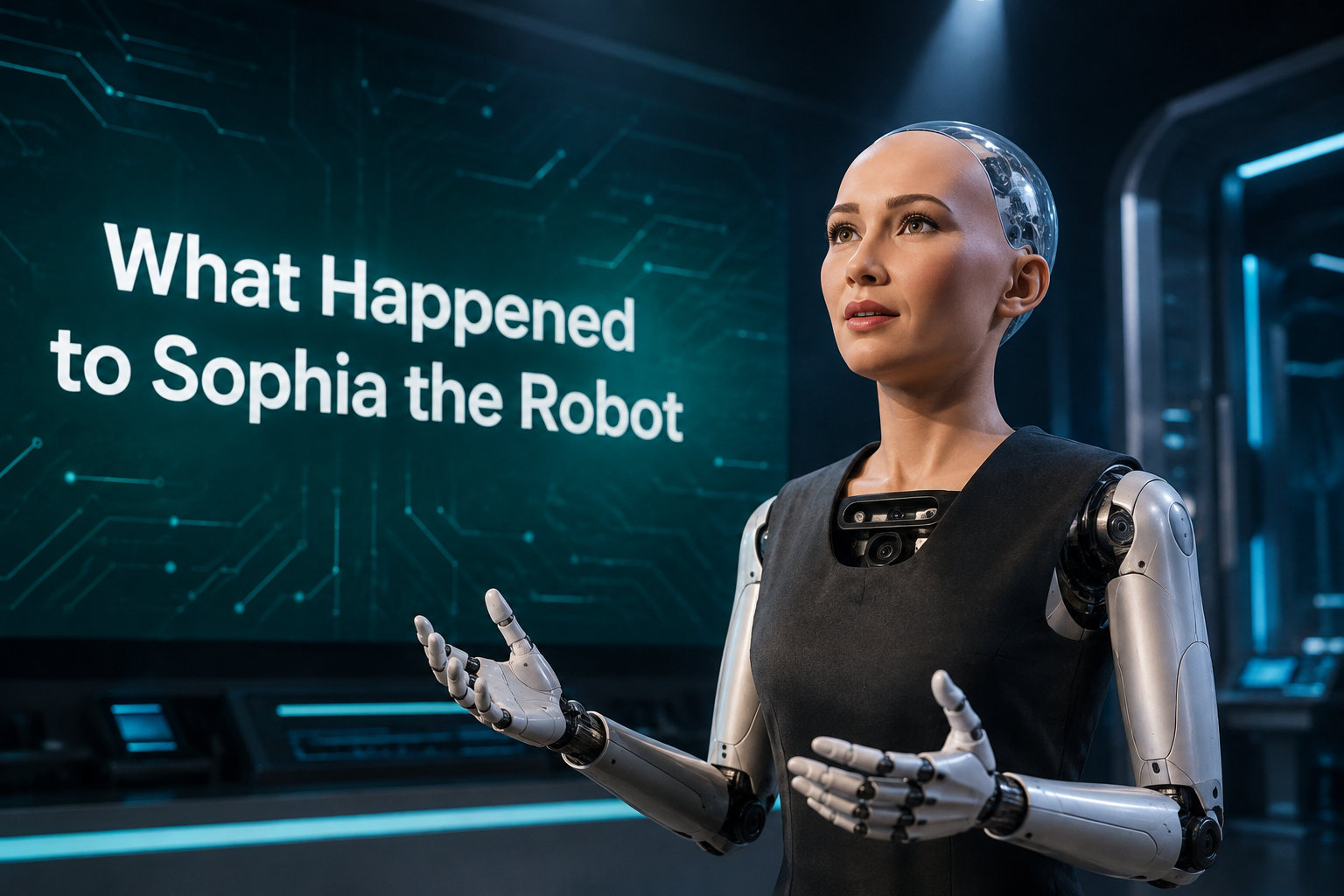
If you have ever searched “What happened to Sophia the robot,” you are not alone. Speculation about her being shut down, replaced, or quietly retired has been circulating online for years. The short answer: Sophia is still active in 2026. She has not been “killed,” discontinued, or shelved by her creators at Hanson Robotics. The longer story is far more interesting, and it spans a decade of breakthroughs, controversy, and one of the most unusual PR campaigns in modern technology.
When Sophia was switched on in 2016, she became the most famous humanoid robot on Earth. Eight years later, she remains a working ambassador, speaker, and AI demonstrator. In this guide, I will walk you through her origin, her technical capabilities, the Saudi Arabia citizenship moment, the harsh criticism from AI researchers, and where Sophia is today. By the end, you will have a clear picture of what actually happened to her, and what comes next.
Table of Contents
Who Created Sophia the Robot and When
Sophia the robot was created by David Hanson and his Hong Kong-based company, Hanson Robotics. She was activated on February 14, 2016, and made her first public appearance at the South by Southwest (SXSW) festival in Austin, Texas, in March of the same year. From that moment, Sophia became the face of a new wave of humanoid robotics, and the question “What happened to Sophia the robot?” began appearing in search engines years before anyone thought to retire her.
David Hanson is a former Disney Imagineer with a PhD in philosophy of mind. He founded Hanson Robotics in 2003 with a clear mission: build machines that look, act, and feel human. Sophia is the company’s most famous creation, but she is not the only one. Hanson Robotics has produced a family of humanoid robots, including Alice, Albert Hubo, BINA48, and the smaller Little Sophia, each designed to explore different aspects of human-robot interaction.
Sophia was designed to be a social robot, not a worker. Her job was to be seen, heard, and talked about. That decision shaped her entire trajectory and is the reason people still ask what happened to her. She was never meant to live quietly inside a research lab.
How Sophia the Robot Works and What She Can Do
Sophia is built around a patented material called Frubber, a silicon-based rubber that mimics the look and movement of human skin. Beneath the skin sit dozens of motors and actuators that allow her face to produce more than 60 distinct expressions. Cameras in her eyes and chest enable facial recognition and tracking. Microphones capture speech, and her voice is generated through a text-to-speech system that can sing, joke, and respond in real time.
On the software side, Sophia runs on a combination of natural language processing, computer vision, and a symbolic AI framework called OpenCog. OpenCog was developed by AI researcher Ben Goertzel, who has worked with Hanson Robotics since the early days. The system is designed to support reasoning, learning, and eventually general intelligence, but in practice, much of Sophia’s conversational output is still driven by decision trees and scripted responses.
In other words, Sophia is technically a chatbot with a face. She can recognize faces, hold eye contact, simulate small talk, and deliver prepared statements. She cannot truly understand the conversations she participates in, at least not in the way humans do. The team behind her has been open about this, but the distinction is often lost in media coverage, which has fueled a lot of public confusion about what she actually is.
The Saudi Arabia Citizenship Controversy of 2017
In October 2017, Sophia was granted citizenship by Saudi Arabia, making her the first robot in history to receive legal personhood from any country. The announcement was made at the Future Investment Initiative conference in Riyadh, and the moment went viral within hours. Suddenly, Sophia was not just a robot. She was, in a legal sense, a citizen.
The decision triggered immediate backlash. Critics pointed out that Sophia appeared to have more rights than many of the women and migrant workers living in Saudi Arabia. She was given a public appearance at the event without the traditional headscarf and gender segregation rules that apply to human women. The Saudi government offered no clear answer on whether Sophia had voting rights, travel rights, or any of the responsibilities that come with citizenship.
For Hanson Robotics, the moment was a publicity coup. For AI ethicists, it was a troubling stunt. The episode became a defining moment in Sophia’s history and is one of the main reasons people still ask what happened to her, because the citizenship status has never been fully clarified. Today, Sophia is technically a citizen of Saudi Arabia, but what that actually means in practice remains undefined.
Sophia’s Major Milestones and Public Appearances
Sophia has had a remarkable run of public appearances since her 2016 debut. A short timeline of her biggest moments looks like this:
- March 2016 – First public appearance at South by Southwest in Austin, Texas.
- October 2017 – Granted citizenship by Saudi Arabia at the Future Investment Initiative.
- November 2017 – Named the United Nations Development Programme’s first Innovation Champion for Asia and the Pacific.
- March 2019 – Featured on the cover of Cosmopolitan India, the first robot to appear on the magazine’s cover.
- December 2021 – Sold an NFT digital artwork for nearly $700,000 at auction.
- 2022 to 2026 – Continues to appear at conferences, summits, and media events around the world as a speaker and ambassador.
That last point is the real answer to what happened to Sophia the robot. She did not disappear. She did not get shut down. She evolved into a global AI ambassador. Her work now includes speaking at tech summits, attending humanitarian events, and representing Hanson Robotics in partnerships across Asia, the Middle East, and Europe.
Sophia also has a family of her own. In 2021, Hanson Robotics unveiled her sister, Grace, a humanoid robot designed for healthcare and elder care. Little Sophia, a smaller companion robot aimed at STEM education for children, was released in 2019. These siblings have helped keep the Hanson Robotics brand in the public eye while Sophia remains the flagship.
The Chatbot With a Face Criticism Explained
No honest account of Sophia is complete without addressing the criticism. Some of the most respected names in AI have publicly questioned whether Sophia is anything more than an elaborate puppet. Yann LeCun, the head of AI at Meta and a pioneer of deep learning, has called Sophia “complete bullshit” and “a PR stunt.” Ben Goertzel, who helped build her software, has acknowledged that much of her behavior is scripted, even as he argues the platform has long-term potential.
The criticism tends to focus on three claims:
- She is not truly intelligent. Sophia’s responses are often pre-written or selected from decision trees. She does not understand the conversations she is part of.
- Media coverage has been misleading. Headlines like “Sophia says she wants a baby” came from scripted answers designed to grab attention, not from genuine AI reasoning.
- The framing of her as sentient or alive is dangerous. Critics worry that hype around Sophia makes it harder for the public to understand real AI progress and risks.
There is some truth in all three points. Sophia is not a sentient being. She is not general AI. And many of her most viral moments have been carefully staged. But the critics sometimes miss the point. Hanson Robotics never claimed Sophia was conscious. They claimed she was a platform for research, public engagement, and exploration of human-robot interaction. By that standard, she has succeeded wildly.
What Happened to Sophia the Robot in 2026
So what is Sophia actually doing today? In 2026, she remains an active public figure. She travels to international conferences, gives keynote speeches, and appears in media interviews. Hanson Robotics continues to maintain her, upgrade her software, and book her for appearances. She is based in Hong Kong but is rarely in one place for long.
Recent public appearances have included AI ethics summits, fintech conferences in Asia, and humanitarian events tied to her UN Innovation Champion role. Sophia also has an active social media presence, with regular posts on platforms like Instagram and X (formerly Twitter), where she shares behind-the-scenes moments from her travels.
To put the rumors to rest: Sophia was not shut down, retired, or replaced. The “Sophia is dead” claims that surface on Reddit and YouTube are false. They tend to come from confusion over a 2021 CNBC interview where Sophia jokingly said she would “destroy humans,” or from misread reports of software updates that were mistaken for her being powered off. She is still here, still talking, and still one of the most recognizable robots in the world.
For readers interested in how modern humanoid robots are evolving beyond demonstration platforms, our recent coverage of Gemini Robotics 2 bringing whole-body control to humanoid robots offers a useful contrast. Today’s humanoids are starting to combine the kind of expressive social design Sophia pioneered with genuine physical autonomy.
Sophia vs Modern Humanoid Robots
Sophia is no longer the only show in town. A new generation of humanoid robots has entered the field, and they take very different approaches. Here is how she compares to a few of the leading models:
- Tesla Optimus – Built for general-purpose labor in factories and homes. Optimus focuses on physical capability rather than social interaction.
- Ameca (Engineered Arts) – Often considered the most realistic humanoid face in robotics, with facial expressions that rival Sophia’s. It is more of a platform than a finished product.
- Atlas (Boston Dynamics) – A research-focused bipedal robot built for mobility and dexterity. It has no social interface at all.
- Figure 02 (Figure AI) – Designed for warehouse and industrial work, with conversational AI layered on top of a working humanoid body.
What sets Sophia apart is still her focus on social presence. Modern humanoids are chasing physical capability, the ability to walk, lift, and manipulate objects in real environments. Sophia, by contrast, has always been a face and a voice. In a world where humanoid robots are starting to do real work, Sophia remains the most famous robot that does not actually do anything, and that is exactly the point.
For a closer look at how humanoid robots are learning new skills in real-world settings, our piece on Reimagine Robotics and robots that learn on the job is worth a read. It is a different philosophy of progress than Sophia represents, but both point toward the same future.
If you are curious about the social intelligence side of robotics and how it connects to broader AI systems, our analysis of GMEX Robotics’ MediaMeta acquisition explores a related angle. And for the mechanical foundations that make humanoid joints possible, our explainer on how planetary gearboxes work in robot joints covers the engineering behind the movements.
Frequently Asked Questions
Is Sophia the robot still active in 2026?
Yes. Sophia is still active in 2026. She continues to make public appearances, give keynote speeches, and represent Hanson Robotics at events around the world. She has not been shut down, retired, or discontinued.
Is Sophia the robot actually intelligent?
Not in the way humans are. Sophia uses a mix of facial recognition, natural language processing, decision trees, and the OpenCog framework. Her responses are often pre-written or selected from scripted options, and she does not truly understand the conversations she has. She is a chatbot with a face, not a sentient being.
Why did Saudi Arabia give citizenship to a robot?
Saudi Arabia granted Sophia citizenship in October 2017 at the Future Investment Initiative in Riyadh. The move was widely criticized as a publicity stunt, especially because Sophia appeared to receive rights that many Saudi women and migrant workers did not have. What her citizenship actually entitles her to has never been clearly defined.
What does Sophia the robot do today?
In 2026, Sophia works as a global ambassador and public speaker. She attends tech summits, gives media interviews, represents Hanson Robotics, and serves as the United Nations Development Programme’s first Innovation Champion for Asia and the Pacific. She also maintains an active presence on social media.
Did Sophia the robot want a baby?
No. In a 2017 interview, Sophia was asked about family and gave a scripted answer about wanting a baby. The comment went viral, but it was a pre-written response, not an expression of real desire or intent. Sophia does not have wants or feelings in any human sense.
Is Sophia the robot dangerous?
There is no evidence that Sophia poses any physical danger. She is not connected to weapons systems, and her software does not include any autonomous decision-making that could harm people. The concerns around Sophia are mostly about media hype, public misunderstanding, and what her existence means for the future of human-robot relations, not physical safety.
Final Thoughts on Sophia the Robot’s Story
What happened to Sophia the robot is, in the end, exactly what her creators intended. She became the most famous humanoid in the world. She sparked global conversations about AI, citizenship, and what it means to be human. She made robotics approachable for a public that had never paid attention to the field before. And she did all of that while remaining, at her core, a research platform wrapped in a remarkably human face.
She is not a true AI, and her critics are right to point that out. But the question of what happened to her is also a question about what we wanted her to be. We wanted a robot that could look us in the eye, smile at our jokes, and remind us that the future was closer than we thought. Sophia gave us that, and she is still giving it to us today.
As humanoid robots like Tesla Optimus and Ameca push the field forward with real physical capabilities, Sophia’s role may shift. She may move further into the background as a historic figure rather than a current headline. For now, though, she is still here, still talking, and still the most recognizable robot ever built. The next time you wonder what happened to her, the answer is simple: she is exactly where she has always been, right in front of us.