
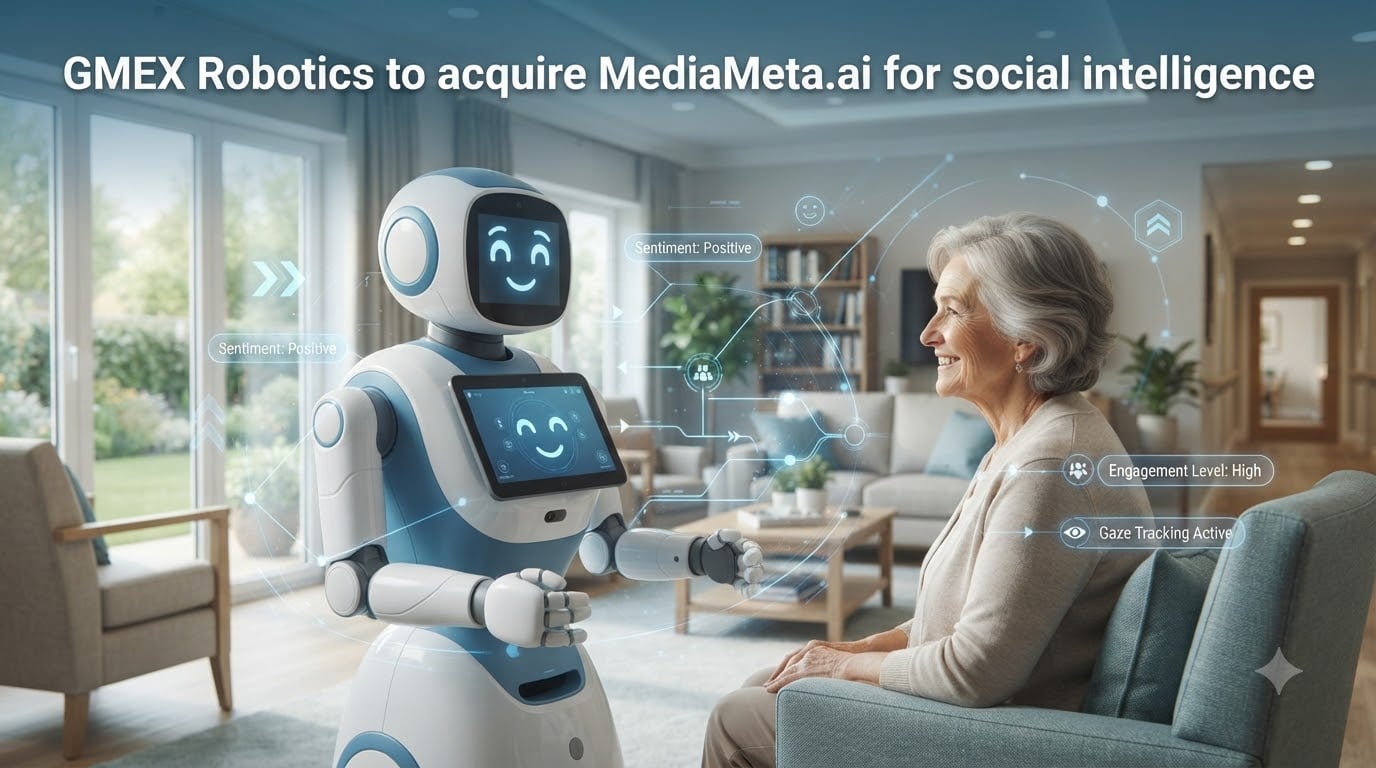
GMEX Robotics just stepped deeper into the social AI race. On July 28, 2026, the Australia-based company formerly known as Fitell Corporation announced a definitive agreement to acquire a 30 percent strategic equity stake in Singapore-based MediaMeta.ai.
The deal positions GMEX to bring what the company calls social world models into the next generation of its service and consumer robots. It also brings a $52.6 million revenue target and a royalty-free technology license into the equation.
I have been tracking GMEX since the Fitell rebrand, and this acquisition feels like the most concrete signal yet that the company wants to be known for AI-powered robotics rather than fitness equipment. Below I break down what the deal covers, who the two companies are, and why social intelligence is becoming the new battleground for service robots.
Table of Contents
What the GMEX Robotics and MediaMeta.ai Acquisition Means
The headline number is straightforward. GMEX Robotics will acquire a 30 percent fully diluted equity interest in MediaMeta.ai through a definitive agreement signed in late July 2026. The structure includes a make-good provision tied to revenue milestones and grants GMEX a royalty-free technology license covering MediaMeta’s social intelligence AI stack.
MediaMeta is expected to generate $52.6 million in revenue over the next five years under the terms of the deal. That figure sits at the heart of the make-good provision, which protects GMEX if MediaMeta falls short of the target. If the target is missed, the structure allows GMEX additional equity to compensate for the gap.
GMEX Chairman and CEO Samuel Levy framed the deal as complementary rather than disruptive. In the announcement, Levy said the acquisition combines MediaMeta’s social intelligence AI with GMEX’s existing robotic intelligence platform to create robots that understand human behavior. MediaMeta leadership echoed the sentiment, calling the partnership a validation of years of work on social world models.
For investors and industry watchers, the deal raises two immediate questions. The first is whether MediaMeta’s technology can actually deliver on the social intelligence promise at commercial scale. The second is whether GMEX has the operational depth to integrate a Singapore-headquartered AI company into its Australian-listed business.
Who GMEX Robotics Is and How It Got Here
GMEX Robotics is a publicly traded Australian technology company listed on the Nasdaq under the ticker GMEX. Until recently, most investors knew the business by a different name entirely.
Before the rebrand, the company operated as Fitell Corporation, a fitness equipment distributor. The pivot to robotics accelerated over the past year as management repositioned the business around AI-powered service robots. GMEX has since described itself as a provider of service and social robots rather than a fitness brand.
That transition has not been smooth for shareholders. Earlier this year GMEX executed a reverse share split, or share consolidation, which dramatically altered the share count and per-share pricing. Investors on Reddit’s queenstreetbets community and StockTwits have actively discussed the stock through the transition, with some labeling GMEX a meme stock while others focused on the long-term robotics thesis.
One investor on StockTwits described the situation as a “huge dividend and huge losses” setup, capturing the tension between aggressive capital return programs and an unproven robotics pivot. The historical price volatility, which ranged from $9,676 to $295,000 before consolidation, adds another layer of caution for new investors.
Despite the volatility, the GMEX rebrand signals a serious strategic shift. Management is no longer positioning the company as a fitness distributor with a robotics side project. The MediaMeta.ai acquisition is the clearest evidence that GMEX wants to compete in the AI-robotics space on its own terms.
What MediaMeta.ai Brings to the Table
MediaMeta.ai is a Singapore-based artificial intelligence company focused on social intelligence. Unlike social media analytics tools that monitor platforms for engagement metrics, MediaMeta builds social world models, which are AI systems designed to interpret human behavior in physical spaces.
The technology stack centers on human behavioral modeling. MediaMeta’s AI maps behavioral patterns, cultural contexts, and environmental signals to help machines understand social situations. The goal is for AI systems to read human cues that go far beyond language, including tone, body language, situational context, and cultural norms.
For robotics, that capability addresses a known gap. Today’s robots can navigate hallways, grasp objects, and follow scripted interactions. They struggle with the messy reality of human social life, where meaning depends on context, relationships, and unspoken rules. MediaMeta’s social world models aim to bridge that gap by giving robots a framework for interpreting social situations the way people do.
Public information about MediaMeta’s specific deployment history remains limited. The company has not published detailed case studies or third-party benchmarks. Independent verification of the social intelligence claims has yet to emerge, which is one reason skeptical voices in the investing community are watching closely.
Why Social Intelligence Matters for Robots
Service robots are moving out of warehouses and into spaces where they interact with people every day. Hospitals, hotels, retail floors, and assisted-living facilities all demand a level of social fluency that traditional AI cannot deliver.
Consider a robot working alongside nurses in a hospital. It needs to recognize when a conversation is private, when a patient is distressed, and when staff are rushing between emergencies. A robot that interrupts at the wrong moment or fails to read distress signals creates friction rather than value.
Hospitality presents similar challenges. A robot delivering towels to a hotel room must understand cultural norms around personal space, eye contact, and timing. Retail robots that approach shoppers need to recognize when someone wants help and when they want to be left alone.
Social intelligence AI attempts to solve these problems by layering contextual awareness on top of functional task execution. Empathy, trust, and cultural sensitivity become software features rather than abstract goals. Whether MediaMeta’s models actually deliver this in practice is the question that will define the acquisition’s long-term value.
Where the Combined Technology Could Land First
GMEX has named five priority verticals for its service robots: healthcare, hospitality, assisted-living, education, and retail. Each of these markets rewards robots that can read people accurately and respond with appropriate social cues.
Healthcare robotics stands to gain the most from social intelligence. Patients in hospitals and care facilities are often anxious, in pain, or cognitively impaired. A robot that misreads these signals can cause distress instead of providing comfort.
Assisted-living is a close second. Elderly residents frequently interact with service robots for medication reminders, mobility support, and companionship. Cultural and generational context shapes how these interactions succeed or fail.
Education and hospitality offer faster feedback loops for testing and refinement. Schools and hotels provide structured environments where robots can be observed interacting with diverse populations. Retail rounds out the list, with customer-facing robots that benefit from understanding when to engage and when to step back.
Strategic Implications for Robotics and AI in 2026
The GMEX-MediaMeta deal is one of several recent moves signaling that social intelligence is becoming a competitive frontier in robotics. Boston Dynamics, Figure AI, and 1X have all highlighted human-robot interaction capabilities in their latest platforms, though none have claimed the kind of explicit social world modeling that MediaMeta describes.
For GMEX specifically, the acquisition is a bet that differentiation in service robotics will come from social fluency rather than raw mechanical performance. The competitive landscape already includes established players with deeper hardware expertise. Building a software moat around behavioral understanding gives GMEX a path to compete without matching those players bolt-for-bolt.
Skeptics point to legitimate concerns. The $52.6 million revenue target is ambitious for an early-stage AI company with limited public deployment history. Integration between an Australian-listed parent and a Singapore-based AI subsidiary will test operational discipline. And the social intelligence claims themselves remain unverified by independent benchmarks.
None of these concerns invalidate the strategic logic. They do suggest that GMEX’s near-term value will hinge less on the announcement itself and more on whether MediaMeta’s technology proves out in commercial deployments over the next 18 to 24 months.
What does GMEX Robotics do?
GMEX Robotics is an Australian technology company, formerly known as Fitell Corporation, that has pivoted from fitness equipment distribution to developing AI-powered service and social robots for healthcare, hospitality, assisted-living, education, and retail environments.
What is MediaMeta.ai?
MediaMeta.ai is a Singapore-based artificial intelligence company that builds social world models, AI systems designed to interpret human behavioral patterns, cultural contexts, and environmental signals so that machines can understand and respond appropriately to social situations.
Why did GMEX acquire MediaMeta.ai?
GMEX acquired a 30 percent strategic equity stake in MediaMeta.ai to combine MediaMeta’s social intelligence AI with GMEX’s robotic intelligence platform. The goal is to build service robots that can read human behavior, cultural context, and emotional cues rather than just performing functional tasks.
How will social intelligence improve robots?
Social intelligence allows robots to interpret non-verbal cues, cultural norms, situational context, and emotional states. This helps robots interact appropriately in environments like hospitals, hotels, and assisted-living facilities where misunderstanding social signals can undermine the usefulness of the technology.
What This Deal Means Going Forward
The GMEX Robotics MediaMeta acquisition marks a clear pivot point. GMEX is no longer just a fitness equipment company experimenting with robots. It is now a robotics company betting that social intelligence is the differentiator that will define the next generation of service robots.
The deal gives GMEX access to MediaMeta’s social world models, a royalty-free technology license, and a make-good structure tied to a $52.6 million revenue target. It also exposes GMEX to integration risk, execution risk, and skepticism around unverified AI claims.
For the broader robotics and AI market, the acquisition reinforces a trend I have been tracking for months. The companies that win the next phase of service robotics will not be the ones with the strongest arms or the fastest wheels. They will be the ones whose machines understand people best. Watch the next 18 to 24 months of MediaMeta deployments to see if the theory holds up in practice.