
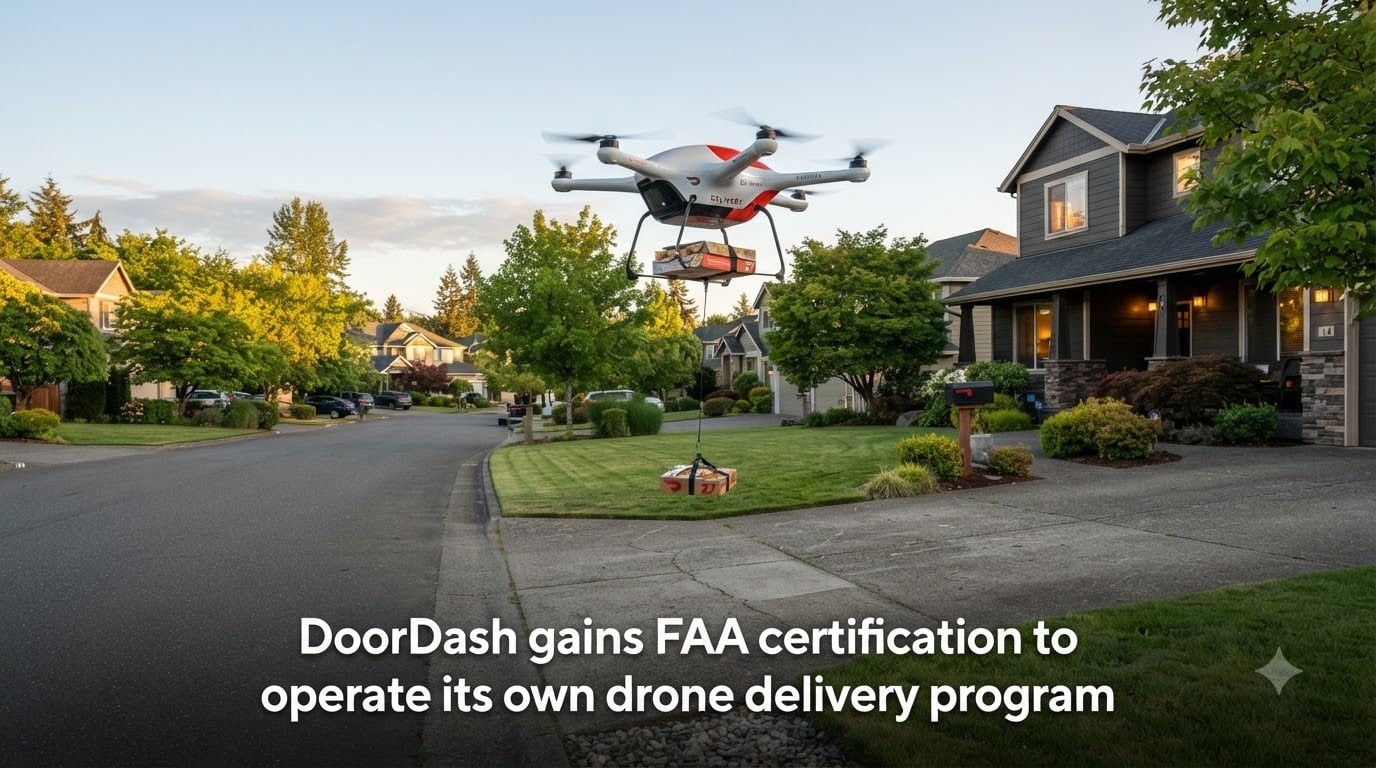
DoorDash has received FAA Part 135 air carrier certification to operate its own commercial drone delivery service, called DoorDash Air, making it the eighth operator approved for package drone flights in the United States. The certification, announced in September 2026, lets DoorDash fly deliveries using aircraft it designed and built inside the company rather than relying only on outside partners.
This is a meaningful milestone for the autonomous delivery industry because DoorDash controls the entire stack, from the aircraft and dispatch software to the restaurant-side loading hub. In this guide, I break down what DoorDash Air actually does, how Part 135 certification works, how the service compares to Amazon Prime Air, Wing, and Zipline, and what the rollout means for delivery drivers.
Table of Contents
What Is DoorDash Air and Why the FAA Certification Matters
DoorDash Air is the company’s in-house commercial drone delivery program, launched after the FAA granted DoorDash a Part 135 air carrier certificate to operate small unmanned aircraft for compensation. In plain terms, DoorDash can now legally run a paid drone delivery service using its own aircraft, its own pilots, and its own operating procedures.
DoorDash joins a short list of US drone delivery operators. With this approval, DoorDash becomes the eighth operator cleared by the FAA for commercial drone package delivery, putting it alongside established players like Wing, Zipline, Amazon Prime Air, and Flytrex. The certification matters because it removes the regulatory bottleneck that until now forced DoorDash to test drones only through partnerships.
Customers will eventually see DoorDash Air as a delivery option in the DoorDash app, alongside the standard Dasher driver option. Orders within range of a launch site can be loaded onto a drone and flown directly to the customer, often arriving in around 25 minutes according to the company. The service is being built to handle meals, groceries, and small essential items.
How DoorDash Drone Delivery Works From Order to Doorstep
A DoorDash drone delivery starts in the DoorDash app when a customer places an order from a participating merchant within range of a drone launch site. If the order is eligible and the weather is acceptable, the order is routed to the drone hub instead of to a Dasher.
Once the merchant finishes the order, a driver or hub worker carries it to the launch site where the drone is prepped for flight. The package is loaded into the drone’s payload bay, the flight plan is validated against airspace and weather, and the aircraft lifts off. The drone flies autonomously along a pre-approved route to the delivery address.
At the destination, the drone does not land on the property. Instead, it hovers at a safe altitude and lowers the package on a tether to a clear area the customer has selected, typically a yard, driveway, or sidewalk. The aircraft then returns to the launch site or proceeds to its next delivery.
Current DoorDash drone operations cover roughly a 4 mile radius from participating restaurants, which limits where the service is practical. Reddit drivers in Charlotte have described having to pick up orders and drive them to the drone hub to be loaded, which adds an extra handoff step compared to a normal Dasher route.
Part 135 Air Carrier Certification Explained
Part 135 is an FAA regulation that governs on-demand air carrier operations, historically written for small charter planes and air taxis. The FAA has been adapting Part 135 to cover small drone operations carrying cargo, and DoorDash’s approval falls under this evolving framework.
To earn Part 135 certification, DoorDash had to demonstrate to the FAA that it has the aircraft, maintenance program, training procedures, safety manuals, and operational controls needed to fly safely for hire. That includes pilot qualifications, drug and alcohol testing programs, record-keeping, and a documented safety management system.
The certification is separate from a beyond visual line of sight, or BVLOS, waiver, which lets drones operate without a human observer watching them at all times. DoorDash still needs a BVLOS waiver for fully scaled operations in dense areas, and the company has signaled that broader BVLOS approvals are a next step on its roadmap.
What Part 135 gives DoorDash that a normal drone operator does not have is the legal right to carry cargo for compensation under a structured carrier framework. That is a higher regulatory bar than flying hobby drones, and it is the same type of certificate traditional courier airlines and air taxi services operate under.
Inside DoorDash Labs and the Autonomous Delivery Platform
DoorDash Air was developed inside DoorDash Labs, the company’s robotics and autonomy unit. DoorDash is not buying off-the-shelf aircraft from a third party for this program. Instead, the company is designing and building its own drones internally, along with the software that runs them.
The hardware side includes a custom multirotor airframe tuned for restaurant-to-home delivery, a payload bay sized for typical food and grocery orders, and a tether-based drop system that lets the aircraft deliver without landing. DoorDash has said the design prioritizes safety, redundancy, and operation in populated areas.
The software side is what DoorDash calls the Autonomous Delivery Platform. This is the dispatch and orchestration layer that decides whether a given order should go to a Dasher, a Dot sidewalk robot, or a drone. It factors in distance, weather, restaurant readiness, traffic, and payload characteristics in real time, and it routes the order to whichever mode makes the most sense.
Dot, DoorDash’s compact sidewalk delivery robot, is part of the same autonomy roadmap. The integration matters because it lets DoorDash stitch together a multi-modal delivery network where a drone might land at a hub, a Dot robot might take over for the last few hundred feet on a sidewalk, and a human Dasher handles stairs, apartment lobbies, and edge cases that robots cannot yet navigate.
DoorDash Drone Delivery vs Amazon Prime Air, Wing, and Zipline
DoorDash Air enters a market with several established operators, each with a different business model and technical approach. The competitive picture matters because the drone delivery space has been consolidating around a handful of credible US operators.
Amazon Prime Air is Amazon’s own drone program, focused on delivering from Amazon-owned fulfillment and from selected merchants in College Station, Texas and Lockeford, California. Like DoorDash, Amazon designed its own aircraft, called MK30, and it has its own FAA certification. The big difference is that Prime Air is closed-loop: it works best inside the Amazon ecosystem, while DoorDash Air plugs into a marketplace of independent restaurants and retailers.
Wing, owned by Alphabet, is the most operationally mature player and has completed hundreds of thousands of deliveries through partnerships with Walmart, Walgreens, and DoorDash itself. Wing drones hover and lower packages on a tether, similar to DoorDash’s approach. Wing is also DoorDash’s existing partner in several markets, and DoorDash has confirmed those partnerships will continue alongside the new in-house program.
Zipline focuses on long-range, high-payload deliveries using a fixed-wing aircraft with a parachute drop system. Zipline is best known for medical logistics in Africa and is now expanding into US retail and healthcare. Its aircraft fly farther than quadcopter designs, but the parachute drop is less precise than a tethered hover delivery.
Flytrex, another DoorDash partner, operates in suburban US markets including parts of North Carolina and Texas. Its drones are optimized for back-yard delivery in lower-density neighborhoods. DoorDash has said it will keep working with Flytrex in markets where its in-house fleet is not yet deployed.
The short version is this: Wing leads on volume and partner breadth, Amazon leads on vertical integration, Zipline leads on range and payload, and DoorDash is positioning itself as the marketplace-agnostic, multi-modal operator that owns the customer relationship.
Timeline, Expansion Plans, and What It Means for Drivers
DoorDash has not published a full national rollout schedule, but the initial DoorDash Air markets will be in select US cities where the company has built launch sites and trained operators. Existing Wing and Flytrex partnerships will continue in markets the in-house program has not reached yet, so coverage will grow through a mix of owned and partner-operated flights.
For DoorDash drivers, the impact is gradual rather than sudden. Drones cover a small radius around launch sites, they cannot deliver to apartments or upper floors, and they cannot carry oversized orders. Dashers will continue to handle the bulk of deliveries, especially in dense urban areas and for orders outside drone range.
The bigger shift is on the operational side. DoorDash is signaling that future deliveries will be routed across drones, sidewalk robots like Dot, and human drivers through the same Autonomous Delivery Platform. Each mode handles what it does best, and the platform decides in real time which one to use for each order.
On the safety and regulatory side, DoorDash will need additional FAA approvals as it expands, including broader BVLOS waivers and operations over people and moving vehicles. The company has emphasized redundant flight systems, geofenced routes, and clear drop zones to address community concerns about drones flying over neighborhoods.
Bottom line: DoorDash’s FAA certification is less about replacing drivers overnight and more about owning the infrastructure for a future where autonomous delivery is normal. Dashers will still be the backbone of the network for years, but the share of orders handled by drones and robots is going to grow steadily from here.
What is DoorDash Air?
DoorDash Air is DoorDash’s in-house commercial drone delivery program. It launched after the FAA granted DoorDash a Part 135 air carrier certification in 2026, letting the company fly its own drones to deliver meals, groceries, and small essentials.
How does DoorDash drone delivery work?
Customers place an order through the DoorDash app. If the order is within range of a drone launch site, the merchant finishes the food, a driver or hub worker loads it onto the drone, and the aircraft flies autonomously to the address. The drone hovers and lowers the package on a tether to a clear area.
Who makes the drones for DoorDash?
DoorDash designs and builds its drones internally through DoorDash Labs, the company’s robotics and autonomy unit. DoorDash is not buying aircraft from a third party for this program, although it continues to partner with Wing and Flytrex in some markets.
Will drones replace DoorDash drivers?
Not anytime soon. Drones cover a limited radius, cannot reach apartments, and cannot carry large orders. Dashers will continue to handle most deliveries while drones and Dot sidewalk robots take on a growing share of short-range orders over time.
DoorDash’s FAA certification marks a real step forward for commercial drone delivery in the US, and it puts the company in a position to build a multi-modal autonomous delivery network that combines drones, sidewalk robots, and human drivers under one platform. Expect to see more DoorDash Air launches in select US cities over the coming months, with continued partnerships filling in the gaps.