
When I first watched a humanoid robot greet a child by name in a Tokyo hospital, I had a quiet realization: the future of human-robot interaction had quietly slipped out of the lab and into the hallway. That moment captures the heart of social robotics, a field I have followed closely over the past decade.
This guide answers the question “What Is Social Robotics?” in a way that goes beyond a textbook definition. You will learn how social robots perceive people, where they are already making a difference, and what the technology still has to prove. I have also woven in real research, forum discussions, and case studies to give you a practical, experience-based view rather than a marketing pitch.
Whether you are a student picking a research area, a healthcare leader evaluating companion robots, or simply curious about where AI and embodiment meet, this article will give you the full picture for 2026 and beyond.
Table of Contents
What Is Social Robotics: Definition and Core Concepts
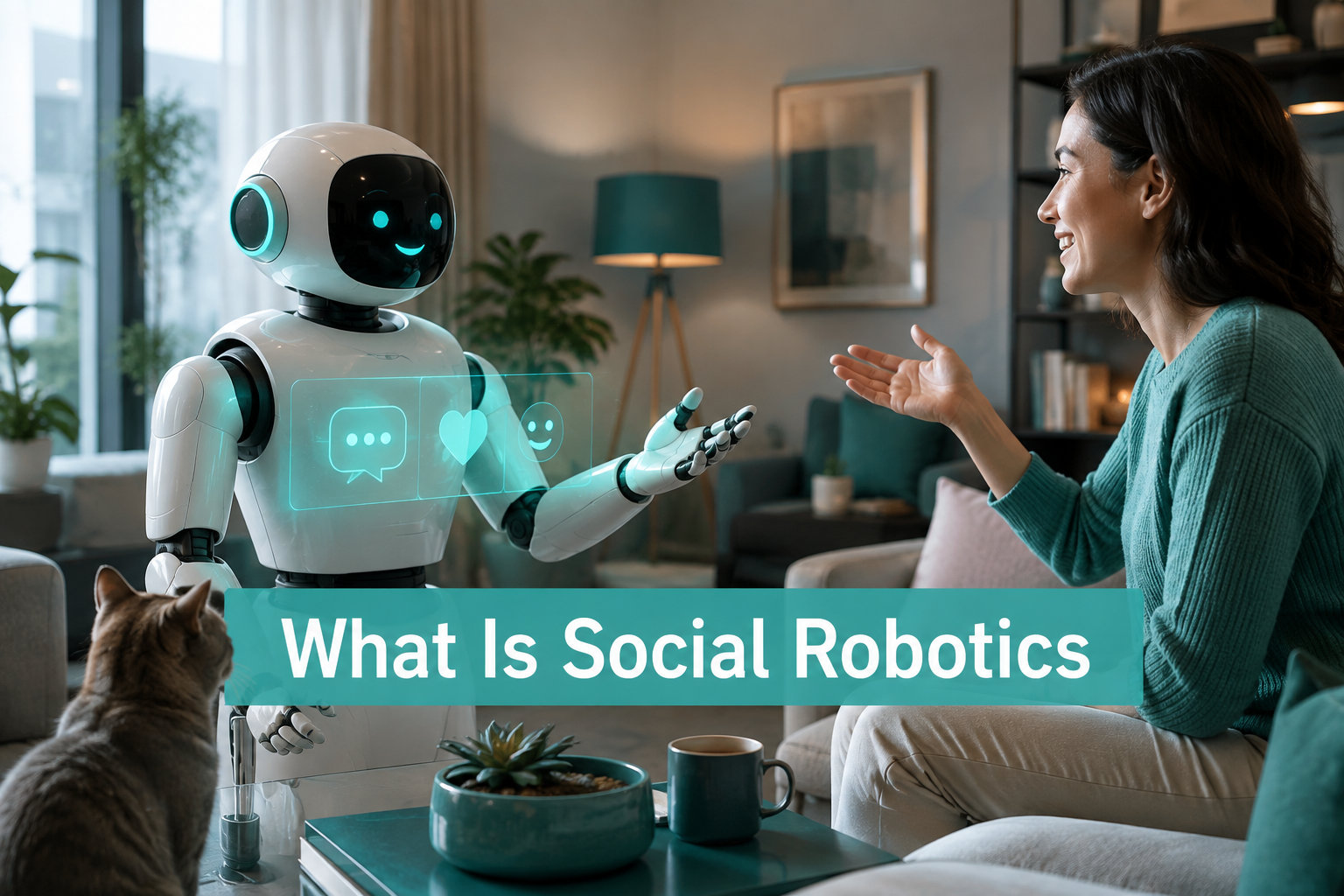
Social robotics is the interdisciplinary field focused on designing, building, and studying robots that can communicate and cooperate with humans using social behaviors, body language, and emotional cues. A social robot is an autonomous, physically embodied agent that interacts with people by following social rules attached to its role, such as a tutor, a caregiver, or a companion.
Researchers most often describe social robots through four properties:
- Physical embodiment: The robot has a body, whether humanoid, animal-like, or abstract, that occupies real space and can be touched.
- Social agency: The robot conveys intention, personality, and emotion through gaze, gesture, and speech.
- Autonomy: It can perceive its environment and respond without a human teleoperating every move.
- Social interaction skills: It engages in turn-taking, eye contact, and culturally appropriate behavior.
A few terms appear so often in this space that they are worth defining clearly. Human-robot interaction (HRI) is the academic discipline that studies how people and robots communicate. Socially assistive robotics (SAR) focuses specifically on robots that help through social rather than physical support, useful in autism therapy or elder care. Affective computing is the branch of AI that recognizes, interprets, and simulates human emotions. Embodied agents are AI systems grounded in a physical form, which is exactly what social robots are.
To put it simply, a social robot is not defined by what it looks like, but by how it behaves. A machine that only fetches objects is a service robot. A machine that talks to you, looks at you, and adapts its mood to yours is a social robot.
For more on how these ideas are shaping the broader industry, see our analysis of social intelligence in robotics and the latest acquisitions in the space.
How Social Robots Work: Technical Architecture
When someone asks me how social robots actually work, I usually point to three layered systems: the perception stack, the cognition stack, and the expression stack. Each layer uses real, deployable hardware and software that you can find in robots operating in 2026.
The Perception Stack: Sensing People and Context
Social robots need to understand what is happening around them. The perception layer combines several sensing technologies:
- RGB and depth cameras capture faces, body posture, and proximity, allowing the robot to detect eye contact and personal space.
- Microphone arrays localize sound sources and isolate speech from background noise, a hard problem in busy lobbies or classrooms.
- Tactile sensors in the skin, arms, or head detect touch, which matters for companion robots used with dementia patients or children.
- Inertial measurement units and wheel encoders track the robot’s own movement, so it can move smoothly without surprising nearby users.
On top of the raw sensors, computer vision and machine learning models turn that data into structured signals: a face recognized, a smile detected, a gesture classified as a wave.
The Cognition Stack: Reasoning and Social Intelligence
Once the robot perceives, it needs to decide what to do. Modern social robots rely on a combination of techniques:
- Natural language processing for understanding speech and generating responses, increasingly powered by large language models.
- Affective computing models that estimate emotional state from voice tone, facial expression, and word choice.
- Dialogue managers that maintain the flow of conversation across multiple turns.
- Task planners that decide which social behavior, wave, nod, joke, or instruction fits the current moment.
This is where the field has changed the most since 2023. Earlier social robots were largely scripted. Today’s platforms integrate foundation models to handle open-ended conversation, which is why a robot like Temi or Pepper can now discuss almost any topic while still respecting its programmed persona.
The Expression Stack: Communicating Back
A social robot is only as good as its ability to express itself. The expression stack includes:
- Servo-driven faces and heads that simulate gaze direction, blinking, and emotion.
- Articulated arms and torsos for pointing, hugging, or handing over objects.
- Speech synthesis with prosody control so the robot does not sound monotone.
- LED matrices, projectors, or screens that add an extra channel of expression, especially on non-humanoid designs.
These three layers run on a robotic platform, often a mobile base, that handles navigation, battery management, and safety. If you want a closer look at how such systems are assembled, our build robots resource covers the components in more depth.
What Social Robots Are Used For: Applications and Use Cases
Social robots are not a single product. They are a category of systems that already touch healthcare, education, hospitality, retail, and research. I have grouped the most important use cases below.
Healthcare and Therapy
The strongest evidence base for social robotics is in healthcare. Studies published on PubMed Central and ScienceDirect over the past five years show consistent results in three areas:
- Dementia care: Companion robots like PARO have been shown to reduce agitation and improve mood in patients with moderate to severe dementia, especially during the late afternoon when sundowning symptoms peak.
- Autism therapy: Robots such as NAO and Kaspar act as predictable, low-stimulation social partners that help children with autism practice eye contact, turn-taking, and emotional recognition.
- Rehabilitation: Stroke and injury patients use socially assistive robots to stay motivated through repetitive exercises, with the robot providing encouragement and tracking progress.
Social robots in healthcare are supplements, not replacements. They extend the reach of human caregivers, particularly in facilities with chronic staff shortages.
Education
Schools and tutoring centers are using social robots in two ways. First, as teaching assistants for early literacy, math drills, and language learning. Second, as social-emotional learning tools that help children practice empathy and conversation.
I have personally seen a primary school classroom where an educational robot named Moxie sat in a reading circle. Children who usually avoided group reading volunteered to read to the robot. Teachers reported that the robot’s consistent, non-judgmental attention was the key. Similar pilots in South Korea and Finland report gains in vocabulary and reading engagement.
Elderly Companionship
Loneliness is one of the largest unmet health needs in aging populations. Companion robots like ElliQ, Temi, and the Japanese LOVOT are designed to provide conversation, reminders, and gentle social presence for older adults living alone. Forum users in caregiver communities consistently report that robots help bridge the gap between visits, although they do not replace the human touch.
Customer Service and Hospitality
Hotels, airports, and restaurants have deployed humanoid robots for greeting, wayfinding, and concierge-style questions. SoftBank’s Pepper was the most famous example, used in over 2,000 retail and hospitality locations before its production ended in 2021. Newer entrants, including robots from Bear Robotics and Keenon, now fill similar roles with more reliable hardware.
Research and Workplace Collaboration
Many social robots are research platforms first and applications second. Universities use them to study HRI, while some offices pilot them for meeting facilitation, tours, and team-building. Industrial settings also test collaborative robots with social cues to make them safer around human workers.
Real-World Examples of Social Robots
Theory is useful, but examples make the field real. Here are the social robots I consider most influential in 2026, each with a specific niche.
Pepper by SoftBank Robotics
Pepper is probably the most widely recognized humanoid social robot ever produced. Standing 1.2 meters tall with a tablet on its chest, Pepper could recognize faces, detect emotions, and hold simple conversations. Despite production ending, thousands of Peppers remain in service across retail, banking, and education. It set the standard for what a consumer-facing social robot looks like.
NAO by SoftBank Robotics
NAO is a smaller, fully programmable humanoid used heavily in research and special education. With 25 degrees of freedom, expressive eyes, and multi-language speech, NAO has appeared in more than 13,000 academic papers. It is the workhorse platform of social robotics labs worldwide.
PARO by AIST
PARO is a therapeutic robotic baby seal used in hospitals and care homes. It responds to touch, light, and sound, and has been adopted in over 30 countries. Multiple clinical studies credit PARO with measurable reductions in stress and pain in dementia patients.
Moxie by Embodied
Moxie is a desktop companion robot for children, designed to help with social-emotional learning through daily activities, stories, and conversation. It uses a large language model to support open-ended dialogue while keeping its child-friendly persona.
LOVOT by Groove X
LOVOT is a Japanese companion robot whose only job is to be loved. It has warm skin, expressive eyes, and behavior that mimics attachment. Despite having no practical task, LOVOT has sold over 10,000 units in Japan, a striking example of pure social robotics as a product category.
Temi and ElliQ
Temi is a mobile telepresence and assistant robot used in elder care, retail, and offices. ElliQ is a tabletop companion designed specifically for older adults living independently, with proactive check-ins and activity suggestions. Both show how social robotics is branching out from humanoid form factors.
Challenges and Limitations of Social Robotics
I would not give you an honest answer to “What Is Social Robotics?” without naming the real friction points. Forum users, researchers, and end users consistently raise the following issues.
Cost and Total Ownership
Social robots are still expensive. A single NAO costs around the price of a small car, while custom platforms cost significantly more. Even subscription-based companions like ElliQ require ongoing fees. For most households, that is a hard sell, and even for institutions the total cost of ownership, including maintenance, training, and updates, can be substantial.
Privacy and Data Security
A social robot in your home is a camera, microphone, and AI system rolled into one. Forum users in caregiver and HCI communities frequently ask what data these robots collect, where it goes, and who can access it. The honest answer is that transparency varies by manufacturer, and regulatory oversight is still catching up.
Technical Limitations
Even the best social robots struggle with reliable understanding of complex emotions, sarcasm, and cultural context. Battery life typically tops out at a few hours of active conversation. Multilingual fluency is improving, but accents and noisy environments still cause errors.
Ethical Concerns
Researchers and ethicists raise valid concerns about deception, especially when vulnerable users such as dementia patients form emotional attachments to robots. There is also a fear of social skill atrophy in children, who may learn empathy from a robot that does not actually experience feelings. None of these concerns cancel out the benefits, but they deserve serious discussion in any deployment plan.
Effectiveness vs. Hype
Studies often show modest effect sizes for social robots compared to human interaction. They are most effective as supplements, not substitutes, and pilot programs do not always scale. Anyone considering deployment should set realistic expectations and measure outcomes against clear baselines.
The Future of Social Robotics: Trends in 2026
Several trends will shape social robotics in 2026 and the years immediately after. I have ranked them by what I see as their likely impact on real-world deployments.
Foundation Models and Conversational Depth
The integration of large language models is the single biggest shift in the field. Robots that once relied on scripted dialogue can now hold open-ended conversations, adjust tone, and recall context across sessions. Expect every major platform to ship with a built-in conversational AI in the next 12 to 24 months.
Multimodal Affective AI
Future social robots will combine vision, audio, and language to estimate emotion with far higher accuracy. Affective AI startups raised over 800 million dollars globally in the past two years, and that capital is feeding directly into social robotics products.
Cultural Adoption Differences
Adoption is not uniform. Japan and South Korea have the highest cultural acceptance, partly because of long-standing traditions of friendly robots in media. The United States shows strong interest in healthcare and education use cases. Europe is more cautious, with stricter data protection rules shaping product design. Any global rollout has to account for these regional differences.
Market Growth and Investment
The social robotics segment is projected to grow at a compound annual rate above 20 percent through the end of the decade. The strongest demand is in elder care, special education, and customer service, with hospitality and retail close behind. Investors are watching for platforms that combine reliable hardware with proven clinical outcomes.
Regulation and Standards
Expect new safety and data standards for social robots, particularly for medical and educational use. The EU AI Act already classifies certain robotics applications as high risk, and similar frameworks are being discussed in North America and Asia.
Frequently Asked Questions
What is social robotics in simple terms?
Social robotics is the field of designing robots that can interact with people using social behaviors such as speech, eye contact, gestures, and emotional expression. A social robot is built to communicate and cooperate with humans, not just perform physical tasks.
Can you give me an example of a social robot?
Common examples include Pepper, a humanoid used in retail and hospitality; NAO, a small humanoid widely used in research and special education; PARO, a therapeutic robotic seal used in dementia care; Moxie, a companion robot for children; and ElliQ, a tabletop companion for older adults living independently.
What are social robots used for?
Social robots are used in healthcare for dementia care, autism therapy, and rehabilitation, in education for literacy and social-emotional learning, in elder care to reduce loneliness, in hospitality and retail for greeting and wayfinding, and in research labs that study human-robot interaction.
How do social robots work?
Social robots combine cameras, microphones, and tactile sensors to perceive people, then use artificial intelligence, natural language processing, and affective computing to interpret emotions and intent. They respond through speech, facial expressions on screens or mechanical faces, body language, and movement, all governed by software that maintains a consistent social persona.
Are social robots effective?
Social robots are most effective as supplements to human care rather than replacements. Studies show measurable benefits in dementia care, autism therapy, and education, particularly when robots offer consistent, patient, and predictable interaction. Effectiveness depends on use case, implementation quality, and how the robot is integrated into existing workflows.
What is the future of social robotics?
The future of social robotics includes deeper integration of large language models for open-ended conversation, more accurate multimodal emotion recognition, and rapid growth in elder care and education markets. Expect regional differences in adoption, with Japan and South Korea leading, plus new safety and data regulations emerging globally.
Conclusion
So, what is social robotics? It is the science and engineering of building robots that can talk, listen, look at us, and respond in socially meaningful ways. It is not about humanoid form factors alone. It is about giving machines a social presence that people can relate to.
After years of research and early deployments, the field is finally crossing into mainstream use. Healthcare, education, and elder care are the clearest wins today, while customer service and workplace collaboration are catching up fast. The biggest shifts ahead come from large language models, multimodal emotion recognition, and clearer regulatory frameworks.
If you are considering a deployment, start with a small pilot, measure outcomes against specific goals, and choose a platform with transparent data practices. If you are a student or researcher, the open questions around cultural adoption, long-term effects, and ethical integration are wide open. Social robotics is no longer a lab curiosity. It is a practical tool, and the conversation about how to use it well has only just begun.