
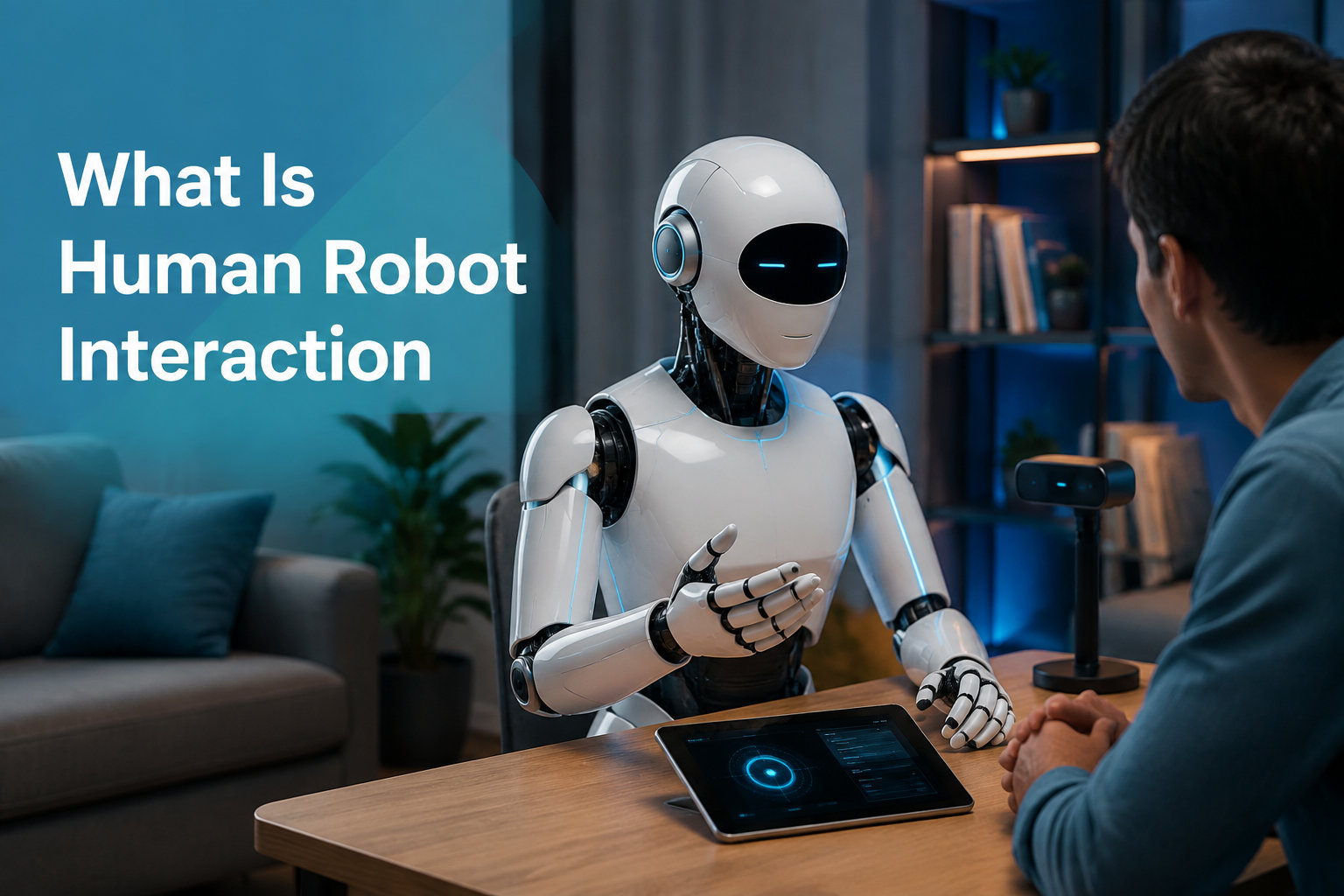
Human Robot Interaction (HRI) is the interdisciplinary field of study focused on how humans and robots communicate, collaborate, and share physical spaces. Our team has followed HRI research for years, and we have seen this area grow from a niche academic topic into a discipline shaping healthcare, manufacturing, and daily life. This guide breaks down what HRI means, how the communication works, the types of interaction, and where the field is heading in 2026.
If you have ever asked a voice assistant to set a timer, watched a robot vacuum dodge your feet, or seen a factory arm slow down when a worker steps close, you have already witnessed human robot interaction in action. Let me walk you through the science, the practical examples, and the career paths behind those moments.
Table of Contents
What Is Human Robot Interaction and Why Does It Matter
Human Robot Interaction is the study of how people and robots exchange information, perform joint tasks, and build trust. Researchers in this field design the rules, sensors, and interfaces that let a robot understand a spoken command, recognize a pointing gesture, or stop before a collision.
I think of HRI as the bridge between two very different agents. Humans rely on context, emotion, and ambiguous language. Robots rely on sensors, code, and probability scores. HRI researchers close that gap from both sides.
Why does it matter? Because robots are leaving controlled factory cages and entering our homes, hospitals, and streets. Without solid HRI principles, those robots would either be unsafe, unhelpful, or both.
Key aspects of HRI at a glance
- Communication – speech, gesture, touch, gaze, and emotion
- Collaboration – shared tasks where humans and robots divide work
- Safety – collision avoidance, force limits, and predictable behavior
- Trust – calibrated confidence so users know when to follow a robot’s lead
- Social acceptance – cultural norms, appearance, and perceived intent
The Multidisciplinary Nature of Human Robot Interaction
HRI pulls from at least six established fields, which is why it often feels hard to pin down for newcomers. Our team has interviewed graduate students who said the field felt “fragmented” until they saw how the pieces fit together.
Here are the main disciplines feeding into HRI today:
- Human-Computer Interaction (HCI) – usability, interface design, and user studies
- Artificial Intelligence (AI) – reasoning, planning, and learning from data
- Robotics – actuators, locomotion, and control theory
- Computer Vision – recognizing faces, gestures, and objects
- Natural Language Processing (NLP) – speech recognition and dialogue
- Cognitive Science and Psychology – how humans perceive and trust machines
That blend is what makes HRI unique. A single project might require a mechanical engineer, a linguist, and a behavioral psychologist working on the same robot.
Types of Human Robot Interaction
Researchers usually split HRI into two broad categories based on physical distance. Both matter, and most real robots combine elements of each.
Proximate interaction
Proximate interaction happens when humans and robots share the same physical workspace. This is the category covering collaborative robots (cobots) in factories, surgical robots in operating rooms, and service robots in restaurants. The robot and the person are close enough to touch, so safety sensors, force limits, and predictable motion are critical.
Remote interaction
Remote interaction happens when the human operator is physically separated from the robot. This covers drone piloting, undersea exploration, space missions, and bomb disposal. The challenge here is latency, limited feedback, and a smaller set of communication channels. Our team has covered wireless network communication for remote robot operation in a separate guide if you want to dive deeper into that side.
Quick comparison of the two types
- Proximate: shared space, real-time feedback, high safety priority
- Remote: separated by distance, delay-tolerant, high bandwidth priority
Communication Modalities in Human Robot Interaction
Communication is the heart of HRI. Robots and humans exchange information through several channels, and good design picks the right channel for the task.
Verbal communication
Verbal communication uses speech recognition, text-to-speech, and dialogue management. Voice assistants in robots rely on automatic speech recognition (ASR) to convert sound into text, then NLP to extract intent. A hospital robot might respond to “take this tray to room 204” by planning a route and confirming out loud.
Non-verbal communication
Non-verbal channels include gestures, facial expressions, body posture, and gaze. A humanoid robot that turns its head toward a speaker signals attention. A factory cobot that pauses when the worker raises a hand signals respect for human authority. Computer vision systems detect these cues using cameras and trained models.
Physical communication
Physical channels use touch and force. Haptic feedback in a controller lets a teleoperator feel resistance. A robot arm equipped with torque sensors can sense when a person grabs it and respond gently. Real-time processing, sometimes handled by FPGA-based real-time torque sensing, is what makes safe physical contact possible.
Passive and environmental cues
Robots also communicate through lights, sounds, and motion patterns. A vacuum that emits a soft tone when it finishes a room is using an environmental cue. So is a delivery robot whose screen shows a smiling face when it arrives.
Application Domains and Everyday Examples
HRI is no longer confined to research labs. Here are the main places you will find it working today.
Healthcare assistance
Surgical robots extend a surgeon’s precision. Rehabilitation robots guide patients through exercises. Social robots like PARO provide comfort to dementia patients. Each example depends on careful HRI design to feel safe and supportive.
Manufacturing and cobots
Collaborative robots work alongside humans on assembly lines. They handle heavy lifting while humans handle fine detail. Modern cobots use force sensing and vision to slow down or stop when a person enters their space.
Education
Educational robots teach coding, language, and social skills. Tools like LEGO Mindstorms and NAO give students a hands-on way to learn HRI concepts starting in elementary school.
Search and rescue
Rescue robots enter collapsed buildings, mines, and disaster zones where humans cannot safely go. Operators control them remotely, and the robots send back video, audio, and sensor data.
Space exploration
Robonaut on the ISS and the Mars rovers are extreme cases of remote HRI. Operators on Earth guide them across environments millions of miles away with seconds of signal delay.
Domestic and social robots
Roomba-style vacuums, lawn mowers, and elder-care companions fill our homes. Social robots like Jibo and Pepper try to read emotions and respond with their own expressions, opening new questions about how humans bond with machines.
Key Research Challenges in HRI
Despite the progress, HRI still faces real technical and human-factor problems. I want to highlight the four that come up most often in papers and at the annual HRI conference.
- Trust calibration – getting humans to neither over-trust nor under-trust a robot’s suggestions
- Intent recognition – predicting what a person will do next, often with limited data
- Social context – reading cultural norms, personal space, and group dynamics
- Long-term adaptation – learning a specific user’s habits without violating privacy
Each of these challenges is a research area on its own, and progress here drives the field forward.
Social and Ethical Considerations
Robots that look human, sound human, or respond emotionally raise questions that pure engineering cannot answer. A few topics our team thinks deserve more public discussion:
- Anthropomorphism – humans tend to treat human-shaped robots as social agents, even when they are not
- Emotional attachment – children and elderly users can form strong bonds with companion robots
- Deception – whether a robot should reveal that it is not “feeling” anything
- Data and privacy – in-home robots collect audio, video, and behavioral data
These concerns are why ethics review boards and policy researchers are now part of every major HRI program.
How HRI Differs From Human Computer Interaction
Because HRI grew out of HCI, the two fields share tools, conferences, and vocabulary. The big difference is embodiment. A computer lives on a screen, but a robot has a physical body that moves through real space.
That embodiment changes everything. Safety, force, motion timing, and physical proximity become design problems. HCI rarely worries about its interface bumping into a user. HRI must.
Career Paths in Human Robot Interaction
Forum threads on Reddit and Stack Exchange show that students often struggle to find a clear entry point. Here is what I tell people who ask.
Relevant degrees
Most HRI researchers come from computer science, electrical or mechanical engineering, psychology, cognitive science, or design. Graduate programs that combine robotics, AI, and human factors give the strongest foundation. Schools like Carnegie Mellon, MIT, Georgia Tech, and the University of Michigan run well-known HRI groups.
Common job titles
- HRI Research Scientist
- Robotics Software Engineer
- UX Researcher for Robotics
- Human Factors Engineer
- Conversational AI Designer
Where to learn more
The ACM/IEEE International Conference on Human-Robot Interaction and the journal ACM Transactions on Human-Robot Interaction are the two main academic venues. Beginners often start with textbooks like Human-Robot Interaction: An Introduction by Goodrich and Schultz.
The Future of Human Robot Interaction
The next decade will likely see HRI move from labs into everyday products. Large language models already let robots understand fuzzy instructions. Vision-language-action models promise more general-purpose assistants. Industry forecasts suggest that by 2026 more than 20% of large manufacturers will deploy some form of collaborative robot.
For students, builders, and curious readers, the field has never been more accessible. Open-source frameworks like ROS 2, low-cost platforms like TurtleBot, and online courses from Coursera and edX lower the barrier. The robots of 2026 will be shaped by the people who start learning about HRI now.
Frequently Asked Questions
What are the main types of human robot interaction?
HRI is generally divided into proximate interaction, where humans and robots share the same physical workspace, and remote interaction, where the operator and robot are separated by distance. Both rely on communication modalities like speech, gesture, and touch.
What degree is required to study human robot interaction?
Most HRI researchers hold a graduate degree in computer science, robotics, electrical or mechanical engineering, psychology, or cognitive science. Programs that combine AI, robotics, and human factors offer the strongest preparation.
What is an example of human robot interaction?
A common example is a collaborative robot arm on a factory line that senses a worker’s approach, slows its motion, and resumes only when the worker moves away. Voice assistants in home robots are another everyday example.
What is the human-robot interface?
The human-robot interface is the set of sensors, displays, and software that lets a person exchange information with a robot. It can include microphones, cameras, touch screens, haptic devices, and dialogue systems.
Do humanoid robots have feelings?
Humanoid robots do not have subjective feelings. They can recognize human emotions through sensors and respond in ways that appear emotional, but their reactions are produced by algorithms, not lived experience.
How is HRI used in healthcare?
In healthcare, HRI supports surgical robots that extend a surgeon’s precision, rehabilitation robots that guide patients through exercises, and companion robots that provide comfort to people with dementia or autism.
Final Thoughts on Human Robot Interaction
Human robot interaction is the discipline that decides whether robots will be trusted partners or expensive tools. Our team believes the people who understand HRI today will shape the products, policies, and workplaces of 2026 and beyond.
Start with the definition, explore the modalities, and pick a domain that excites you. Whether you build cobots, design dialogue systems, or study how children react to robots, the field has room for you. If you want a deeper look at the hardware that makes safe contact possible, check out our guide on FPGAs in robotics. And if remote operation is your angle, our piece on Wi-Fi control of robots is a good next read.
Thanks for spending time with this guide. The robots of 2026 are listening, learning, and waiting for designers who take the human side of the equation seriously.