
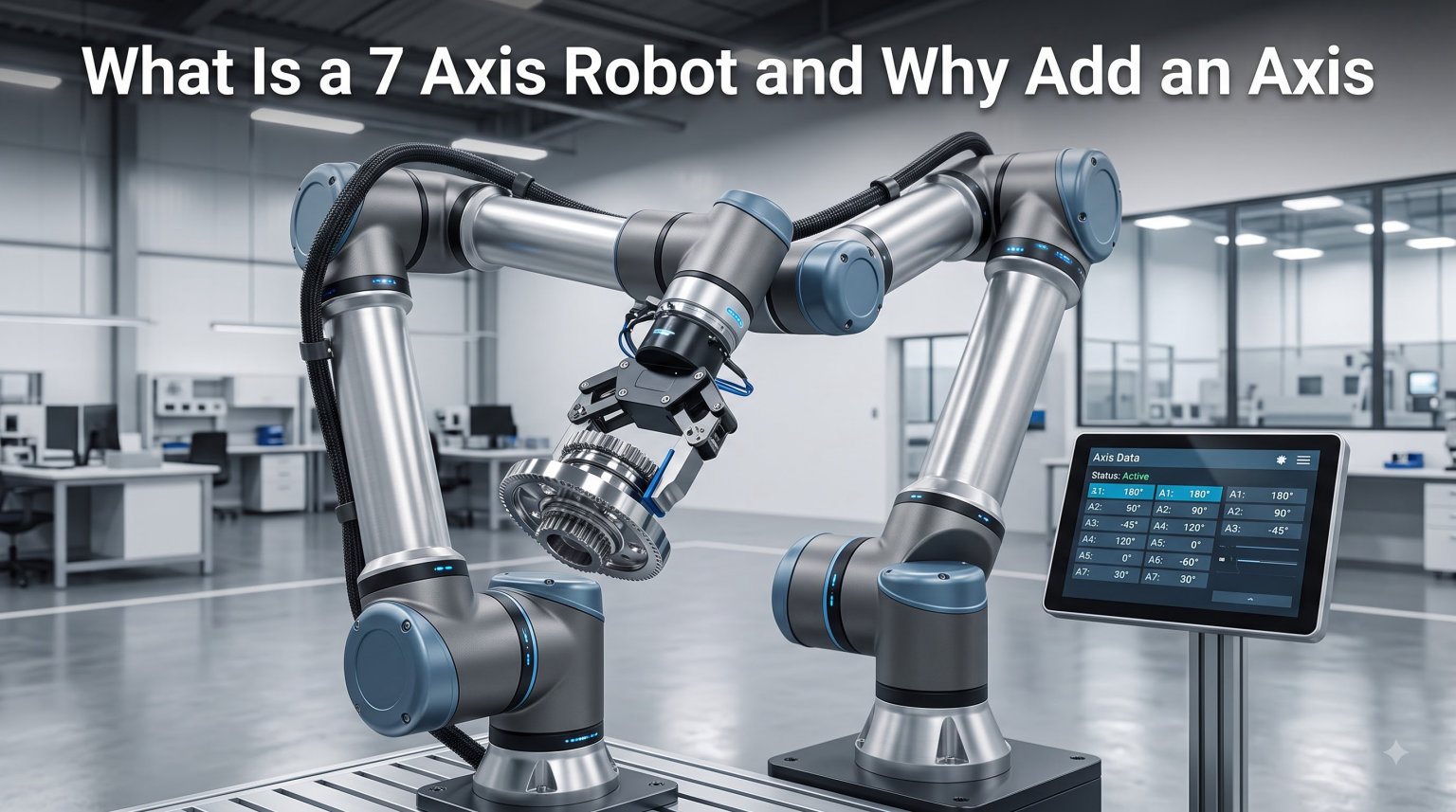
If you have ever watched an industrial robot arm snake into a tight engine bay or weld a seam from an impossible angle, you have seen the value of extra articulation. A 7 axis robot is exactly that: a robotic arm with seven independently controlled degrees of freedom instead of the standard six. That single extra joint or linear track unlocks reach, flexibility, and cycle times that a 6-axis arm simply cannot match.
I have spent time on factory floors watching 6-axis arms stall out at awkward fixtures, then seen a 7-axis setup glide through the same motion without hesitation. In this guide, I will break down what a 7 axis robot is, how the seventh axis actually works, and why so many automation engineers are adding one to their cells in 2026.
Table of Contents
What Is a 7-Axis Robot?
A 7 axis robot is a robotic manipulator with seven degrees of freedom (DOF), one more than the standard 6-axis articulated arm. Each degree of freedom is an independent joint or linear motion that the controller can drive on its own, giving the robot one more way to position and orient its end effector.
The “seventh axis” can take two very different physical forms, and this is where a lot of newcomers get confused:
- External linear 7th axis: A floor-mounted or ceiling-mounted linear track that the entire robot rides on. This is the most common setup in production. The track itself is the seventh axis.
- Internal redundant joint: A seventh rotational joint built into the arm itself, usually mounted between the base and the upper arm linkage. This is the “true” redundant robot because it adds freedom inside the kinematic chain.
Either way, the goal is the same: more ways to reach the same point in space. This redundancy is why engineers often call 7-axis designs redundant robots. If you want to understand how those joints are actually driven, our guide on planetary gearboxes in robot joints is a good next read.
How the 7th Axis Works Technically
At the hardware level, the 7th axis behaves just like any other axis. A servo motor drives a gear reducer, which moves a rack-and-pinion carriage (for a linear track) or rotates a redundant joint. The controller synchronizes this axis with the other six in real time so the end effector follows the planned path.
For a linear track system, the robot transfer unit (RTU) is bolted to the floor or suspended overhead. The carriage carries the entire robot along a single linear direction, often 5 to 30 meters. This is what you see in large welding cells, CNC machine tending lines, and automotive body shops.
For an internal redundant joint, the seventh axis is built into the arm. The most common configuration is a pivoting elbow that rotates the upper link around the axis running from the base to the shoulder. This is exactly the motion your own shoulder blade performs, and we will come back to that in the human arm section.
Both setups need careful calibration. The controller must know exactly where the carriage is at every millisecond, or the robot will drift off path. Backlash in any of the seven joints compounds quickly, which is why precision components like those explained in our article on backlash in robot gearing matter so much.
To make this work, the robot controller treats the seventh axis as a fully integrated servo loop. On KUKA, FANUC, and ABB systems, you configure the 7th axis as an external kinematic group. The teach pendant then lets you jog it just like any other joint, and the inverse kinematics solver handles trajectory planning across all seven axes together.
6-Axis vs 7-Axis Robot: Key Differences
The most common question I get from automation buyers is: do I really need the extra axis, or will a 6-axis arm do the job? Here is a direct comparison.
| Feature | 6-Axis Robot | 7-Axis Robot |
|---|---|---|
| Degrees of freedom | 6 | 7 |
| Workspace shape | Spherical around base | Spherical extended along linear track or through redundant joint |
| Reach into confined spaces | Limited by joint angles | Significantly improved via redundant positioning |
| Obstacle avoidance | Often impossible without repositioning base | Can route elbow around obstructions |
| Singularity handling | Stops or slows at singularities | Can reconfigure to avoid singularities |
| Typical cost | Lower | 15 to 40 percent higher depending on configuration |
| Programming complexity | Standard | Higher, requires redundant motion planning |
| Best fit applications | Standard pick and place, simple welding | Complex welding, machine tending, large work envelopes |
The short version: if your cell fits inside the 6-axis reach envelope and you have no obstacles, stick with 6. If you need to serve multiple machines, reach around fixtures, or maintain a constant torch angle over a long seam, the seventh axis pays for itself fast.
Why Add an Axis? The Core Benefits
Adding a seventh axis is not just a marketing bullet. It changes what the robot can physically do. Here are the benefits I see most often on real production lines.
Reach into Confined Spaces
A 6-axis arm has exactly one configuration for most points in space. If that configuration puts the wrist joint or an upper link into a fixture or machine guard, the robot cannot complete the move. The 7th axis gives the controller an extra degree of freedom to fold the arm into a different shape while still hitting the target point. This is the single biggest reason manufacturers add a 7th axis for CNC machine tending.
Avoid Obstacles and Singularities
A singularity is a joint configuration where the robot loses a degree of freedom momentarily. A 6-axis arm can get stuck in a wrist singularity where two joints try to align. With a seventh axis, the controller has freedom to reconfigure the arm and keep moving. I have watched a 7-axis arm run a continuous weld path that a 6-axis arm had to stop and restart every 90 seconds.
Maintain Optimal End-Effector Orientation
Tasks like welding, painting, and adhesive dispensing need the tool to stay at a specific angle relative to the workpiece. With 6 axes, you sometimes have to compromise the angle to reach the point. With 7 axes, you can lock the tool angle and use the extra freedom to position the rest of the arm comfortably. The result is consistent bead quality and less rework.
Extend Workspace Along a Track
A linear 7th axis can extend a robot’s reach from a 3-meter sphere to a 30-meter work envelope. One robot can now tend three, four, or five CNC machines in a row. This is the foundation of flexible manufacturing cells in modern factories.
Faster Cycle Times
Because the 7th axis lets the arm take the shortest, least obstructed path, cycle times often drop 10 to 25 percent compared to a 6-axis arm repositioning its base. Over a year of two-shift production, that adds up to real money.
The Human Arm Analogy: Why 7 Degrees of Freedom Is Special
Here is something most articles on 7 axis robots miss: 7 degrees of freedom is the same number your own arm has. Biomechanics researchers have measured the human arm at 7 DOF for decades. The shoulder gives you 3, the elbow gives you 1, and the wrist gives you 3.
Why 7? Because 6 is not enough to do everything we do. With only 6 DOF, your hand would have a unique arm configuration for every point and orientation in space. With 7 DOF, you can reach the same point with your elbow up or down, your shoulder rolled forward or back, your arm tucked in or extended.
That extra freedom is what lets you scratch the middle of your back, reach into a tight cabinet, or thread a needle while looking at it from above. It is also exactly what a 7 axis robot gains: redundant positioning. The same end effector pose can be reached with multiple arm configurations, and the controller picks the best one for the job.
This is also why roboticists consider 7 the magic number for human-like dexterity. Below 7, you cannot match the full range of human arm motion. Above 7, the extra joints add complexity without proportional benefit for most industrial tasks. That is why 7-axis arms are the standard for advanced manipulation research and why collaborative robots like the Franka Emika Panda and the Kinova Gen3 use 7 DOF.
Common Applications for 7-Axis Robots
The 7 axis robot shows up wherever a 6-axis arm runs out of freedom. These are the most common use cases I see in 2026.
CNC Machine Tending
This is the headline application. A 7-axis arm with a linear track can load and unload parts from a row of CNC mills or lathes, reach deep into the machine door, and clear fixtures that block a 6-axis arm. We cover this in depth in our warehouse robot fleet scaling webinar, which touches on similar cell-level deployment patterns.
Welding
Long seams on large parts like truck frames, ship sections, or structural beams need a constant torch angle. A 7-axis setup lets the welder keep the torch exactly perpendicular to the joint while the linear track moves the arm down the length of the part. Quality goes up and rework goes down.
Material Handling and Palletizing
For palletizing mixed-size boxes or loading parts onto conveyor lines that snake around equipment, the extra reach and obstacle avoidance of a 7 axis robot is genuinely useful. It can fold around pillars, support columns, and overhead obstructions that stop a 6-axis arm cold.
Assembly Operations
When a part must be inserted from an awkward angle or underneath an existing assembly, the 7th axis shines. The redundant joint lets the arm approach the insertion point from below or from the side while keeping the tool aligned with the hole.
Painting and Coating
Consistent spray angle is everything in painting. A 7-axis arm keeps the nozzle perpendicular to the surface even on contoured parts, which reduces overspray and improves finish quality.
Implementation Considerations and Challenges
Adding a seventh axis is not a drop-in upgrade. Here are the practical issues I have watched teams run into.
Programming Complexity
Seven axes mean the inverse kinematics solver has more work to do. For a 6-axis arm, the math gives one solution for each pose. For a 7-axis arm, the system has to choose from infinite solutions. Most modern controllers handle this automatically, but your programmers need to understand the redundancy optimization settings or the arm will pick weird-looking paths. The KUKA OfficeLite and FANUC iRVision toolkits both include redundant motion planning, but they require training.
Calibration and Synchronization
On a linear 7th axis, the carriage position must be exact. A 1 mm position error on a 10 meter track can throw the end effector off by 2 mm at the tool. Most integrators use laser trackers or ball-bar tests during commissioning, and they schedule a recalibration every 6 to 12 months. For more on the mechanical precision side, our guide to how a robot chassis works explains how the underlying frame and drivetrain affect accuracy.
Cost vs Benefit
Adding a 7th axis typically adds 15 to 40 percent to the cost of a robot cell. That is a real number and you need to justify it. The math works out when one 7-axis robot replaces two or more 6-axis robots, or when cycle time savings are large enough to recover the investment in 12 to 24 months. Run the numbers before you commit.
Controller Compatibility
Not every controller supports an external 7th axis out of the box. KUKA, FANUC, ABB, and Yaskawa all offer 7th axis options, but smaller brands may not. Confirm the controller supports your chosen linear track or redundant joint before you buy. For deployments at scale, electrical and power issues like those covered in why robots brown out and reset also become more pronounced when you add a seventh servo drive to the cabinet.
Mechanical Footprint
A linear track takes floor space or ceiling space. A redundant internal joint adds length to the arm. Plan your cell layout around the 7th axis envelope, not the original 6-axis envelope. I have walked into too many factories where a 7-axis robot was bolted into a 6-axis cell and the track physically could not reach the second machine.
Frequently Asked Questions
What is the 7th axis on a robot?
The 7th axis is an additional degree of freedom added to a standard 6-axis robot arm. It can be an external linear track that moves the entire robot along one direction, or an internal redundant rotational joint built into the arm itself. Either way, it gives the controller more ways to position the end effector.
What is the difference between a 6-axis and 7-axis robot?
A 6-axis robot has six independently controlled joints. A 7-axis robot has a seventh axis that provides redundant positioning, allowing the arm to reach the same point in space using multiple configurations. This improves reach into confined spaces, obstacle avoidance, and cycle time.
Does the human arm have 7 degrees of freedom?
Yes. The human arm has 7 degrees of freedom: 3 at the shoulder, 1 at the elbow, and 3 at the wrist. This is the same number used in advanced 7 axis robot designs and is widely considered the minimum for human-like dexterity.
Can a robot have more than 6 degrees of freedom?
Yes. Any robot with more than 6 degrees of freedom is called a redundant robot. 7-axis arms are the most common redundant design in industry, but research robots with 8, 9, or even more degrees of freedom exist for specialized applications.
What can a 7 axis robot do that a 6 axis robot cannot?
A 7 axis robot can reach into confined spaces, route its arm around obstacles, maintain a constant tool angle over long paths, and avoid singularities that would stop a 6-axis arm. This makes it ideal for CNC machine tending, complex welding, and large work envelopes.
How much does adding a 7th axis cost?
Adding a 7th axis typically increases the cost of a robot cell by 15 to 40 percent, depending on whether it is a linear track system or an internal redundant joint. The investment usually pays back in 12 to 24 months through cycle time gains and reduced labor.
Conclusion
A 7 axis robot is a 6-axis arm with one extra degree of freedom, either as a linear track or as an internal redundant joint. That seventh axis gives the controller multiple ways to reach the same point in space, which translates into real benefits on the factory floor: better reach into confined spaces, fewer singularities, faster cycle times, and longer work envelopes.
If your automation project is hitting the limits of what a 6-axis arm can do, the 7 axis robot is the next logical step. Start by mapping your work envelope, identifying the obstacles, and running a cost-benefit comparison. In most cases I have seen, the math works out within 18 months. For more on robot hardware and design, browse the rest of our robotics guides to plan your next cell with confidence in 2026.