
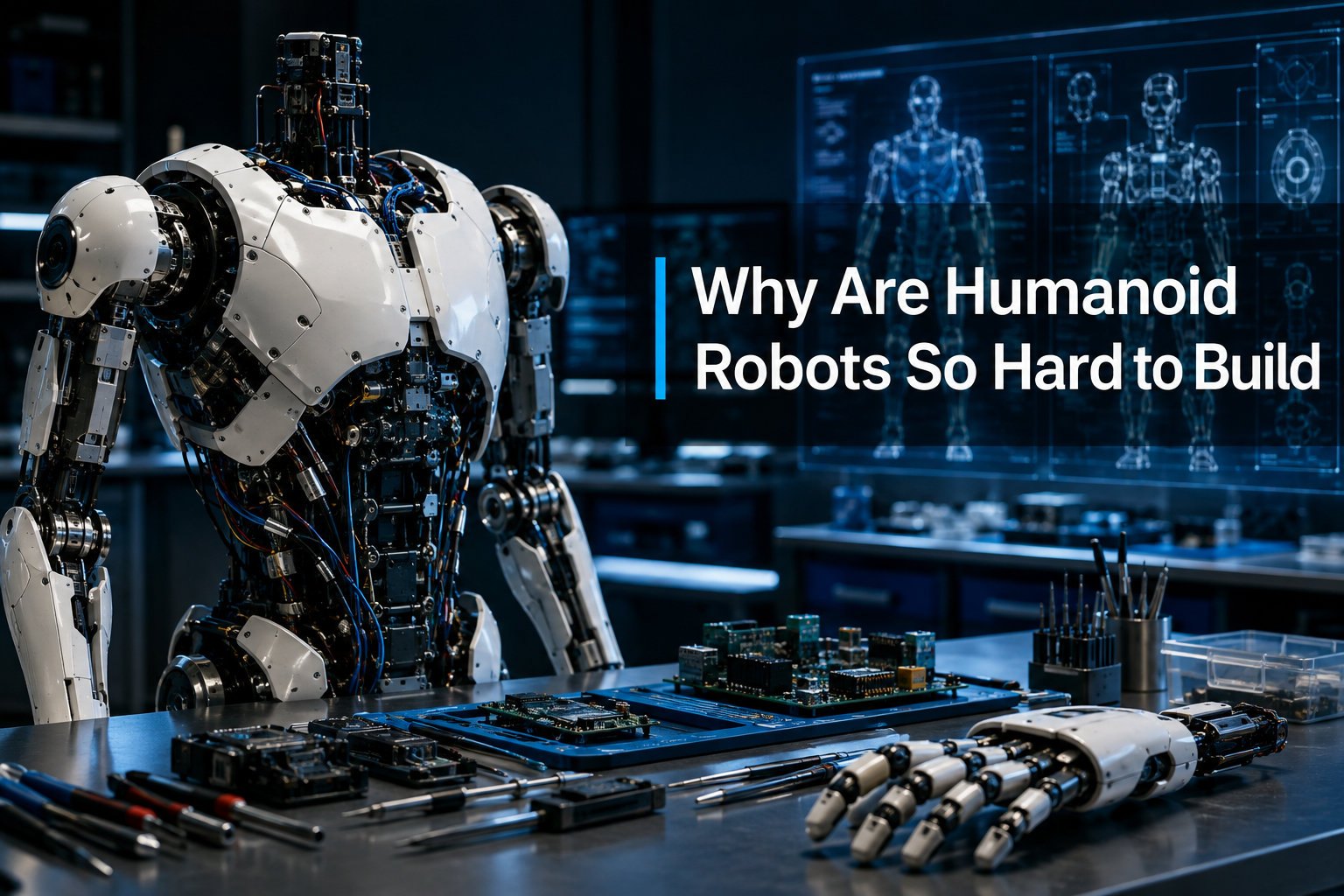
Every few months I see another polished video of a humanoid robot walking through a warehouse or folding a shirt. Then I scroll down to the comments and find engineers pointing out the dozens of takes, the safety harness just out of frame, and the toddler-like fall rate. I have spent the last decade building and reviewing robots for Smashing Robotics, and the question I get most often is some version of this: why are humanoid robots so hard to build?
The honest answer is that combining bipedal locomotion, human-level dexterity, and real-world AI in a single machine pulls against physics, biology, and economics all at once. A quadruped can afford to fall. A robot arm bolted to a table can ignore walking entirely. A human-shaped robot has to do both, plus reason about an environment that was never designed for it. In this guide I will walk through the four engineering pillars that make this so difficult, share what our team has seen in labs and on factory floors, and explain where the real bottlenecks still sit in 2026.
Table of Contents
Why Are Humanoid Robots So Hard to Build: The Core Engineering Trilemma
Humanoid robots are hard to build because they must solve three problems at once that are each individually decades-long research fields. A walking robot must be stable on two legs, a manipulation robot must coordinate fingers, wrists, and arms, and an embodied AI system must perceive and reason about an open-ended world.
No industrial form factor has this constraint. A robotic arm on a production line is bolted down. A wheeled logistics robot is statically stable. A drone uses four rotors to hover. Humanoid robots, by design, are the only category that is simultaneously underactuated, unanchored, and expected to manipulate the same tools, doors, and objects that people use. That overlap is what makes the problem so brutal.
To make this manageable, I group the challenges into four pillars: balance and locomotion, dexterity and fine motor control, AI and sensing, and cost plus hardware complexity. We will go through each one in depth.
Balance and Locomotion Challenges in Bipedal Walking
Two-legged walking is mathematically a problem called an underactuated system, which simply means the robot has fewer ways to push on the ground than it has degrees of freedom to control. When you walk, your planted foot can only push at the contact point. Everything else – your swinging leg, your torso, your arms – has to be balanced by that single contact.
How Humanoid Robots Keep Their Balance
- IMUs (inertial measurement units) measure the robot’s tilt and angular velocity hundreds of times per second.
- Force sensors in the feet detect ground contact and load distribution.
- A real-time controller, often running on an FPGA for latency, combines that data into a model of the robot’s state.
- Model predictive control calculates the next joint commands to keep the center of mass over the support polygon.
- The whole loop repeats at 1 kHz or faster, with adjustments every cycle.
The math is solvable in a lab. The trouble is everything that the math has to ignore. Floor tiles with a 2 mm lip, a wet patch near a door, a cable someone left behind – any of these can flip a robot in under a second. Reddit’s r/robotics community often jokes that the state of the art is a humanoid that can walk for 20 minutes on a flat floor before falling. The World Humanoid Robot Games in 2026 drove this point home when robots tipped over during simple relay races, an outcome that looked funny but underscored how brittle the systems still are.
There is a deeper issue. Humans learn to walk using years of childhood failure and constant feedback from their vestibular system, skin, and vision. A robot has to do the same thing with maybe six to twenty force sensors and a handful of cameras. We compensate by overengineering the control software, but that brings us to the next pillar: even a perfectly balanced robot cannot pick up a coin.
If you want to understand how power systems feed into this, our guide on battery technology limitations for robots explains why most humanoids can only run for one to two hours between charges, which is another way the form factor fights against itself.
Dexterity and Fine Motor Control Problems
Balance gets all the press, but in my experience dexterity is the silent killer of humanoid robot development. A bipedal robot that can walk across a room is impressive. A bipedal robot that can pick up a coffee cup, open a door, and fold laundry is the actual goal, and we are nowhere close.
Why Robot Manipulation Is So Hard
Human hands have about 27 degrees of freedom, more than 100 ligaments, and roughly 17,000 touch receptors. Even a very expensive humanoid hand might have 12 to 20 actuators and a few hundred pressure sensors. That gap shows up the moment the robot tries anything fiddly.
Pick-and-place tasks in factories work because the parts are rigid, the lighting is controlled, and the robot is calibrated to a specific location. In a kitchen, nothing is in the same place twice. A bag of beans deforms when you grab it. A knife slides on a cutting board. A plastic bag reflects light in ways that confuse vision systems. These are not edge cases – they are the normal environment humanoids are supposed to operate in.
Hardware is part of the problem. Tactile sensors are still expensive, low resolution, and hard to integrate at scale. Pneumatic and hydraulic hands are powerful but heavy and slow. Cable-driven hands are elegant but unreliable. Each approach trades off against the others, and there is no clear winner yet.
Software is the other half. Reddit users in the robotics subreddit often note that hardware advances have lagged behind AI advances, which is the opposite of what most people assume. Our team has watched teleoperated demos that look magical, only to learn the robot was being driven by a human through a haptic suit. When the AI takes over, success rates on dexterous tasks drop into the 50-70% range for well-funded systems, and much lower for anything general.
A related issue is hand-eye coordination. Humans fuse visual, proprioceptive, and tactile information subconsciously. Robots must do this explicitly, and the timing is brutal. By the time the vision system recognizes an object, plans a grasp, and the arm executes, the object may have moved. Closing that loop is an active research area, and a key reason dexterous humanoid robots remain rare outside of staged demos.
For builders thinking about control architectures, our piece on FPGA-based motion control explains the hardware side of the latency problem in more detail.
AI and Sensing Limitations in Humanoid Robots
The third pillar is the one that has improved the most, and the one that still has the longest way to go. Modern humanoid robots rely on a stack of AI systems: perception, planning, control, and increasingly learned policies trained on large datasets.
Sensor Fusion and Real-World Adaptation
Sensor fusion is the process of combining data from cameras, depth sensors, IMUs, and force sensors into a single coherent picture of the world. A human does this without thinking. A robot has to do it with software that can fail in surprising ways.
Glare, smoke, transparent objects, mirrors, and low light all break vision systems in different ways. Tactile and force sensors can get noisy after a few months of use. IMUs drift and need recalibration. Fusing all of this in real time, with bounded latency, is a hard systems engineering problem on its own.
The bigger issue is generalization. A large language model can answer questions about topics it has never seen because language is symbolic. A robot that has never seen your kitchen does not know that the cabinet doors open outward, that the kettle is on the third shelf, or that the cat is going to walk in front of it. Embodied AI has to ground all of that knowledge in physical interaction, and that requires either massive real-world training data (expensive and slow to collect) or much better sim-to-real transfer (still imperfect).
This is what people mean when they say there is a gap between promotional videos and reality. A 30-second clip can be cherry-picked from 200 takes. A reliable robot is one that works the tenth time, in a new environment, with no human in the loop. We are not there yet.
The Next Big Challenge for Humanoid Robots
If I had to pick the single biggest unsolved problem, it is long-horizon task planning in unstructured environments. Walking is mostly solved in controlled settings. Picking up a cup is mostly solved with good perception. Picking up a cup, walking it across a room, putting it in a sink, and turning on the faucet is still a research problem for almost every team in the world.
Cost, Hardware Complexity, and Supply Chain Barriers
Even if all the software problems were solved tomorrow, the bill of materials for a competent humanoid robot is daunting. A single robot can use 20 to 50 rotary actuators, each one a custom unit with integrated gearing, encoders, and sometimes force sensing. The hands alone can cost more than a mid-range car.
Supply chain issues make this worse. Torque-dense motors, high-resolution tactile sensors, and precision-machined gearboxes are not commodities yet. Most humanoid robot companies source these from a small number of suppliers, often in the same region, which creates fragility. The same supply constraints that have affected electric vehicles and drones now affect humanoid robots, and the volumes are too small to drive prices down quickly.
There is also a hidden cost: maintenance. A humanoid robot that walks into a wall and falls can break an actuator, a finger, or a camera in a single event. Each repair requires parts, technicians, and downtime. For a humanoid to make sense economically, the mean time between failures has to be measured in weeks, not hours. Most current platforms are nowhere close.
When you add up the actuators, sensors, computing, batteries, structural components, and software development, the realistic cost of a research-grade humanoid robot in 2026 sits in the six-figure range. Mass-market adoption requires dropping that by one or two orders of magnitude, which is a manufacturing problem as much as a design problem.
Humanoid Robots vs Specialized Robots: A Practical Comparison
Given all these challenges, it is fair to ask whether the humanoid form factor is the right answer at all. In most industrial settings today, it is not. Specialized robots win on cost, reliability, and performance because they are not trying to do everything.
Consider three common use cases:
Welding in an automotive plant. A six-axis robotic arm bolted to the floor can do this faster, more accurately, and for 20 years without complaint. A humanoid would be a downgrade in every measurable way.
Warehouse order picking. A wheeled base with a telescoping arm and a suction gripper handles 80% of items. The remaining 20% – deformable, irregular, or heavy items – are where humanoids theoretically shine, but the business case is still thin. Companies like Amazon have stuck with specialized systems plus occasional human help.
Home assistance. This is the one place where humanoids could be uniquely useful, because homes are designed for human bodies. Doors, stairs, switches, and tools all assume a bipedal operator with two five-fingered hands. But home deployment is also the highest bar: the robot must be safe around children and pets, quiet enough to live with, and cheap enough for a household to buy.
For context, our coverage of industrial robot deployments shows how specialized automation has scaled in manufacturing, and why humanoid designs are not yet competitive in those environments.
The honest answer is that humanoids make sense when the environment is human-centric, and they do not make sense when the environment can be redesigned for a robot. Right now, that limits them to a few specific use cases, and explains why the major investments are still coming from companies that see a long-term consumer or service market, not a short-term industrial one.
Frequently Asked Questions
What country is leading in humanoid robots?
China and the United States lead humanoid robot development in 2026, with South Korea, Japan, and the United Kingdom close behind. China has the largest number of dedicated humanoid robot companies, supported by heavy state investment and a deep manufacturing supply chain. The United States leads in the AI software stack, with several well-funded startups and major research labs. Japan and South Korea bring decades of experience in actuators and human-robot interaction.
Is Elon Musk creating humanoid robots?
Elon Musk’s company Tesla is developing a humanoid robot called Optimus. As of 2026, Tesla has shown prototypes walking and handling simple objects, and has stated plans to deploy units internally at low volume. Whether Optimus reaches large-scale deployment remains an open question given the technical and cost challenges covered in this article.
How do humanoid robots keep their balance?
Humanoid robots keep their balance through a real-time control loop. IMUs measure tilt, foot sensors detect ground contact, and a controller running at 1 kHz or faster computes joint commands to keep the robot’s center of mass over its feet. Model predictive control and learned policies help anticipate disturbances, but the system remains sensitive to slippery floors, cables, and small obstacles.
What is the next big challenge for humanoid robots?
The next big challenge for humanoid robots is reliable long-horizon task execution in unstructured environments. Walking and single-object grasping are mostly solved in controlled settings. Combining perception, planning, and manipulation across many minutes, in homes and workplaces the robot has never seen, is the active research frontier in 2026.
Will robots ever look like humans?
Robots will look like humans only where the environment forces it. In homes, hospitals, and offices built for people, human-shaped robots have a real advantage because doors, tools, and furniture assume a bipedal operator. In factories and warehouses, robots will keep their specialized shapes because they are cheaper and more reliable. Expect a mix of forms, with humanoids concentrated in human-centric spaces.
Why do humanoid robots fall so often?
Humanoid robots fall because bipedal walking is an underactuated control problem with very little margin for error. A 5 kg payload, a 2 mm obstacle, or a wet floor can tip the robot in under a second, faster than the balance controller can recover. Hardware failures, sensor noise, and software edge cases add to the failure rate. Falling is the single biggest reliability problem facing humanoid robots in 2026.
Final Thoughts on the Future of Humanoid Robotics
Humanoid robots are hard to build because the form factor inherits the hardest problems from every other branch of robotics at once. Bipedal balance is an underactuated control nightmare. Dexterous manipulation still cannot match a toddler. Embodied AI struggles to generalize beyond controlled demos. And the hardware to do all of this costs more than a luxury car.
None of these problems are unsolvable. The teams I talk to are making real progress, especially on control loops and learned policies. But the gap between a viral video and a reliable home assistant is still measured in years, and probably in a decade or more. Until that gap closes, expect humanoid robots to appear first in narrow commercial settings – warehouses, factories, and showcases – rather than in your living room.
For readers who want to dig deeper into the supporting technologies, our guides on robot battery technology and FPGA-based control systems cover two of the unsung enablers of any humanoid platform.