
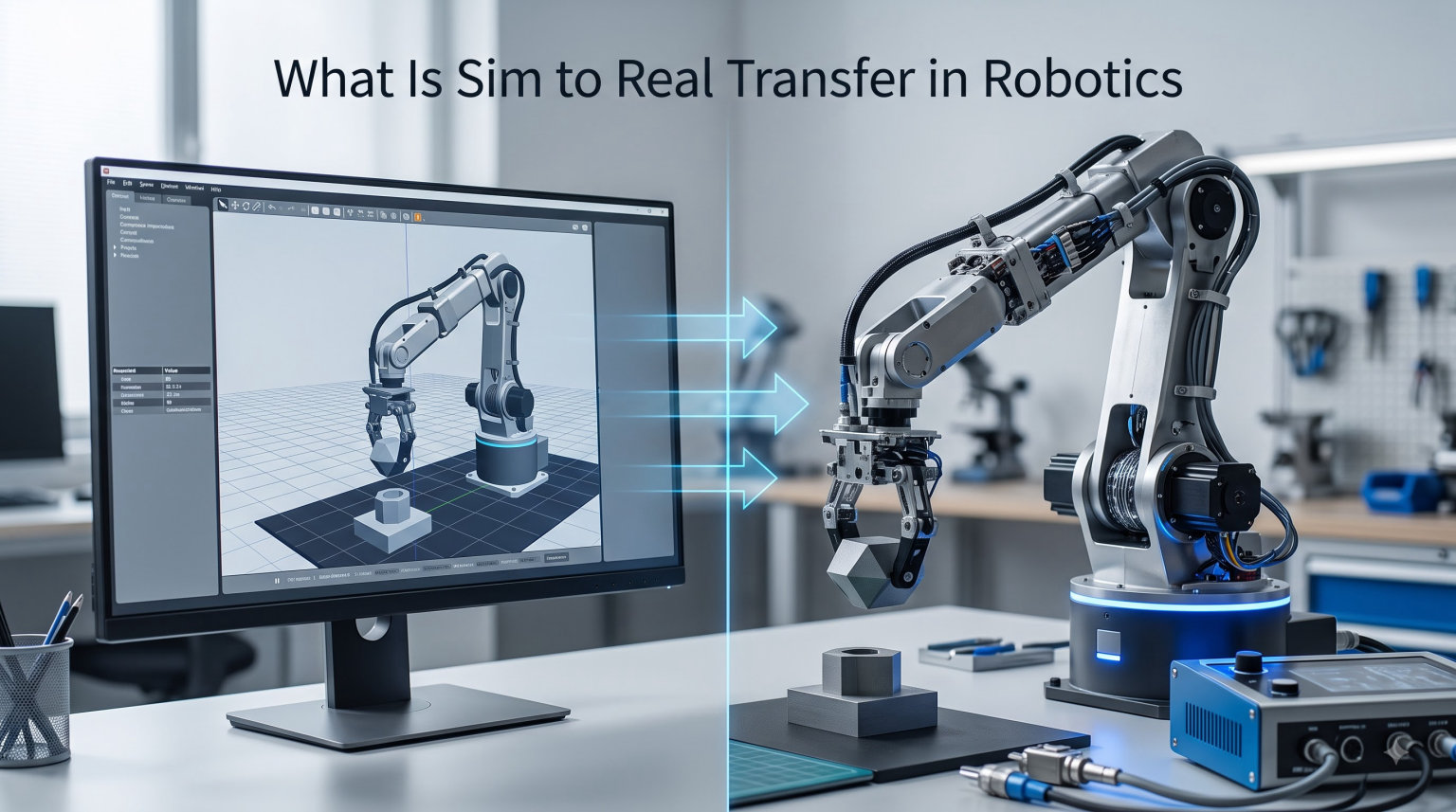
Sim to real transfer in robotics is the process of training a robot’s control policy inside a physics simulator and then deploying that same policy to a physical real-world robot, ideally without any retraining. I have spent years watching this field mature from a research curiosity into a production-ready workflow, and in 2026 it underpins everything from warehouse picking arms to quadruped robots trekking across rough terrain. If you have ever wondered how engineers teach a robot a new skill without risking a million-dollar machine, this guide will walk you through the entire concept, the techniques that make it work, and the pitfalls that still trip up experienced teams.
Table of Contents
What Is Sim to Real Transfer in Robotics
Sim to real transfer is the practice of training a robot’s neural network policy in a virtual physics environment, then running that same trained policy on a real robot. The simulator runs thousands of trials per second, letting a deep reinforcement learning agent fail safely, iterate quickly, and discover behaviors that would take months to learn on physical hardware.
The core idea is simple: instead of teaching a robot in the real world where each trial costs time, energy, and risk of damage, you teach it in software where every failure is free. Once the policy converges, you transfer it to the physical robot. The catch is that simulators are imperfect models of reality, so the policy often fails when it meets the real world for the first time. Bridging that gap is the central challenge of the field.
This concept sits at the intersection of deep reinforcement learning, physics simulation, and classical robotics. Researchers often refer to it using shorthand like sim2real, sim-to-real, or policy transfer. All three terms describe the same pipeline: train in simulation, deploy in the real world.
The 2020 survey by Zhao and colleagues at the Norwegian University of Science and Technology, which has now passed 1,700 citations, defines sim-to-real transfer as the set of techniques that allow a control policy learned in simulation to generalize to real-world robots. That definition still holds in 2026, though the toolbox has expanded considerably since then.
Why Sim to Real Transfer Matters for Robot Learning
Training a robot in the real world is brutally slow. A single physical trial of a manipulation task can take 30 seconds. A locomotion policy might need 10 million trials to master a single gait. At one trial every 30 seconds, that is 9.5 years of nonstop robot work, not counting hardware replacements when something breaks.
Simulation compresses that timeline dramatically. Modern GPU-accelerated simulators like NVIDIA Isaac Lab, MuJoCo, and Genesis can run hundreds or thousands of steps in parallel per real-world second. A policy that needs 10 million trials can converge overnight on a workstation with a few GPUs, and a cloud cluster can finish in minutes.
Beyond speed, there are three other reasons this approach dominates modern robotics research and development.
Safety. Early-stage reinforcement learning policies explore aggressively, producing jerky motions that can break actuators, pinch fingers, or destabilize a humanoid. Training in simulation keeps the dangerous exploration phase off the factory floor.
Cost. A single industrial robot arm costs more than many research budgets. Physical trials also wear out grippers, bend cables, and burn electricity. Simulation costs only GPU time.
Reset speed. In the real world, every failed trial requires a human or scripted system to put objects back where they belong. In simulation, reset is instantaneous, which means a policy can attempt a million pick-and-place cycles without a single human in the loop.
For companies scaling robot learning, the math is straightforward. Training a manipulation policy in the real world can cost hundreds of thousands of dollars in hardware and technician time. The same policy trained in simulation might cost a few hundred dollars of compute. That 1000x cost reduction is why nearly every serious robotics lab uses sim to real transfer as its default training workflow in 2026.
The Sim to Real Gap: Why Transfer Is Hard
The sim-to-real gap, sometimes called the reality gap, is the performance drop that happens when a policy trained in simulation meets a real robot. If simulators were perfect, the gap would be zero and transfer would be trivial. In practice, simulators are always simplified models of the world, and the differences between model and reality are exactly what breaks trained policies.
Several sources contribute to the reality gap. Understanding each one is the first step toward closing it.
Physics modeling errors. Simulators approximate contact dynamics, friction, and deformable materials. Real rubber grippers deform in ways that no rigid-body simulator captures exactly. Real floors have subtle bumps that no mesh model represents perfectly.
Sensor noise and latency. A simulated camera returns clean RGB images at perfect frame rates. A real camera has rolling shutter, motion blur, exposure variation, and 30 to 100 milliseconds of latency. A policy that depends on crisp, perfectly timed observations can fail the moment real noise enters the loop.
Actuator dynamics. Real motors have backlash, stiction, current limits, and temperature-dependent behavior. Simulated joints move with infinite precision on demand. Policies that learn to exploit unrealistic actuator responses fail when real motors cannot keep up.
Mass and inertia mismatch. The mass of a grasped object, the friction of a joint, and the inertia of a link are all continuous physical parameters that the simulator must estimate. Small errors compound over time, and policies that exploit a precise value for, say, a payload mass will fail when the real payload is 5 percent heavier.
On robotics Stack Exchange and the r/reinforcementlearning subreddit, the most common pain point users report is that zero-shot transfer fails on the first try. Almost no policy trained in simulation works perfectly on the first real-world deployment. The expectation of multiple iterations is the norm, not the exception. Graduate students in the field routinely report spending months tuning domain randomization parameters before getting reliable transfer.
Key Methods for Sim to Real Transfer
Over the last decade, the robotics community has developed a toolbox of techniques for closing the sim-to-real gap. No single method works for every task, and most successful projects combine two or three of them. Here are the core approaches you will encounter.
Domain Randomization
Domain randomization is the most validated and widely used technique in 2026. Instead of training on a single perfectly modeled environment, you randomize the simulator’s physical and visual parameters across a wide range. The policy sees thousands of slightly different worlds during training, so it cannot overfit to any specific simulator quirk. When it meets the real world, the real world looks like just another variation.
Typical randomization covers object masses, friction coefficients, joint damping, lighting conditions, camera position, and texture colors. The 2018 paper from OpenAI on dynamics randomization for robotic manipulation showed that randomizing physical parameters alone could transfer a Rubik’s cube solving policy to a real robot hand with no real-world training data at all.
System Identification
System identification takes the opposite approach. Instead of randomizing everything, you measure the real robot’s properties carefully and tune the simulator to match. You record joint friction curves, motor response times, camera intrinsics, and object weights, then build a digital twin that mirrors reality as closely as possible.
System identification is more time-consuming than randomization, but it produces higher-fidelity simulators. It works best when the robot and its environment are well-defined and stable, like a fixed manufacturing cell.
Domain Adaptation
Domain adaptation techniques try to make the simulator and the real world look alike to the policy, usually by learning a translation between simulated and real observations. GAN-based image translation, where a neural network converts synthetic images into realistic ones, was a hot research direction around 2018 to 2020. Modern approaches often use contrastive learning to align feature spaces instead.
Meta-Learning and Adaptive Methods
Meta-learning trains a policy that can adapt quickly to a new environment with only a few real-world trials. The policy is optimized not for a single environment but for an entire distribution of environments. In deployment, the robot collects a small amount of real-world data and fine-tunes itself on the fly.
Residual learning is a related technique where a simple classical controller handles the easy parts of a task and a neural network only learns the residual error. The base controller grounds the policy in known-good behavior, which makes transfer more reliable.
For practical projects in 2026, the most common combination is heavy domain randomization plus a small amount of real-world fine-tuning at the end. That hybrid approach gives the safety of randomization and the precision of real data.
Domain Randomization in Depth
Because domain randomization is the workhorse of the field, it is worth understanding how practitioners actually use it. The key insight from years of community experience is that you should randomize more, not less, and expect to tune the ranges for months.
A typical domain randomization configuration for a manipulation task randomizes the following parameters during training. Object mass is varied by plus or minus 20 percent. Friction coefficients are sampled uniformly between 0.3 and 1.5. Joint damping is randomized across a 2x range. Lighting brightness and color temperature are perturbed. Camera position is jittered by several millimeters. Background textures are replaced with random images from a large dataset.
The intuition is that if the policy can succeed across all of these variations, it has learned a robust strategy that does not depend on any single precise value. When deployed on the real robot, the real parameters fall somewhere inside the training distribution, so the policy is prepared for them.
The downside is that excessive randomization hurts sample efficiency. A policy that needs to handle a 5x mass range may converge much more slowly than one trained on a narrow 1.2x range. Practitioners often start with conservative randomization and gradually widen the ranges as the policy improves.
One common mistake beginners make is randomizing visual parameters without randomizing physical parameters, or vice versa. A 2024 study from the Robotics and Automation Letters journal found that policies trained with only visual randomization showed only a 5 percent improvement in transfer success, while policies trained with both visual and dynamics randomization showed a 40 percent improvement. For manipulation tasks especially, dynamics randomization matters more than visual randomization.
Real-World Applications of Sim to Real Transfer
Sim to real transfer is no longer a research curiosity. It powers production systems across the robotics industry in 2026. Here are the most prominent application areas.
Robotic manipulation. Picking, placing, and assembling objects is the canonical application. Amazon’s warehouse robots, Berkshire Grey’s sorting systems, and countless academic manipulation projects all use simulation to train grasping and insertion policies before real-world deployment. The dexterity required for tasks like cable insertion or bin picking is far easier to learn in simulation than on a real production line.
Quadruped and bipedal locomotion. Walking robots are notoriously hard to control, and a single fall can break expensive hardware. The famous 2020 paper Learning Agile Locomotion for Quadruped Robots from ETH Zurich showed that policies trained in simulation could transfer directly to real ANYmal robots. Open-source bipedal robots in 2026, trained with NVIDIA Isaac Lab, are now achieving reliable sim-to-real transfer for the first time outside of well-funded labs.
Autonomous driving. Self-driving stacks use simulation to train perception and planning policies. Waymo, Cruise, and Tesla all operate large-scale driving simulators that generate billions of synthetic miles. While the full self-driving problem is far from solved, the perception components that run inside the cars are routinely trained with sim-to-real techniques.
Aerial robotics. Drone racing and acrobatic flight demand precise, low-latency control. Policies trained in simulation can fly drones through gaps and perform flips that would be extremely dangerous to learn by trial and error in the real world.
Soft robotics. Soft robots have highly complex contact dynamics that are hard to model analytically. Simulation is often the only tractable way to train them, and recent progress in differentiable physics simulators has made sim-to-real transfer for soft robots significantly more reliable.
Step-by-Step Sim to Real Transfer Pipeline
Most of the public content on sim to real transfer focuses on theory and skips the practical pipeline. Based on my own projects and community reports, here is the workflow that actually works in 2026.
Step 1: Choose a simulator. For most projects, the choice is between NVIDIA Isaac Lab (best for GPU parallelism and photorealism), MuJoCo (best for accurate contact dynamics), and Genesis (newer, with strong differentiable physics). PyBullet is a good starting point for learning because it is lightweight and free.
Step 2: Build a digital twin. Import your robot’s URDF or MJCF model. Calibrate mass, inertia, and joint limits against the manufacturer’s spec sheet. Add sensors: cameras, force-torque sensors, proprioception.
Step 3: Define the task. Write down the observation space (what the policy sees), the action space (what the policy can control), and the reward function (how the policy is scored). Reward shaping is the most important and most error-prone part of the pipeline. A poorly designed reward can lead to policies that game the metric without actually completing the task.
Step 4: Configure domain randomization. Start with conservative ranges and tune over weeks or months. Randomize physics first, visual second. Track training performance to ensure the policy still learns despite the noise.
Step 5: Train the policy. Use a modern deep RL algorithm like PPO, SAC, or TD3. For manipulation, asymmetric actor-critic methods that give the critic more information than the actor often converge faster. Expect training to take from a few hours to a few days on a multi-GPU setup.
Step 6: Validate in simulation. Test the policy on held-out simulator configurations that are different from the training distribution. If it fails here, it will fail in the real world.
Step 7: Deploy to the real robot. Expect the first attempt to fail. Use it to identify what the simulator is missing, then either tune the simulator or widen the randomization ranges.
Step 8: Iterate. Real-world data is precious. Collect every trial, label the failures, and use them to refine the simulator or fine-tune the policy. Most successful projects go through five to ten cycles of this loop before achieving reliable transfer.
Common Challenges and How to Solve Them
Even with the best tools, sim to real transfer is full of failure modes. Here are the ones I see most often, and the fixes that actually work.
Challenge 1: Policy works in sim, fails immediately on real robot. The most common cause is unmodeled actuator dynamics. Real motors have current limits and thermal throttling that simulators ignore. Solution: randomize actuator strength by plus or minus 30 percent during training and add latency to the action loop.
Challenge 2: Policy succeeds in 80 percent of trials in sim, only 20 percent in real world. The training distribution was too narrow. The real world is hitting a corner case the policy never saw. Solution: widen domain randomization ranges, especially for friction and object mass, and add noise to the observations.
Challenge 3: Policy is jittery on the real robot. The action space is too high-frequency for the real control loop. Solution: lower the policy’s control rate to 10 to 20 Hz, or smooth the actions with a low-pass filter.
Challenge 4: Reward hacking. The policy finds a way to maximize reward without completing the task, like flipping the object over and exploiting a sensor quirk. Solution: redesign the reward to be sparse and based on the actual end goal, or use multiple complementary reward terms that are harder to game simultaneously.
Challenge 5: Sample inefficiency. The policy takes weeks to converge. Solution: use curriculum learning, where the task difficulty increases gradually, or warm-start the policy from a behavior-cloned demo instead of training from scratch.
The honest reality is that sim to real transfer is still as much art as science in 2026. Even teams with the best tools and the most experience expect multiple iterations before getting reliable performance. Treat the first real-world deployment as a data-gathering exercise, not a final test.
Frequently Asked Questions
What is sim-to-real transfer in robotics?
Sim-to-real transfer is the process of training a robot’s control policy in a simulated physics environment and then deploying that same trained policy to a physical real-world robot, usually without retraining. It uses techniques like domain randomization to bridge small differences between simulator and reality.
What is sim-to-real reinforcement learning?
Sim-to-real reinforcement learning is the application of deep RL algorithms in physics simulation to learn robot control policies that can be transferred to real hardware. It is the most common context in which sim-to-real transfer is used, because RL typically requires millions of trials that are only practical in simulation.
What is real to sim transfer?
Real to sim transfer is the reverse direction: collecting data from a real robot and using it to build or improve a simulator. It is often used in system identification, where real-world measurements inform the parameters of a digital twin so that future sim-to-real training is more accurate.
Why is sim-to-real transfer hard?
Sim-to-real transfer is hard because simulators are imperfect models of reality. Differences in physics, sensor noise, actuator dynamics, and object properties all create a reality gap that can cause a policy trained in simulation to fail on the real robot. Techniques like domain randomization, system identification, and real-world fine-tuning exist specifically to close that gap.
Final Thoughts on Sim to Real Transfer in 2026
Sim to real transfer has moved from research labs into production robotics, and in 2026 it is the default workflow for any team training a robot with deep reinforcement learning. The key takeaways are simple: train in simulation for speed, safety, and cost; expect multiple real-world iterations; lean heavily on domain randomization; and treat the first deployment as a learning opportunity rather than a final test. The sim to real gap is real, but it is closing every year, and the tools available today are the best the field has ever had.