
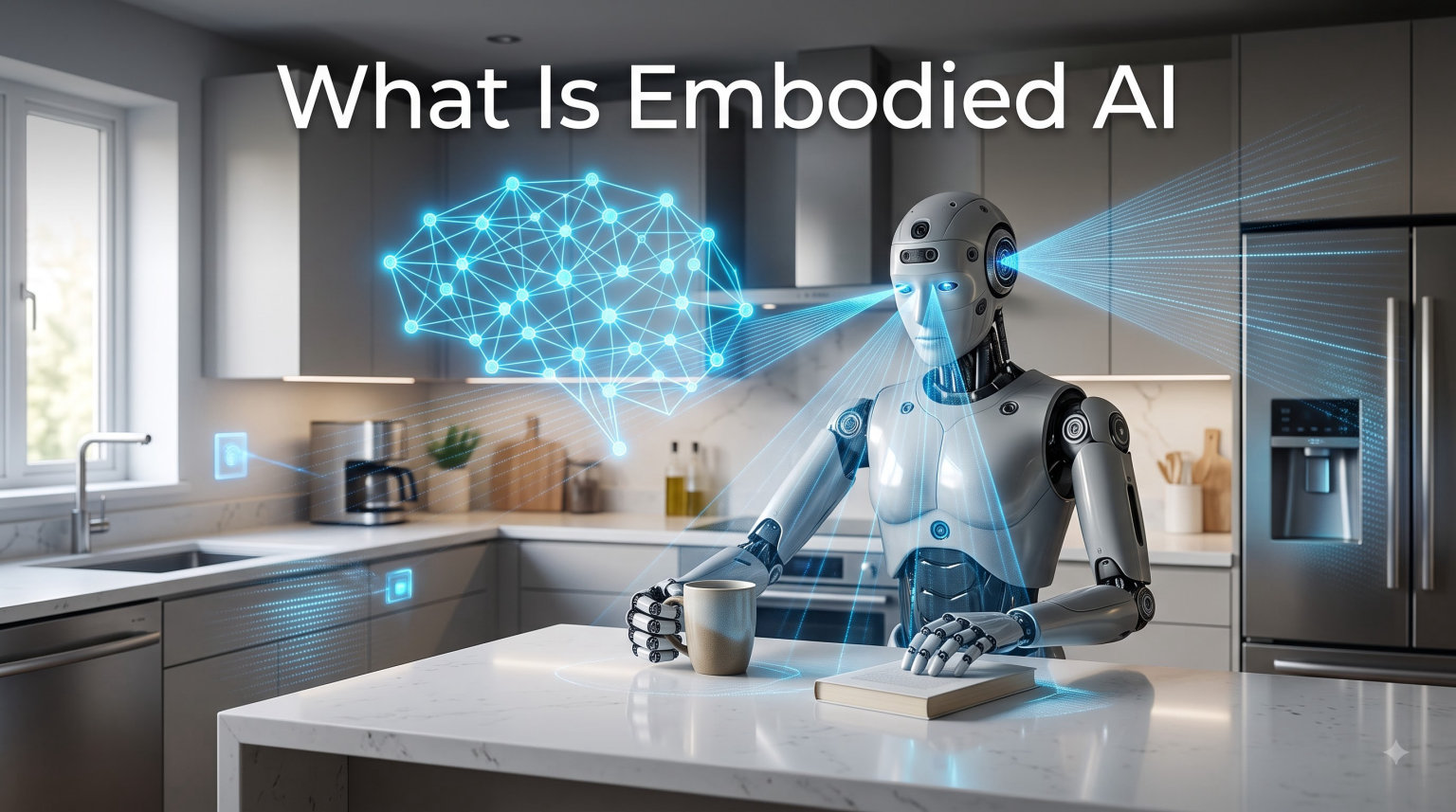
If you have been reading about humanoid robots, self-driving cars, or warehouse automation, you have run into the term embodied AI. But what is embodied AI, really, and why does it matter? In this guide, I will break down the idea in plain language, show you how it works under the hood, and walk through the examples our team has been tracking across robotics labs and production deployments.
Embodied AI is the branch of artificial intelligence that gives a machine a body, sensors, and the ability to act in the real world. Instead of only reading text or analyzing images on a screen, an embodied AI system can walk, grip, steer, and react to what is in front of it. Think of a robot vacuum that learns your floor plan, a self-driving car that brakes for a child chasing a ball, or a humanoid worker on an assembly line. Each of these is an embodied AI agent.
I have spent the past few years following this field, and the pace has jumped sharply. Foundation models, cheaper sensors, and better simulation tools are pushing embodied AI out of research labs and into warehouses, hospitals, and city streets. By 2026, the technology is no longer a science project. It is a business decision. Let me explain why.
Table of Contents
What Is Embodied AI: A Clear Definition
Embodied AI is artificial intelligence that is integrated into a physical body, such as a robot arm, a humanoid, a drone, or a self-driving car, so it can perceive, reason, and act in the real world. The body is not a side accessory. It is a core part of how the AI learns. By moving, touching, and bumping into things, the system builds a kind of physical intuition that pure software cannot.
To put it in simple terms, embodied means the AI has a body that lives in and reacts to the world around it. A chatbot does not have a body. A robot dog that can dodge your vacuum cleaner does. The body and the brain work together, and that combination is what researchers mean by embodied.
You will often see this called Physical AI, especially by companies like NVIDIA. The two terms overlap heavily, but there is a subtle difference worth knowing. Physical AI tends to describe the broader stack of compute, simulation, and models that make physical systems intelligent. Embodied AI focuses more on the agent itself and how the body shapes learning. I will come back to this comparison in a moment.
The Embodiment Hypothesis
Why does having a body matter? The embodiment hypothesis is the idea that intelligence cannot be separated from the physical experience of the world. In other words, a brain only becomes truly smart when it has hands, feet, eyes, and feedback from real contact.
This idea has roots in philosophy. Maurice Merleau-Ponty argued in the 1940s that our perception of the world is shaped by our bodies, not just by our minds. Cognitive scientists Linda Smith and Michael Gazzaniga later brought similar ideas into psychology. In robotics, Rodney Brooks pushed this view forward in the 1980s and 1990s with robots like Genghis and Cog, arguing that intelligence should be built from the ground up, starting with how a machine moves and senses.
Modern researchers point to practical evidence. Robots that learn by trial and error, the same way a toddler learns to stack blocks, often outperform robots that only learn from pre-labeled data. The body acts as a teacher.
Embodied Agents Explained
An embodied agent is the full package: sensors, actuators, a controller, and the AI models that tie them together. Sensors might include cameras, LiDAR, depth sensors, microphones, and force sensors in the joints. Actuators are the motors that turn wheels, move arms, or open grippers. The controller runs the AI models that turn sensor data into motion commands in real time.
Here is a simple example. A humanoid robot walking through a kitchen has cameras in its head watching for obstacles, pressure sensors in its feet measuring weight distribution, and motors in its knees and ankles adjusting every few milliseconds. The AI running on its onboard computer is the embodied agent. The metal and wires are the body. Together, they are embodied AI.
How Embodied AI Works: The Perception-Reasoning-Action Loop
Most embodied AI systems follow a three-step cycle: perceive the world, reason about what to do, and act on that decision. Then they learn from the result and start the loop again. This happens many times per second.
- Perception: Cameras, LiDAR, and other sensors collect data about the environment. AI models turn that raw data into objects, distances, and events the system can understand.
- Reasoning: A planning model decides what to do next. Should the robot step over a cable, reach for a cup, or stop because a person is in the way? This step often uses foundation models and world models.
- Action: Motors, wheels, and grippers carry out the plan. Feedback from sensors confirms whether the action worked, which feeds the next round of learning.
This loop is why embodied AI is different from a language model on a server. A chatbot only processes inputs and outputs. An embodied AI system has to handle the messiness of physics, including slip, friction, light glare, and delayed responses. Our team has seen robots that look great in demos fail the moment a floor surface changes or a stranger walks in front of them.
Vision-Language-Action Models (VLAs)
The most exciting shift in 2026 is the rise of Vision-Language-Action models, or VLAs. A VLA is a single neural network that can look at a scene, understand a command in plain English, and produce a motor command. Think of it as the same kind of foundation model approach behind ChatGPT, but wired to a robot’s body.
Google DeepMind’s RT-2 and Physical Intelligence’s Pi0 are early examples. You can tell a robot, “pick up the red mug and put it in the sink,” and the VLA figures out which object is the red mug, where the sink is, and how to move the arm to get there. Traditional robots needed hand-coded rules for each step. VLAs can generalize across tasks they have never seen before.
For non-technical readers, here is the plain version: VLAs let a robot use the same kind of flexible understanding that lets a person follow a new instruction in a new kitchen. They are a big reason why embodied AI is moving so fast right now.
How Embodied AI Learns
There are three common training methods. First, reinforcement learning, where the robot tries an action, gets a reward if it works, and improves over millions of trials. Second, imitation learning, where a human teleoperates the robot and the system copies the behavior. Third, simulation training, where the robot practices inside a virtual world before being deployed in the real one.
Simulation is the workhorse. It is faster, cheaper, and safer than training on a real robot. The catch is the sim-to-real gap, which I will cover in the challenges section. Modern pipelines train in simulation, then fine-tune on real-world data to close that gap.
Embodied AI vs Physical AI vs Traditional Robotics
These terms get used interchangeably, but they are not the same. Here is a quick comparison.
- Traditional robotics: Robots that follow fixed, pre-programmed rules. They repeat the same motion over and over with no learning. Classic factory arms fall here.
- Embodied AI: AI that lives inside a physical body and learns from real-world interaction. The body shapes the intelligence.
- Physical AI: A broader term from NVIDIA and others that covers the full stack, including simulation platforms, GPUs, and the foundation models that make physical systems intelligent.
Think of it this way. Traditional robotics is a vending machine. Embodied AI is a toddler. Physical AI is the whole science of building smart, connected machines, of which embodied AI is one branch.
Real-World Examples of Embodied AI
This is where the theory gets exciting. I have been tracking the deployments that actually run in the real world, and there are more than you might think.
Humanoid Robots
Figure AI’s Figure 01 and 02 robots have been working in BMW assembly plants, moving parts and learning new tasks. Tesla’s Optimus is being tested in its own factories. Agility Robotics’ Digit is already moving totes in warehouses. These are not science demos. They are paid pilots doing real work, even if the pace is slow.
Our team watched Digit at a logistics demo in 2026. It walked carefully, picked up a bin, and handed it to a conveyor. The motion was slow and deliberate, but it was autonomous. No human was driving it with a joystick.
Autonomous Vehicles
Waymo and Cruise robotaxis are the largest deployment of embodied AI by miles driven. Each vehicle is an embodied agent with cameras, radar, LiDAR, and driving models that make thousands of decisions per second. The “body” is the car, and the “brain” is the driving stack.
Tesla’s Autopilot and FSD are another flavor. They rely more on vision than LiDAR, but the same logic applies: sense, reason, act, learn. By 2026, Waymo alone has logged tens of millions of autonomous miles.
Warehouse and Logistics Robots
Amazon’s Kiva robots, now called Proteus, move shelves around fulfillment centers. They navigate by reading QR codes on the floor and using depth sensors. They do not look like humanoid robots, but they are embodied agents. They have wheels, sensors, and onboard AI. They learn the layout of a warehouse over time and optimize their routes.
Symbotic and Locus Robotics run similar fleets for Walmart, Target, and other retailers. These are the quiet workhorses of embodied AI in 2026.
Drones
Skydio drones fly themselves through complex environments using onboard vision models. They are used for bridge inspection, search and rescue, and military reconnaissance. A Skydio drone can fly under a bridge, around a pylon, and back without a human pilot, even when GPS is jammed. That is embodied AI in the air.
Service and Healthcare Robots
Moxi by Diligent Robotics delivers meds and supplies in hospitals. Service robots in Japan deliver food trays. Robots in restaurants flip burgers, mix drinks, and bring food to tables. Each one is a small example of embodied AI in a setting where humans once had to do the work.
Applications of Embodied AI by Industry
Embodied AI is showing up in nearly every sector that moves physical things. Here is how the major industries are using it.
Manufacturing and Assembly
Car factories, electronics plants, and metal shops are the first big users. Robots handle welding, painting, and machine tending. Newer humanoid-style robots are being tested for tasks that need more flexibility, like reaching into a bin of mixed parts. BMW, Mercedes, and Tesla have all piloted humanoid robots in 2026.
Logistics and Warehousing
Sorting, picking, packing, and moving goods is the second-largest use case. Amazon, Walmart, and DHL run large fleets of mobile robots that move shelves, boxes, and totes. Embodied AI is what lets a robot handle a cluttered aisle or a shifted pallet without breaking the system.
Healthcare
Surgical robots like the da Vinci system have been around for years, but the latest generation adds more AI-driven autonomy. Delivery robots carry supplies through hospitals so nurses can spend more time with patients. Rehabilitation robots help patients re-learn to walk or move an arm after a stroke.
Agriculture
Autonomous tractors, fruit-picking robots, and weeding robots are starting to appear on real farms. John Deere’s autonomous tractors and See & Spray robots from Blue River use computer vision to tell weeds from crops and act in real time.
Defense and Security
Military forces in the US, UK, China, and Israel are testing embodied AI for reconnaissance, logistics, and search and rescue. The ethics here are complex, but the deployments are real.
Key Challenges Facing Embodied AI
Embodied AI has made real progress, but the field is far from solved. Here are the biggest hurdles our team sees in 2026.
The Sim-to-Real Gap
Robots that train in simulation often fail when they meet the real world. Physics simulators cannot perfectly model friction, light, and material behavior. A robot that learned to grip a smooth block in a virtual world may drop the same block in a real warehouse. Closing this gap is one of the most active research areas in robotics.
Data Scarcity
Large language models were trained on most of the public internet. Embodied AI has no equivalent. Real-world robot data is expensive to collect. You have to physically run a robot through a task, often with a human teleoperating it. Companies like Tesla, Physical Intelligence, and Encord are building tools to collect and label embodied data at scale.
Movement Speed and Efficiency
This pain point came up in the embodied AI community on Reddit. Current humanoid robots move slowly compared to humans. Top walking speed for most humanoids is around 1 to 1.5 meters per second, while a person walks at 1.4 meters per second. Running is much further off. Some forum users argue that humanoid form is the wrong approach and that fleets of simple wheeled robots or swarms would be more efficient for most tasks.
Cost
A humanoid robot like Optimus or Figure 02 is still expensive. Sensors, actuators, and onboard compute add up. Until unit costs drop, embodied AI will be limited to high-value use cases like warehousing, manufacturing, and defense. Mass deployment will likely take a few more years.
Safety and Regulation
A 70-kilogram humanoid working next to humans raises real safety questions. So do self-driving cars on public roads. Governments are still catching up. The EU AI Act, US state-level rules, and new ISO standards are starting to define what safe embodied AI looks like, but the policy is still evolving.
Reliability
Embodied AI systems fail in ways that text-based AI does not. A wrong prediction from a chatbot is a bad sentence. A wrong prediction from a humanoid is a dropped box or a fall. The bar for reliability is much higher in the physical world, and most current systems do not meet it for full autonomy yet.
The History of Embodied AI: From Shakey to Foundation Models
The field is older than most people think. The first major embodied AI was Shakey the Robot, built at SRI in the late 1960s. Shakey could navigate a room, plan a path, and push blocks. It was painfully slow by modern standards, but it proved that a physical machine could reason about its environment.
In the 1980s, Rodney Brooks pushed back on the slow, deliberate approach. His robots, like Genghis and Attila, were simple six-legged walkers that reacted to the world instead of planning everything in advance. His subsumption architecture argued that intelligence should emerge from layers of simple behaviors, not from a central planner.
The 2010s brought deep learning and reinforcement learning, and the 2020s brought foundation models. By 2026, we have VLAs, world models, and large-scale simulation platforms. The field has gone from Shakey pushing blocks to humanoids working on assembly lines, mostly in 60 years.
What Is Embodied AI Going to Look Like Next?
Three trends are worth watching in 2026. First, more capable foundation models trained on internet-scale data plus robot data. Second, cheaper sensors and actuators, especially new event cameras and tendon-driven hands. Third, better simulation platforms, with NVIDIA Isaac Lab and Google DeepMind’s MuJoCo leading the way.
I expect the next wave to focus less on flashy demos and more on reliability. A humanoid that works 95 percent of the time is a research project. A humanoid that works 99.9 percent of the time is a product. That gap is where embodied AI will either succeed or stall in the next few years.
If you are an engineer, the field is hiring fast. If you are a business leader, the time to start piloting embodied AI in your operation is now. The early adopters will be the ones who figure out where these systems earn their keep, and where they are still toys.
Frequently Asked Questions
What is embodied AI in simple terms?
Embodied AI is artificial intelligence that lives inside a physical body, like a robot, a car, or a drone, and can sense, move, and react to the real world. Instead of only reading data on a screen, it learns by touching, walking, and bumping into things.
How is embodied AI different from regular AI?
Regular AI usually processes text, images, or numbers on a computer. Embodied AI also has a body with sensors and motors, so it can act on the physical world. The body is part of how it learns, not just an accessory.
What are examples of embodied AI?
Self-driving cars, humanoid robots like Figure and Optimus, warehouse robots like Amazon Proteus, drones like Skydio, and surgical robots in hospitals are all examples of embodied AI.
Why is embodiment important for AI?
Embodiment lets AI learn the way humans and animals do, through real-world feedback. A robot that tries a task and fails can adjust, which often produces more flexible and capable behavior than training on pre-labeled data alone.
What is a VLA model?
A VLA, or Vision-Language-Action model, is a neural network that can look at a scene, understand a natural-language command, and output a motor action. It is the same foundation model idea behind chatbots, but wired to a robot’s body.
What is the sim-to-real gap?
The sim-to-real gap is the difference between how a robot performs in a simulator and how it performs in the real world. Physics simulators cannot perfectly model friction, light, and material behavior, so a robot that works in simulation may fail on a real factory floor.
What is the difference between embodied AI and Physical AI?
Physical AI is a broader term that covers the full stack of simulation, compute, and models used to make physical systems intelligent. Embodied AI focuses on the agent itself and how the body shapes learning. They overlap heavily, and many companies use them as synonyms.
What challenges does embodied AI face in 2026?
The main challenges in 2026 are the sim-to-real gap, scarce training data, slow movement speeds, high hardware costs, and unresolved safety and regulation questions. Reliability in messy real-world settings is still the biggest barrier to mass deployment.
Final Thoughts on What Is Embodied AI
So, what is embodied AI? It is the branch of artificial intelligence that puts a brain inside a body, so machines can learn by interacting with the real world. The body is not decoration. It is the teacher. And in 2026, that idea is no longer academic. It is reshaping how we build, ship, drive, heal, and farm.
If you want to go deeper, the NVIDIA glossary and Encord’s blog are solid starting points. Watch the field for VLA models, humanoid pilots in real factories, and the first regulation frameworks. The next few years will tell us whether embodied AI becomes everyday infrastructure or stays stuck in pilot mode.