
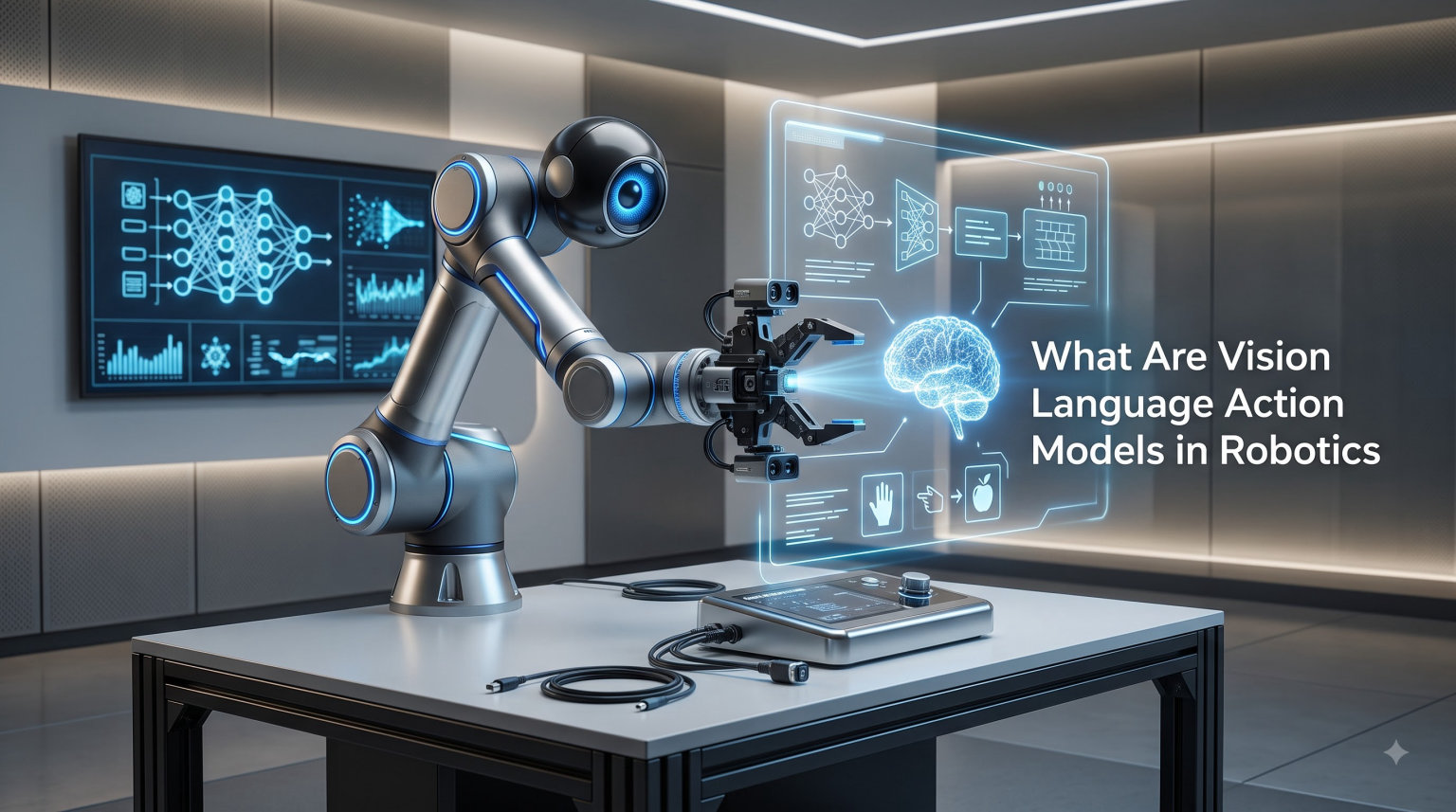
Vision Language Action Models in Robotics are the multimodal AI systems turning today’s robots from scripted machines into general-purpose helpers. A VLA takes camera images and a plain-English instruction like “pick up the blue mug” and directly outputs the motor commands to make it happen. In this guide, I’ll walk you through exactly what a VLA is, how it works under the hood, how it compares to a VLM or a classical robot stack, and which models you should know about in 2026.
I’ve been following this space closely since the first RT-2 demos dropped, and the pace of progress in just the last 18 months has been wild. I’ll share the practical takeaways our team has picked up from reading the papers, running open-source checkpoints, and talking to researchers on forums like r/robotics. By the end, you’ll know what a VLA can and cannot do today, and where the field is heading next.
Table of Contents
Vision Language Action Models in Robotics: A Clear Definition
A Vision Language Action (VLA) model is a single neural network that ingests visual observations and natural language instructions and produces robot actions as output. It is a class of multimodal foundation model designed for embodied AI, meaning the model lives inside a physical or simulated robot and controls it directly. VLAs combine three capabilities that were historically separate: visual perception, language understanding, and action generation.
At a high level, a VLA model does four things in one forward pass:
- Encodes camera images and other sensor data into a compact representation of the scene.
- Reads a natural language command and reasons about the goal.
- Plans a sequence of low-level robot actions to accomplish that goal.
- Outputs those actions, usually as joint velocities, end-effector deltas, or waypoints.
The result is a robot that can be told what to do in plain English and figure out the how on its own. This is the core promise of Vision Language Action models in robotics: replace hand-engineered behavior trees with a learned policy that generalizes across tasks, objects, and even robot embodiments.
How VLA Models Work: The Three-Part Architecture
Most VLA models follow a three-stage architecture, even when the underlying model is one giant neural network. Understanding these three pieces makes the rest of the topic click.
1. The Vision Encoder
The vision encoder is a pretrained model, often a Vision Transformer (ViT) or a SigLIP-style contrastive vision encoder, that turns each camera frame into a set of image tokens. These tokens describe what’s in the scene: the mug, the table, the user’s hand, the lighting. The encoder is usually frozen or lightly fine-tuned so the model inherits internet-scale visual knowledge.
2. The Language Backbone
Next, the language backbone, typically a 7B to 72B parameter LLM adapted from a model like Llama, PaLM, or Qwen, fuses the image tokens with the tokenized instruction. This is where the model grounds the phrase “the blue mug on the left” in the actual pixels it sees. The language model is what gives VLAs their ability to parse novel commands and chain reasoning steps.
3. The Action Head
The action head turns the fused multimodal representation into robot commands. There are three common designs:
- Discrete token actions. The action space is quantized, and the model outputs action tokens the same way it outputs words. RT-2 pioneered this approach.
- Continuous regression. A small MLP head regresses joint or end-effector targets directly. OpenVLA uses this style.
- Diffusion or flow matching heads. The model iteratively denoises an action chunk, which improves smoothness and multi-modal behavior. Pi0 and many 2026 systems use this approach.
End to end, the VLA takes in pixels and words and outputs actions at 1 to 50 Hz, depending on the robot and the model. There is no symbolic planner, no motion library, no hand-coded state machine in the loop. That single fact is what makes VLAs such a big deal for general-purpose robotics.
VLA vs VLM vs Traditional Robot Control
One of the most common questions I see on r/MachineLearning is how a VLA differs from a VLM. The answer is short: a VLA is a VLM plus an action head, trained on robot data.
VLM: Eyes and Ears, No Hands
A Vision Language Model (VLM) like GPT-4V, Gemini 1.5 Pro, or LLaVA takes images and text as input and produces text as output. It can describe a scene, answer questions about it, and even write code. But it cannot move a robot. A VLM is great for high-level reasoning and planning, but it has no concept of joint torques or gripper closures.
VLA: Eyes, Ears, and Hands
A VLA extends a VLM by adding an action head and training the whole stack on robot trajectories. The same model that “understands” the scene can also “act” on it. In practice, that means you can prompt a VLA the same way you’d prompt a VLM, but the output is motor commands instead of paragraphs.
Traditional Robot Control: Rigid but Reliable
Classical robotics stacks split the problem into perception, planning, and control modules. A perception module builds a map, a planner searches for a path, and a controller tracks that path. This works extremely well in structured environments like factory floors but breaks the moment a human moves a chair or the lighting changes. VLAs trade some of that reliability for flexibility in unstructured environments.
Here’s a quick comparison to keep the differences straight:
- Output modality: VLM = text, VLA = actions, traditional = pre-scripted trajectories.
- Generalization: VLM generalizes across text tasks, VLA generalizes across physical tasks, traditional control generalizes only within its tuned parameters.
- Data hunger: VLMs need internet text, VLAs need robot trajectory data, traditional stacks need expert engineering.
- Interpretability: Traditional stacks are the most inspectable, VLAs are largely black boxes.
None of these approaches is strictly better. In production, you’ll often see VLAs paired with classical safety controllers and learned perception modules. The VLA handles the high-level “what should I do” question, and the classical stack enforces joint limits, collision avoidance, and force constraints.
How VLA Models Are Trained
Training a VLA from scratch is a multi-stage process that combines internet-scale pretraining with carefully curated robot data. The recipe matters more than any single architecture choice, and a lot of the magic is in the data.
Stage 1: Pretrain the VLM Backbone
Start with a pretrained VLM that already understands the world through images and text. Models like PaLI-X, PaLM-E, LLaVA, and Qwen-VL are common starting points. This gives the VLA a free head start on language grounding, object recognition, and basic reasoning.
Stage 2: Add Robot Trajectory Data
Next, the model is fine-tuned on robot trajectory datasets where each sample is a (camera image, language instruction, action) triple. The largest public datasets, like Open X-Embodiment, contain more than 2 million trajectories collected across 60+ robot embodiments. This is the step where the VLA actually learns to act.
Stage 3: Embodiment-Specific Fine-Tuning
Finally, practitioners often fine-tune the generalist VLA on their specific robot, be it a Franka arm, a Stretch, or a humanoid. Even a few hundred teleoperated demonstrations can adapt a 7B VLA to a new morphology. This is also where the action head is often retrained from scratch because joint counts and control rates differ across robots.
Simulation plays a big role, too. Policies are bootstrapped in simulation where data is cheap, then transferred to real hardware with domain randomization or real-to-sim-to-real pipelines. Forums on r/robotics regularly discuss sim-to-real as one of the trickier parts of any VLA project, and most teams now use a mix of simulation and real-robot data rather than either alone.
Notable VLA Models Worth Knowing in 2026
There are dozens of VLA models in the wild now, but a handful define the state of the art. Here are the ones I tell every new robotics engineer to learn first.
RT-2 (Google DeepMind)
RT-2 was the first model to convincingly show that a VLM backbone, in this case PaLI-X and PaLM-E, could be turned into a robot policy by treating actions as language tokens. It sparked the entire VLA wave. RT-2 demonstrated impressive zero-shot generalization to novel objects and instructions, including commands it had never seen during robot training.
OpenVLA 7B
OpenVLA is the open-source 7B-parameter VLA that has become the de facto baseline for academic research. It is built on Llama 2 7B and Prismatic’s vision encoder, and the weights are publicly available. Our team has fine-tuned OpenVLA on a custom pick-and-place task and was surprised how well it transferred with just 200 demonstrations.
Gemini Robotics (Google DeepMind)
Gemini Robotics extends the Gemini 2.0 family into the action space. It is a multimodal model that can reason about physics, dialogue, and actions in one stack. Early demos show whole-body control of an ALOHA 2 and dexterous manipulation tasks that previously required specialized policies.
Pi0 and Octo
Pi0 from Physical Intelligence is a flow-matching VLA trained on a very large, very diverse dataset of mobile manipulators. It is one of the best public results for folding laundry and bussing tables. Octo, from UC Berkeley and Stanford, is a smaller open-source model designed as a research baseline. Both are widely cited in 2026.
If you’re picking a starting point today, OpenVLA is the safest bet for research, Pi0 is the strongest generalist for mobile manipulation, and Gemini Robotics is the most aggressive on reasoning. RT-2 is still worth studying for the design ideas even if the weights are no longer state of the art.
Real-World Applications of Vision Language Action Models
VLAs are still early, but they’re already being used in places where classical control struggles. Here are the application areas I’m most excited about in 2026.
Dexterous Manipulation
Tasks like folding a towel, opening a drawer, or plugging in a cable require contact-rich, multi-step reasoning. VLAs are the first models that can learn these tasks end to end from demonstrations, without per-task engineering. Pi0’s laundry-folding demo is the canonical example.
Humanoid Robots
Humanoids like Figure 02, Tesla Optimus, and Unitree H1 need a single policy that controls dozens of degrees of freedom while processing rich visual scenes. VLAs scale to whole-body control far better than modular stacks because they share representations across the entire robot. Expect humanoid demos in 2026 to be dominated by VLA-style policies.
Service and Home Robots
Stretch, Hello Robot, and similar mobile manipulators are being piloted in homes and eldercare facilities. VLAs let a single robot handle dozens of loosely defined tasks like “tidy the kitchen” without exhaustive programming. Field reports suggest reliability is still the main bottleneck, not task diversity.
Industrial Automation
Factories are the last place you’d expect a generalist model to win, but VLAs are surprisingly good at high-mix, low-volume work. A VLA can switch between inspecting, sorting, and kitting parts based on a written work order. Several automotive suppliers have shared pilot results in 2026 showing 30 to 60 percent reduction in changeover time.
Challenges and Limitations of Current VLA Systems
VLAs are powerful, but they’re not magic. Anyone deploying them in production runs into the same handful of issues, and the r/robotics threads are full of honest war stories about them.
Latency and Real-Time Control
A 7B VLA typically runs at 3 to 10 Hz on a single A100 or RTX 4090. That’s fine for slow manipulation but too slow for dynamic tasks like catching a thrown object. Distillation, action chunking, and smaller backbones help, but the latency ceiling is real.
Compute and Hardware Cost
Running a 72B VLA in the cloud is fine for a research demo, but it gets expensive at scale. Edge deployment usually means distilling to a 1B to 3B model, which trades some capability for a much cheaper inference footprint. Hardware is one of the most common forum questions, and the answer in 2026 is “expect at least one high-end GPU per active robot.”
Generalization Gaps
VLAs generalize surprisingly well, but not infinitely. Out-of-distribution objects, unusual lighting, or cluttered scenes can still break them. A common pattern on forums is “the VLA nailed 95 percent of trials, but the 5 percent failures were catastrophic.” Recovery behaviors and classical safety layers fill that gap today.
Data Quality
VLAs are data-hungry, and the best data still comes from expensive human teleoperation. Crowdsourced datasets like Open X-Embodiment are amazing, but they have biases toward certain embodiments and tasks. Building a high-quality, in-house dataset remains one of the biggest costs of any VLA project.
Choosing a VLA Model: A Practical Guide for Teams
If you’re building with VLAs in 2026, here is the framework I walk every new team through. It covers the four decisions that matter most before you write a single line of training code.
Open-Source vs Proprietary
Open-source models like OpenVLA and Octo give you full control, the ability to fine-tune, and no API costs. Proprietary systems like Gemini Robotics offer stronger out-of-the-box reasoning but lock you into a vendor. Most teams start with open-source for the first prototype and consider proprietary only for tasks where the closed model is clearly better.
Embodiment Compatibility
Check whether the model’s action space matches your robot. A VLA trained on 6-DoF end-effector deltas will not directly control a 30-DoF humanoid. You may need to retrain the action head or use a low-level controller that translates end-effector commands into joint targets.
Hardware Requirements
Plan your compute budget before you commit. A 7B VLA needs roughly 16 GB of VRAM at inference, while a 72B model needs 80 GB or more. For edge deployment, look at distilled 1B to 3B variants or consider the new generation of Jetson Thor and Apple silicon accelerators.
Fine-Tuning Plan
Decide in advance how you will collect fine-tuning data. Teleoperation with a VR headset or a leader arm is the gold standard. Budget at least 200 to 1000 demonstrations per task, and budget the engineering time to build a data collection rig if you don’t already have one. Skipping this step is the single most common reason VLA projects stall.
Finally, set up evaluation early. Standard benchmarks like RT-1’s evaluation suite, CALVIN, and Meta-World give you a baseline. Without them, it’s almost impossible to tell whether your fine-tune is helping or hurting.
Frequently Asked Questions
What are vision action language models?
Vision Action Language models, more commonly called Vision-Language-Action (VLA) models, are multimodal AI systems that take camera images and a natural language instruction as input and output robot actions. They unify visual perception, language understanding, and motor control in a single neural network so a robot can be told what to do in plain English and figure out the how on its own.
What is the difference between VLM and VLA models?
A Vision Language Model (VLM) takes images and text and produces text, while a Vision Language Action (VLA) model takes images and text and produces robot actions. A VLA is essentially a VLM with an added action head and extra training on robot trajectory data. The VLM reasons about the world, the VLA also acts on it.
How do vision language action models work?
VLAs work in three stages. A vision encoder turns camera frames into image tokens. A language backbone fuses those tokens with the instruction to ground the request in the scene. An action head then outputs motor commands, either as discrete tokens, continuous regression targets, or denoised chunks from a diffusion model. The whole pipeline runs end to end at 1 to 50 Hz.
How are VLA models trained?
VLA models are trained in three stages. First, the VLM backbone is pretrained on internet-scale image and text data. Second, the model is fine-tuned on large robot trajectory datasets such as Open X-Embodiment that pair camera observations, instructions, and actions. Third, the model is fine-tuned further on the specific robot embodiment it will control, often with only a few hundred teleoperated demonstrations.
What is the best VLA model?
The best VLA model depends on the task. For research and fine-tuning, OpenVLA 7B is the most popular open baseline. For mobile manipulation on dexterous tasks, Pi0 from Physical Intelligence currently leads in published results. For whole-body humanoid control and reasoning, Gemini Robotics is the most aggressive proprietary system. RT-2 and Octo remain important reference points for ideas and reproducibility.
What hardware is needed to run VLA models?
A 7B VLA like OpenVLA needs roughly 16 GB of VRAM at inference, which fits on a single RTX 4090 or A100. A 72B VLA needs 80 GB or more, usually multiple high-end GPUs or a cloud endpoint. For edge deployment on the robot itself, teams typically distill to a 1B to 3B model and run it on Jetson Thor, Apple silicon, or a comparable accelerator.
The Bottom Line on Vision Language Action Models in Robotics
Vision Language Action Models in Robotics are the closest thing the field has to a general-purpose robot brain. They replace brittle, hand-engineered control stacks with a single learned policy that reads pixels, parses language, and outputs actions. In 2026, they are the dominant paradigm in research labs and the fastest-growing one in industry.
If you’re new to the space, my advice is simple. Start by reading the RT-2 paper for the original idea, then fine-tune OpenVLA on a small task of your own. You’ll learn more in a week of hands-on work than in a month of reading surveys. Once you have a working baseline, you’ll know exactly which direction to push next, whether that’s smaller models, more data, or better safety wrappers. The era of general-purpose robots is here, and VLAs are how we get there.