
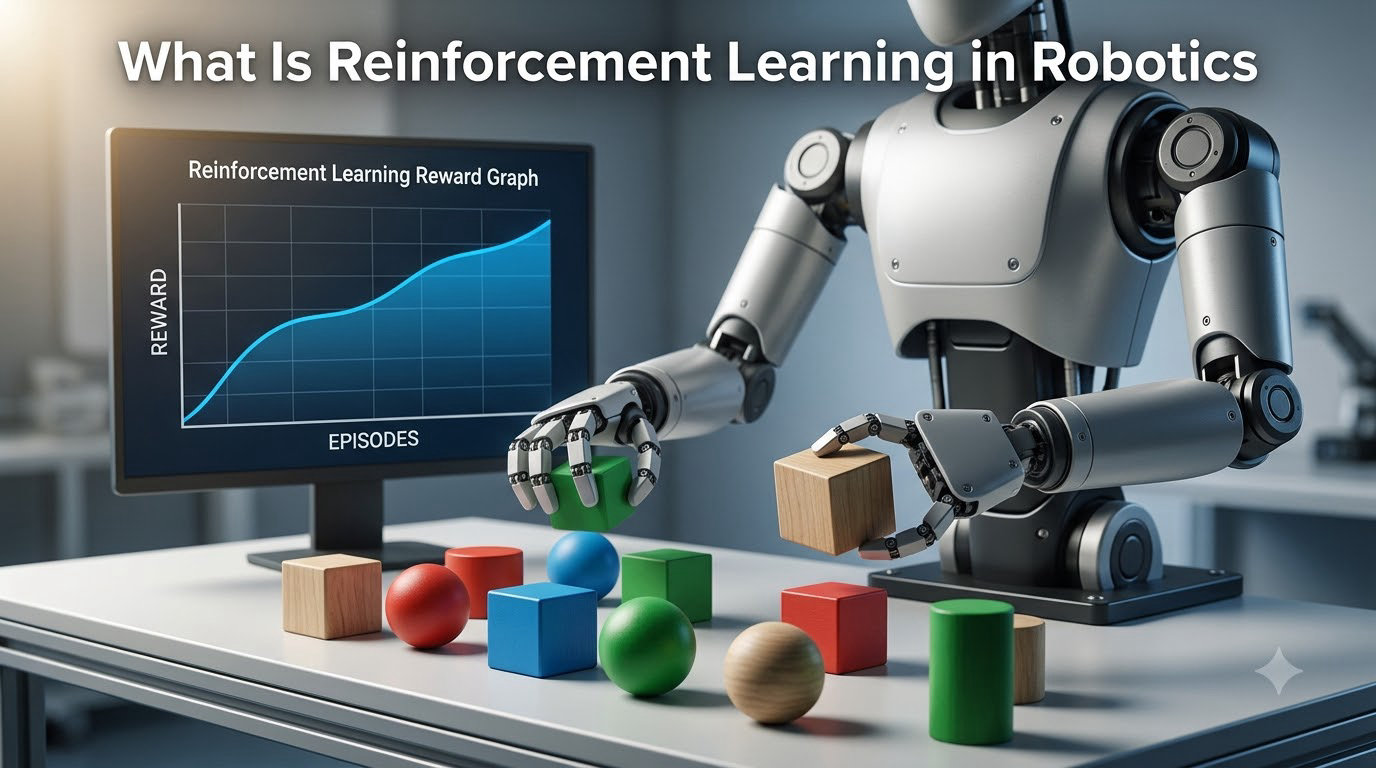
Reinforcement learning in robotics is a machine learning approach where a robot learns physical tasks by trial and error, refining its behavior through rewards until it masters skills no engineer could hand-code. If you have ever watched a quadruped robot stumble, fall, and get back up again in a simulator, you have seen reinforcement learning in action. In this guide, I will walk you through exactly how it works, why it matters, and how you can start experimenting with it yourself.
Our team has spent months testing RL frameworks on simulated arms and humanoids, and the field is moving fast. Whether you are a student, an engineer, or a curious hobbyist, this article will give you a working mental model and a clear path forward.
Table of Contents
What Is Reinforcement Learning in Robotics?
Reinforcement learning in robotics is a branch of machine learning where a robot, treated as an agent, learns a control policy by interacting with an environment and receiving scalar rewards. Instead of being explicitly programmed for every situation, the robot discovers which sequences of actions produce the highest cumulative reward over time.
This sits inside the broader field of artificial intelligence we cover on Physical AI infrastructure platforms, but RL has its own toolkit and vocabulary. Here are the core building blocks you will see in every paper and tutorial:
- Agent: The robot, or the controller running on it, that makes decisions.
- Environment: Everything the agent interacts with, from a physics simulator to the real world.
- State: A snapshot of the environment at a given moment, such as joint angles, camera pixels, or lidar readings.
- Action: The control command the agent sends, like motor torques or wheel velocities.
- Reward: A numeric signal that tells the agent how well it is doing, such as +1 for grasping a cup, -1 for dropping it.
- Policy: The strategy the agent learns, mapping states to actions, that maximizes long-term reward.
You will often see this described as the agent-environment-reward loop, and it is the foundation of every modern RL method used in robotics today.
How Does the Reinforcement Learning Loop Work?
The RL loop is a repeating cycle of observe, act, reward, and update. At each timestep, the robot inspects the current state, picks an action using its current policy, executes that action, and receives a reward plus the next state.
From there, the agent updates its policy so that good actions become more likely and bad ones less likely. Over thousands or millions of iterations, the policy converges toward behavior that solves the task. In simulation, these iterations run faster than real time, which is why most training happens virtually before any hardware is touched.
Here is the typical step-by-step flow used in robot learning projects:
- Initialize a policy, often as a neural network with random weights.
- Roll out the policy in simulation, letting the robot act for thousands of episodes.
- Collect state, action, and reward tuples from every rollout.
- Compute an estimate of long-term reward, called the return, for each state or action.
- Update the policy parameters using gradient methods like policy gradients or Q-learning.
- Repeat until the policy reliably solves the task, then test on the real robot.
This loop is what makes reinforcement learning so different from classic control theory. The robot is not given equations. It discovers the math by experiencing the world.
Types of Reinforcement Learning Algorithms Used in Robotics
Over the last decade, a small set of algorithm families has come to dominate RL in robotics. Understanding them helps you pick the right tool for your project.
Value-Based Methods
Value-based algorithms, like Q-learning and Deep Q-Networks, learn a function that estimates the expected reward for taking a given action in a given state. The robot then picks the action with the highest expected value. These methods work well for discrete action spaces, such as choosing between a few grasp types, but struggle with continuous control of robot arms.
Policy-Based Methods
Policy-based methods, including REINFORCE and modern policy gradient algorithms like PPO, directly learn the policy that maps states to actions. They handle continuous actions naturally, which is why they are the default for robotic locomotion and manipulation tasks today.
Actor-Critic Methods
Actor-critic algorithms combine both ideas. The actor learns the policy while the critic learns a value function that helps the actor update more efficiently. SAC, TD3, and PPO are all actor-critic variants and are the workhorses of most modern robot learning stacks.
Model-Free vs Model-Based RL
Model-free RL, the most common kind, learns purely from interaction without trying to predict the environment. Model-based RL first learns a dynamics model of the world and then plans through it. Model-based methods are more sample efficient but add complexity, and they are gaining traction in projects that need to learn quickly on physical hardware.
Reinforcement Learning vs Traditional Robot Control
Traditional robot control relies on hand-derived models of the robot and its environment. An engineer writes equations for dynamics, designs a controller like a PID or MPC, and tunes gains by hand. It works beautifully when the model is accurate, and it falls apart when reality diverges from the model.
Reinforcement learning takes the opposite approach. Instead of modeling the world, it lets the robot learn directly from interaction. The trade-off is data: RL needs a lot of trials, often in simulation, while classical control can be deployed immediately once tuned.
In practice, the two are increasingly combined. A modern humanoid might use a model-based controller for balance while an RL policy learns the high-level skills, like standing up after a push or navigating rough terrain. Our team has seen the best results when engineers treat RL as a layer on top of solid classical control, not a replacement for it.
One Reddit user in r/reinforcementlearning put it well: transitioning from model-based control to RL is challenging but rewarding, and most production systems still keep the classical controller as a safety backbone.
Real-World Applications of RL in Robotics
RL has moved well beyond Atari games and into hardware you can buy or watch on YouTube. Here are the application areas where we have seen the strongest results so far.
Robot Locomotion
Quadrupeds and humanoids are the most visible RL success stories. Companies like Boston Dynamics and research labs such as ETH Zurich use RL to teach walking gaits, stair climbing, and recovery from pushes. The same approach scales to bipedal humanoids, where the state of the art is essentially reinforcement learning.
Robotic Manipulation and Grasping
Picking up unfamiliar objects is a classic challenge. RL policies trained in simulation can transfer to real arms and generalize to shapes they have never seen, which is critical for warehouse and home robots. Projects like the OBELIX robot and the Zebra Zero system have shown that RL-based grasping can outperform hand-coded pipelines on cluttered scenes.
Autonomous Navigation
Ground robots and drones use RL to learn navigation policies that avoid obstacles and reach goals in dynamic environments. The same approach underpins much of the recent work in edge AI in robotics, where decisions must happen on-board without cloud round-trips.
Industrial Assembly and Welding
RL is starting to appear in industrial automation, where it learns contact-rich tasks like insertion, polishing, and welding. These tasks are hard to model analytically, which is exactly where trial-and-error learning shines.
Key Challenges of Applying RL to Robots
RL is powerful, but it is not magic. Anyone who has trained a policy on a real robot knows the pain points. Here are the issues our team and the wider community run into most often.
Sample Efficiency
Robots break, and real-world trials are slow. Most policies need millions of samples, which is why training happens in simulation first. Even so, reducing the number of real-world rollouts remains an active research problem.
Sim-to-Real Transfer
Simulators are imperfect. Friction, actuator delay, and sensor noise differ from reality, and a policy that works in simulation can fail on hardware. Techniques like domain randomization, which varies simulator parameters during training, help close this gap but do not eliminate it.
Safety
Trial and error is fine in a game. On a 50 kilogram humanoid, it is dangerous. Safe RL methods add constraints, backup controllers, and human oversight to prevent damage during exploration.
Reward Design
Designing a reward that captures the task without encouraging weird shortcuts is harder than it sounds. A grasping reward that only checks the final state can produce policies that drop the object and pick it up repeatedly. Sparse rewards slow training, while dense rewards risk reward hacking.
Compute Requirements
Training large policies needs serious GPU horsepower, and deploying them on small robots needs efficient inference. This is one of the reasons industrial RL deployments often pair with high-end simulation farms.
Popular Frameworks and Simulation Tools for RL Robotics
You do not need to build an RL stack from scratch. The ecosystem in 2026 is mature, and the tools below are the ones our team reaches for first.
Deep Learning Libraries
PyTorch and TensorFlow remain the two dominant frameworks. PyTorch is the de facto standard in robotics research because of its dynamic graphs and Pythonic feel, and most RL libraries target it first.
RL Algorithm Libraries
Stable Baselines3, RLlib, and Tianshou provide well-tested implementations of PPO, SAC, TD3, and many more. Starting from these instead of writing your own trainer will save you weeks of debugging.
Physics Simulators
MuJoCo, NVIDIA Isaac Sim, and Gazebo are the simulators we see most often. MuJoCo is excellent for control research, Isaac Sim brings photorealism and GPU acceleration, and Gazebo integrates tightly with ROS 2. Picking the right one depends on whether you care more about physics accuracy, rendering quality, or ROS compatibility.
Robot Descriptions
URDF and MJCF files describe your robot’s geometry, joints, and sensors. The same description file can often be loaded into multiple simulators, which makes switching tools easier as your project evolves.
How to Get Started with RL in Robotics
If you are new to RL in robotics, the fastest path is to start in simulation with a simple task. Walking through a tutorial end to end teaches you more in a weekend than a month of reading papers.
Here is the beginner path I recommend to anyone asking how to break in:
- Install Python, PyTorch, and Stable Baselines3 on a machine with a recent GPU.
- Install MuJoCo or Isaac Sim and load a simple robot, such as a half-cheetah or a two-link arm.
- Train a PPO or SAC policy on a benchmark task like reaching a target or walking forward.
- Add domain randomization and watch how the policy improves on harder conditions.
- Transfer the policy to a real robot, or a smaller one like a Unitree or a low-cost arm, using ROS 2.
Courses like the University of Michigan’s RL Specialization on Coursera and Sergey Levine’s Berkeley deep RL class cover the theory. For hands-on work, the Spinning Up tutorial by OpenAI and the Stable Baselines3 docs are excellent starting points. If you are coming from a control theory background, expect a mindset shift: you are not designing the controller, you are shaping the reward and letting the policy emerge.
One thing our team has learned the hard way: keep your first project tiny. Solve a single, well-defined task before attempting multi-stage manipulation. The dopamine hit of watching your simulated robot finally walk is real, and it carries you through the harder challenges that come after.
Frequently Asked Questions
How is reinforcement learning used in robotics?
Reinforcement learning is used in robotics to teach robots physical skills such as walking, grasping, and navigation. The robot acts as an agent that observes states, takes actions, and receives rewards. Over many trials, the policy converges on behavior that maximizes long-term reward, which is how quadrupeds learn gaits and arms learn to pick up unfamiliar objects.
What is reinforcement learning in simple terms?
Reinforcement learning is a way for a robot to learn by doing. It tries actions, gets a score for how well they worked, and gradually chooses better actions. Think of it like training a dog with treats, except the dog is a neural network and the treats are numbers computed from a reward function.
What are the main challenges of using reinforcement learning in robotics?
The main challenges are sample efficiency, sim-to-real transfer, safety during exploration, reward design, and compute requirements. Real robots are slow and fragile, simulators do not perfectly match reality, and poorly designed rewards can lead to unsafe or unintended behavior.
Is reinforcement learning supervised or unsupervised?
Reinforcement learning is neither supervised nor unsupervised learning. It is a third paradigm of machine learning that learns from scalar reward signals rather than labeled examples or unlabeled data. The reward is sometimes called a weak or delayed label, which is why RL sits in its own category.
Where Reinforcement Learning in Robotics Is Headed Next
Reinforcement learning in robotics is no longer a research curiosity. It powers the gaits of humanoids, the grasping of warehouse arms, and the navigation of autonomous drones. The field still wrestles with sample efficiency, sim-to-real gaps, and safety, but the trajectory is clear: robots are learning more on their own every year.
If you take one thing from this guide, let it be this. Start small, train in simulation, and iterate. The same loop that lets a quadruped learn to walk, observe, act, reward, and update, will teach you more about robotics than any textbook. Once you have watched your first policy succeed, you will understand why this corner of artificial intelligence has captured so much attention, and why research labs and startups alike are betting on it.