
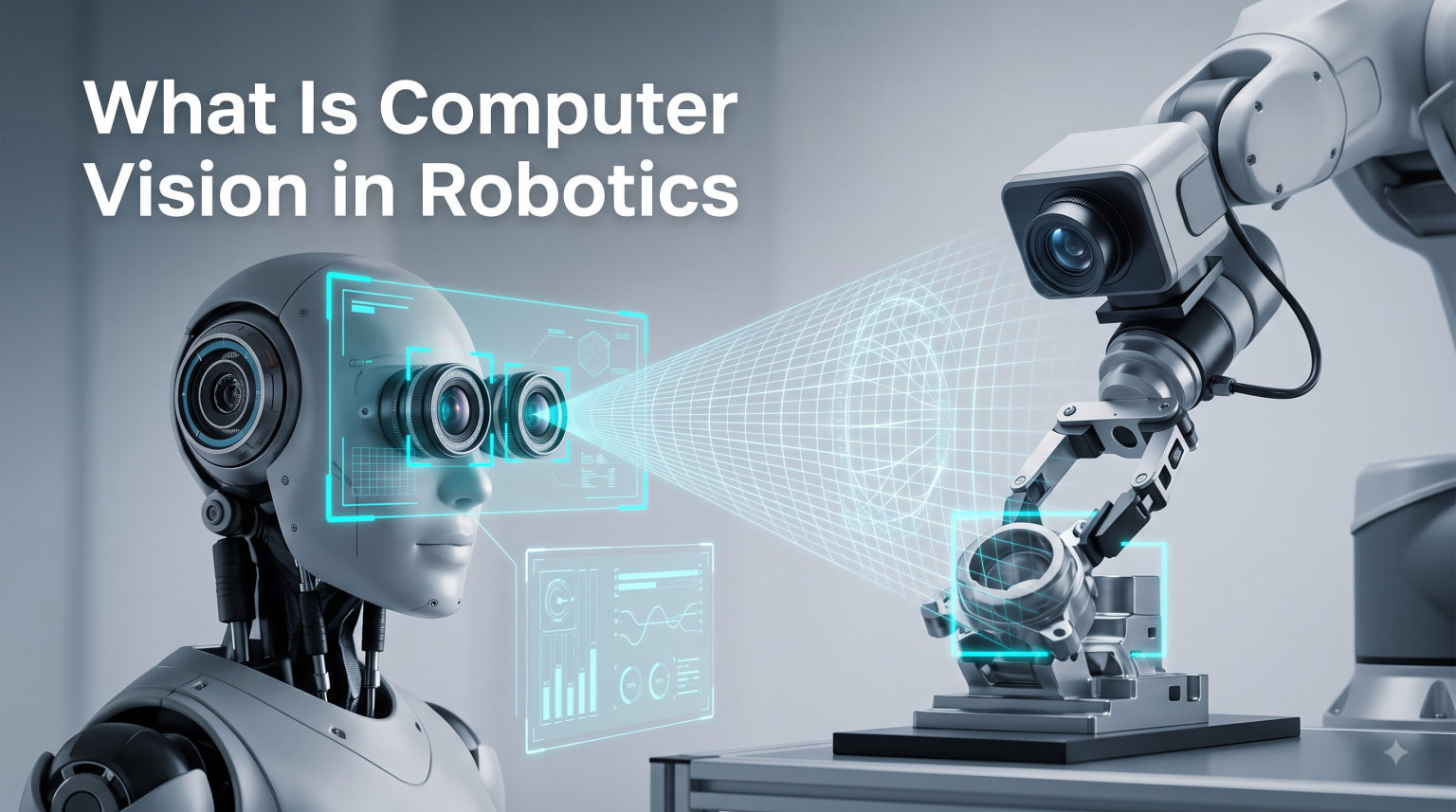
Computer vision in robotics is the branch of artificial intelligence that gives machines the ability to see, understand, and act on visual information from cameras and sensors. It is what turns a blind industrial arm into a robot that can pick the right part, weld a clean seam, sort fresh produce, or navigate a warehouse without bumping into a person.
I have spent the last several years writing about robots and testing vision systems on small arms, drones, and mobile platforms. In this guide, I will walk you through the full picture: how the technology works, where it shows up, what hardware it needs, and where it is heading in 2026. If you have ever wondered how a robot actually “sees” a cluttered bin or a busy street, you are in the right place.
This article is part of our broader coverage of physical AI and edge AI in robotics, so I will link out to related deep dives where they add value.
Table of Contents
What Is Computer Vision in Robotics?
Computer vision in robotics is a subfield of artificial intelligence that equips robots with the ability to process, analyze, and interpret visual inputs from cameras, depth sensors, and LiDAR so they can perceive their environment and make physical decisions. Where a static image-analysis system might just label a photo, a robot must connect what it sees to what it does next, in real time.
In simple terms, computer vision is the robot’s eyes, and the perception stack is the brain that turns pixels into motion. Cameras capture frames, models turn those frames into structured understanding (objects, distances, poses, scene labels), and the robot’s control system uses that understanding to plan and execute actions like grasping, driving, or stopping.
AI vs Computer Vision: What’s the Difference?
Artificial intelligence is the broad effort to make machines perform tasks that normally require human intelligence. Computer vision is one specialized branch of AI, just like natural language processing or reinforcement learning. Vision focuses on images, video, and 3D point clouds, while AI as a whole also covers reasoning, planning, speech, and decision-making.
For a robot, vision usually sits at the front of a larger AI pipeline. A manipulation robot might use vision to find a part, a learned policy to decide how to grasp it, and a motion planner to execute the move. Vision is the perception layer; AI is the whole stack.
| Aspect | Artificial Intelligence | Computer Vision |
|---|---|---|
| Scope | Any technique that mimics human or animal cognition | Techniques that interpret images, video, and 3D scenes |
| Typical inputs | Text, audio, sensor logs, images, rules | RGB images, depth maps, point clouds, video |
| Common outputs | Predictions, plans, language, actions | Detections, segmentations, poses, depth, maps |
| Example task | Decide which route a delivery robot should take | Detect a pedestrian crossing the road |
Computer Vision vs Machine Vision vs Robot Vision
You will hear three terms that sound similar but mean different things. Machine vision is the older, factory-floor term for fixed-camera inspection systems that look for defects or read barcodes. It usually runs on a stationary rig and is tuned for a specific part. Computer vision is the broader academic and software field. Robot vision is what happens when computer vision is embedded into a moving, acting system that closes the loop with motors and grippers.
Robot vision adds two hard problems that ordinary computer vision does not face: real-time constraints and active perception. The robot must decide in milliseconds, and it can move its cameras to see better, not just passively look at a frame.
How Computer Vision Works in Robots (The Pipeline)
Every vision-enabled robot I have worked with follows the same five-stage pipeline, even when the models and sensors change. Once you know these stages, every new system starts to look like a variation on a theme.
Stage 1: Image Capture
The robot collects raw visual data from one or more cameras, often combined with depth sensors or LiDAR. The choice of sensor shapes everything that comes next. A standard RGB camera is cheap and rich in color, a stereo or depth camera adds geometry, and LiDAR adds long-range, lighting-robust 3D points. Many serious systems fuse all three.
Stage 2: Preprocessing
Raw frames are noisy, blurry, and full of irrelevant detail. The preprocessing stage cleans them up: undistorting lens effects, normalizing lighting, removing motion blur, resizing, and aligning depth with color. On a real robot, preprocessing also has to be fast, so engineers often run it on dedicated hardware or edge AI accelerators close to the sensor.
Stage 3: Perception
This is the heart of the system. Perception models turn preprocessed data into structured outputs: bounding boxes around objects, pixel-level segmentation masks, 6D poses of parts, depth maps, or full 3D reconstructions. The dominant approach in 2026 is still deep learning, especially convolutional neural networks and vision transformers, often trained on large labeled datasets and fine-tuned for the robot’s specific task.
Stage 4: Decision and Planning
Once the robot knows what is in the scene, the planning layer decides what to do. For a mobile robot this might mean choosing a path that avoids a person. For a manipulator, it means picking a grasp pose, sequencing motions, and checking for collisions. Many modern systems now use learned policies or large vision-language models to make these decisions.
Stage 5: Action and Feedback
The robot executes the plan through its motors and grippers, then watches the result. If a grasp slips or a door is closed, the vision system re-detects the situation and the loop restarts. This continuous feedback is what separates robot vision from offline image analysis, and it is why real-time performance matters so much.
Active Perception: Using Motion to See Better
One thing that makes robot vision special is active perception. A static camera cannot lean in for a closer look; a robot can. By moving its arm, head, or base, a robot can change its viewpoint, resolve occlusions, and reduce uncertainty in ways a fixed camera never could. This is why I always tell beginners: in robotics, vision is not a one-shot classifier, it is a loop.
Key Computer Vision Tasks in Robotics
Most robotics vision systems combine a handful of well-studied tasks. Once you know what each one does, you can read almost any research paper or product spec sheet with confidence.
| Task | What it does | Robot application | Example |
|---|---|---|---|
| Object detection | Draws boxes around objects and labels them | Find parts on a conveyor | YOLO, Faster R-CNN |
| Image segmentation | Labels every pixel by class or by instance | Separate fruit from leaves | Mask R-CNN, SAM |
| SLAM | Builds a map and localizes the robot inside it | Drive through a warehouse | ORB-SLAM, RTAB-Map |
| Pose estimation | Estimates 6D position and orientation | Align gripper to a part | PoseCNN, FoundationPose |
| Object tracking | Follows an object across frames | Keep eyes on a worker | SORT, DeepSORT |
| Visual inspection | Detects defects, cracks, or anomalies | Quality control on a line | Autoencoder anomaly detection |
| OCR and barcode reading | Reads text or codes on packages | Sort parcels in logistics | PaddleOCR, ZBar |
Object detection and SLAM are the two tasks you will see most often in real deployments. Detection handles the “what is in the scene” question, while SLAM answers “where am I and what does the world look like.” Most autonomous mobile robots run both at once, then fuse the results.
Hardware and Sensor Stack for Robot Vision
Software gets the headlines, but hardware decides what is actually possible on a robot. I think of the vision stack as four layers: optics, sensing, compute, and power. Each choice has tradeoffs in cost, weight, latency, and robustness.
Cameras
Most robots start with a global-shutter RGB camera, which avoids the rolling-shutter distortion you get on cheap cell phone sensors when the robot moves. Machine vision cameras from FLIR, Basler, or Allied Vision are common in industrial cells, while stereo pairs, fisheye lenses, and event cameras show up in research and on small drones.
Depth Sensors and LiDAR
Color alone is rarely enough. Depth sensors like Intel RealSense, Microsoft Azure Kinect (where still available), and stereo pairs add per-pixel distance. LiDAR sensors like Velodyne, Ouster, and Livox add long-range, lighting-robust 3D points. For outdoor robots and autonomous vehicles, LiDAR is often non-negotiable. For indoor manipulation, a good depth camera is usually enough.
Compute and Edge AI
Running modern vision models in real time is a compute problem. Industrial cells use industrial PCs with powerful GPUs. Mobile robots need to be more careful: NVIDIA Jetson Orin modules, Google Coral accelerators, and Apple silicon in research labs are common. As I covered in our edge AI guide, pushing inference onto the robot itself reduces latency and improves safety when the network drops out.
Power and Thermal Constraints
A GPU doing 30 inferences per second can pull 200 watts and run hot. On a small mobile robot or a drone, that is a serious fraction of the battery. Choosing the right model size, quantization level, and accelerator matters as much as picking the camera.
| Sensor | Strengths | Weaknesses | Typical robot use |
|---|---|---|---|
| RGB camera | Cheap, color-rich, high resolution | No depth, lighting-sensitive | Inspection, sorting |
| Stereo / depth camera | Adds per-pixel depth, works indoors | Limited range, struggles in sun | Manipulation, indoor SLAM |
| LiDAR | Long range, robust to lighting | Expensive, sparse at distance | Autonomous vehicles, outdoor AMRs |
| Event camera | Ultra-low latency, high dynamic range | Newer, less mature tooling | High-speed drones, research |
Applications of Computer Vision in Robotics
Computer vision in robotics is no longer a research toy. It runs on production lines, in hospitals, on farms, and on Mars. Here are the application areas where our team sees the most impact right now.
Industrial Robotics and Manufacturing
Welding, assembly, and quality inspection are the classic use cases. A great real-world example is the recent HII agreement with Path Robotics and GrayMatter Robotics, which we covered in our Path Robotics and GrayMatter coverage. Those systems use vision to find seams, track tolerances, and grind complex parts without rigid fixtures.
Warehouse Automation and Logistics
Amazon, Symbotic, and Locus Robotics run massive fleets of vision-enabled mobile robots. Cameras and depth sensors let the robots identify totes, read labels, and avoid human workers in busy aisles. Vision is also the basis for dimensioning systems that measure every parcel before it ships.
Agriculture and Food
Robotic weeders, fruit pickers, and crop-health drones all rely on computer vision. A modern strawberry-picking robot uses segmentation models to find ripe fruit, pose estimation to align the gripper, and force feedback to pick without bruising. The same stack powers yield estimation from drone imagery.
Healthcare and Surgical Robotics
From da Vinci-style surgical systems to rehabilitation robots and pharmacy dispensing, vision is everywhere in modern healthcare. Surgical systems overlay live imaging on the operative field, while pharmacy robots verify pills and packaging with sub-millimeter accuracy.
Autonomous Vehicles and Drones
Self-driving cars and autonomous drones are perhaps the most visible examples. They fuse cameras, LiDAR, and radar to track pedestrians, read signs, and build real-time maps. The same perception stack now shows up in last-mile delivery robots and security drones.
Space Exploration
NASA’s Perseverance rover uses stereo vision and AI to navigate Jezero Crater autonomously, choosing routes around rocks that would have taken hours to plan from Earth. Smaller satellites use vision-based navigation to dock with debris or inspect other spacecraft. Our earlier piece on HEBI Robotics’ NASA SBIR work shows how new actuator technology pairs with vision to enable compact space robots.
Construction and Human-Robot Collaboration
Robots like those developed at the University of Florida’s industrialized construction lab use vision to lay bricks, tie rebar, or print structural components. In collaborative settings, vision-based safety systems detect when a human enters a robot’s workspace and trigger an immediate slowdown or stop.
Tools and Libraries for Vision-Enabled Robots
You do not have to build everything from scratch. A mature stack of open-source and commercial tools covers almost every step of the pipeline, from low-level image processing to full simulation environments.
Core Libraries
- OpenCV: The default C++ and Python library for classical image processing, camera calibration, and feature extraction.
- ROS and ROS 2: The Robot Operating System provides camera drivers, message types, and a huge ecosystem of perception nodes. Most research robots run ROS.
- NumPy, SciPy, scikit-image: Python staples for image arrays, signal processing, and classical algorithms.
Deep Learning Frameworks
- PyTorch and Torchvision: The most common choice in robotics research thanks to its flexibility and strong ecosystem.
- TensorFlow and Keras: Still dominant in production deployments, especially on edge devices.
- JAX and Flax: Rising stars for high-performance training and research.
Robotics-Focused Tooling
- NVIDIA Isaac Sim and Isaac ROS: Photorealistic simulation and GPU-accelerated perception for robot development.
- MATLAB and Simulink: Common in industry for rapid prototyping, especially for control and sensor fusion.
- MoveIt: The standard motion-planning library in ROS for manipulation.
Beginner Learning Roadmap
If you are just starting out, I usually suggest a three-step path: first, learn how robots work (sensors, actuators, basic kinematics), then get comfortable with Python and PyTorch, and finally specialize in vision tasks like detection, segmentation, and SLAM. Build small projects as you go: a line-following car, a face-tracking pan-tilt, then a vision-guided pick-and-place arm. Hands-on time matters far more than theory alone, and that theme comes up again and again in the r/computervision community.
Challenges and Limitations of Computer Vision in Robotics
Computer vision in robotics is powerful, but it is far from solved. Here are the limitations our team runs into most often, and the ones that come up again and again in robotics forums.
Lighting, Occlusion, and Real-World Messiness
Models trained in clean labs often break in real warehouses, fields, and operating rooms. Shadows, glare, dust, and self-occlusion all degrade performance. A robot arm holding a part occludes the very part it is trying to see, which is why active perception and multi-view systems matter.
Compute and Power Budget
Running a foundation vision model on a small mobile robot can drain the battery in minutes. Engineers constantly trade off model size, frame rate, and accuracy, and the right choice changes with the platform. A 10-kilogram industrial arm can carry a beefy GPU; a 500-gram drone cannot.
Data Bias and Generalization
Vision models are only as good as the data they are trained on. A model trained mostly on bright, indoor scenes can fail on overcast farms or dim warehouses. Datasets that underrepresent certain skin tones, lighting conditions, or object variants lead to biased, unreliable robots. Synthetic data and large, diverse datasets are part of the answer, but the problem is not gone.
Safety, Verification, and Certification
A misclassified pedestrian is a serious safety hazard. Unlike a chatbot, a robot’s mistake is physical. This is why industries like autonomous driving and surgical robotics demand rigorous testing, redundancy, and formal verification before deployment.
Future Trends: Embodied AI, Foundation Models, Edge AI
Robotics in 2026 is moving fast, and vision is at the center of almost every major trend. Here is where I see the field heading.
Embodied AI and Vision-Language-Action Models
Foundation models that combine vision, language, and action are starting to control robots directly. Instead of writing a separate detector for every object, a single large model can take a camera image plus a text command and output motor commands. RT-2, PaLM-E, and the new wave of open-source models point in this direction.
Edge AI and On-Device Perception
As I wrote in our edge AI guide, more inference is moving onto the robot itself. New accelerators, model compression, and quantization make it possible to run serious models on batteries, which reduces latency, improves privacy, and keeps robots working when the cloud is down.
Synthetic Data and Simulation
Real labeled data is expensive. Photorealistic simulators like Isaac Sim, MuJoCo, and CARLA can generate millions of labeled images with perfect ground truth. Combined with sim-to-real transfer, this is rapidly closing the data gap, especially for rare or dangerous scenarios.
Physical AI Infrastructure
Underpinning all of this is a new layer of physical AI infrastructure that combines vision, world models, and robot fleets. Our recent look at the 5 physical AI infrastructure platforms shaping robotics shows how companies are building the data and compute stack that vision-enabled robots will rely on.
Careers in Computer Vision and Robotics
Computer vision and robotics are two of the most in-demand specializations in AI, and they overlap heavily. If you are thinking about a career, here is how the paths differ.
Computer Vision Engineer
A CV engineer focuses on the perception side: building and deploying models for detection, segmentation, tracking, and 3D reconstruction. They tend to work on model architectures, datasets, training pipelines, and evaluation. In the United States, mid-level CV engineers commonly earn total compensation in the $180,000 to $300,000 range, and senior roles at autonomous-vehicle or humanoid-robotics companies can go significantly higher.
Robotics Software Engineer
A robotics software engineer works on the whole stack: perception, planning, control, and integration with hardware. They spend more time on ROS, real-time systems, and motion planning, and less on training new models. Compensation is similar to CV engineers, with a slight premium for people who can ship production systems end to end.
Will AI Replace Computer Vision Jobs?
Like most engineering roles, AI is changing the work, not eliminating it. AutoML tools, foundation models, and copilots are accelerating routine tasks, but robots still need engineers who can collect the right data, debug failure modes in the real world, and certify safety. The demand for people who combine vision expertise with robotics is, if anything, increasing.
What Are the Big 4 of Robotics?
You will sometimes see the “big 4” of robotics described as perception, planning, control, and actuation, or alternatively as sensing, thinking, acting, and collaborating. Either way, computer vision lives at the perception and sensing end of the stack, which is why vision skills unlock the rest.
Highest-Paid Roles in Robotics
The highest-paid roles in robotics tend to be at autonomous-driving companies, humanoid-robotics startups, and big-tech labs, especially for staff and principal engineers who can lead perception teams. Specialized roles in surgical robotics and space robotics also pay well, often because of clearance requirements or regulatory expertise.
Frequently Asked Questions
What is computer vision in simple terms?
Computer vision is a field of artificial intelligence that teaches machines to understand images, video, and 3D scenes. In robotics, it gives robots the ability to see objects, judge distances, and decide what to do next based on what their cameras and sensors capture.
What is the difference between AI and computer vision?
Artificial intelligence is the broad effort to make machines perform tasks that need human-like intelligence, from reasoning to speech. Computer vision is one specific branch of AI that focuses on interpreting visual data such as photos, video feeds, and 3D point clouds so the system can detect, classify, and measure things in the world.
How is computer vision used in robotics?
Robots use computer vision to detect and pick objects, navigate without collisions, inspect parts for defects, estimate poses for manipulation, track people for safety, and read labels or barcodes. It powers self-driving cars, warehouse robots, surgical systems, agricultural machines, drones, and space rovers.
What are the big 4 of robotics?
The big 4 of robotics are usually described as perception, planning, control, and actuation, sometimes phrased as sensing, thinking, acting, and collaborating. Computer vision lives in perception and sensing, providing the data that planning and control then turn into motion.
Will AI replace computer vision jobs?
AI is changing computer vision work rather than replacing it. AutoML and foundation models automate routine labeling and training, but engineers are still needed to collect the right data, debug real-world failure modes, certify safety, and integrate vision into physical robots. Demand for vision-plus-robotics skills is strong.
What is the highest paid job in robotics?
The highest paid roles in robotics tend to be staff and principal engineers at autonomous-driving companies, humanoid-robotics startups, and big-tech research labs, often focused on perception, planning, or systems engineering. Specialized roles in surgical robotics and space robotics also pay well due to regulatory and clearance requirements.
How advanced are robots in 2026?
Robots in 2026 can autonomously navigate complex warehouses, sort irregular parcels, weld complex seams, assist surgeons, drive on highways in geofenced areas, and explore other planets. Humanoid robots are moving from demos to early commercial pilots, but general-purpose home robots remain an open research challenge.
Final Thoughts on Computer Vision in Robotics
Computer vision in robotics is the perception layer that turns cameras and sensors into action. It spans a clean five-stage pipeline, a small set of well-understood tasks like detection, segmentation, and SLAM, and a growing stack of hardware from RGB cameras to LiDAR to edge AI accelerators.
If you are new to the field, start with a simple pipeline, a global-shutter camera, and a real robot. If you are evaluating vision for a business, focus on the use case, the data, and the safety story before the model architecture. And if you want to keep up with where the field is heading, watch embodied AI, foundation models, and the new physical AI infrastructure platforms that we cover every week on Smashing Robotics.