
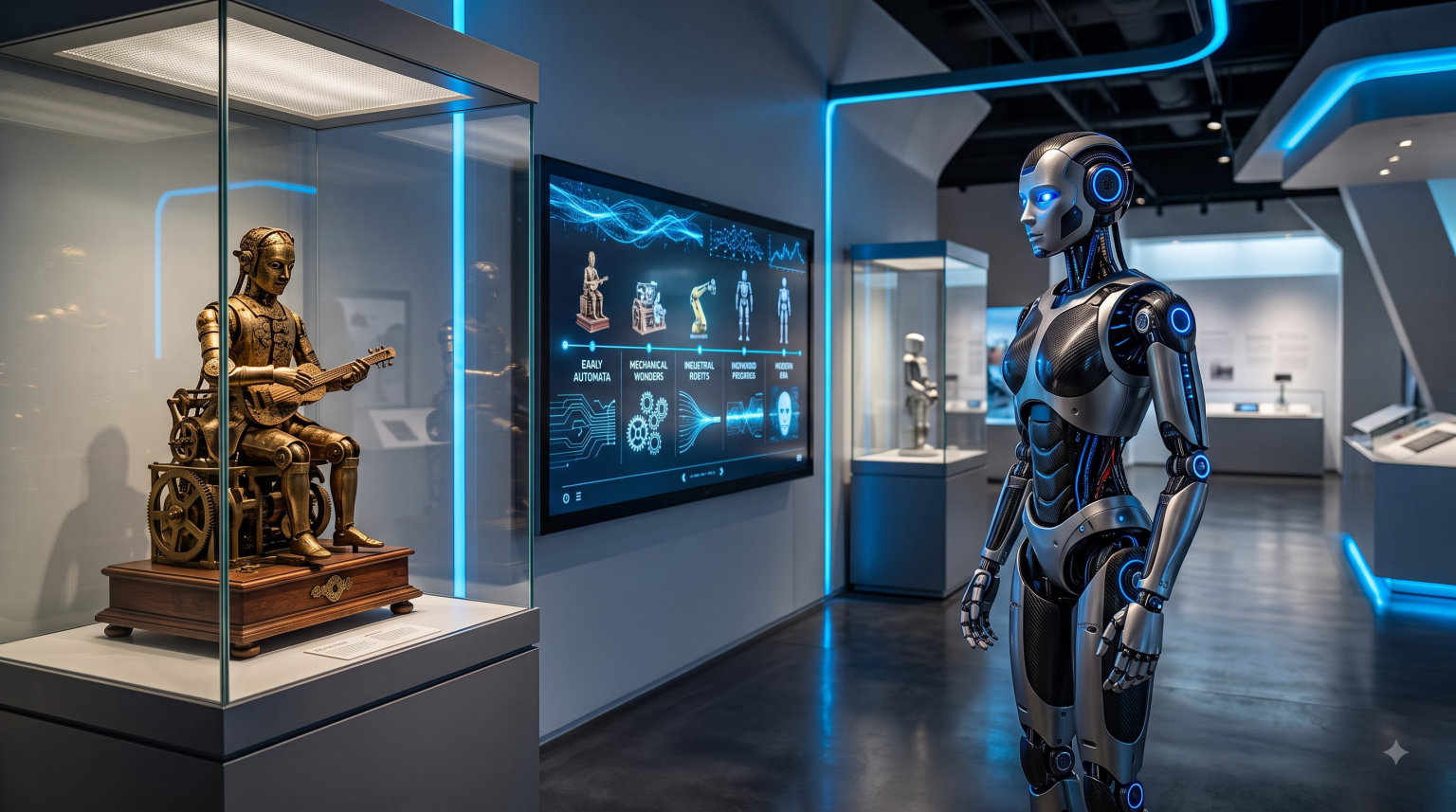
When I first stood next to a bipedal robot that was walking on its own, I had a moment of quiet vertigo. The machine looked almost human, moved with a slow grace, and carried a head full of cameras where its eyes should be. I remember thinking, how did we get here, and how long did it actually take? That question is what drove me to write this guide to the history of humanoid robots.
Our team has been tracking humanoid robotics for years, and the speed of the last three years has been unlike anything we have seen. In this explainer, I want to walk you through the full timeline, from a Czech playwright coining the word “robot” in 1920, all the way to factory floors in 2026 where human-shaped machines are picking up real parts next to real people.
You will get the technical milestones, the breakthrough research labs, the science fiction moments that shaped public expectations, and the modern industrial pivot that is happening right now. By the end, you will have a clear mental model of how we got from clockwork automatons to the AI-driven humanoids that are about to enter our daily lives.
Table of Contents
What Is a Humanoid Robot
A humanoid robot is a robot whose body shape is designed to resemble the human body. In practice that means a torso, a head, two arms, and two legs, though the level of detail varies from a fully fleshed face down to a bare mechanical skeleton with human proportions.
The reason engineers bother with this design is the world around us. Door handles, stairs, car seats, kitchen counters, and tools are all built for bodies shaped like ours. A robot that walks on two legs and reaches with two arms can, in theory, do any task a human can without anyone having to redesign the room.
There are two common sub-categories worth knowing:
- Android. A humanoid robot designed to look like a male human, from the Greek word for “man”.
- Gynoid. A humanoid robot designed to look like a female human, from the Greek word for “woman”.
You will also see the term anthropomorphic robot used in academic papers. It means essentially the same thing, with a slightly broader scope that includes robots with a human-like shape but not necessarily a face.
Origins of the Word Robot and the First Mechanical Humans
The word “robot” entered the world in 1920. Czech playwright Karel Capek used it in his play R.U.R. (Rossum’s Universal Robots) to describe artificial workers built in a factory. The word comes from the Czech “robota”, meaning forced labor. His brother, the painter and writer Josef Capek, is often credited with suggesting the term.
Long before Capek gave us the vocabulary, engineers were already building human-shaped machines. These were not robots in the modern sense, but they set the stage for everything that came after.
Key early mechanical humans
- Leonardo da Vinci’s mechanical knight (around 1495). A clockwork humanoid that could sit, wave its arms, and move its head. The original design has been reconstructed and it works.
- Jacques de Vaucanson’s Digesting Duck (1739). A mechanical duck that appeared to eat and digest grain, a sensation in its day.
- Hisashige Tanaka’s Karakuri puppets (19th century Japan). Tea-serving mechanical dolls that poured cups and bowed with surprising realism.
By the late 1800s the world was inventing the electrical and mechanical parts that would eventually power real robots. Nikola Tesla demonstrated a remote-controlled boat in 1898, and in the 1920s Westinghouse built Herbert Televox, a wire-connected humanoid that could respond to voice commands through simple tone matching.
Herbert Televox is the first widely exhibited humanoid-shaped robot in the United States. He could not walk or think, but he looked human enough to draw crowds and to set the cultural template for what a “robot” should be.
The First Digitally Controlled Humanoid Robots (1960s to 1970s)
The history of humanoid robots as we know them really starts in Japan in the late 1960s. Researchers at Waseda University in Tokyo wanted to build a machine that could communicate and move the way a person does. Their work gave us the first true digital humanoids.
WABOT-1 (1972)
WABOT-1 was the first full-scale anthropomorphic robot in the world. Built by Ichiro Kato and his team at Waseda University, it could walk on two legs, grip objects with its hands, and even hold a basic conversation in Japanese using artificial ears, eyes, and a mouth.
The project took about six years and produced a robot with around 26 degrees of freedom. It was a sensation in the research community. In many histories you will see WABOT credited as the first humanoid robot, and it is the first that most roboticists agree on.
WABOT-2 (1984)
Twelve years later the same lab released WABOT-2, this time focused on musical performance. WABOT-2 could read sheet music, play a simplified version of an electronic organ, and even sing in a synthesized voice. It was the first humanoid that could perform a real creative task from start to finish.
Together, the WABOT projects proved that a humanoid form factor was technically possible and started a wave of research programs around the world that would run for the next forty years.
The Golden Era of Research Humanoids (1980s to 2000s)
Once Waseda proved it could be done, the next three decades were a sprint to make humanoids faster, smoother, and smarter. Most of the work happened in university labs and in-house R&D divisions of car companies, because the motors, control systems, and batteries were the same ones being developed for electric vehicles and industrial automation.
The Honda E series and ASIMO
Honda’s humanoid program started in 1986, hidden inside the company’s automotive R&D group. The early prototypes, called the E0 through E6, were strictly experimental. The E0 in 1986 took more than 5 seconds to take a single step.
By 1996 Honda had produced the P2, the first self-regulating, two-legged walking humanoid. P2 was nearly 6 feet tall and weighed 463 pounds, but it could walk on its own, climb stairs, and push a cart.
ASIMO (Advanced Step in Innovative Mobility) followed in 2000, named after science fiction writer Isaac Asimov. ASIMO stood about 4 feet 3 inches tall, weighed 119 pounds, and could run, hop on one foot, and pour drinks. It became the public face of humanoid robotics for a generation, performing at trade shows, in theme parks, and even conducting the Detroit Symphony Orchestra.
Other major research humanoids of the era
- Waseda University WABIAN and TWENDY-ONE. Continued the WABOT line with robots focused on rehabilitation and human interaction.
- Sony QRIO (2003). A small entertainment humanoid that could run, recognize faces, and play music. Sony discontinued the program in 2006.
- Fujitsu HOAP series. A research platform that helped dozens of labs study bipedal walking.
- Kawada HRP-2 and HRP-4. Japanese National Institute of Advanced Industrial Science and Technology humanoids that pioneered dynamic walking.
- HUBO (2004, KAIST, South Korea). A full-sized humanoid with a unique rotating waist joint that improved its walking speed.
This was the period when bipedal walking stopped being a research stunt and started to feel reliable. Most of the algorithms we use today, including the famous zero moment point (ZMP) stability method, were refined during these decades.
How Humanoid Robots Work: Core Technology
To appreciate the history of humanoid robots, you need to know the moving parts, literally. Every humanoid is built from the same basic stack of components, regardless of whether it was built in 1972 or 2026.
Sensors: how the robot perceives
Humanoids use two main classes of sensors.
- Proprioceptive sensors measure the robot’s own body. These include joint encoders, gyroscopes, accelerometers, and force sensors in the feet. They tell the control system where each limb is, how fast it is moving, and whether the robot is tipping over.
- Exteroceptive sensors measure the world around the robot. These include cameras, depth sensors, microphones, and increasingly LiDAR. They let the robot see obstacles, hear speech, and build a 3D map of its surroundings.
Actuators: how the robot moves
Actuators are the muscles of the robot. There are three main types.
- Electric actuators use motors and gearboxes. Most modern humanoids rely on these because they are precise, easy to control, and cheap to mass-produce.
- Hydraulic actuators use pressurized fluid. They are powerful and can handle heavy impacts, which is why Boston Dynamics chose them for the original Atlas.
- Pneumatic actuators use compressed air. They are lightweight and compliant, useful for soft robotics and some humanoid hands.
A typical modern humanoid has between 20 and 50 degrees of freedom (DOF), meaning that many independent joints it can control. ASIMO had 34. Tesla Optimus reportedly has more than 40.
Control: how the robot keeps from falling over
The most famous control theory in humanoid robotics is zero moment point (ZMP). The idea is simple: as long as the robot keeps the point where the ground reaction force acts inside the polygon formed by its feet, it will not tip over. ZMP was developed in the late 1960s and is still the foundation of most walking controllers today.
More recent systems blend ZMP with model predictive control and reinforcement learning. That is what lets modern humanoids like Optimus and Figure 02 walk on uneven ground, recover from pushes, and learn new movements from human demonstration.
For a deeper look at the muscle side, our team recently covered how servo motors work in robots, which is the actuator technology most current humanoids are built on.
The Modern Humanoid Era (2010 to 2020)
The 2010s were the decade when humanoids stopped being research toys and started looking like products. A few of the most important developments:
Boston Dynamics Atlas (2013)
Atlas started as a DARPA-funded search and rescue robot. The 2013 prototype was tethered to an external power supply. By 2016 the company showed Atlas running outdoors, jumping on boxes, and doing backflips. Atlas is the humanoid most people picture when they think of a robot doing parkour.
SoftBank Pepper (2014)
Pepper was the first mass-produced humanoid designed for human interaction. About 140 cm tall, with a tablet on its chest and a friendly cartoon face, Pepper was deployed in retail stores, banks, and hotels in Japan and Europe. It could read emotions from voice and expression, and SoftBank sold tens of thousands of units before discontinuing production in 2021.
Aldebaran NAO and Romeo
NAO became the standard small humanoid in research and education. The Romeo project pushed the platform toward home assistance, particularly for elderly care.
Toyota T-HR3 (2017)
Toyota’s third-generation humanoid introduced a telepresence system where a human operator wearing exoskeleton-style controllers could have the robot mirror their movements in real time. It was a key step toward remote-controlled humanoids for hazardous environments.
If you are following the latest control software, we have been tracking Gemini Robotics 2 and whole-body control developments that are changing what these machines can do.
Humanoid Robots in 2024 to 2026: The Industrial Pivot
Between 2024 and 2026 the history of humanoid robots shifted gears again. We are no longer in the research era, and we are not yet in the mass consumer era. We are in the industrial pilot era, where dozens of humanoids are working real shifts in real factories.
Tesla Optimus Gen 2
Tesla’s Optimus Gen 2, shown working in Tesla’s own factories, walks at about 1.4 meters per second and can sort objects, fold laundry, and handle small parts. Tesla has stated the long-term goal is to manufacture Optimus at scale and sell it for a small multiple of the cost of a compact car.
Figure 02 at BMW
Figure AI’s second-generation humanoid began real shift work in BMW’s Spartanburg plant in 2025. By early 2026, BMW reported that Figure 02 units were spending hours at a time on sheet metal handling and other defined tasks alongside human workers, one of the first commercial factory deployments of a bipedal humanoid in automotive production.
1X Technologies NEO
NEO is a home-focused humanoid built by 1X Technologies in Norway, backed by OpenAI. The company has been testing in-home assistance tasks, including tidying, fetching items, and basic elder care support. NEO is one of the first humanoids designed and priced for the consumer market.
Unitree H1 and G1
Chinese robotics company Unitree shook the market by releasing bipedal humanoids at prices under $90k. The H1 set records for humanoid running speed in 2024, and the smaller G1 launched in 2024 at a price point that brought bipedal robots within reach of small research labs and individual developers.
World Humanoid Robot Games and other events
In 2025 the first World Humanoid Robot Games were held, with teams from more than 20 countries competing in soccer, running, manipulation, and even robot boxing. The events are a useful public testbed and a powerful recruiting showcase. The recent push to compete in robot boxing is drawing huge audiences online and is covered in our recent piece on humanoid robotics and competitive events.
Software and AI breakthroughs
The biggest change in 2024 to 2026 is not in the hardware. It is in the software. Foundation models trained on large video and manipulation datasets now let a single neural network handle perception, planning, and whole-body control. That is why recent humanoids can be trained by demonstration rather than hand-coded for every task. If you are tracking deployment at scale, our autonomous mobile robots report covers the broader shift toward AI-driven robotics.
Where Humanoid Robots Are Used Today
After more than a century of work, humanoid robots are starting to find real homes in industry and research. Here is where you are most likely to encounter one in 2026.
Manufacturing and logistics
Automotive plants are the early adopters. BMW, Mercedes, and Tesla have all piloted humanoids on production lines for parts handling, bin picking, and moving totes between stations. The draw is that humanoids can drop into existing human workflows without rebuilding the floor.
Healthcare and elder care
Humanoids in hospitals and care homes today mostly assist with non-contact tasks such as patient transport, telemedicine reception, and reminders. Trials in Japan and Singapore are testing robots for fall detection and to support nurses with lifting.
Research and education
Most humanoids you will see in universities are still research platforms. NAO, Pepper, and Unitree humanoids are common in labs studying bipedal locomotion, manipulation, and human-robot interaction.
Space exploration
NASA and partner agencies continue to test humanoid and humanoid-adjacent robots (such as Valkyrie and Robonaut 2) for tasks in low-gravity or hazardous environments. The idea is simple: send a humanoid where the cost or risk of sending a person is too high.
Consumer and domestic use
This is the smallest segment today, but the most discussed. Robots like 1X NEO and Tesla Optimus are aimed squarely at the home, with prices and capabilities that are still moving targets. Most consumer pilots in 2026 are supervised and limited to a few hours of autonomous work per day.
Science Fiction Versus Reality
You cannot write the history of humanoid robots without talking about the stories that pushed the field forward. The most famous mechanical women and men in fiction arrived long before the engineering caught up.
Maria in Metropolis (1927)
Fewer than ten years after Karel Capek named the robot, the German film Metropolis introduced Maria, a female machine that looked human enough to pass in a crowd. She set the visual template for the dangerous, beautiful robot that still shows up in modern movies.
Asimov’s three laws (1942)
Isaac Asimov’s short story “Runaround” introduced the Three Laws of Robotics, a set of rules for how robots should behave around humans. The laws are not real engineering constraints, but they shaped how generations of researchers think about robot ethics and safety.
C-3PO, Data, and the popular imagination
C-3PO in Star Wars and Data in Star Trek: The Next Generation defined the friendly, human-shaped helper that the public expects. The gap between that expectation and the reality of a 2026 humanoid is one of the biggest marketing challenges the industry faces.
Today’s humanoids can walk, pick up objects, and even do light gymnastics. They cannot hold a real conversation without scripted AI, and they do not have feelings. The fictional C-3PO is still 30 to 50 years ahead of the hardware most labs are shipping.
Ethical Questions and the Road Ahead
As humanoids move from labs into workplaces and homes, the questions shift from how to what now should we. A few that our team hears in nearly every forum and conference panel:
Replacement, not displacement
On r/robotics and other forums, working roboticists often frame the issue as human labor replacement rather than displacement. The argument is that a humanoid doing a back-breaking bin-picking job in a factory is replacing a task that is already hard to staff, not pushing a human worker into unemployment.
Why the human form factor at all
Critics point out that wheels and arms on a fixed base can do 90% of factory tasks more cheaply. Defenders argue that the world is already built for human bodies, and a humanoid can take any human workstation without retrofit. Both sides have data, and the truth probably depends on the task.
Regulation, safety, and trust
In 2026 regulators in the United States and the European Union are working on new safety frameworks specific to humanoids. Topics include force limits, data privacy from home cameras, liability when a robot makes a mistake, and how to certify AI-driven behavior.
What to watch for in the next five years
- Falling unit costs, with serious forecasts of sub-$30k humanoids by 2030.
- Foundation models trained on robot video data, similar to large language models for text.
- Wider consumer pilots, especially in Japan, South Korea, and parts of the United States.
- Standardized safety standards, which are currently fragmented across regions.
If you are interested in how the software side of these updates is being shipped and managed, we recently covered how ATC Deploy is simplifying over-the-air updates for robots, which is becoming a hot topic in humanoid fleet management.
Frequently Asked Questions
Who was the first humanoid robot?
The first full-scale digitally controlled humanoid robot was WABOT-1, built by Ichiro Kato and his team at Waseda University in Japan in 1972. It could walk on two legs, grip objects, and carry a basic conversation in Japanese.
When was the first human killed by a robot?
The first widely reported fatal industrial robot incident occurred in 1979 at a Ford Motor Company plant in Flat Rock, Michigan, where a robot arm struck a worker. The event became a key case study in industrial robot safety, not a humanoid robot incident, but it shaped how the robotics industry thinks about human-machine safety today.
Which country is no. 1 in robotics?
Japan and the United States are the two leading countries in robotics, with China rising fast. Japan has the deepest history in humanoid robotics thanks to Waseda, Honda, and Toyota, while the United States leads in humanoid AI software, and China leads in low-cost humanoid hardware such as the Unitree H1 and G1.
What country built the first robot?
The first humanoid-shaped robot is often credited to Japan, with WABOT-1 in 1972. The word robot itself comes from a 1920 Czech play by Karel Capek, and earlier mechanical humanoids, like Westinghouse’s Herbert Televox in the 1920s, were built in the United States. The Czech Republic therefore coined the term, Japan built the first true humanoid, and the United States built the first publicly exhibited humanoid-shaped machine.
The Story So Far
When you step back and look at the full history of humanoid robots, the pattern is clear. The ideas kept arriving long before the engineering could catch up. Capek gave us the word in 1920, Waseda gave us the body in 1972, Honda gave us the walk in 1996, and the AI labs of the 2020s gave the body a brain.
In 2026 we are in the middle of the industrial pivot, the moment where humanoids stop being research demos and start showing up on real factory floors. Figure 02 is sorting parts at BMW, Optimus is folding laundry in Tesla labs, and NEO is in the first homes. None of it would be possible without a hundred years of patient work, from Capek’s typewriter to Kato’s WABOT-1 to the foundation models running inside today’s humanoids.
My advice if you want to follow along: read the timelines, watch the demos, but pay the most attention to the safety and software layers. The hardware is catching up fast, and the bottleneck is now how reliably these machines can act in the messy, human-shaped world we have already built.
The history of humanoid robots is still being written, and the next chapter is going to be the most interesting one yet.