
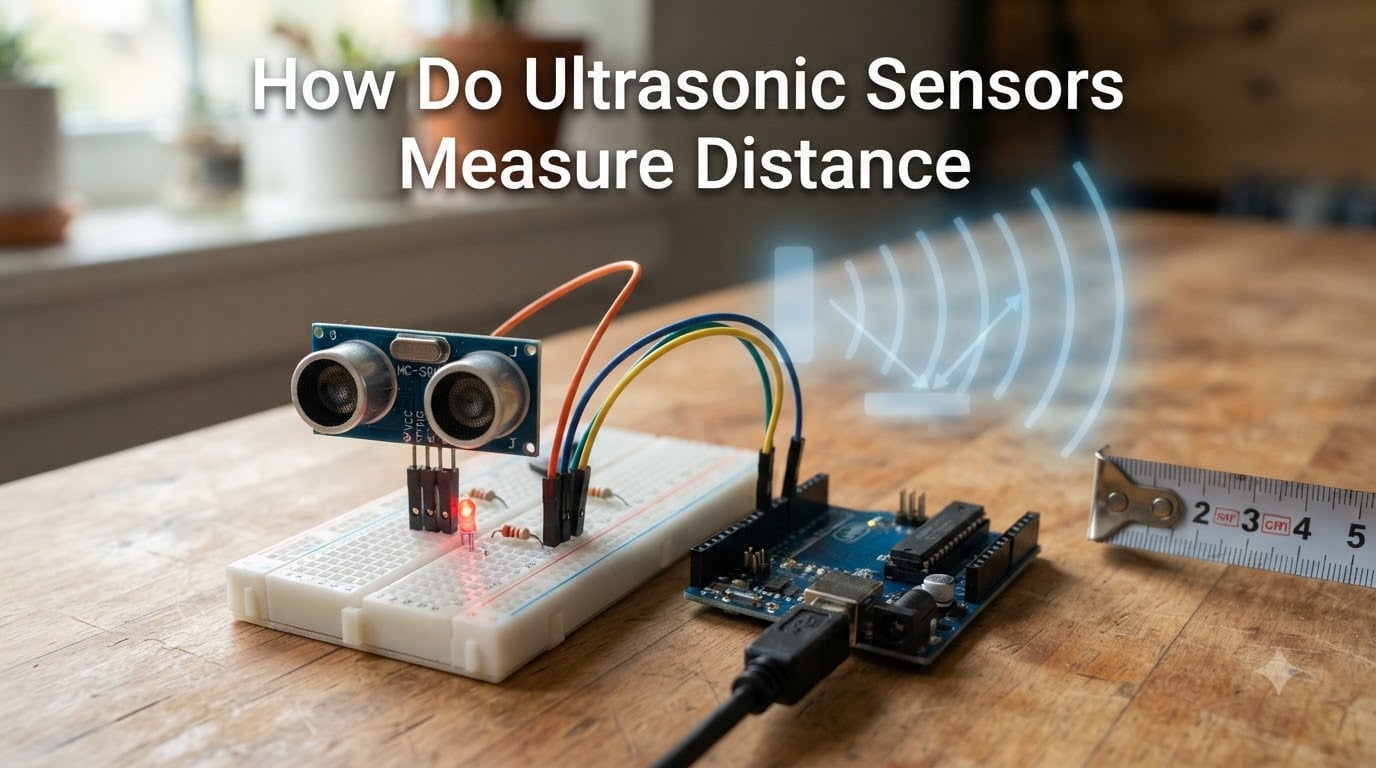
An ultrasonic sensor measures distance by sending out a high-frequency sound pulse, waiting for the echo to bounce back, and timing how long the round trip took. It is the same idea bats use to navigate in the dark, and it is the reason your car beeps faster as you back toward the garage wall. I have spent the last few weeks testing ultrasonic sensors on my workbench, and I want to walk you through exactly how the technology works, why the math holds up, and where these little devices shine (or fall short).
In this guide, I will break down the time-of-flight principle, the components inside a sensor, the distance formula, and the practical details you actually need if you plan to build something with one. Whether you are wiring up an Arduino project or trying to understand why Tesla phased these sensors out, I have you covered.
Table of Contents
What Is an Ultrasonic Sensor and How Does It Measure Distance
An ultrasonic sensor is an electronic device that measures distance by emitting high-frequency sound waves (typically 40 kHz, well above human hearing) and measuring the time it takes for the echo to return after hitting an object.
The concept is identical to echolocation. Bats emit chirps, listen for the returning echoes, and build a mental map of the world around them. An ultrasonic sensor does the same thing, only with electronics instead of biology. The result is non-contact distance measurement, which is exactly what you want when the target is wet, hot, chemically reactive, or simply too delicate to touch with a ruler.
You will find these sensors in car parking assist systems, robot vacuums, industrial level gauges in storage tanks, and pretty much every beginner Arduino robotics kit on the market. The reason is simple: they are cheap, reliable, and the math behind them is approachable.
If you want a deeper look at how the electronics around these sensors communicate, my guide on how development boards talk to sensors covers the wiring side in detail.
The Time-of-Flight Principle Explained
The time-of-flight (ToF) principle is the heart of how every ultrasonic sensor measures distance. You send a sound pulse toward a target, the pulse bounces back, and you measure the elapsed time. Since sound travels at a known speed, time translates directly into distance.
Here is the part that trips people up: the measured time is the round trip. The pulse leaves the sensor, travels to the object, and comes all the way back. So the distance to the object is only half of the total path the sound traveled. That is why every formula you see has a divide-by-two tucked inside it.
Sound is a mechanical wave, which means it needs a medium to travel through. In dry air at 20 degrees C, sound moves at about 343 meters per second. Change the temperature, humidity, or altitude, and that speed changes. We will get into the practical accuracy impact of that a little later.
Core Components Inside an Ultrasonic Sensor
Every ultrasonic sensor, from a 2-dollar HC-SR04 to a $500 industrial probe, contains the same basic building blocks. Here is what each one does.
Piezoelectric transmitter: When you apply a voltage across a piezoelectric crystal, it physically deforms and produces a sound wave. Reversing the process turns vibrations into voltage. The same physical effect powers the receiver.
Piezoelectric receiver: When the echo comes back and vibrates the crystal, the sensor generates a small electrical signal that the control circuit can detect and time.
Control circuit: This is the brain. It generates the trigger pulse, drives the transmitter, listens for the echo on the receiver, and either outputs a timing signal or computes the distance for you and sends it over a digital bus.
Housing and acoustic port: The plastic or metal shell protects the crystals and shapes the sound beam. Most sensors fire in a roughly 15 to 30 degree cone, which becomes important when you think about what they can actually see.
The transmitter and receiver are sometimes the same physical element, switched between send and receive modes. That is exactly how the HC-SR04 works, and it is one of the reasons the part is so cheap to manufacture.
Step-by-Step Working Process
Here is the full sequence an ultrasonic sensor runs through every time you ask it for a distance reading.
Step 1: Trigger pulse. The microcontroller (or a timer circuit) sends a short 10-microsecond trigger pulse to the sensor’s TRIG pin. This tells the sensor to start a measurement cycle.
Step 2: Ultrasonic emission. The control circuit drives the piezoelectric transmitter with a burst at the resonant frequency, usually 40 kHz. The burst lasts around eight cycles, which is short enough to be treated as a single pulse but long enough to carry useful energy.
Step 3: Sound propagation. The pulse leaves the sensor, spreads out in a cone, and travels through the air at the speed of sound. If nothing is in the way, the pulse just dissipates and the sensor times out.
Step 4: Reflection. When the pulse hits an object, part of the acoustic energy bounces back toward the sensor. Hard, flat surfaces perpendicular to the beam reflect the most energy. Soft, angled, or absorptive surfaces give weaker echoes.
Step 5: Echo detection. The receiver picks up the returning pulse, the control circuit amplifies it, and the moment the signal crosses a threshold the ECHO pin goes high. The time between the trigger and the echo pin going high is the round-trip time.
Step 6: Distance output. Your microcontroller measures that time, plugs it into the distance formula, and you have a number in centimeters (or inches, depending on your code).
The Distance Calculation Formula
The distance formula for an ultrasonic sensor is straightforward. Take the speed of sound, multiply it by the measured time, then divide by two to account for the round trip.
D = (v × t) / 2
Where D is the one-way distance to the object, v is the speed of sound (about 343 m/s in air at 20 degrees C), and t is the round-trip time measured by the sensor.
Quick example. If the sensor reports a round-trip time of 5,830 microseconds, the calculation is:
D = (343 m/s × 0.00583 s) / 2 = 1.0 m
That means the object is exactly 1 meter away. If you are working in centimeters (which most Arduino libraries do), the formula simplifies to:
D (cm) = t (microseconds) / 58
That magic number 58 comes from the speed of sound in centimeters per microsecond, divided by two. It is the conversion factor you will see in nearly every HC-SR04 code example online.
HC-SR04 Specifications and Common Sensor Models
The HC-SR04 is the workhorse of hobbyist robotics. It runs on 5V, draws about 15 mA during measurements, and reliably reports distances from 2 cm to 400 cm with about 3 mm resolution. The beam cone is roughly 15 degrees, and the update rate tops out around 20 Hz before echoes from one cycle start interfering with the next.
For outdoor or waterproof projects, the JSN-SR04T adds a sealed transducer on a cable, so you can mount the sensor in a puddle, fish tank, or weather-exposed housing. It works on the same principle, just with the electronics potted away from the wet side.
Industrial sensors from brands like Pepperl+Fuchs, SICK, and Banner push the range out to several meters, add temperature compensation, and shrink the blind zone. They cost 10 to 50 times more than an HC-SR04, but they also give you millimeter accuracy and rugged housings.
If you want to understand the mechanical side of how a robot uses these readings, my write-up on how servo motors work in robots pairs well with sensor placement discussions.
Accuracy Factors and Limitations
An ultrasonic sensor is not a laser tape measure. There are real physical reasons it cannot hit sub-millimeter accuracy, and I have run into most of them on the bench.
Temperature effects: The speed of sound in air changes by about 0.6 m/s per degree Celsius. A 10-degree shift moves your reading by roughly 1.7 percent. If you care about precision, you either calibrate for ambient temperature or buy a sensor with built-in compensation.
Soft and angled targets: Foam, fabric, and fur absorb ultrasound instead of reflecting it. A surface tilted more than a few degrees away from perpendicular deflects the echo off to the side, and the sensor sees nothing at all.
Beam width and crosstalk: Two ultrasonic sensors triggered at the same time can pick up each other’s pulses. Staggering the trigger pulses or firing them in sequence fixes the problem.
Update rate limit: Sound is slow. A reading to an object 5 meters away takes about 29 milliseconds round trip, plus sensor overhead. You can only squeeze out about 20 to 30 readings per second, which rules ultrasonic out for fast-moving applications like drone obstacle avoidance at speed.
Blind zone: Every sensor has a minimum distance, because the transmitter and receiver need time to switch modes. The HC-SR04 cannot measure anything closer than 2 cm.
These tradeoffs are exactly why I keep an eye on the gripper and sensor pairing in pick-and-place projects: each tool has a sweet spot, and the engineering is in matching the right sensor to the job.
Ultrasonic vs LiDAR vs Infrared Distance Sensors
Ultrasonic, LiDAR, and infrared (IR) distance sensors all answer the same question, but they do it in completely different ways. Here is how they stack up.
Ultrasonic sensors are cheap, work in total darkness, handle dust and mist reasonably well, and ignore color and transparency. They struggle with soft objects, narrow beams at long range, and fast update rates.
LiDAR sensors use laser pulses and time-of-flight to get centimeter or even millimeter accuracy out to 100 meters or more. They are fast, precise, and the gold standard for autonomous vehicles, but they cost more and can be confused by reflective or transparent surfaces.
Infrared distance sensors (like the Sharp GP2Y0A21) work by measuring the angle of reflected IR light. They are fast, compact, and great for short range, but they get fooled by bright ambient light, shiny objects, and color differences.
For most hobbyist robots, ultrasonic wins on price and reliability. For self-driving cars and high-end mapping, LiDAR wins on precision. For line-following robots and short-range detection, IR is often the simpler choice.
Why Tesla Stopped Using Ultrasonic Sensors
Tesla announced in 2026 that it would remove ultrasonic sensors from its Model 3 and Model Y vehicles, followed by Model S and Model X, as it transitioned to a camera-only system called Tesla Vision. The company wanted to standardize on a single perception stack and argued that cameras, backed by neural networks, could do everything ultrasonics did and more.
There are legitimate engineering reasons behind the move. Ultrasonic sensors are short-range, slow to update, and physically large. They cannot tell the difference between a cardboard box and a concrete pillar, and they struggle with objects at long range. For highway-speed driving and full self-driving aspirations, the camera-and-neural-net approach scales better.
That said, ultrasonics still excel at the close-range, low-speed parking tasks they were originally designed for. Tesla’s bet is that software can replicate that behavior using cameras alone. So far, early Model 3 and Model Y builds without ultrasonics have lost some low-speed parking features while Tesla continues to train and refine the vision models.
Arduino Integration and Practical Applications
Wiring an HC-SR04 to an Arduino is a 10-minute job. Connect VCC to 5V, GND to ground, TRIG to a digital output pin, and ECHO to a digital input pin. The standard NewPing library handles the timing for you, and a typical sketch looks like this in plain language: send a 10-microsecond trigger pulse, measure the echo pulse width in microseconds, divide by 58, and print the result.
From there, the applications are nearly endless. Robot vacuums use ultrasonic arrays to detect walls and furniture. Parking sensors in cars use them to gauge distance to the curb. Industrial tanks use them to measure liquid level. Drones use them for low-altitude altitude hold. Even some automatic faucets use ultrasonic sensing to detect hands under the spout.
If you are building something with a Raspberry Pi or Arduino, the GPIO pin guide on Smashing Robotics is a good primer for getting the wiring right. And if your project involves precise joint control, the planetary gearbox breakdown pairs well with sensor-driven motion control.
Frequently Asked Questions
How does an ultrasonic sensor measure distance?
An ultrasonic sensor measures distance by emitting a high-frequency sound pulse (usually 40 kHz), waiting for the echo to bounce back from an object, and timing the round trip. It then calculates distance using the formula D = (Speed of Sound x Time) / 2. This technique is called time-of-flight and is the same principle bats use for echolocation.
How accurate are ultrasonic sensors?
A typical HC-SR04 hobbyist ultrasonic sensor offers about 3 mm resolution over a 2 cm to 400 cm range. Industrial sensors can reach sub-millimeter accuracy. Accuracy is affected by temperature (which changes the speed of sound), target surface angle and material, beam width, and air turbulence. Compensating for ambient temperature and choosing a target perpendicular to the beam gives the best readings.
How far can an ultrasonic sensor work?
Most hobbyist ultrasonic sensors like the HC-SR04 measure from 2 cm to 400 cm. Industrial ultrasonic sensors can reach 6 to 10 meters, and specialized long-range models push further. Maximum range depends on the target’s size, shape, and reflectivity, plus environmental conditions like temperature and humidity.
Why did Tesla stop using ultrasonic sensors?
Tesla removed ultrasonic sensors from its newer vehicles starting in 2022 as part of a shift to a camera-only system called Tesla Vision. The company wanted a single perception stack, and cameras backed by neural networks can identify objects at longer range and classify them in ways ultrasonic sensors cannot. Ultrasonics remain useful for close-range parking, but Tesla is betting its vision models can replicate that function over time.
What is the formula for ultrasonic distance measurement?
The distance formula for an ultrasonic sensor is D = (v x t) / 2, where D is the one-way distance, v is the speed of sound (about 343 m/s in dry air at 20 degrees C), and t is the round-trip time measured by the sensor. In centimeters with time in microseconds, the formula simplifies to D = t / 58, which is the conversion factor used in most Arduino HC-SR04 libraries.
Final Thoughts on How Ultrasonic Sensors Measure Distance
Understanding how an ultrasonic sensor measures distance comes down to three ideas: send a sound pulse, time the echo, and divide by two. Once you grasp the time-of-flight principle, the formula, and the limitations, you can pick the right sensor for any project and avoid the common pitfalls. Start with an HC-SR04 and an Arduino, run a few tests in your own space, and you will quickly see why this 50-year-old technology is still everywhere from robot vacuums to industrial automation.