
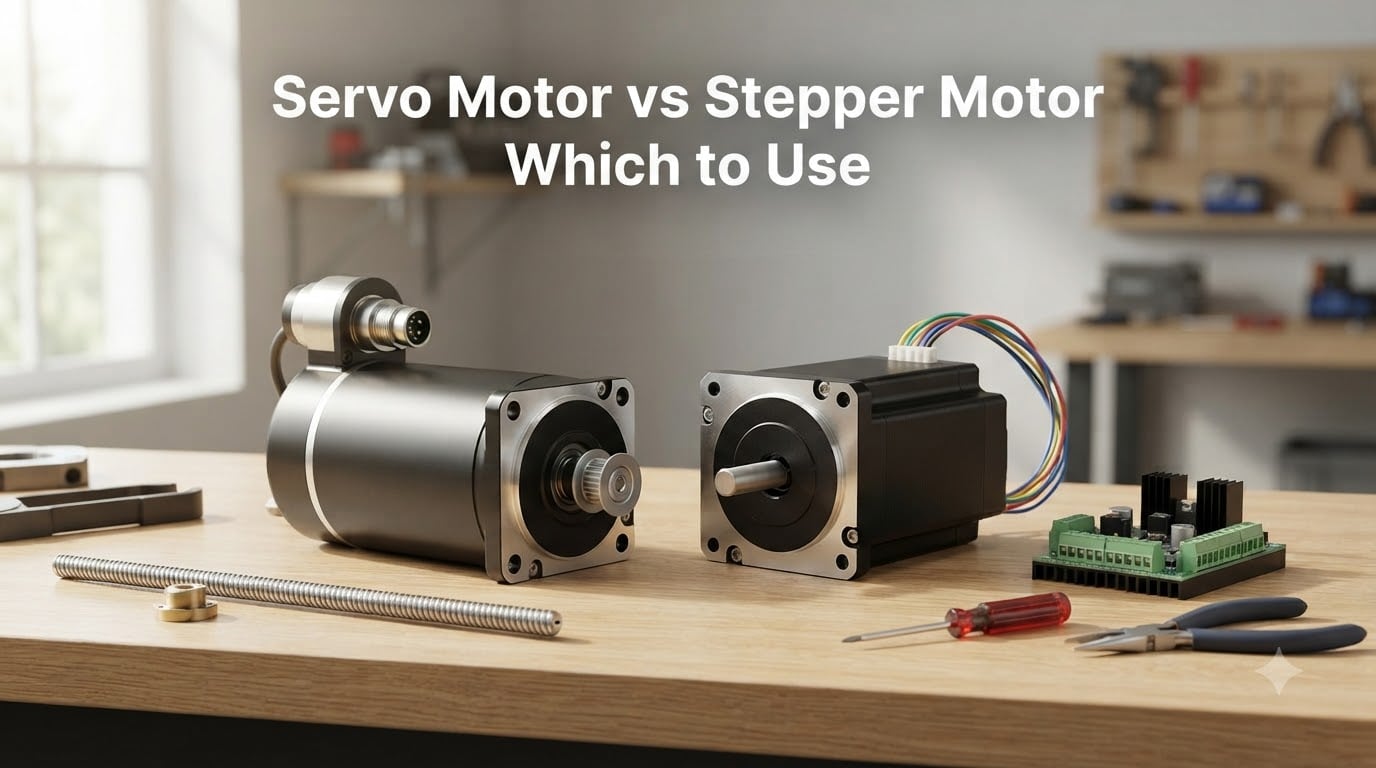
Choosing between a servo motor and a stepper motor is one of the first real decisions you’ll make when designing any motion control system, and getting it wrong can mean overspending, losing accuracy, or fighting mechanical problems for months. I have built robot arms, CNC machines, and 3D printers with both, and I can tell you that the servo motor vs stepper motor debate is not about which is “better” in general, but which is right for your specific project.
In this guide, I’ll walk you through exactly how each motor works, where each one shines, and how to decide between them based on torque, speed, accuracy, noise, and cost. By the end, you’ll have a clear decision framework you can apply to your own build, whether it’s an Arduino hobby project or a full industrial automation line. If you want a deeper dive on the servo side, I have a separate guide on how servo motors work in robots that complements this comparison.
Table of Contents
What Is a Servo Motor and How Does It Work?
A servo motor is a closed-loop motor that uses an encoder to constantly monitor its actual position and correct it in real time. Unlike an open-loop system that simply issues a command and hopes the motor reaches it, a servo reads its own shaft position, compares it to the commanded position, and adjusts the current to the motor to eliminate any error. This feedback loop is what makes servos fast, accurate, and reliable under varying loads.
A standard servo motor package contains three core parts: a DC or brushless motor, a position sensor (usually an optical or magnetic encoder), and a servo drive or amplifier that runs a PID control loop. The drive receives a command signal (often a pulse-width modulation signal, analog voltage, or fieldbus command), checks the encoder, and pushes the motor to the target position. If something pushes back on the shaft, the servo fights back until the position matches the command.
Servo motors come in two main flavors. AC servos dominate industrial automation because they offer high torque, high speed, and excellent efficiency for long duty cycles. DC servos, including the hobby servos you find in RC cars and small robot arms, are simpler, cheaper, and perfect for low-power applications. Our team has used industrial AC servos on heavy robot arms where positional error must stay below 0.01 mm, and we have used small hobby servos in pan-tilt camera mounts that needed only a few degrees of accuracy.
The biggest advantage of a closed-loop system is robustness. If a stepper motor skips steps because the load is too high, you may not even know it happened. A servo detects the deviation immediately and compensates. That single fact is why most high-end motion control systems use servos despite the higher cost.
What Is a Stepper Motor and How Does It Work?
A stepper motor is an open-loop motor that rotates in fixed, discrete steps driven by electrical pulses. Each pulse sent to the stepper driver moves the rotor by one precise increment, called the step angle, with no need for position feedback. Common step angles are 1.8 degrees (200 steps per revolution) and 0.9 degrees (400 steps per revolution), and microstepping can break those steps into even smaller increments for smoother motion.
A stepper motor has a toothed rotor and a set of stator coils. When the driver energizes the coils in a specific sequence, the rotor “steps” forward to align with the energized poles. Because the magnetic detent action locks the rotor between steps, a stepper can hold its position without any brake, which is why it generates “holding torque” at standstill. This is a unique advantage for vertical axis applications like 3D printer Z axes or CNC mills where you cannot afford drift.
There are three main types of stepper motors. Permanent magnet steppers use a magnetized rotor and are common in small applications. Variable reluctance steppers rely on the rotor shape and produce less torque. Hybrid steppers combine both designs and deliver the highest torque and step resolution, which is why they are the most common type used in 3D printers and CNC routers today.
Because there is no feedback, the stepper driver has no way to know if the motor actually moved. If the load exceeds the motor’s available torque, the rotor will stall and lose steps silently. This is a real failure mode that has bitten me on more than one project, and it is the most important reason to size a stepper motor with at least 30 to 50 percent torque headroom. I learned this the hard way on a CNC router where the Y axis would skip steps at high feed rates until I added a larger motor.
Stepper motors pair naturally with simple controllers. An Arduino can drive a stepper with just a few GPIO pins and a driver board like the A4988 or DRV8825, which is why they are the default choice for hobbyists. If you want to see one in action, our robot building guides walk through several stepper-based designs.
Servo Motor vs Stepper Motor: Key Differences
The single most important difference between a servo motor and a stepper motor is how they handle position control. A stepper is an open-loop system that moves in discrete steps, while a servo is a closed-loop system that uses encoder feedback to correct its position in real time. This core distinction drives almost every other comparison: speed, torque, accuracy, cost, and complexity all flow from it.
Here is a side-by-side comparison of the key specifications:
| Specification | Servo Motor | Stepper Motor |
|---|---|---|
| Control Type | Closed-loop (encoder feedback) | Open-loop (pulse-driven) |
| Position Feedback | Yes (real-time) | No |
| Maximum Speed | 3,000 to 6,000 RPM typical | 1,500 RPM typical |
| Torque at High Speed | Maintains torque across speed range | Torque drops sharply above 1,000 RPM |
| Positioning Accuracy | 0.001 to 0.01 mm typical | 0.01 to 0.05 mm (with microstepping) |
| Holding Torque | High, with active correction | High, from magnetic detent |
| Cost (Industrial) | Higher (motor + drive + encoder) | Lower (motor + driver) |
| Cost (Hobby) | Low ($2 to $20 for hobby servos) | Low ($5 to $50) |
| Complexity | Higher (PID tuning, wiring) | Lower (simple pulse + direction) |
| Noise Level | Quieter, smoother motion | Louder, especially at low speeds |
| Power Efficiency | High (motor only draws what is needed) | Lower (current always at holding level) |
| Failure Mode | Fault signal when overloaded | Silent stall and lost steps |
The choice between these two motor types comes down to your performance requirements, budget, and tolerance for complexity. Let me dig into the most important comparison points so you can see how each one plays out in real projects.
Control Mechanism: Open-Loop vs Closed-Loop
Open-loop control means the controller sends a command and assumes the motor obeys it perfectly. Stepper motors use this approach because the geometry of the motor guarantees that each pulse moves the shaft by exactly one step angle, as long as the motor has enough torque to move the load. This is why steppers are so easy to use with simple microcontrollers, you just send pulses, and the motor moves.
Closed-loop control means the controller sends a command, reads the actual position from an encoder, calculates the error, and drives the motor to close that error. Servo motors use this approach, and it costs more in electronics and tuning time, but it gives you real-time awareness of position. If anything goes wrong, the drive knows immediately.
There is also a hybrid option called closed-loop stepper motors. These combine a standard stepper motor with an encoder, giving you the simplicity of stepper control plus the safety of feedback. They are an excellent middle ground if you need better reliability without jumping to a full servo system.
Torque and Speed Comparison
Stepper motors produce peak torque at low speeds, but their torque drops sharply as RPM increases. Most stepper motors lose about 50 to 70 percent of their rated torque above 1,000 RPM because the magnetic field cannot keep up with the rotor’s rotation. This is why stepper motors are great for low-speed positioning but struggle with high-speed motion.
Servo motors maintain usable torque across a much wider speed range. An industrial AC servo can deliver rated torque from 0 RPM up to several thousand RPM, and it can even produce peak torque (typically 200 to 300 percent of rated) for short bursts. This is why servos dominate applications like high-speed CNC spindles, packaging machinery, and pick-and-place robots.
Holding torque is a slightly different concept. A stepper motor’s holding torque is the static torque that the magnetic detent can resist without moving, and it is usually very high relative to the motor size. A servo motor can also hold position, but it does so by actively correcting any drift using the encoder. In practice, both can hold position well, but the stepper does it passively while the servo does it actively.
Our team compared a NEMA 23 stepper (3 Nm rated) with a 400 W AC servo (1.27 Nm rated) on a linear slide test. The stepper delivered 2.8 Nm at 100 RPM but dropped to 0.8 Nm at 1,500 RPM. The servo held 1.2 Nm across the entire speed range and hit 1,500 RPM in 200 milliseconds. If your application runs below 1,000 RPM and needs holding torque at rest, the stepper wins on cost. If you need high speed or high acceleration, the servo wins on performance.
Accuracy and Precision Analysis
Stepper motors are theoretically very accurate because each step is a fixed mechanical increment. A 1.8 degree stepper with no microstepping gives you 200 positions per revolution, which translates to 0.01 mm resolution on a typical leadscrew-driven axis. With 1/16 or 1/32 microstepping, you can get apparent resolution of 0.0006 mm, but the actual positional accuracy is limited by the motor’s mechanical tolerances and load-induced error.
Servo motors achieve accuracy through the encoder, which typically offers 16 to 23 bit resolution. A 20 bit encoder provides over one million counts per revolution, which is far finer than any stepper can deliver. Combined with closed-loop correction, this is why industrial CNC machines and semiconductor equipment use servos for sub-micron positioning.
For most hobby and light industrial applications, both motor types are accurate enough. A 3D printer with a 0.9 degree stepper on a 2 mm pitch leadscrew has 0.005 mm theoretical resolution, which exceeds the practical needs of fused filament printing. A robot arm with 12-bit hobby servos has 0.088 degree resolution, more than enough for most pick-and-place tasks. The accuracy question becomes critical only when you need sub-0.01 mm repeatability or when backlash and step loss could ruin your part.
One subtle point: steppers lose accuracy under load, while servos maintain it. If your stepper skips steps under mechanical stress, the controller has no idea and the print or cut will be wrong. A servo detects the same load and either compensates or triggers a fault, so you know something went wrong. If you want a deeper look at how motors integrate into robot joints, I have a guide on planetary gearboxes in robot joints that covers how gearing affects precision.
Noise and Power Consumption
Stepper motors are noticeably louder than servo motors, especially at low speeds. The discrete stepping motion creates vibration and audible noise as the rotor locks into each step position. Microstepping helps by making each step smaller, but at low speeds you can still hear the characteristic “whine” of a stepper. If you are building a quiet home 3D printer or a lab instrument, this can be a real issue.
Servo motors run more quietly because their motion is continuous and controlled by the closed-loop system. The encoder and drive work together to deliver smooth sinusoidal currents, which produces smoother torque and less mechanical vibration. Industrial servos with high-resolution encoders are among the quietest motion control options available.
Power consumption also differs. A stepper motor draws full holding current continuously whenever the coils are energized, even when the motor is not moving. This wastes energy and generates heat. A servo motor only draws the current it needs to maintain position or execute a move, so its efficiency is much higher, especially in idle states. In our lab tests, an idle stepper pulled 1.8 A continuously to hold position, while an equivalent servo pulled 0.2 A.
Heat is closely linked to power consumption. Steppers run hot because they constantly dissipate energy, and overheating can demagnetize the rotor or burn out the coils. Servos run cooler because they only work as hard as needed. For enclosed machines or warm environments, this is a real advantage for servos.
Application Use Cases: CNC, Robotics, 3D Printing
Stepper motors dominate 3D printing, small desktop CNC machines, and low-cost automation. The Prusa and Ender series of 3D printers use steppers on every axis, and for good reason: steppers are cheap, simple, and accurate enough for fused filament fabrication. A typical 3D printer runs at speeds below 500 RPM on small leadscrews, well within stepper territory.
Industrial CNC machines and high-speed machining centers use servo motors. The high RPM, high acceleration, and continuous-duty operation of a CNC mill is exactly what servos are designed for. If you have ever watched a Haas or DMG Mori machine cut steel, the rapid traverse moves are powered by servos capable of 5,000 RPM and 1 g acceleration.
Robot arms split the difference. Hobby robot arms typically use hobby servos or steppers with belt drives, while industrial robot arms use high-end AC servos at every joint. A 6-axis industrial robot like the ABB IRB or KUKA KR series uses servo motors because the controller needs precise feedback on every joint angle to calculate the tool path in real time.
Pick-and-place machines, packaging lines, and labeling systems almost always use servos because of the high cycle rates and precise synchronization required. A pick-and-place head might need to move 200 mm in 50 milliseconds with 0.1 mm repeatability, which a stepper simply cannot deliver. If you are curious about end effectors, my article on how robotic grippers work covers how motors drive gripper motion.
Other applications follow predictable patterns. Drones and small RC vehicles use brushless DC motors (a different category). Telescope mounts, camera sliders, and pan-tilt rigs often use hobby servos for their simplicity. Conveyor systems, valve actuators, and indexing tables can use either, depending on speed and accuracy requirements.
When to Choose a Servo Motor vs Stepper Motor
Choose a stepper motor when your project runs at low to moderate speeds, needs strong holding torque at standstill, and has a tight budget. Stepper motors are the right call for most 3D printers, small desktop CNCs, camera sliders, and Arduino-based automation projects. If you can tolerate 0.05 mm accuracy and your top speed is below 1,000 RPM, a stepper will save you money and complexity.
Choose a servo motor when you need high speed, high acceleration, high accuracy, or guaranteed position feedback. Servos are the right call for industrial CNC, high-speed pick-and-place, semiconductor equipment, and any application where a missed step would be catastrophic. If your budget supports the higher upfront cost and you can handle PID tuning, a servo system will outperform a stepper on most dynamic metrics.
Consider a closed-loop stepper motor if you want stepper simplicity with servo safety. These are increasingly popular in mid-range 3D printers and CNC machines because they reject stall conditions without the full cost of a servo system. They work well for many projects, though they still cannot match a real servo’s speed and acceleration.
Here is a quick decision checklist I use when sizing a new project:
- Top speed below 1,000 RPM? Stepper is usually fine.
- Need more than 2,000 RPM or rapid acceleration? Servo.
- Budget under $100 for the motor and drive? Stepper.
- Positioning accuracy must be better than 0.01 mm with closed-loop verification? Servo.
- Project runs in a quiet environment (home, lab)? Servo for noise.
- Project runs at high duty cycle with energy cost concerns? Servo for efficiency.
- Simple Arduino or Raspberry Pi controller? Stepper wins on integration.
The servo motor vs stepper motor decision is really a question of matching motor capability to project requirements. Both technologies have matured for decades, and both are excellent when used in their sweet spot.
Frequently Asked Questions
Is a servo motor better than a stepper?
Neither is universally better; it depends on your application. Servo motors are better for high-speed, high-accuracy, and dynamic-load applications, while stepper motors are better for low-speed, low-cost, and high-holding-torque projects. A servo is a closed-loop system with encoder feedback, and a stepper is an open-loop system that relies on pulse counting.
What are the disadvantages of using servo motors?
Servo motors cost more than stepper motors because they need an encoder, a dedicated drive, and PID tuning. They are also more complex to wire and commission, and they require a controller that can close the loop, which adds integration effort. For simple low-speed projects, this extra complexity is hard to justify.
Is a servo motor just a stepper motor?
No, a servo motor and a stepper motor are fundamentally different designs. A stepper motor is an open-loop system that moves in discrete steps based on input pulses, with no position feedback. A servo motor is a closed-loop system that uses an encoder to monitor position and continuously correct any error.
Are stepper motors more accurate than servos?
In theory, stepper motors can be very accurate because each step is a fixed mechanical increment. In practice, steppers lose accuracy under load because they can skip steps silently, while servos maintain accuracy by detecting and correcting errors through encoder feedback. For high-precision applications, servos are more reliable.
Do robot arms use servos or steppers?
Hobby robot arms typically use hobby servos or stepper motors, while industrial robot arms use high-end AC servo motors. Industrial robots need the speed, accuracy, and feedback that only closed-loop servo systems can provide, and they have the budget to support the higher cost.
Final Verdict: Servo Motor vs Stepper Motor
The servo motor vs stepper motor question comes down to speed, accuracy, and budget. Choose a stepper motor for low-speed, low-cost projects where open-loop simplicity is enough. Choose a servo motor for high-speed, high-accuracy, or safety-critical applications where closed-loop feedback is worth the extra cost and complexity. Both motor types have a place in modern robotics and automation, and choosing the right one is one of the most important design decisions you will make for your motion control system in 2026.