
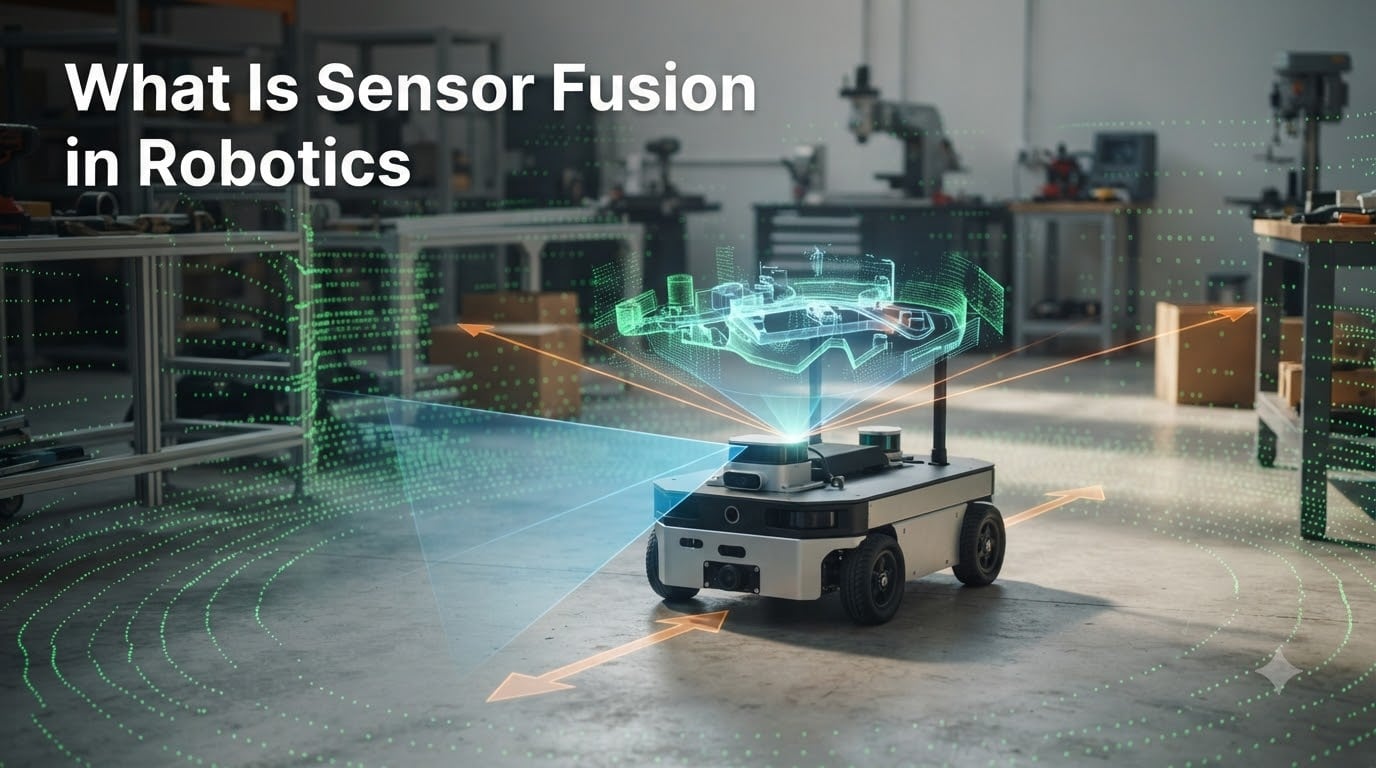
If you have ever wondered how a self-driving car knows where it is on the road, how a drone holds a steady hover in a crosswind, or how a robot vacuum maps your living room without crashing into the couch, the answer is the same: sensor fusion in robotics. This guide explains what sensor fusion is, how it works under the hood, and why nearly every modern robot relies on it.
I have spent years working with robots of all sizes, from small Arduino rovers to full-size autonomous platforms. I have watched beginners struggle because they trusted a single sensor too much. I have also seen expert teams ship robots that fail because they ignored calibration. The single biggest lesson I keep relearning: one sensor is never enough. Combining sensors is what turns a pile of parts into a robot that actually works.
By the end of this article, you will understand what sensor fusion is, the different ways engineers fuse data, the algorithms behind the scenes, the sensors most commonly combined, and how you can start experimenting yourself, even on a hobby budget.
Table of Contents
What Is Sensor Fusion in Robotics? A Clear Definition
Sensor fusion in robotics is the process of combining data from multiple sensors to produce a more accurate, reliable, and complete understanding of a robot’s state and environment than any single sensor could provide on its own. Each sensor in a robot has strengths and weaknesses. Cameras give rich detail but struggle in low light. LiDAR gives precise distances but misses color. IMUs update hundreds of times per second but drift over time. Fusing their data cancels out the weaknesses and amplifies the strengths.
The goal is not just to average readings. The goal is to produce a single, internally consistent model of the world that a robot can use to decide what to do next. That model might include the robot’s position, velocity, orientation, and a map of nearby objects. We call this model the state estimate, and building it is the heart of sensor fusion.
You will see the term used interchangeably with data fusion and multi-sensor integration. In robotics, sensor fusion specifically refers to combining physical sensor streams in real time, often using probabilistic methods, to support perception, localization, and control.
If you are new to robotics perception, our guide on what FPGAs are and how they are used in robotics explains the hardware side of high-speed sensor processing.
How Sensor Fusion Works in Robotics
Sensor fusion works by integrating data from multiple sensors, reducing noise and measurement errors, and compensating for individual sensor limitations through overlapping coverage. The process has a few core stages that repeat continuously while a robot operates.
The Sensor Fusion Pipeline Step by Step
- Data acquisition. Each sensor reports its own measurements, such as distance, acceleration, or image pixels, at its own sample rate.
- Preprocessing. Raw data is cleaned. This step filters out obviously bad readings, removes outliers, and converts values into common units.
- Time alignment. Sensors sample at different rates. Data is timestamped and aligned so events happening at the same moment are processed together.
- Feature extraction. Useful information is pulled from each stream. For a camera, that might be feature points. For a LiDAR, that might be detected planes or edges.
- State estimation. The combined evidence is fed into a fusion algorithm, usually a filter, that produces the best estimate of the robot’s state given all available data and known uncertainties.
- Feedback to the robot. The resulting state estimate is sent to the navigation, planning, and control systems, which use it to decide what the robot should do next.
Each step happens continuously. On a typical autonomous car, the entire pipeline may run 50 to 200 times per second. The choice of algorithm matters as much as the choice of sensors.
Two ideas come up over and over in fusion: complementary sensors and redundant sensors. Complementary sensors cover each other’s blind spots, like a camera plus LiDAR. Redundant sensors measure the same thing so the robot can detect when one fails, like two wheel encoders on the same axle.
Types and Levels of Sensor Fusion
There are different ways to classify sensor fusion, and the literature uses two main cuts: architecture (where fusion happens) and level (where in the processing chain it happens). Understanding both helps you choose the right approach for your project.
Fusion by Architecture
Centralized fusion sends raw data from every sensor to a single processing unit. This gives the best accuracy because nothing is thrown away, but it requires huge bandwidth and compute power. It is the architecture used in most research self-driving cars.
Distributed fusion processes data locally on or near each sensor, then shares only the resulting estimates. It scales better, is more fault tolerant, and is the architecture used in most production robots and drones.
Hierarchical fusion mixes the two. Low-level sensors process locally, then higher-level nodes combine their outputs. You will see this in large robot swarms and in modular industrial systems.
Fusion by Level of Processing
- Data-level fusion (also called pixel-level fusion) combines raw sensor data before any interpretation. It preserves the most information but requires very tight time alignment and is rarely used outside of image-plus-image work.
- Feature-level fusion extracts features from each sensor, then fuses those features. This is the most common level in robotics, for example fusing LiDAR points with image features for object detection.
- Decision-level fusion lets each sensor make its own decision (such as obstacle ahead or free space), then combines those decisions. It is the simplest, most robust, and easiest to debug, but it throws away information.
Most real robots use a mix. A self-driving car, for example, might fuse cameras and LiDAR at the feature level for object detection, and fuse IMU and GPS at the decision level for fault detection.
Common Sensor Combinations Used in Robotics
Sensor fusion is only as good as the sensors you choose to combine. Over time, the robotics community has settled on a few tried-and-true pairings. Here are the combinations I see most often in working robots.
IMU + GPS for Outdoor Navigation
The inertial measurement unit gives fast updates about acceleration and rotation, but its position estimate drifts. GPS gives stable absolute position but updates slowly and drops out near buildings. Fusing the two gives a navigation solution that is both smooth and accurate, which is why almost every outdoor robot, from autonomous tractors to delivery robots, uses this pair.
LiDAR + Camera for Perception
LiDAR provides accurate 3D geometry but cannot read signs or detect color. Cameras provide rich color and texture but struggle with depth. LiDAR-camera fusion is the backbone of modern object detection and is the standard perception stack in self-driving cars.
Wheel Encoders + IMU for Odometry
Wheel encoders track how far each wheel has rolled, which gives a good short-term estimate of distance traveled. They slip, however, on loose ground. IMUs fill in during slips and also provide orientation. Together they form a robust dead-reckoning system, which is why this combination is so common in mobile robots.
Depth Camera + IMU for Visual-Inertial Odometry
Visual-inertial odometry, often called VIO, fuses camera images with IMU data to estimate motion. It is the technology behind most AR/VR headsets, drone stabilization, and indoor robots. Platforms like the Intel RealSense and the ZED SDK ship VIO out of the box.
Ultrasonic + Infrared for Low-Cost Obstacle Avoidance
For hobbyists on a budget, combining a few cheap ultrasonic and infrared sensors at different heights on a small robot is a great way to learn the basics. The sensors are redundant, which lets the robot detect when one of them fails.
Sensor Fusion Algorithms You Should Know
Algorithms are where the magic of sensor fusion really happens. They turn a pile of noisy measurements into a clean, useful state estimate. Here are the algorithms you will meet again and again in robotics.
Kalman Filter
The Kalman filter is the workhorse of sensor fusion. It assumes sensors are noisy but their noise follows a Gaussian distribution, and it computes an optimal linear estimate of the system state. The Kalman filter is light, fast, and runs in real time on microcontrollers. Its main limitation is the linearity assumption, which real robots often violate.
Extended Kalman Filter (EKF)
The EKF linearizes the system around the current estimate, which lets it handle mildly nonlinear problems like rotating robots. EKF is the most common filter in real-world robotics. It is what most GPS+IMU units run internally, and it is the default in many ROS packages.
Unscented Kalman Filter (UKF)
The UKF picks a small set of sample points to capture the shape of the probability distribution, which gives better accuracy than the EKF on highly nonlinear systems. It costs more per step but converges faster.
Particle Filter
A particle filter represents the state distribution as a cloud of weighted samples, called particles. It can represent any shape of distribution, which makes it perfect for global localization and SLAM. It is heavier than a Kalman filter, but it handles ambiguity and multimodal beliefs very well.
Complementary Filter
The complementary filter is a simple, low-cost option often used to fuse accelerometer and gyroscope data on small drones. It is not as accurate as a Kalman filter, but it is easy to tune, runs on 8-bit microcontrollers, and is good enough for many hobby projects.
If you are planning to run any of these on hardware, our guide on what a BeagleBone is and when to use one is a good starting point. The BeagleBone is well suited to running sensor fusion workloads in real time.
Real-World Applications in Robotics
Sensor fusion is not just an academic idea. It is the reason modern robots can do things that would have been impossible a decade ago. Here are the application areas where I have seen fusion make the biggest difference.
Autonomous Vehicles
Self-driving cars are probably the most sensor-fusion-heavy robots in existence. A typical robotaxi fuses data from multiple LiDARs, radar units, cameras, GNSS receivers, and IMUs. Without fusion, the car would be unable to tell a pedestrian from a shadow or know where it is on a foggy night.
Aerial Robots and Drones
Quadcopters and other UAVs depend on IMU fusion for stable flight. Adding GPS and a downward camera turns a basic drone into a mapping platform. Adding LiDAR or a depth camera enables obstacle avoidance, which is what lets modern inspection drones fly inside cluttered industrial sites.
Mobile and Service Robots
Warehouse robots, hospital delivery robots, and cleaning robots all use sensor fusion to navigate. They typically combine wheel odometry, 2D or 3D LiDAR, and sometimes cameras. SLAM, which stands for Simultaneous Localization and Mapping, is itself a sensor fusion problem.
Industrial Robotic Arms
Even stationary robot arms benefit from fusion. Force-torque sensors combined with vision let an arm perform precise insertion tasks. Modern collaborative robots use multiple joint encoders plus force sensors to stay safe around people.
Benefits and Challenges of Sensor Fusion
Sensor fusion delivers real value, but it is not free. Here is the honest trade-off picture I share with every team I work with.
The Main Benefits
The most important benefit is redundancy. If one sensor fails or gets blinded, others cover for it. Fusion also delivers improved accuracy, because noise from independent sensors tends to average out. It provides completeness, since different sensors see different aspects of the world. Finally, fusion enables uncertainty awareness: a good fusion system not only gives you an estimate, it also tells you how much to trust that estimate.
The Main Challenges
Fusion is hard because calibration is hard. A camera and a LiDAR that are not calibrated to within millimeters will give you nonsense. Sensors also need to be time-synchronized, often to within microseconds, which requires careful hardware design. Fusion algorithms are mathematically demanding, and the computational cost can be significant, especially for particle filters. Finally, debugging a fused system is notoriously tricky because a single bad sensor can quietly poison the whole estimate.
Plan for these challenges from day one. Build calibration routines before you build features. Log raw sensor data so you can replay and debug. And always design your robot to fail safe if one sensor drops out.
Getting Started With Sensor Fusion as a Hobbyist
The good news is that getting started with sensor fusion no longer requires a research lab. Hobbyists can build real fusion systems today for under one hundred dollars, and the software ecosystem is friendlier than ever.
Start With an IMU and a Complementary Filter
The cheapest entry point is a 9-DoF IMU board, like the MPU-9250 or the BNO055, paired with an Arduino. The BNO055 even has a built-in fusion processor that gives you orientation out of the box. This is a great way to learn the basics without getting lost in math.
Add a Camera for Visual-Inertial Fusion
Once you are comfortable, add a small camera module and try a visual-inertial odometry library. Open-source options like ORB-SLAM, VINS-Mono, and RTAB-Map run well on a Raspberry Pi 4 or 5. You will quickly move from theory to a working mapping system.
Use the Robot Operating System
ROS, the Robot Operating System, includes battle-tested sensor fusion packages. The robot_localization package implements EKF and UKF sensor fusion out of the box. There is a learning curve, but the time you invest pays back many times over.
Consider a More Capable Board
As your projects grow, you will outgrow microcontrollers. A Raspberry Pi handles camera fusion well. A BeagleBone gives you real-time I/O for tighter sensor timing. An FPGA, covered in detail in our FPGA robotics guide, can run custom fusion pipelines at very high speed. Match the board to your fusion algorithm, not the other way around.
My advice: start small, log everything, and add sensors one at a time. Each new sensor should solve a real problem on your robot. Avoid the temptation to throw every sensor you own at the problem. The cleanest fusion systems I have ever built came from restraint, not abundance.
Frequently Asked Questions
What is the purpose of sensor fusion?
The purpose of sensor fusion in robotics is to combine data from multiple sensors so a robot can perceive its environment and its own state more accurately and reliably than any single sensor could. By merging complementary and redundant measurements, fusion reduces noise, cancels out individual sensor weaknesses, and provides a single trustworthy estimate that the robot’s planning and control systems can act on.
What is the difference between sensor fusion and data fusion?
Data fusion is a broad term that covers combining any kind of information from multiple sources, including databases, reports, or non-sensor inputs. Sensor fusion is a specific subset of data fusion that focuses on combining real-time signals from physical sensors. In robotics, sensor fusion is almost always the relevant discipline because the inputs are time-stamped sensor measurements that must be aligned and processed continuously.
What are the different types of sensor fusion?
The main types of sensor fusion are organized two ways. By architecture, fusion can be centralized, distributed, or hierarchical. By processing level, fusion can happen at the data level, the feature level, or the decision level. Most robots use a mix, fusing some sensors at the feature level for accuracy and others at the decision level for robustness and easier debugging.
What is sensor fusion data?
Sensor fusion data is the combined output produced when raw measurements from multiple sensors are merged into a single, unified estimate. It typically includes a state estimate such as position, velocity, and orientation, plus an associated uncertainty that tells the robot how much to trust that estimate. The robot’s control software then uses this fused data instead of any individual sensor’s raw readings.
How does sensor fusion improve robot perception?
Sensor fusion improves robot perception by combining complementary information from multiple sensors, which compensates for the limitations of any one sensor. A camera might miss depth, a LiDAR might miss color, and an IMU might drift, but fusing all three yields a perception output that is more accurate, more complete, and more robust to noise, lighting changes, and partial sensor failures.
What sensors are used in robotics for sensor fusion?
Common sensors used in sensor fusion in robotics include IMUs, GPS/GNSS receivers, wheel encoders, LiDAR, cameras, depth cameras, radar, ultrasonic sensors, and force-torque sensors. The exact combination depends on the robot and its task, but the goal is always the same: pick a set of sensors whose strengths and weaknesses complement each other.
Conclusion
Sensor fusion in robotics is the discipline of turning multiple imperfect sensors into a single, trustworthy picture of the world. It is the quiet technology behind self-driving cars, warehouse robots, mapping drones, and even hobbyist projects. Without fusion, every sensor stands alone, and every robot would be only as good as its weakest measurement.
You have seen what sensor fusion is, how the pipeline works, the different types and levels, the most common sensor pairings, the key algorithms from the Kalman filter to particle filters, and how to start experimenting yourself. The path from here is simple. Pick one sensor pair, learn one filter, and watch your robot become noticeably more capable.
If you want to keep going, the FPGA guide and the BeagleBone guide linked above are the next logical reads. They will help you match the hardware to the algorithm so your sensor fusion system runs fast and reliably. The robots of 2026 will be defined by how well they fuse their sensors, and now you have the foundation to build them.