
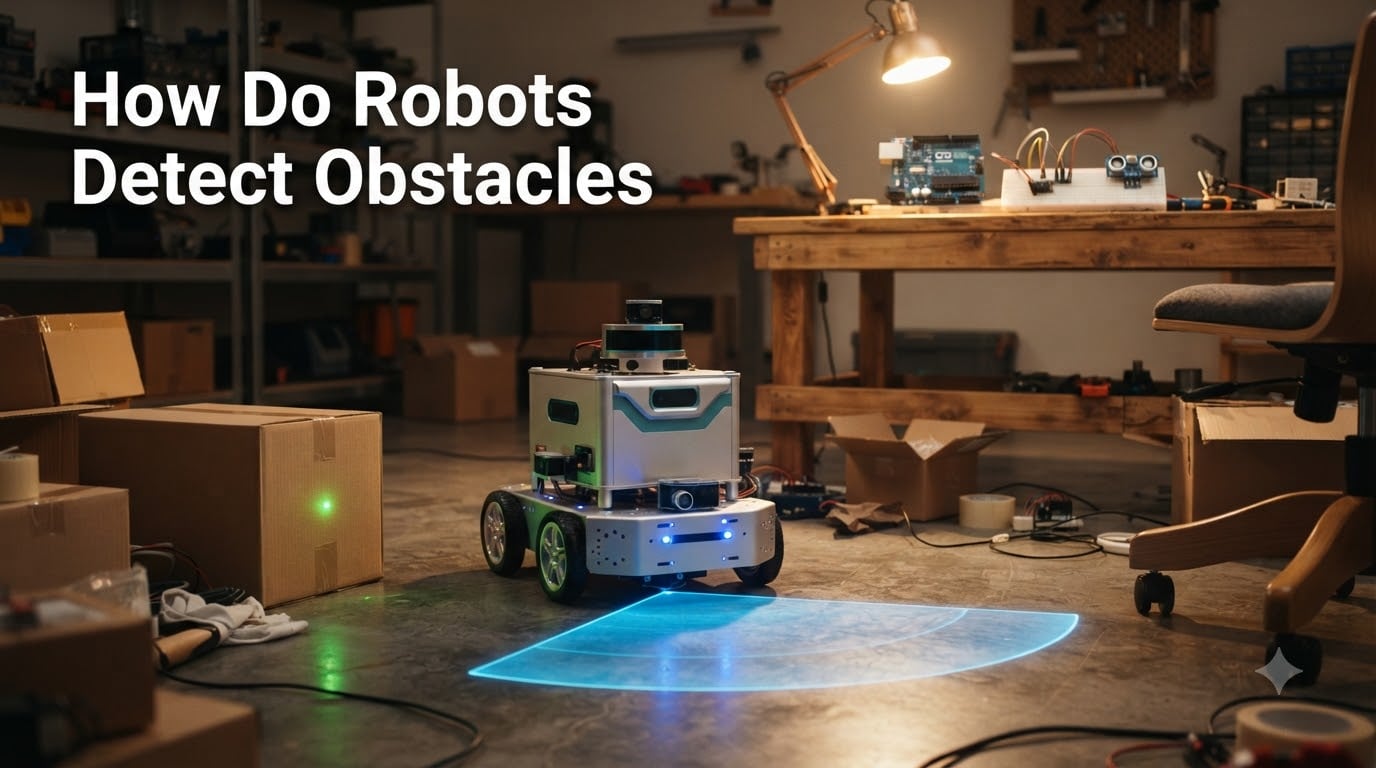
Robots detect obstacles by combining physical and electronic sensors, such as LiDAR, ultrasonic, infrared, and cameras, to scan their surroundings, then running software algorithms in real time that turn those readings into a spatial map and a safe motion decision. If you have ever watched a robot vacuum weave around a chair leg or a drone brake before a tree branch, you have already seen this two-part system in action.
In this guide I will walk you through the exact hardware and software stack that makes modern obstacle detection possible, the tradeoffs between the most common sensor families, and how to pick the right combination for your own robot project. We will look at the step-by-step physics of how a sensor pulse becomes a “turn left” command, how algorithms like SLAM and A* plan around those detections, and what is changing in 2026 as edge AI and neuromorphic vision push the field forward.
Whether you are a robotics hobbyist wiring an Arduino, an engineer designing an autonomous mobile robot (AMR) for a warehouse, or just curious about the technology, by the end of this article you will have a clear mental model of how robots perceive the world and avoid bumping into it.
Table of Contents
What Is Obstacle Detection in Robotics?
Obstacle detection in robotics is the process of using sensors and software to identify objects in a robot’s path and gather enough information about them to avoid a collision. The robot does not need to “know” what the object is in the human sense; it only needs a position, a distance, and ideally a velocity, then a decision about whether to stop, slow down, or reroute.
Modern systems almost always rely on two cooperating layers. The first is the sensor layer, which can include LiDAR, ultrasonic transducers, infrared proximity sensors, depth cameras, RGB cameras, radar, or simple bump switches. The second is the software layer, which interprets raw measurements as a depth map, an occupancy grid, or a labeled bounding box, then feeds that representation into a planner that decides the next motion command.
Real time is the key constraint. A robot vacuum has about 50 to 200 milliseconds to detect a wall, plan a turn, and apply new wheel speeds before it makes contact. A highway autonomous vehicle has even less. That is why most modern robots fuse multiple sensor types: each one covers a weakness in the others, and together they keep the perception pipeline running at the latency the application demands.
How Do Robots Detect Obstacles Step by Step
Regardless of which sensor you pick, every obstacle detection system follows the same five-step pipeline. Understanding this loop makes the differences between LiDAR, cameras, and ultrasonics much easier to reason about, because each step has a single job and a single failure mode.
- Emit a signal. The sensor sends out a pulse of light, sound, or radio waves toward the area in front of the robot. A LiDAR fires a laser pulse, an ultrasonic sensor produces a 40 kHz chirp, and a Time-of-Flight (ToF) camera flashes an infrared floodlight.
- Wait for reflection. The pulse hits an object and a portion of the energy bounces back toward the sensor. The shape, angle, and material of the object all change how much energy returns.
- Measure the return. The sensor records the time of flight, phase shift, or signal strength of the reflection. Distance is then calculated using the speed of light or sound: distance = (speed x time) / 2, with the divide-by-two because the signal travels out and back.
- Process the measurement. Onboard software turns a stream of distance readings into a useful spatial format, usually a 2D scan line, a 3D point cloud, a depth image, or a labeled bounding box. Filtering algorithms remove noise, cluster nearby points, and track objects across frames.
- Decide on motion. The planner compares the obstacle map to the robot’s current goal and outputs a new velocity command. This could be a hard stop, a swerve around the object, or a full path replan via SLAM.
This loop runs continuously, often 10 to 100 times per second depending on the sensor. When you watch a LiDAR-equipped robot slow down as it approaches a person, that is one full iteration of the loop: laser pulse, return, measurement, classification, brake command, repeat.
Types of Sensors Robots Use to Detect Obstacles
There is no single best sensor for obstacle detection. Each technology has a sweet spot, and most serious robots carry two or three different types. Below are the seven sensor families you will encounter most often in 2026, along with the strengths and blind spots of each.
LiDAR Sensors
LiDAR, which stands for Light Detection and Ranging, is one of the most popular obstacle detection sensors in modern robotics. A LiDAR unit fires rapid laser pulses (usually at 905 nm or 1550 nm wavelengths) and times how long each one takes to return. Rotating LiDARs sweep a full 360-degree scan up to 20 times per second, producing a dense 2D or 3D point cloud of the surroundings.
LiDAR excels at long range (often 100 m or more for automotive units), millimeter-level accuracy, and reliable operation in darkness. It works poorly in heavy rain, fog, or snow, which scatter the laser pulses, and it can struggle with mirror-like surfaces that bounce energy away from the sensor. Solid-state LiDAR units are now common in robot vacuums and AMRs, replacing older spinning designs at lower cost.
Ultrasonic Sensors
Ultrasonic sensors are the workhorse of hobbyist robotics. The most common module, the HC-SR04, emits a 40 kHz sound pulse and listens for the echo. Because sound is so much slower than light, the time-of-flight is long enough to measure cheaply with a microcontroller.
They are dirt cheap (often under $2), easy to wire to an Arduino, and fairly immune to lighting conditions. The downsides are real, though: typical range is 2 cm to 400 cm, beam width is wide (around 15 degrees), and soft materials like fabric can absorb the pulse entirely. Ultrasonic sensors are great for “is there something in front of me” but poor for “what exactly is there and how far.”
Infrared Sensors
Infrared (IR) proximity sensors work by emitting an IR LED pulse and measuring how much light bounces back to a photodiode. Sharp GP2Y0A21 units, for example, output an analog voltage that corresponds to distance between roughly 10 cm and 80 cm.
IR sensors are small, light, and fast. They are perfect for short-range cliff detection on robot vacuums and for line-following robots. They are also heavily dependent on surface reflectivity: a white wall reads as much closer than a black couch at the same distance. Most modern robots use IR only as a complementary sensor, not as a primary obstacle detector.
Cameras and Computer Vision
Camera-based obstacle detection uses one or more regular RGB cameras paired with computer vision algorithms. A monocular camera estimates depth using motion parallax, learned models, or known object sizes. A stereo camera pair computes depth directly through triangulation, similar to how human eyes work.
Modern deep learning models like YOLO, DINO, and Depth Anything can detect, classify, and estimate distance to obstacles from a single camera feed, which is why vision is now the dominant sensor family in humanoid robots and autonomous vehicles. The catch is that cameras struggle in low light, glare, and featureless environments (a white wall is just a white wall, no parallax to extract), and they require significant compute, often a dedicated GPU or NPU.
Depth Cameras and ToF Sensors
Depth cameras, also called RGB-D cameras, combine a regular color image with a per-pixel distance reading. Time-of-Flight (ToF) sensors like the Intel RealSense D455, Stereolabs ZED 2i, and Luxonis OAK-D produce a full 3D point cloud at 30 to 90 frames per second.
ToF cameras flood the scene with modulated IR light and measure the phase shift of the returning light to compute distance. They are excellent for indoor obstacle detection, robotic arm grasping, and 3D SLAM. They have shorter range than LiDAR (usually under 10 m), can be confused by multiple reflections, and struggle in direct sunlight where the ambient IR swamps the signal.
Bump and Touch Sensors
Bump sensors are the simplest obstacle detectors of all: a mechanical switch, a microswitch, or a flexible whisker that closes a circuit on contact. They are the last line of defense on many robots, used to confirm that an object was actually touched if every other sensor missed it.
They cannot predict a collision, only confirm one. That is why they are never used alone. In a layered safety stack, however, they are incredibly valuable as a hardware-level fail-safe. If all perception software fails, the bump switch can still stop the robot before it damages something.
Radar Sensors
Radar, which uses radio waves instead of light, is a long-range, weather-resistant sensor originally developed for aviation. Automotive radar at 77 GHz can detect vehicles at 200 m and pedestrians at 50 m, even through fog, rain, and dust. Newer 4D imaging radar adds height resolution.
Radar is now standard in autonomous vehicles and is making its way into outdoor AMRs, agricultural robots, and security drones. It has lower angular resolution than LiDAR, so it is almost always paired with a camera or LiDAR for fine-grained obstacle classification.
How Robots Process Sensor Data to Avoid Obstacles
Sensors only produce numbers. Turning those numbers into a safe path requires a software stack that can filter noise, fuse multiple sources, plan around obstacles, and re-plan when the world changes. The most common layers in that stack are reactive avoidance, path planning, and SLAM.
Reactive Avoidance
Reactive avoidance is the simplest form of obstacle response: when an obstacle is detected, the robot immediately changes its behavior without any memory of the past. The classic Braitenberg vehicle, for example, connects a left-side sensor to a right-side motor and vice versa, causing the robot to swerve away from anything it senses.
More advanced reactive systems use the subsumption architecture, where behaviors like “avoid obstacle,” “wander,” and “seek goal” run in parallel and higher-priority behaviors can override lower-priority ones. Reactive systems are fast, predictable, and computationally cheap, which is why they are the foundation of most robot vacuum firmware. They do not, however, plan an optimal path; they only react to the immediate situation.
Path Planning Algorithms
Path planning algorithms take the current obstacle map and the robot’s goal and compute an efficient route that avoids collisions. The two most famous are A* (A-star) and Dijkstra’s algorithm. A* uses a heuristic to search the grid faster than Dijkstra, and it remains the workhorse of mobile robot navigation in tools like ROS Nav2.
More advanced planners, including D* and RRT (Rapidly-exploring Random Trees), can replan on the fly when new obstacles appear. D* is common in unknown environments because it can re-use previous search results instead of starting from scratch. RRT is popular for high-dimensional problems like robotic arms with many joints.
SLAM and Mapping
SLAM stands for Simultaneous Localization and Mapping. The robot is asked to do two things at once: build a map of its environment and figure out where it is on that map. SLAM algorithms like Cartographer, ORB-SLAM, and LIO-SAM turn a stream of LiDAR or camera measurements into a consistent 2D or 3D map while tracking the robot’s pose over time.
SLAM is the backbone of autonomous navigation. Once a robot has a map and knows its own location, obstacle detection is reduced to comparing incoming sensor data against the map. Anything in the map that is not in the current scan is a static obstacle; anything new in the current scan but not in the map is a dynamic obstacle that needs special handling.
Sensor Fusion and Multimodal Data
Sensor fusion is the practice of combining data from multiple sensors to get a perception result that is better than any single sensor could produce. The Kalman filter, the Extended Kalman Filter (EKF), and newer graph-based optimizers all serve this role.
For example, a robot vacuum might fuse LiDAR (accurate geometry), an RGB camera (semantic understanding of what objects are), wheel odometry (short-term motion), and an IMU (orientation changes when the robot bumps). The fused state estimate is more accurate, more robust to sensor failures, and more informative than any one source on its own.
3D vs 2D Obstacle Detection
The choice between 2D and 3D obstacle detection comes down to how much of the environment your robot needs to “see.” A 2D sensor returns a flat scan line at a single height, like a single slice of the world. A 3D sensor returns a full volumetric point cloud with width, height, and depth for every point.
2D LiDAR is cheap, fast, and well-understood, which is why it dominates warehouse AGVs operating in flat environments with no overhangs. The problem is that 2D sensors miss anything above or below their scan plane. A forklift tine, a hanging cable, a tabletop edge, or a low curb can all be invisible to a 2D scanner, even when the robot is about to drive into them.
3D detection uses depth cameras, solid-state 3D LiDAR, or stereo vision to capture the full scene. It is more expensive, generates more data (often millions of points per second), and requires more onboard compute, but it is the only safe option for human-scale robots, drones, and any environment with three-dimensional obstacles. The MRDVS CV-SLAM camera, for example, combines a wide-angle ToF sensor with edge AI to deliver real-time 3D obstacle avoidance at 20 Hz for low-profile AGVs.
If your robot operates in a controlled, flat environment, 2D LiDAR is the right call. If it shares space with people, pets, or uneven terrain, go 3D or accept the safety risk.
Limitations and Challenges of Each Sensor Type
Every sensor family has failure modes. Knowing them is what separates a robot that works in a lab demo from one that works in a busy warehouse. Here are the limitations you will hit, drawn from real user reports on ROS and Arduino forums.
Ultrasonic: Range is limited (usually under 4 m), beam width is wide, soft surfaces absorb the sound, and a slanted surface can deflect the pulse entirely. Two ultrasonic sensors firing at once can also cross-talk and produce false readings.
LiDAR: Performance degrades in fog, heavy rain, and snow. Bright sunlight can saturate the detector on some units. Mirror-like surfaces and very black objects can both return little or no signal. Cost remains a barrier for hobbyists, with quality 2D units starting around $100 and 3D units running into the thousands.
Camera / vision: Performance collapses in low light, glare, or textureless scenes. Monocular depth estimation can be fooled by unusual object sizes. Compute requirements are high, which means more power draw and more heat to manage.
Infrared: Output varies wildly with surface color and reflectivity. Sunlight contains strong IR and can saturate the sensor outdoors. Range is short, often under 1 m.
Bump sensors: They only trigger on contact, by which point the robot is already colliding. They are useful as a safety backup, never as the primary detection system.
These are exactly the reasons real robots use multiple sensor types. Each one covers the gaps in the others.
How to Choose the Right Sensor for Your Robot
Sensor selection is an engineering tradeoff, not a “best one” question. Before you buy anything, answer four questions: what environment will the robot operate in, what is the maximum detection range you need, what is your compute and power budget, and what is your cost ceiling. The matrix below maps the most common use cases to the sensors that actually work in production today.
- Indoor home (robot vacuum, hobby robot): Combine a 2D LiDAR or 3D ToF camera for mapping with IR cliff sensors and bump switches. Add a single front-facing RGB camera if you want object recognition (shoes, pet waste, cables).
- Indoor warehouse AMR: Use a 2D safety-rated LiDAR as the primary obstacle sensor, with a 3D depth camera for areas where humans and forklifts mix. Add wheel odometry and an IMU for state estimation.
- Outdoor delivery or lawn mower robot: You need weather resistance, so add automotive radar or a long-range outdoor LiDAR. GPS plus RTK handles global positioning; vision handles the last few meters around obstacles.
- Aerial drone: Vision-based obstacle avoidance dominates because LiDAR is heavy and expensive. The latest DJI drones, for example, use six fisheye cameras plus a forward ToF sensor for omnidirectional sensing.
- Autonomous vehicle: Layered stack of automotive radar, multiple LiDARs, and a ring of cameras, all fused through a central compute platform running the perception stack at 30 Hz or faster.
A useful rule of thumb: start with the cheapest sensor that can solve the problem in the easiest environment, then add redundancy for the failure cases you actually care about. Hobbyists should start with an HC-SR04 ultrasonic and a servo, then graduate to a 2D LiDAR like the RPLidar A1 once they outgrow the ultrasonic’s range.
Applications of Robot Obstacle Detection
Obstacle detection is no longer confined to research labs. It is shipping in millions of consumer devices and tens of thousands of industrial robots. Here are the deployment scenarios I find most instructive.
Robot Vacuums and Consumer Robots
Modern robot vacuums are obstacle detection marvels at a low price point. The top models combine a top-mounted LiDAR for whole-room mapping, a front-facing camera or 3D sensor for object recognition (so the vacuum avoids pet waste and stray cables), IR cliff sensors on the bottom to prevent stair falls, and bump switches as a final safety net. They are a great case study in how sensor fusion lets a $300 device do what used to require a $30,000 industrial robot.
AGVs and AMRs in Warehouses
Automated Guided Vehicles (AGVs) follow fixed paths, often using magnetic tape or QR codes on the floor, while Autonomous Mobile Robots (AMRs) navigate freely. AMRs use 2D safety LiDAR to detect humans, pallets, and other robots in real time, with 3D sensors added in busy zones. Safety-rated LiDAR is treated as a functional safety device and certified to standards like ISO 13849.
Drones and Aerial Robots
Drone obstacle avoidance has improved dramatically. The latest DJI Mavic and Air models use a six-camera vision system plus a forward ToF sensor to detect and avoid obstacles in all directions, even at speed. DJI’s APAS system can plan a path around an obstacle and resume the original mission without operator input.
Autonomous Vehicles
Self-driving cars are the most complex deployment of obstacle detection. A typical robotaxi uses multiple LiDARs, a ring of cameras, several radar units, and ultrasonic sensors for close-range parking, all fused into a real-time 3D model of the road. The processing requirements are extreme, often multiple kilowatts of compute per vehicle, which is why most autonomous vehicle companies are also developing their own AI silicon.
Healthcare and Service Robots
Hospital delivery robots, like those from Diligent Robotics and Aethon, navigate busy corridors full of people, beds, and equipment. They use a 360-degree LiDAR plus depth cameras and rely heavily on SLAM to localize in a building where GPS does not work. Obstacle detection in this setting is safety-critical: a collision with a patient or a fragile IV line is unacceptable.
DIY Obstacle Detection: Building an Arduino Robot
You can build a working obstacle-avoiding robot in an afternoon for under $30 in parts. The classic setup uses an Arduino Uno, an HC-SR04 ultrasonic sensor mounted on a small servo, two DC motors with a motor driver, and a simple chassis. The idea is that the sensor scans the area in front of the robot, and the robot turns away from anything closer than 25 cm.
Wire the HC-SR04 as follows: VCC to 5V, GND to GND, Trig to digital pin 9, Echo to pin 10. Mount the sensor on the servo horn so it can sweep left and right. The motor driver takes commands from pins 5, 6, 10, and 11 (or any free PWM-capable pins).
A minimal sketch sends a 10-microsecond pulse on the Trig pin, measures the Echo pulse width with pulseIn(), divides by 58 to get distance in centimeters, and then issues motor commands: forward if the front is clear, slight right turn if the right side is closer than the left, and vice versa. You can find the full code in any beginner Arduino obstacle-avoiding robot tutorial; the important point is that the same emit-reflect-measure-process-act loop we covered earlier is happening in your kitchen.
Once that works, swap the HC-SR04 for a 2D LiDAR like the RPLidar A1 and an ESP32 or Raspberry Pi, and you have a robot that can build a real map of its environment and plan paths around obstacles, the same architecture as a $10,000 industrial AMR.
Future Trends in Robot Obstacle Detection
The field is moving fast. Three trends are reshaping obstacle detection in 2026 and will define the next five years.
Edge AI and onboard inference. Modern robot controllers like the NVIDIA Jetson Orin and the Qualcomm RB5 Robotics Platform can run perception models at the edge, with no cloud connection. That means a robot can detect and classify obstacles in milliseconds, even without internet access. Latency drops, privacy improves, and robots can operate in places with no connectivity.
Neuromorphic and event cameras. Event cameras like the Prophesee Metavision sensor only report changes in the scene, not full frames. They have microsecond latency, enormous dynamic range, and use a fraction of the power of a regular camera. They are still expensive, but they are starting to appear in research drones and high-speed industrial robots where traditional cameras saturate or lag.
Semantic obstacle recognition. Knowing that something is in the way is useful; knowing it is a person versus a cardboard box versus a glass wall is transformative. Foundation models for robotics, including RT-2, PaLM-E, and the latest vision-language-action models, are starting to bring semantic understanding directly into the obstacle detection pipeline. A robot that can tell the difference between a sleeping dog and a pile of laundry is much safer than one that just knows to stop.
Add improvements in solid-state 3D LiDAR (cheaper, smaller, automotive-grade), 4D imaging radar, and SLAM that runs entirely in the cloud for collaborative mapping, and the next few years of robot obstacle detection are going to look very different from today.
Frequently Asked Questions
What is obstacle detection in robotics?
Obstacle detection in robotics is the process of using sensors and software to identify objects in a robot’s path. Sensors such as LiDAR, ultrasonic, infrared, and cameras collect distance and image data, and onboard algorithms turn that data into a spatial map the robot can use to avoid collisions in real time.
Which sensor helps a robot detect obstacles?
There is no single best sensor, but the most common ones are LiDAR for long-range accuracy, ultrasonic sensors for low-cost short-range detection, infrared sensors for close proximity, depth and RGB cameras for visual understanding, and bump switches as a last-resort safety backup. Most production robots combine two or more of these for sensor fusion.
How can a robot avoid obstacles?
A robot avoids obstacles by running a perception-to-action loop: sensors detect objects, software builds a map of their position, a planner compares the map to the robot’s goal, and the controller issues a new motion command such as stop, slow down, or turn. The loop runs continuously, often 10 to 100 times per second.
How does an obstacle avoiding robot work?
An obstacle avoiding robot uses sensors like ultrasonic, LiDAR, or cameras to scan the area in front of it. When an object is detected within a set distance, the robot’s microcontroller decides whether to stop, turn, or reroute. In a simple Arduino build, an HC-SR04 ultrasonic sensor triggers a turn whenever the distance drops below 25 cm.
Can LiDAR be used for obstacle avoidance?
Yes. LiDAR is one of the most widely used sensors for obstacle avoidance in autonomous vehicles, AMRs, robot vacuums, and drones. It produces a dense 2D or 3D point cloud of the surroundings, which the robot’s planner uses to detect and route around obstacles in real time.
Can a robot be self-aware?
No, not in the human sense. Today’s robots can model their own state (position, velocity, battery level) and reason about the world, but they do not have consciousness, subjective experience, or self-awareness as understood in philosophy or cognitive science. They simulate awareness through sensors and algorithms rather than actually feeling it.
Conclusion
How do robots detect obstacles? They do it by layering physical sensors over smart software. The sensors, whether LiDAR, ultrasonic, infrared, depth cameras, RGB cameras, radar, or bump switches, turn physical energy into distance and image data. The software, including reactive avoidance, A* path planning, SLAM, and sensor fusion, turns that data into a spatial map and a safe motion command. Neither layer works well on its own; together they let a robot vacuum dodge a chair leg, an AMR share a warehouse aisle with a human, and a drone brake before it hits a tree.
If you are starting a project, my recommendation is to begin simple. Wire up an HC-SR04 and an Arduino, get the loop working, then graduate to a 2D LiDAR and a Raspberry Pi running ROS 2. As your robot grows, add cameras for semantic understanding, then more sensors for redundancy. The same architectural principles scale from a $30 hobby bot to a $100,000 autonomous vehicle.
For more deep dives on robot perception, mapping, and AI, keep exploring Smashing Robotics. The field is moving quickly in 2026, and the basics you have learned here will help you follow, and contribute to, what comes next.