
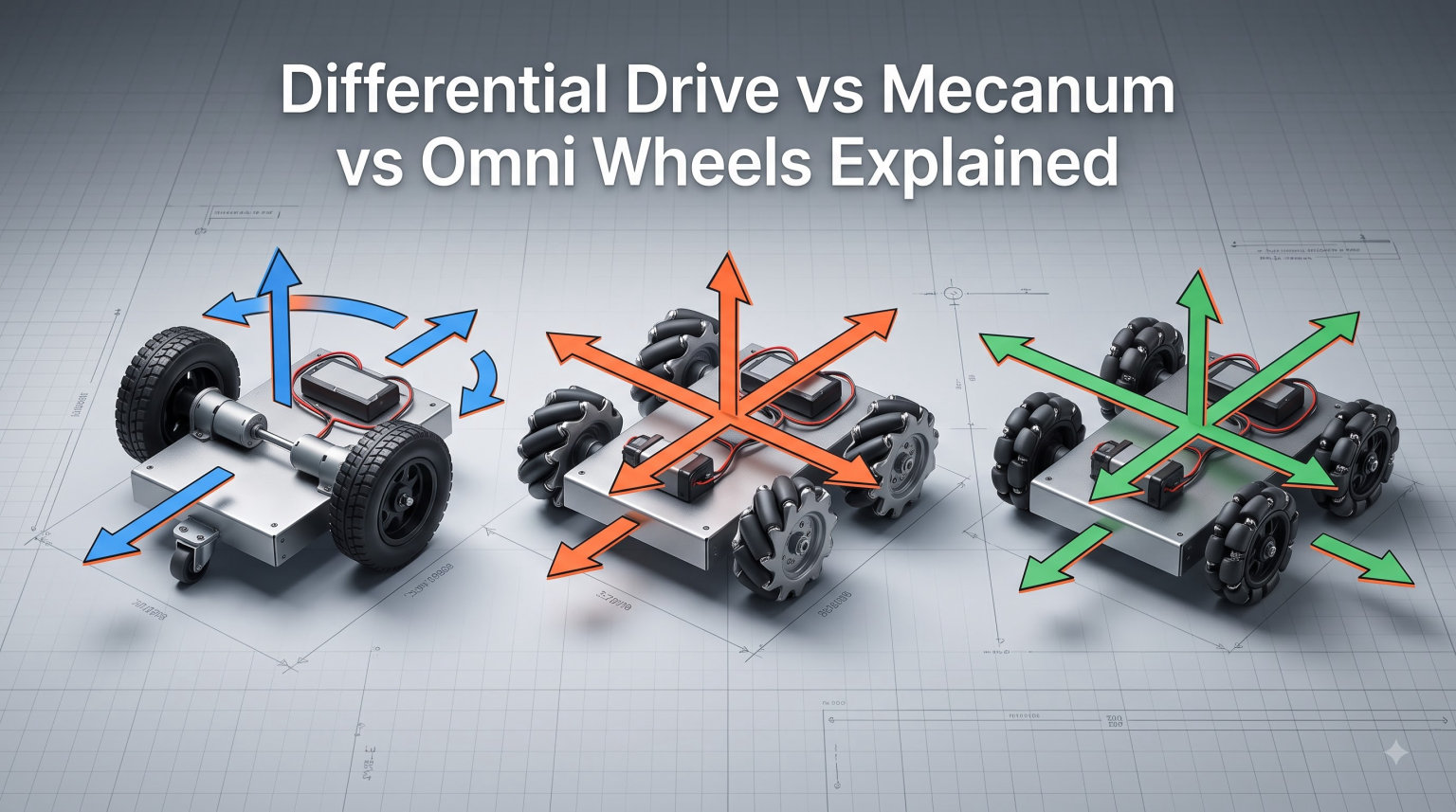
When you build a mobile robot, the wheel system you choose shapes everything that follows. Your decision affects how the robot moves, how hard it is to program, what surfaces it can handle, and how much money you spend over its lifetime. The three options that dominate mobile robot locomotion are differential drive, mecanum wheels, and omni wheels.
The question of differential drive vs mecanum vs omni wheels comes up in almost every robotics project, from FIRST Tech Challenge robots to warehouse autonomous mobile robots. Each system moves the robot in fundamentally different ways. Differential drive uses two independently driven wheels and turns by changing their relative speeds. Mecanum wheels use angled rollers to create omnidirectional movement. Omni wheels use a different roller arrangement to achieve similar freedom.
I have built robots with all three systems over the years. Each has strengths that make it the right choice in specific situations, and weaknesses that can derail a project if you do not account for them early. Our team has seen differential drive robots run reliably for years in factories while omni wheel robots struggle with the same floor surface.
This guide breaks down how each wheel type works, compares them head-to-head across maneuverability, cost, control complexity, and terrain adaptability. By the end, you will have a clear framework for picking the right system for your specific robot project.
Table of Contents
What Is Differential Drive and How Does It Work?
Differential drive is the simplest and most widely used mobile robot locomotion system. A differential wheeled robot uses two independently driven wheels placed on either side of the robot body, with one or more passive caster wheels or ball casters providing balance. The robot steers by varying the speed of the left and right wheels relative to each other.
Here is how the mechanics work in practice. When both wheels spin forward at the same speed, the robot moves straight. When the left wheel spins faster than the right, the robot turns right. When the wheels spin in opposite directions at equal speed, the robot rotates in place with a zero turning radius. This is the core principle behind differential steering.
The kinematics behind differential drive are straightforward. The linear velocity of the robot equals the average of the two wheel velocities. The angular velocity depends on the difference between the two wheel velocities divided by the track width. These simple relationships make differential drive the easiest system to model and control.
Advantages of Differential Drive
Differential drive wins on simplicity and reliability. Here is why so many robots use it:
Simplicity: You only need two drive motors, two motor controllers, and two encoders. The mechanical design is straightforward, and the wiring stays clean.
Low cost: Fewer motors and simpler wheels mean a lower bill of materials. Replacement parts are cheap and easy to source.
High traction and payload capacity: Standard wheels with rubber treads grip well on most surfaces. Differential drive robots can carry heavy loads without the rollers that introduce slippage on omni and mecanum systems.
Reliability at scale: Forum discussions on r/ROS and robotics communities consistently show that teams prefer differential drive for production and deployment scenarios because it simply works. Fewer moving parts mean fewer failure points.
Beginner-friendly programming: The control math is intuitive. Even students new to robotics can get a differential drive robot moving in an afternoon.
Limitations of Differential Drive
Differential drive is a non-holonomic system, which means it cannot move sideways without first rotating. This creates real limitations:
No lateral movement: The robot cannot slide left or right directly. To reach a point beside it, the robot must turn, drive forward, and turn again. This three-point turn wastes time and space.
Maneuvering in tight spaces is slow: While zero-radius rotation is possible, positioning in narrow aisles or crowded environments takes more motion than an omnidirectional robot would need.
Caster wheel drag: The passive caster wheels that provide balance can catch on uneven surfaces, thresholds, or debris, causing jerky movement and position errors.
Odometry drift on turns: Wheel slippage during turns introduces errors in position estimation over time, requiring sensor fusion or external references to correct.
Best Applications for Differential Drive
Differential drive shines in applications where straight-line travel and predictable paths matter more than lateral movement. Warehouse AGVs, delivery robots, lawn mowers, vacuum robots, and most educational platforms use differential drive. If your robot needs to follow paths, navigate corridors, or travel long distances efficiently, this is usually the right choice.
What Are Mecanum Wheels and How Do They Work?
Mecanum wheels are a type of omnidirectional wheel that allows a robot to move in any direction, including sideways and diagonally, without changing its orientation. The Mecanum wheel was invented by Bengt Erland Ilon in 1973 while working at the Swedish company Mecanum AB. Each wheel has a series of rollers mounted around its circumference at a 45-degree angle.
The secret to mecanum movement lies in those angled rollers. When a mecanum wheel spins, each roller is free to rotate passively. Because the rollers sit at 45 degrees to the wheel axis, the force generated by spinning the wheel breaks down into two components: one forward and one sideways. By combining four mecanum wheels with rollers arranged in an X pattern, the robot can produce movement in any direction.
Here is the breakdown. Spinning all four wheels forward drives the robot forward. Spinning the left wheels forward and right wheels backward rotates the robot. Spinning the diagonal wheels in the same direction moves the robot sideways. This is holonomic motion, meaning the robot can move in any direction in its plane with full controllability.
Advantages of Mecanum Wheels
Mecanum wheels provide true omnidirectional movement with four drive motors and no steering mechanism. Key benefits include:
Full omnidirectional movement: Forward, backward, sideways, diagonal, and rotational motion are all possible. The robot never needs to reorient to reach a target.
Zero turning radius with 360-degree movement: The robot can rotate in place and translate in any direction simultaneously if the control system supports it.
Strong motion capability: Forum users on Chief Delphi and robotics communities note that mecanum wheels offer stronger and more capable omnidirectional motion than omni wheels, especially for heavier robots.
Precision positioning: In controlled environments with flat floors, mecanum robots can position themselves with high accuracy, making them popular for warehouse and manufacturing applications.
Compact footprint: Unlike omni wheel configurations that may use angled wheel mounts, mecanum wheels mount straight on the chassis like normal wheels.
Limitations of Mecanum Wheels
Mecanum wheels come with significant trade-offs that you must understand before committing:
Vibration and instability: The rollers create a bumpy ride as they transition across the floor. An academic review published in Applied Sciences (MDPI) found that mecanum and omni wheels have notable drawbacks including vibration, instability, and poor shock absorption on uneven terrain.
Large and heavy: Mecanum wheels tend to be bigger and heavier than comparable omni wheels. Competition builders report that this adds weight and reduces speed compared to omni alternatives.
Higher cost: A set of four quality mecanum wheels costs significantly more than standard wheels or omni wheels. The complex roller mechanisms also cost more to replace.
Floor surface sensitivity: Mecanum wheels perform best on smooth, flat surfaces like polished concrete or tile. Carpet, rough floors, and outdoor surfaces cause unpredictable slippage and movement errors.
Pushed easily: Because the rollers spin freely, external forces can push a mecanum robot sideways. This creates security and stability concerns in environments where collisions or pushing are possible.
Requires four motors: Unlike differential drive, which uses two, a mecanum system needs four independently driven wheels and four motor controllers. This increases cost, wiring complexity, and motor port requirements.
Best Applications for Mecanum Wheels
Mecanum wheels are ideal for indoor environments with flat, smooth floors where lateral movement provides a clear advantage. Material handling in warehouses, factory automation, assembly line robotics, and research platforms all benefit from mecanum omnidirectional capabilities. Our team has seen them perform exceptionally well in pick-and-place operations where the robot needs to reposition frequently in tight spaces.
What Are Omni Wheels and How Do They Work?
Omni wheels are another type of omnidirectional wheel that enables holonomic movement. Like mecanum wheels, omni wheels have rollers around their circumference. The key difference is the roller angle: omni wheel rollers are mounted perpendicular to the wheel’s rotation axis, typically at zero degrees relative to the wheel face, rather than at 45 degrees like mecanum rollers.
This perpendicular roller arrangement means each omni wheel can roll freely sideways while providing traction in the forward direction. A typical omni wheel robot uses three or four wheels arranged at specific angles around the chassis. A three-wheel configuration arranged at 120-degree intervals is called a Kiwi drive. A four-wheel configuration with wheels at 45-degree angles to the chassis is called an X-drive or Killough platform.
The way omni wheels generate omnidirectional movement depends on their mounting configuration. In an X-drive, each wheel can only drive the robot in one primary direction but rolls freely perpendicular to that. By combining the forces from all wheels, the robot achieves holonomic motion in any direction.
Advantages of Omni Wheels
Omni wheels offer omnidirectional movement with some advantages over mecanum wheels:
Lighter and more compact: Omni wheels are typically smaller and lighter than mecanum wheels. Competition teams report that this translates to faster robots with better acceleration.
Lower cost: Omni wheels are cheaper to manufacture and purchase than mecanum wheels. Forum users consistently report omni wheels as the more affordable omnidirectional option.
Truly omnidirectional motion: Like mecanum wheels, omni wheels allow movement in any direction. Users on r/FTC and VEX Forum confirm that omni wheels provide effective omnidirectional motion at a lower price point.
Programming is manageable: Experienced robotics builders report that the programming for omni drive is really not that difficult. Inverse kinematics for omni wheels follows a well-documented pattern that most robotics frameworks support natively.
Flexible configurations: You can build a three-wheel Kiwi drive, a four-wheel X-drive, or even use omni wheels as traction wheels with lateral sliding capability in a modified differential drive.
Limitations of Omni Wheels
Omni wheels share many of the same limitations as mecanum wheels, plus a few unique challenges:
Pushed easily from the side: This is the most commonly reported issue. Because the rollers allow free lateral movement, external forces can push an omni wheel robot sideways. Users in competition robotics report this as a significant disadvantage in contact scenarios.
Less effective traction: The rollers mean only a portion of the wheel width provides forward traction at any time. This reduces climbing ability and pushing force compared to standard wheels.
Vibration on uneven surfaces: The MDPI systematic review found that omni wheels share the vibration and instability issues of mecanum wheels. They perform poorly on uneven terrain or when crossing thresholds.
Mounting complexity: Unlike mecanum wheels that mount straight, omni wheels in an X-drive configuration require angled mounts. This complicates the chassis design and can introduce structural weaknesses.
Requires more motors than differential drive: Like mecanum systems, an omni drive needs at least three and usually four independently driven motors, which increases cost and wiring complexity.
Less raw power than mecanum: Forum users note that while omni wheels are lighter and faster, mecanum wheels offer stronger motion capability for pushing and heavier payloads.
Best Applications for Omni Wheels
Omni wheels excel in competition robotics, educational platforms, and budget-conscious projects that need omnidirectional movement. FIRST Tech Challenge teams, VEX robots, and hobby projects frequently use omni wheels for their balance of cost, performance, and movement freedom. They also work well in lightweight service robots and research platforms operating on smooth indoor surfaces.
Differential Drive vs Mecanum vs Omni Wheels: Head-to-Head Comparison
The real value of understanding differential drive vs mecanum vs omni wheels comes from seeing them compared side by side. Let me break down how each system performs across the dimensions that matter most for your project.
Maneuverability Comparison
Maneuverability is where the three systems differ most dramatically. Here is how each handles the four basic movement types:
Differential drive: Moves forward and backward freely. Rotates in place with a zero turning radius. Cannot move sideways or diagonally without turning first. This makes it a non-holonomic system with limited maneuverability in tight spaces.
Mecanum wheels: Moves in all directions: forward, backward, sideways, diagonally, and can rotate while translating. This is full holonomic movement. The robot never needs to reorient to reach any point in its plane.
Omni wheels: Also provides full holonomic movement in all directions. In an X-drive or Kiwi drive configuration, the robot can translate and rotate simultaneously. Maneuverability matches mecanum wheels in theory, though roller contact differences affect real-world performance.
For tight-space maneuvering and frequent repositioning, both mecanum and omni wheels dramatically outperform differential drive. If your robot works in narrow aisles or needs to approach objects from any angle, omnidirectional movement saves significant time.
Control Complexity Comparison
Control complexity determines how hard your robot is to program and tune. Here is how the three systems compare:
Differential drive is the simplest to control. The forward velocity and rotation rate map directly to the left and right wheel speeds through basic arithmetic. A simple proportional controller can keep the robot on course. Most robotics frameworks, including ROS, provide ready-made differential drive controllers that work out of the box.
Mecanum wheel control requires inverse kinematics. The controller must translate desired robot velocity (forward, lateral, and rotational) into four individual wheel speeds using a matrix transformation. Each wheel needs its own speed calculation based on its roller angle and position. This is more complex than differential drive but follows a well-documented formula.
Omni wheel control depends on the wheel configuration. A Kiwi drive with three wheels at 120 degrees uses a different kinematic matrix than a four-wheel X-drive. The math is similar in principle to mecanum control but with different angles. ROS and other frameworks provide standard implementations, but you need to select the right configuration for your setup.
Experienced builders report that once you understand the kinematics, programming omni or mecanum drive is not significantly harder than differential drive. The learning curve is real, but it is manageable with the resources available today.
Cost and Maintenance Comparison
Cost and maintenance vary significantly between the three systems. Here is what to expect:
Differential drive is the most cost-effective option. Two drive motors, two standard wheels, and simple casters keep the bill of materials low. Replacement wheels are inexpensive and available from many suppliers. Maintenance involves checking caster wheel condition and motor alignment. Our team has run differential drive robots for years with minimal maintenance beyond battery replacement.
Mecanum wheels carry the highest upfront and maintenance costs. A quality set of four mecanum wheels costs substantially more than standard or omni wheels. The rollers wear down over time, especially on rough surfaces, and need replacement. With four motors and controllers, the electrical system costs more than differential drive. Total cost of ownership over the robot’s lifetime can be significantly higher.
Omni wheels fall between differential drive and mecanum wheels on cost. They are cheaper than mecanum wheels but more expensive than standard wheels when you account for the three or four motors required. Roller maintenance is similar to mecanum wheels but typically less costly due to simpler wheel designs.
Terrain and Environmental Adaptability
Terrain adaptability is a critical factor that many guides underemphasize. The surface your robot operates on can make or break the wheel system you choose:
Differential drive handles the widest range of surfaces. Standard wheels with rubber treads grip concrete, carpet, tile, grass, and even moderate outdoor terrain. Caster wheels can catch on thresholds and debris, but overall, differential drive is the most terrain-tolerant system.
Mecanum wheels are highly sensitive to surface conditions. They perform best on smooth, flat surfaces like polished concrete, tile, or linoleum. Carpet introduces slippage and unpredictable movement. Outdoor surfaces are generally unsuitable. Floor gaps, expansion joints, and uneven transitions cause the rollers to catch and the robot to stutter.
Omni wheels share the surface sensitivity of mecanum wheels. Smooth indoor floors are essential for reliable performance. The rollers struggle with debris and uneven surfaces. However, some teams report better outdoor performance with omni wheels than mecanum wheels in light-duty scenarios, likely due to the simpler roller design.
Power Consumption
One area that few comparison guides cover is power consumption. Forum discussions reveal real differences in energy use that affect battery life:
Differential drive is the most energy-efficient system. Two motors draw less current than four, and the robot travels shorter distances to reach targets on typical paths. Standard wheels have low rolling resistance, minimizing continuous power draw.
Mecanum and omni wheel systems draw more power because they use four motors simultaneously. The roller mechanisms introduce additional friction and rolling resistance. Constant micro-adjustments to maintain position draw current even when the robot appears stationary. Plan for larger batteries or shorter run times with omnidirectional systems.
Which Robot Wheel Type Fits Your Application?
Understanding the technical differences is only half the battle. The real question is which wheel type fits your specific use case. Let me walk through the most common scenarios.
Warehouse Logistics and Material Handling
Warehouse environments typically have smooth concrete floors and narrow aisles where omnidirectional movement provides real value. Automated guided vehicles and autonomous mobile robots in logistics increasingly use mecanum wheels or omni wheels for precise positioning at loading docks, shelves, and conveyor systems.
However, differential drive remains the backbone of most warehouse AGVs because of its reliability and simplicity. If your robot follows fixed paths or virtual tracks between stations, differential drive gets the job done at a lower cost and with fewer maintenance headaches. The omnidirectional advantage matters most when the robot must frequently reorient in tight spaces or approach shelving from multiple angles.
For mixed environments where robots transition between smooth warehouse floors and rougher outdoor loading areas, differential drive is the safer choice. Mecanum and omni wheels will struggle with the surface transitions.
Competition Robotics: FTC, VEX, and FRC
Competition robotics teams face unique constraints: weight limits, game-specific challenges, and contact with other robots. The wheel choice can determine match outcomes.
Differential drive dominates FRC and many VEX builds because of its pushing power, traction, and reliability in contact scenarios. Tank drive configurations provide the torque needed to win pushing battles and the stability to maintain position.
Omni wheels are popular in FTC and VEX for games that reward maneuverability. They are cheaper than mecanum wheels and lighter, which matters under weight constraints. However, the lateral push vulnerability means opponents can shove an omni wheel robot sideways during defense.
Mecanum wheels appear in FTC and VEX when games demand strong omnidirectional movement with pushing capability. Teams report that mecanum offers better pushing resistance than omni wheels, but the weight and cost trade-offs require careful budgeting.
Research and Educational Platforms
For research and education, the choice depends on your learning objectives. If you are teaching basic robotics, differential drive provides the gentlest introduction to mobile robot control. Students learn kinematics, odometry, and navigation fundamentals without the added complexity of omnidirectional control.
If your research involves advanced motion planning, swarm robotics, or algorithms that benefit from holonomic movement, mecanum or omni platforms provide the movement freedom you need. Many research robots like those from PAL Robotics offer both differential and omnidirectional drive options for exactly this reason.
For students who want to understand omnidirectional kinematics, omni wheels offer a more affordable entry point than mecanum wheels. The programming concepts transfer directly between the two systems.
Industrial AGV and AMR Systems
Industrial automated guided vehicles and autonomous mobile robots face the toughest requirements: continuous operation, heavy payloads, and zero tolerance for failure. In these environments, reliability trumps maneuverability.
Differential drive AGVs have proven themselves over decades of factory deployment. They carry heavy loads, navigate reliably, and require minimal maintenance. Most commercial AMR platforms from major manufacturers use differential drive or a variation of it.
Mecanum wheel systems appear in specialized industrial applications where precise lateral positioning is essential, such as assembly line robots that need to approach workpieces from multiple angles without reorienting. The higher cost is justified by the productivity gains from omnidirectional movement.
For outdoor industrial applications like agricultural robots or construction site vehicles, differential drive is essentially the only practical option. Mecanum and omni wheels cannot handle the uneven, dirty, and wet conditions found outdoors.
Decision Framework for Choosing a Robot Chassis
Let me give you a practical framework for making the call between these three systems. Walk through these questions in order.
Step 1: Define Your Movement Requirements
Ask yourself whether your robot needs to move sideways. If lateral movement is never required and the robot follows predictable paths, differential drive is almost always the right answer. It is cheaper, simpler, and more reliable.
If the robot needs omnidirectional movement, you have eliminated differential drive and must choose between mecanum and omni wheels. The answer depends on your budget, weight constraints, and pushing requirements.
Step 2: Evaluate Your Environment
What surface will the robot operate on? Smooth, flat indoor floors open up all three options. Uneven surfaces, outdoor terrain, or environments with debris and thresholds essentially force you toward differential drive.
Be honest about your floor conditions. Forum users consistently report that mecanum and omni wheel problems trace back to floor surfaces that were not as smooth as expected. Test the actual floor before committing.
Step 3: Set Your Budget and Weight Constraints
Differential drive is the cheapest option with the lowest weight. Omni wheels cost more but are lighter than mecanum wheels. Mecanum wheels are the most expensive and heaviest omnidirectional option but offer the best pushing performance.
Factor in the cost of four motors and controllers for omnidirectional systems versus two for differential drive. Also consider replacement wheel costs over the expected lifetime of the robot.
Step 4: Consider Programming and Team Experience
If your team is new to robotics, start with differential drive. The simpler control system lets you focus on other aspects of the robot. Move to omnidirectional systems when you have the experience to handle the kinematics and tuning.
For teams with ROS or advanced robotics experience, mecanum and omni drive programming is well-documented and supported by standard libraries. The learning curve is real but manageable.
Common Mistakes to Avoid
After years of building robots, I have seen the same mistakes repeatedly. Here are the pitfalls to watch for:
Choosing omni wheels for outdoor use: The rollers cannot handle dirt, gravel, or uneven ground. You will get stuck or experience unpredictable movement.
Underestimating mecanum wheel weight: Four large mecanum wheels add significant weight. Budget for this in your robot design.
Ignoring floor quality: Test the actual operating surface. Smooth in theory is not always smooth in practice.
Forgetting about power consumption: Four motors draw more current than two. Plan your battery capacity accordingly, especially for long-running applications.
Neglecting wheel alignment: Mecanum and omni wheels are sensitive to mounting angle errors. Even small misalignments cause drift and unpredictable movement. Use precision mounts and verify alignment.
Skipping the push test: If your robot will operate in an environment with other robots or obstacles, test whether external forces can push it. Omni and mecanum robots are more vulnerable than differential drive robots.
FAQs
What is the difference between mecanum and omni wheels?
Mecanum wheels have rollers mounted at a 45-degree angle, while omni wheels have rollers mounted perpendicular to the wheel axis. Mecanum wheels mount straight on the chassis like normal wheels, while omni wheels typically require angled mounts in an X-drive or Kiwi drive configuration. Mecanum wheels are heavier and more expensive but offer stronger pushing performance, while omni wheels are lighter, cheaper, and faster.
What is the difference between differential drive and omnidirectional drive?
Differential drive uses two independently driven wheels and steers by varying their relative speeds. It is a non-holonomic system that cannot move sideways without turning first. Omnidirectional drive uses mecanum or omni wheels to enable holonomic movement in any direction, including sideways and diagonally, without reorienting the robot. Differential drive is simpler and cheaper, while omnidirectional drive offers superior maneuverability at higher cost and complexity.
What are the disadvantages of using omni wheels?
Omni wheels can be pushed sideways easily because the rollers allow free lateral movement. They offer reduced forward traction compared to standard wheels, vibrate on uneven surfaces, require more motors than differential drive, and are sensitive to floor conditions. They also need angled mounting configurations that complicate chassis design.
What are the disadvantages of mecanum wheels?
Mecanum wheels are large, heavy, and expensive. They vibrate during movement, perform poorly on uneven terrain, can be pushed sideways, require four motors instead of two, and are sensitive to floor surface quality. The rollers wear down over time and need costly replacement.
Wrapping Up the Wheel Debate
The comparison of differential drive vs mecanum vs omni wheels ultimately comes down to matching the technology to your specific needs. Differential drive remains the workhorse of mobile robotics because it is simple, reliable, cost-effective, and terrain-tolerant. It is the right default choice for most projects.
Mecanum wheels deliver the strongest omnidirectional performance for heavy-duty indoor applications where the budget and floor conditions support them. Omni wheels offer a lighter, cheaper alternative for competition robotics and educational projects that need movement freedom without the mecanum price tag.
The best advice I can give is to start with your movement requirements and work backward. Define what your robot must do, evaluate your environment honestly, and let those answers guide your wheel choice. Every system has its place, and picking the wrong one will cost you time, money, and frustration.
If you are still unsure, build a small differential drive robot first. The skills you learn translate directly to omnidirectional systems, and you will have a working robot to iterate on while you decide whether you need that extra movement freedom.