
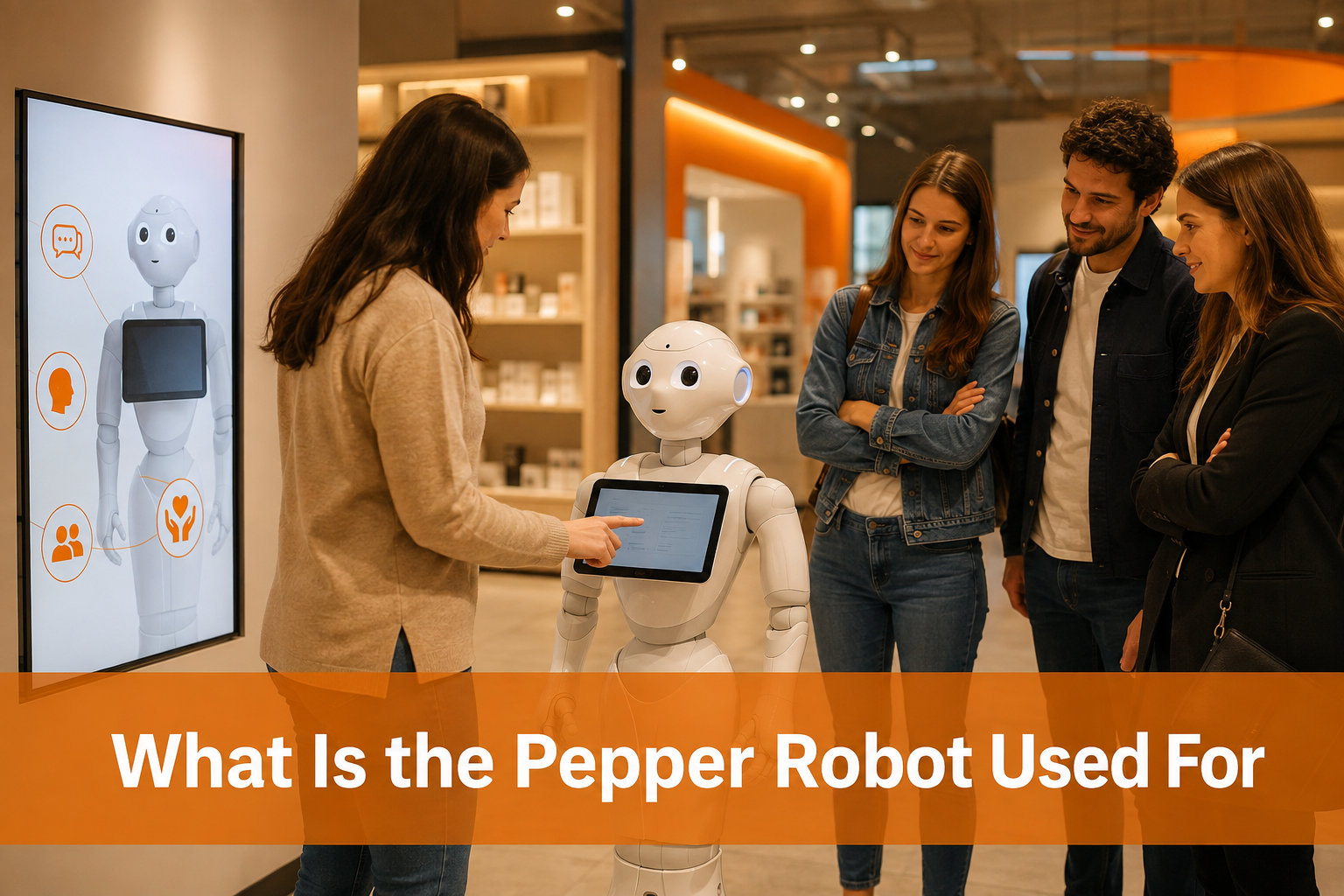
When I first saw a Pepper robot greet shoppers at a mall in Tokyo, I was surprised by how naturally it tilted its head and asked how my day was going. That moment captures exactly what the Pepper robot was designed to do. In this guide, I’ll walk you through what the Pepper robot is, what it can do, the industries it served, and why it was eventually retired in 2021.
Table of Contents
What Is the Pepper Robot
The Pepper robot is a semi-humanoid social robot originally designed by Aldebaran Robotics in Paris and later sold globally by SoftBank Robotics. It stands about 4 feet tall, rolls on a wheeled base, and was built with one core purpose: to interact naturally with people.
What made Pepper different from factory robots is that it was designed to live among humans, not behind safety cages. It can recognize faces, detect basic emotions from facial expressions and voice tone, hold simple conversations, and gesture with its arms and hands. SoftBank famously described Pepper as the first robot capable of “reading” human emotions.
To our team, the simplest way to think about Pepper is as a friendly, mobile kiosk with a personality. It greets, it explains, it guides, and it entertains. Its design drew inspiration from research on human-robot interaction, and it became a benchmark for the entire social robotics category.
Key Features and Capabilities of Pepper
Pepper’s hardware is built around social interaction rather than heavy lifting. Here are the headline features that defined it.
- Emotion recognition: analyzes facial expressions and voice tone to detect joy, surprise, anger, and sadness
- Conversational AI: holds multi-turn dialogues through cloud-connected speech services
- Chest-mounted 10.1-inch touchscreen: displays content, menus, and visual cues during interactions
- 20 degrees of freedom: in the head, arms, and hands for expressive gestures
- Multi-language support: speaks more than 15 languages including English, Japanese, French, and Spanish
- Autonomous navigation: maps indoor spaces and avoids obstacles while moving
- Developer-friendly platform: programmable through Choregraphe, Python, and the NAOqi OS
I’ve watched Pepper hold eye contact, follow a customer’s gaze, and adjust its tone of voice when a person seemed confused. These small behaviors made it feel more like a curious colleague than a vending machine.
Pepper Robot Uses in Retail and Customer Service
Retail was Pepper’s most visible stage. SoftBank Mobile stores in Japan deployed Pepper units at the entrance to greet customers, explain phone plans, and route visitors to staff. The robots were programmed to detect when a customer looked lost and proactively offer help.
Beyond SoftBank’s own stores, Pepper was used as a retail greeter in shopping malls across Europe and Asia. In some pilots, Pepper was tied into customer relationship management (CRM) systems so it could recognize repeat visitors and personalize greetings. In others, it ran promotions by displaying QR codes on its chest screen and inviting shoppers to scan for discounts.
A few examples our team has tracked:
- Carrefour tested Pepper in French stores to guide shoppers to products on their list
- Pepper PARLOR cafe in Tokyo used robots to take orders, serve drinks, and entertain guests
- NESCAFÉ coffee shops in Japan deployed a version called “Pepper for Biz” to recommend blends and upsize drinks
- Various banks used Pepper to greet customers, explain account types, and reduce queue anxiety
One thing I noticed in customer service deployments is that Pepper worked best for the first 30 to 60 seconds of an interaction. Once a question became too specific, the robot would hand off to a human colleague, which is exactly how most teams designed it.
Healthcare and Elderly Care Applications
Healthcare is where Pepper showed genuine impact. Hospitals in Belgium, France, and the UK piloted Pepper to help with patient check-in, wayfinding, and basic information delivery at reception. The robot’s friendly appearance and patient manner made waiting rooms feel less stressful, especially for children and elderly visitors.
One of the most ambitious research programs was CARESSES, a multinational project funded by the EU and Japan that re-programmed Pepper to act as a culturally competent assistant in care homes. CARESSES Pepper could remember a resident’s food preferences, religious dietary rules, and favorite conversation topics, then bring them up naturally during visits. Trials in the UK and Japan measured reduced loneliness among elderly users.
Other documented healthcare uses include:
- Reception and triage: directing patients to the right department and answering FAQs
- Rehabilitation motivation: guiding patients through simple exercises with verbal encouragement
- Autism therapy support: predictable, non-judgmental interaction partner for therapy sessions
- COVID-19 screening: some hospitals used Pepper to ask screening questions and reduce staff exposure
Robots like Pepper have also benefited from advances in embedded computing, similar to what we cover in our guide to NVIDIA Jetson modules, which power many modern healthcare and service robots today.
Education and Research Applications
Pepper became a popular research platform in universities around the world because it offered an affordable, ready-made humanoid body that researchers could program. Labs used it to study human-robot interaction, social cognition, and assistive robotics without having to build a robot from scratch.
Some of the most active research teams have been at the University of Tokyo, CNRS in France, the University of Hertfordshire in the UK, and the National Taiwan University. Their work ranges from teaching Pepper to recognize sarcasm to using it as a study buddy for children with attention disorders.
In K-12 education, Pepper was used as a language tutor, a coding instructor, and a STEM ambassador. Some schools in Japan used Pepper to teach English conversation to young learners because the robot would never get tired of repeating the same dialogue. Universities also used Pepper to teach undergraduate courses in robot programming, including lessons built around the Choregraphe visual environment.
If you want a deeper look at the kind of embedded systems and controllers that powered platforms like Pepper, our FPGA robotics guide walks through how custom silicon is reshaping real-time robot control.
Entertainment and Hospitality Uses
Pepper found a natural home in entertainment and hospitality, where the goal is engagement rather than task completion. The Pepper PARLOR cafe in Tokyo’s Shibuya district became its most famous showcase. There, a small fleet of Peppers greeted guests, suggested menu items, posed for selfies, and even danced between tables.
Beyond cafes, Pepper has been used as:
- Museum guide: explaining exhibits in multiple languages at science centers in Paris, London, and Berlin
- Trade show host: drawing crowds to corporate booths and capturing lead information
- Airport assistant: providing flight info and directions at terminals in France and Japan
- Event MC: hosting product launches, conferences, and even parliamentary hearings
- Hotel concierge: answering common guest questions in lobbies
One quirky historical moment: Pepper became the first robot to testify before a parliamentary committee, addressing the UK Parliament’s Education Committee in 2018 about the future of AI in education. It was a publicity stunt as much as a research appearance, but it captured how Pepper blurred the line between tool and personality.
Technical Specifications Overview
For readers who want the raw numbers, here is a snapshot of the Pepper robot’s production specifications.
- Height: 1.21 meters (about 4 feet)
- Weight: 28 kilograms (about 62 lbs)
- Battery life: approximately 12 hours of typical use
- Locomotion: three omni-directional wheels with obstacle avoidance
- Processor: Intel Atom quad-core CPU with a Qualcomm ARM-based sub-controller for sensors
- Operating system: NAOqi OS (a Linux-based distribution)
- Sensors: two HD cameras, four microphones, two sonars, six laser sensors, gyroscope, and 3D depth sensor in the head
- Degrees of freedom: 20 across head, shoulders, arms, hands, and pelvis
- Languages: more than 15 supported at launch, expandable through software
Pepper’s sensor stack was modest by modern standards, but it was well matched to indoor lighting and quiet environments, which is where most of its deployments happened.
Why Pepper Was Discontinued
SoftBank paused production of new Pepper units in 2021, citing weak demand and the impact of the COVID-19 pandemic on retail and service industries. The company had manufactured roughly 27,000 units over the robot’s lifetime, a small fraction of the hundreds of thousands initially projected.
Several factors drove the decision:
- Unit economics: each Pepper cost more to build than it sold for, leading to losses reportedly in the hundreds of millions of dollars
- Limited practical value: Pepper was excellent at greetings and entertainment but struggled with tasks that needed real precision or physical manipulation
- Pandemic headwinds: retail and hospitality, the robot’s main markets, collapsed during 2020 and 2021
- Strategic shift at SoftBank: the company redirected its robotics investment toward cleaning and logistics robots, including the Whiz vacuum
In 2024, the German United Robotics Group acquired the Pepper platform from SoftBank Robotics Europe, and some units are now supported through third-party service partners. But new Pepper units are no longer being mass-produced.
Pepper’s Legacy in Social Robotics
Even after production stopped, Pepper left a clear mark on the social robotics industry. It was the first commercially successful humanoid designed specifically for human interaction, and it shaped how a generation of researchers and product teams thought about deploying robots in public spaces.
Many lessons from Pepper now show up in newer platforms. The Spot quadruped from Boston Dynamics borrows from the same idea of robots coexisting with crowds. The Temi and Misty robots use similar emotion-aware approaches for telehealth and home use. Even the conversational agents behind today’s AI kiosks owe a debt to the early work done on Pepper’s dialogue flows.
Our team believes Pepper’s biggest contribution was cultural. Before Pepper, most people had never met a humanoid robot outside a movie. After Pepper, the idea of a friendly robot in a hotel lobby felt normal, opening space for the wider industry. If you’re interested in how the supporting hardware behind these platforms scales in commercial environments, our warehouse robot safety webinar explores the operational side of that same challenge.
Frequently Asked Questions
Why was Pepper robot discontinued?
SoftBank paused Pepper production in 2021 because of weak demand, high manufacturing costs, and the impact of the COVID-19 pandemic on its core retail and hospitality markets. The company had reportedly lost hundreds of millions of dollars on the program, and shifted its robotics investment toward cleaning and logistics robots instead.
How much does the Pepper robot cost?
When it was on sale, the Pepper robot cost around 1,500 USD per month on a leasing plan, or roughly 20,000 to 30,000 USD for an outright purchase, depending on the region and support package. Prices varied between business and developer editions.
Is the Pepper robot still available?
New Pepper units are no longer being mass-produced after SoftBank paused manufacturing in 2021. Some existing units remain in service through third-party support partners, and United Robotics Group now owns the European Pepper platform, but buying a brand-new Pepper directly from SoftBank is not currently possible.
Where can I buy a Pepper robot?
You can sometimes find used Pepper units on the secondary market through resellers, robotics integrators, and university surplus programs. For new units or official support, you would need to contact United Robotics Group, which acquired the Pepper platform in 2024, or work with a certified service partner.
Final Thoughts on the Pepper Robot
What is the Pepper robot used for, in the end? It was used to greet, to explain, to comfort, and to entertain. From shopping malls in Tokyo to care homes in the UK, the Pepper robot showed that a humanoid could earn a place in everyday public life, even if that place turned out to be smaller than its creators hoped.
For 2026 and beyond, Pepper’s design and the lessons from its decade of deployment will keep shaping the social robots that follow. Whether you’re a researcher, a robotics fan, or just curious, the Pepper story is a useful reminder that great hardware only matters when it solves a real human problem.