
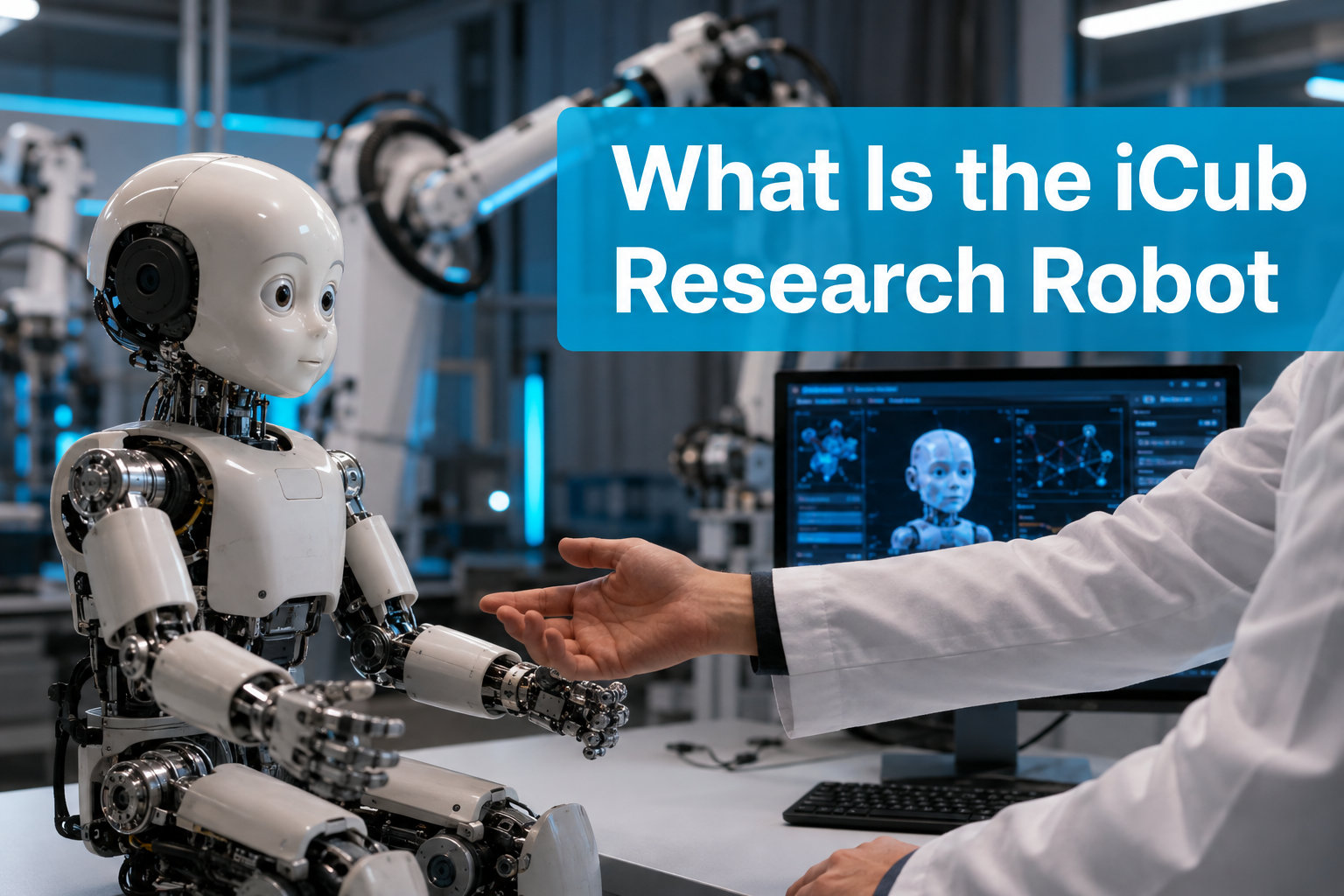
The iCub research robot is an open-source, child-sized humanoid platform developed by the Italian Institute of Technology (IIT) for studying embodied cognition and artificial intelligence. Standing 104 cm tall and weighing about 22 kg, iCub has 53 actuated degrees of freedom, full-body tactile sensing, and a fully open hardware and software stack. In this guide, I will walk you through what iCub is, where it came from, what it can do, and why it has become one of the most important humanoid research platforms in the world.
If you have ever wondered how researchers test theories of the human mind using a robot, or how a machine the size of a 3-year-old can solve mazes and shoot arrows, you are in the right place. I have spent time digging through the official IIT documentation, the RobotCub Consortium archives, and a stack of academic papers to put together a beginner-friendly explainer that does not require a PhD to follow.
Table of Contents
What Is the iCub Research Robot?
The iCub is a one-meter-tall, open-source humanoid robot testbed designed for research into human cognition and artificial intelligence. It was created by the RobotCub Consortium, a group of European universities, and is built and maintained today by the Italian Institute of Technology in Genoa, Italy.
Unlike consumer robots or industrial arms, iCub is a research platform. That means its purpose is not to perform a single task in a factory, but to give scientists a common hardware and software baseline for testing ideas about how humans learn, perceive, and act. Everything from the CAD files of its joints to the source code of its control software is published openly, which is why dozens of labs around the world can use the same robot to compare results.
Key Specifications at a Glance
Here is a quick reference of the iCub’s headline specifications. I have kept this tight so you can scan it in a few seconds and come back to it later as needed.
- Height: 104 cm (about 3.4 ft, the size of a 3.5-year-old child)
- Weight: 22 to 25 kg depending on configuration
- Degrees of freedom: 53 total (7 per arm, 9 per hand, 6 in the head, 3 in the torso, 6 per leg)
- Actuators: Brushless DC motors with tendon-driven joints in the hands
- Cameras: Stereo and RGB-D cameras in the head, plus an additional chest-mounted camera
- Sensors: Distributed tactile skin, force-torque sensors in the arms, inertial measurement units, Hall-effect position sensors
- Onboard compute: PC104 controller (iCub 2) and NVIDIA Jetson TX2 boards (iCub 3)
- Software: YARP middleware, C++ and Python APIs, runs on Linux and FreeBSD
- License: Hardware and software released under GNU GPL and LGPL
Those numbers tell most of the story. The combination of a child-sized body, dense tactile sensing, and a fully open stack is what makes iCub unusual among humanoids.
The History of the iCub Project
The iCub project began in 2004 as a five-year effort funded by the European Commission’s Cognition Unit (E5) under the Sixth Framework Programme. The RobotCub Consortium pulled together eleven partners across Europe, with the goal of creating an open humanoid platform that cognitive scientists and AI researchers could share.
The first prototype, sometimes called iCub 1, was completed around 2008 to 2009. A widely cited 2009 Nature article, “The bot that plays ball,” introduced the platform to a broader scientific audience. Since then, the Italian Institute of Technology has taken over as the primary developer and custodian of the design. The project has gone through two major hardware revisions (iCub 2 and iCub 3) and continues to ship robots to labs in Europe, the United States, Japan, and beyond.
One thing I find interesting about iCub’s history is how the consortium bet on openness very early. In the mid-2000s, releasing full mechanical drawings and control code for a sophisticated humanoid was unusual. That decision is the reason the iCub community is as broad as it is today.
Hardware Design and Degrees of Freedom
The iCub’s mechanical design mirrors a young child’s body proportions. That choice is not cosmetic. Researchers use it because a smaller robot is safer, cheaper to house, and easier to reason about when modeling the way a child interacts with the world.
The 53 degrees of freedom break down like this:
- Head (6 DOF): three neck joints, two eye joints, and a jaw, which together allow gaze, head turning, and simple facial articulation.
- Arms (7 DOF each): shoulder yaw, pitch, and roll, an elbow, a forearm twist, and a wrist with two axes, similar to a human arm’s main movement planes.
- Hands (9 DOF each): the index, middle, ring, and pinky fingers each have two joints, the thumb has three, and there is one extra joint for the thumb base, allowing fine grasping and in-hand manipulation.
- Torso (3 DOF): yaw, pitch, and roll so the upper body can twist and bend.
- Legs (6 DOF each): hip yaw, pitch, and roll, plus knee, ankle pitch, and ankle roll, supporting both crawling and walking gaits.
The hands use tendon-driven actuation, which keeps the fingers slim and lets the motors sit in the forearm. A distributed tactile skin, made of flexible capacitive sensors, covers large portions of the body and gives the robot a sense of touch across its arms, torso, and legs.
Software and the Open-Source Ecosystem
YARP, which stands for Yet Another Robot Platform, is the middleware that ties the iCub’s hardware and software together. I like to think of YARP as the robot’s nervous system. It handles communication between the cameras, the motor controllers, the tactile skin, and the higher-level AI code that decides what to do next.
YARP is written in C++ with bindings for Python and supports Linux and FreeBSD. It exposes a clean port-based abstraction: sensors publish data on named ports, and control algorithms subscribe to those ports. That model makes it relatively painless to mix and match modules written by different labs.
Beyond YARP, the iCub software stack includes the iCub simulator (built on ODE and later Gazebo) for running experiments in a virtual world, integration with ROS for researchers who prefer that ecosystem, and a growing library of perception and control modules on GitHub. Everything is released under permissive GNU GPL and LGPL licenses, which has been a major reason the platform has spread so widely.
What Can the iCub Do?
If you have ever watched a humanoid robot video, you have probably seen iCub doing something a bit uncanny. Over the years, researchers have used iCub to demonstrate crawling, walking, object grasping, and even shooting an arrow at a target. There is a famous demo of iCub solving a maze by rolling a ball through a tilting platform, and another where it learns to predict the consequences of its own actions.
Its facial expressiveness is limited but effective. A grid of red LEDs on the face can suggest eyebrows, eye direction, and mouth shape, which is enough for short interaction studies. The tactile skin allows the robot to react to being touched, to find objects by brushing against them, and to regulate its grip force so it does not crush delicate items.
Here is a short list of capabilities I have seen documented across the official IIT media library and published demos:
- Crawling on hands and knees and walking upright on flat surfaces
- Reaching for and grasping objects of different shapes and sizes
- Shooting a foam-tipped arrow at a target
- Solving a marble-maze puzzle by tilting a platform
- Imitating gestures performed by a human teacher
- Tracking faces, eyes, and hands with the head cameras
- Reacting to tactile cues from the sensor skin
None of these tasks are easy, and iCub does not perform them with the polish of a Boston Dynamics Atlas demo. But that is not the point. The point is that the platform is open, reproducible, and standardized enough that a result from one lab can be checked by another.
Research Applications and Embodied Cognition
So why build a humanoid robot the size of a small child? The short answer is the embodied cognition hypothesis, which holds that the body is not just a vehicle for the brain, it is part of how the brain learns. A child does not learn language by absorbing abstract rules. A child learns by touching things, knocking them over, listening to sounds, and watching what other people do.
Roboticists want to test the same idea in machines. If you give a robot a body with the right proportions, the right sensors, and the right control loops, can it develop more human-like understanding? iCub is the testbed that lets a generation of researchers run that experiment.
Concrete research areas that lean heavily on iCub include sensorimotor learning, language acquisition through interaction, human-robot interaction studies, developmental robotics, and the study of how a robot can model the intentions of the people it works with. Several PhD theses each year use iCub as the experimental platform, and the resulting code often lands back in the open-source repositories for the next lab to build on.
iCub Versions and Evolution
There have been three major iCub generations, and the differences between them are mostly about electronics, materials, and reliability, rather than a brand-new robot.
- iCub 1 (around 2008 to 2009): The original prototype. Used the PC104 controller, cable-driven hands, and the first-generation distributed tactile skin. About a dozen units were built.
- iCub 2 (around 2014 to 2015): A major electronics refresh with a more powerful onboard computer, improved force-torque sensors, and refined cabling. Most iCub robots running in labs today are iCub 2 units.
- iCub 3 (around 2018 onward): Introduced the NVIDIA Jetson TX2 as a vision-processing co-processor, modular electronics, and a more robust skin. Newer labs and recent deliveries are iCub 3 machines.
All three generations are roughly the same size, share the same 53-DOF kinematic layout, and run the same YARP-based software stack. That continuity is deliberate. It means a piece of code written for iCub 1 in 2010 will usually still run on an iCub 3 today, with minor adjustments.
How to Get an iCub
You cannot buy an iCub on Amazon, and that is by design. The iCub is a research-grade platform that ships only to qualified academic and industrial research partners, and only after a review by the Italian Institute of Technology. Reported prices sit in the neighborhood of €250,000 depending on configuration, sensors, and support package.
Around 30 to 40 iCub units are estimated to be in operation worldwide, spread across labs in Italy, the United Kingdom, Germany, France, the United States, Japan, and a handful of other countries. The simplest path to “having” an iCub is to use the open-source simulator, which lets you run realistic experiments on a desktop computer, or to collaborate with one of the existing labs that already operates a physical robot.
Frequently Asked Questions About the iCub
What is the iCub robot?
The iCub is an open-source, child-sized humanoid research robot developed by the Italian Institute of Technology (IIT) for studying embodied cognition and artificial intelligence. It stands 104 cm tall, weighs around 22 to 25 kg, and has 53 degrees of freedom.
Who created the iCub robot?
The iCub was designed by the RobotCub Consortium, a group of European universities, and is now built and maintained by the Italian Institute of Technology (IIT) in Genoa, Italy. The project was originally funded by the European Commission in 2004.
How much does an iCub robot cost?
An iCub robot costs approximately €250,000 depending on the configuration and version. It is a research-grade platform, not a consumer product, and is only sold to qualified academic and industrial research partners.
How tall is the iCub robot?
The iCub is 104 cm (about 3.4 feet) tall, roughly the size of a 3.5-year-old child, and weighs between 22 and 25 kg depending on the exact configuration and sensor package.
How many degrees of freedom does the iCub have?
The iCub has 53 actuated degrees of freedom in total: 7 in each arm, 9 in each hand, 6 in the head, 3 in the torso, and 6 in each leg. The hands are tendon-driven to keep the fingers slim and dexterous.
What is YARP in the context of iCub?
YARP (Yet Another Robot Platform) is the middleware that handles communication between the iCub’s hardware and external software. It is written in C++ and supports Linux and FreeBSD.
Is the iCub open source?
Yes. The iCub is fully open source. The hardware designs, firmware, and software are released under GNU GPL and LGPL licenses, which is why so many labs worldwide can collaborate on the same platform.
What is the iCub used for?
The iCub is used for research in embodied cognition, artificial intelligence, human-robot interaction, cognitive development, and sensorimotor learning. It is one of the most widely adopted humanoid research platforms in the world.
Conclusion
The iCub research robot is, in my view, one of the most important humanoid platforms of the last two decades. Its combination of a child-sized body, dense tactile sensing, and a fully open hardware and software stack has made it the reference testbed for embodied cognition and humanoid AI research. If you are curious to go deeper, the official IIT iCub portal is the best starting point, the YARP GitHub repository has the code, and the iCub simulator lets you experiment on your own laptop before you ever set foot in a robotics lab.