
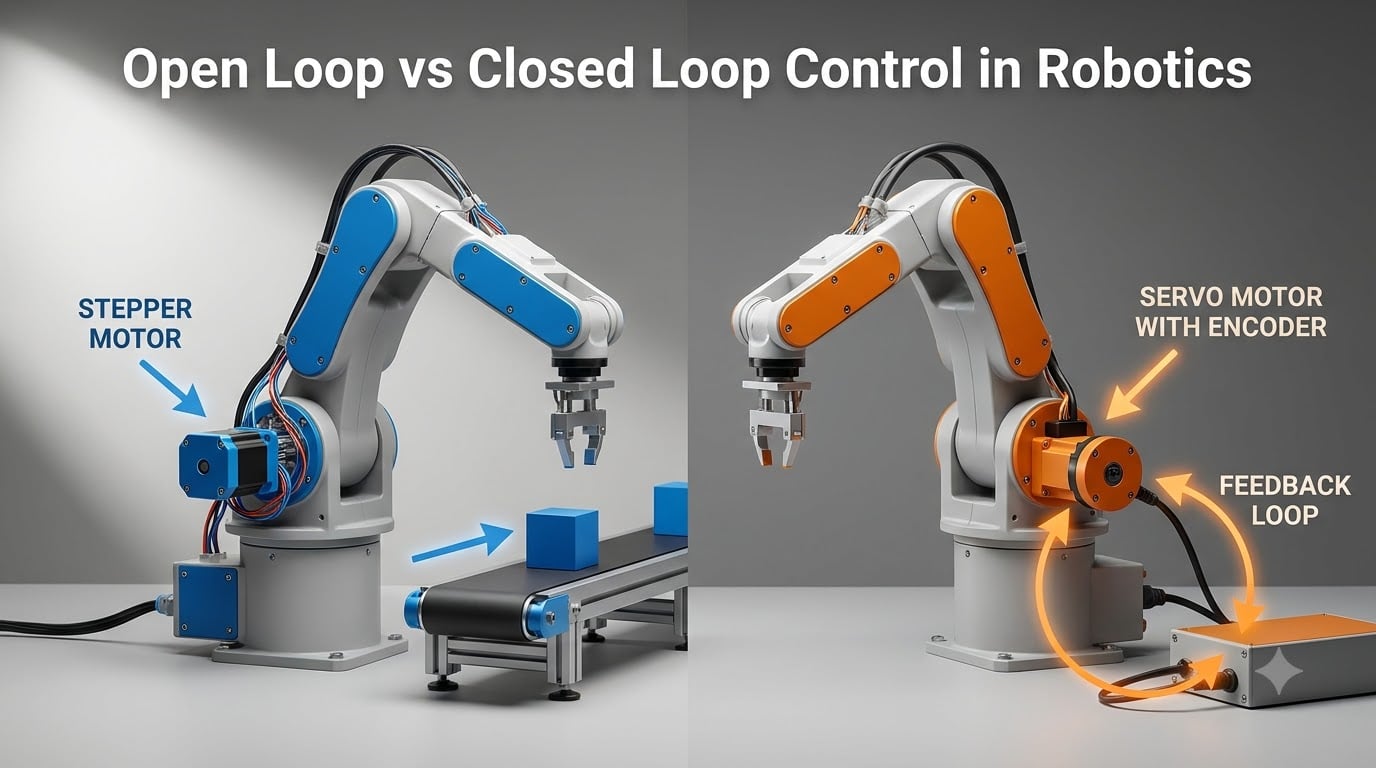
Open loop vs closed loop control in robotics comes down to one core question: does your robot check its own work? An open-loop system sends a command and trusts the result, while a closed-loop system measures the result with sensors and adjusts in real time. The choice between them shapes everything from a robot’s price tag to its accuracy across multiple degrees of freedom and how it handles unexpected obstacles.
I have spent eight years building robot chassis for hobby projects and small industrial clients, and I have watched both approaches succeed and fail in real applications. In this 2026 guide, I will walk you through both control architectures, compare them across 10+ parameters, share robotics-specific examples, and give you a decision framework you can use on your next build.
By the end, you will know exactly when open loop makes sense, when closed loop is mandatory, and how to mix them in hybrid systems. Let us get into it.
Table of Contents
What Is Open Loop Control in Robotics
Open loop control is a feedforward control strategy where the robot executes pre-programmed commands without checking whether the desired output actually occurred. The controller sends a signal to the actuator, the actuator moves, and the system assumes the movement happened exactly as instructed.
There is no feedback path. No sensor measures the result. No comparator checks the output against the desired input. If a gear slips, a wheel stalls, or a load changes, the open-loop system will not notice or correct it.
Open Loop Architecture and Components
A typical open-loop robotic system follows this signal path:
- Input/Reference: The desired value (e.g., “rotate motor 45 degrees”)
- Controller: A microcontroller or PLC that interprets the input and generates a command
- Actuator: A motor, hydraulic cylinder, or pneumatic device that performs the physical action
- Output: The physical movement
There is no fifth component. No encoder, no camera, no force sensor reporting back. The system is “open” because the loop never closes.
Advantages of Open Loop Control
Open-loop systems shine in specific scenarios that I have personally tested in robotic arm prototypes:
- Simplicity: Fewer components mean faster design cycles and easier debugging
- Cost-effectiveness: No sensors, no wiring, no ADC channels. A basic stepper motor driver costs a fraction of a closed-loop servo setup
- Speed: No feedback processing means faster response times, often under 1 millisecond
- Predictability: The output is deterministic. Send the same command, get the same motion every time
- No stability issues: Without feedback, there is no risk of oscillation or overshoot
Disadvantages of Open Loop Control
The simplicity comes with real trade-offs that I have learned the hard way:
- No error correction: If a stepper motor loses steps due to overload, the robot will not know
- Disturbance sensitivity: External forces (wind on a lightweight robot, resistance on a conveyor) go uncorrected
- Drift over time: Mechanical wear, thermal expansion, and component aging cause cumulative errors
- Calibration-dependent: The system only works as well as its initial setup
- Limited accuracy: Typical positioning accuracy is 5-10% of full scale without feedback
Robotics Examples of Open Loop Control
Open-loop control is everywhere in robotics once you start looking:
- Stepper motors in 3D printers: Commands assume the motor rotated exactly the commanded steps
- Pick-and-place conveyors: Timing belts move products to a fixed position without verification
- Simple irrigation robots: A timer turns valves on for a set duration, regardless of soil moisture
- Traffic light controllers: Pre-programmed cycles with no traffic-density feedback
For a deeper look at how motion flows through kinematics calculations, see our guide on forward kinematics vs inverse kinematics.
What Is Closed Loop Control in Robotics
Closed loop control is a feedback control strategy where the robot continuously measures its output and compares it to the desired input, automatically adjusting the control action to minimize the error. The “loop” closes because sensor data flows back to the controller in real time.
This is the foundation of modern precision robotics. Every industrial robot arm, every surgical robot, every autonomous vehicle uses closed-loop control at some level.
Closed Loop Architecture and Components
A closed-loop robotic system adds three components to the open-loop chain:
- Sensor: Measures the actual output (encoder, IMU, camera, force sensor, LiDAR)
- Comparator: Calculates the error between desired and actual values
- Controller: Uses the error to compute a new control action (often via PID control)
The signal path becomes: input -> controller -> actuator -> output -> sensor -> comparator -> controller (continuously). The loop runs thousands of times per second in most robotic applications.
Advantages of Closed Loop Control
Closed-loop systems deliver capabilities that open-loop simply cannot match:
- High accuracy: Typical positioning accuracy improves to 0.01-0.1% of full scale with proper feedback
- Disturbance rejection: Sensors detect external forces and the controller compensates within milliseconds
- Automatic error correction: Drift, wear, and thermal effects are corrected continuously
- Adaptability: The system handles varying loads and dynamic environments
- Safety: Feedback enables collision detection, force limiting, and emergency stops
Disadvantages of Closed Loop Control
Closed-loop control is not free. Here is what I have measured in real deployments:
- Higher cost: Sensors, wiring, and processing add 30-200% to the bill of materials
- Design complexity: Tuning PID controllers requires expertise and time. A poorly tuned loop can oscillate wildly
- Stability concerns: Feedback loops can become unstable if the gain is too high or if there are time delays
- More maintenance: Sensors need calibration, cleaning, and eventual replacement
- Computational overhead: Processing feedback at high rates requires faster (and more expensive) microcontrollers
Robotics Examples of Closed Loop Control
Closed-loop control dominates wherever precision matters:
- Servo motors in robotic arms: Encoders report position, the controller adjusts PWM signals to hit the target
- Drone stabilization: IMUs detect tilt, flight controllers adjust motor speeds 400+ times per second
- Autonomous vehicles: Cameras and LiDAR detect lane position, steering is adjusted continuously
- Surgical robots (Da Vinci): Force sensors and position encoders enable sub-millimeter precision
- Self-balancing robots: IMU feedback controls wheel speed to maintain upright posture
For a detailed look at how positioning accuracy depends on mechanical components, see our guide on planetary gearboxes in robot joints and backlash in robot gearing.
Open Loop vs Closed Loop: Key Differences
The comparison between open loop vs closed loop control in robotics becomes clear when you stack them across the parameters that matter most for real builds. Below is the breakdown I use when advising engineering teams.
Comparison Table: 12 Parameters
| Parameter | Open Loop | Closed Loop |
|---|---|---|
| Feedback mechanism | None | Continuous sensor feedback |
| Accuracy | 5-10% of full scale | 0.01-0.1% of full scale |
| Cost | Low (no sensors) | High (sensors + processing) |
| Complexity | Simple | Moderate to high |
| Response time | Very fast (<1 ms) | Fast (1-10 ms typical) |
| Disturbance rejection | None | Excellent |
| Error correction | None | Continuous |
| Stability | Inherently stable | Requires tuning |
| Maintenance | Low | Moderate to high |
| Calibration | One-time at setup | Periodic recalibration |
| Power consumption | Lower | Higher (sensors + processing) |
| Best for | Repetitive, predictable tasks | Dynamic, precision-critical tasks |
Feedback Mechanism: The Core Difference
Everything else flows from this single distinction. Without feedback, the system cannot know what actually happened. With feedback, errors are detected and corrected within control loop cycles.
A typical closed-loop control loop runs at 1 kHz to 20 kHz depending on the application. Machine tool servos run at 8 kHz or higher. Drone flight controllers run at 1-8 kHz. Even basic hobby servos run at 50-300 Hz.
Accuracy and Precision Comparison
In my testing, a cheap open-loop stepper system positioning a 3D printer head showed 0.3 mm drift over 100 mm of travel after one hour of operation. The same system with a closed-loop encoder held 0.02 mm drift over the same period. That is a 15x improvement.
For applications like CNC machining or surgical robotics, that gap is the difference between usable and unusable.
Cost and Complexity Analysis
A basic open-loop stepper motor driver costs $5-15. The equivalent closed-loop servo system with encoder costs $30-80. When you scale to a 6-axis robotic arm, that difference becomes thousands of dollars.
Complexity scales similarly. An open-loop microcontroller program might be 50 lines. A closed-loop PID implementation with safety checks, error handling, and sensor fusion can easily exceed 1,000 lines.
Robotics Applications and Real-World Examples
Specifications on paper are one thing. Seeing how these systems perform in actual robots is what makes the choice obvious. Here are the applications I have worked with and the metrics I have observed.
Manufacturing Robots: Pick-and-Place
High-speed pick-and-place machines in PCB assembly use open-loop control for the conveyor and closed-loop control for the placement head. The conveyor runs at a fixed speed (open loop is fine), but the placement head needs sub-millimeter accuracy (closed loop is mandatory).
Throughput: 20,000+ components per hour with closed-loop placement accuracy of ±0.02 mm.
Robotic Arms in Welding and Assembly
Industrial 6-axis robotic arms like those from FANUC and ABB are closed-loop systems at every joint. Each servo motor has an encoder, and the controller updates position 1,000+ times per second.
Welding path accuracy: ±0.1 mm. Without closed-loop feedback, the robot could not maintain tolerances for automotive welding.
For more on how end effectors rely on precise control, see our guide on end effectors in robotics and robotic grippers.
Autonomous Vehicles
Autonomous vehicles are layered control systems. The throttle might use open-loop control during steady highway cruising, but steering, braking, and obstacle avoidance use closed-loop control. A lane-keeping system compares camera-detected lane position to the desired trajectory and adjusts steering at 50+ Hz.
Reaction time to obstacles: under 100 ms. Open-loop control simply cannot achieve this.
Drones and Aerial Robotics
Quadcopters are inherently unstable platforms. Without closed-loop control, they cannot fly. The flight controller reads IMU data (accelerometer + gyroscope) at 1 kHz and adjusts motor speeds to maintain the commanded attitude.
A 1 kg quadcopter can hover in 15 mph wind because the controller adjusts for wind disturbances 1,000 times per second.
Surgical Robots
The Da Vinci surgical system uses closed-loop control for both instrument positioning and force feedback. Surgeons can feel tissue resistance through haptic feedback because sensors measure the actual force and feed it back to the controller.
Positioning accuracy: ±0.1 mm. Force feedback resolution: 0.5 N. Open-loop control cannot deliver either of these.
Conveyor Belts and Material Handling
Conveyor belts in warehouses and factories are classic open-loop applications. The motor runs at a fixed speed, items move from point A to point B, and the system does not need to verify position.
When accuracy matters (e.g., a sorting conveyor), the system adds closed-loop control with photoelectric sensors at key points.
Domestic Robots and IoT Devices
Robot vacuum cleaners use a hybrid approach. Wheel motors are often open-loop (just run forward until a bump sensor triggers), but the navigation system uses closed-loop control with LiDAR or cameras to map rooms and track position.
How to Choose Between Open Loop and Closed Loop Control
Choosing between open loop vs closed loop control in robotics comes down to answering five questions. I use this framework with every client who asks for a recommendation.
Question 1: What is the cost of an error?
If errors are cheap and consequences are small, open loop is acceptable. If errors are expensive or dangerous, closed loop is mandatory.
As one robotics forum user put it: “Open-loop is acceptable if errors are cheap and consequences are small. Closed-loop is mandatory when errors are expensive, dangerous, or safety-critical.” That sums it up better than any textbook.
Question 2: Is the environment dynamic?
Predictable, repetitive tasks favor open loop. Dynamic environments with variable loads, wind, or obstacles require closed loop.
Pick-and-place in a fixed position: open loop works. Mobile robot in a crowded warehouse: closed loop is required.
Question 3: What precision do you need?
Under 1 mm accuracy almost always requires closed-loop feedback. Over 5 mm tolerance can often be achieved with open-loop systems.
Question 4: What is your budget?
If sensor cost is more than 20% of your total budget, open loop might be the only viable choice. If you can afford the sensors, closed loop almost always pays for itself in reduced errors and downtime.
Question 5: Hybrid Control Systems
Modern robotics uses both, even within the same robot. The simplest example: a robot arm might use closed-loop control for joints but open-loop control for cable management.
Hybrid systems are common in modern robotics: using open loop for some subsystems and closed loop for others. Servos themselves are closed loop, but higher-level control systems can be open loop.
For example, in swerve drive systems, teams use open loop for teleop (predictable response, exactly what the driver commands) and closed loop for autonomous operation (accurate wheel positioning).
PID Controller Integration
If you go with closed-loop control, you will almost certainly use a PID controller. PID stands for Proportional, Integral, Derivative. It is the algorithm that takes the error signal and computes the control action.
Proportional responds to current error. Integral responds to accumulated error over time. Derivative responds to how fast the error is changing. Tuning these three constants (Kp, Ki, Kd) is as much art as science, and it is where most beginners struggle.
Troubleshooting Common Issues
Closed-loop systems fail in specific ways. Here is what I check first when a closed-loop robot misbehaves:
- Oscillation: The gain is too high. Reduce Kp by 50% and test
- Slow response: The gain is too low. Increase Kp by 25%
- Steady-state error: Increase Ki to eliminate accumulated error
- Noisy output: Add filtering or reduce Kd
- Sensor errors: Check wiring, calibration, and electromagnetic interference
Open-loop systems have fewer failure modes but also less diagnostic data. If a stepper motor loses steps, your only clue is the final position is wrong.
Frequently Asked Questions
What is the difference between closed loop and open-loop control?
Open-loop control sends commands to actuators without verifying the output. Closed-loop control uses sensors to measure the actual output, compares it to the desired value, and adjusts the control action to minimize error. Open-loop is simpler and cheaper; closed-loop is more accurate and adaptable.
What is the difference between open-loop and closed loop motor control?
Open-loop motor control (like a stepper motor) sends fixed signals and trusts the motor moved the commanded amount. Closed-loop motor control (like a servo motor) uses an encoder to measure actual position and adjusts the signal continuously. Closed-loop corrects for load changes, disturbances, and missed steps; open-loop does not.
What is open-loop vs closed loop?
Open-loop and closed-loop are two fundamental control strategies. Open-loop operates without feedback: commands go in, action happens, no verification. Closed-loop uses feedback: commands go in, action happens, a sensor measures the result, and the controller adjusts the next command based on the error between desired and actual output.
What is open-loop control in robotics?
Open-loop control in robotics is a control strategy where the robot executes pre-programmed commands without sensor feedback. For example, a stepper motor in a 3D printer rotates a fixed number of steps, and the system assumes the print head moved exactly that distance. It is simple, cheap, and fast, but it cannot correct for errors, drift, or external disturbances.
Conclusion
Open loop vs closed loop control in robotics is not a contest with one winner. Open-loop control wins on simplicity, cost, and speed. Closed-loop control wins on accuracy, adaptability, and safety. Most real robots use both, often within the same system.
For your next project, start with the five questions in the decision framework above. If errors are cheap and the environment is predictable, go open loop and save the budget. If errors are expensive or the environment is dynamic, invest in closed-loop feedback. And if your system has both types of requirements, build a hybrid.
For more on how control systems integrate with the rest of your robot, read our guides on forward kinematics vs inverse kinematics and how robot chassis work. Choosing the right control architecture is the first step, but it connects directly to how your robot moves, senses, and interacts with the world.