
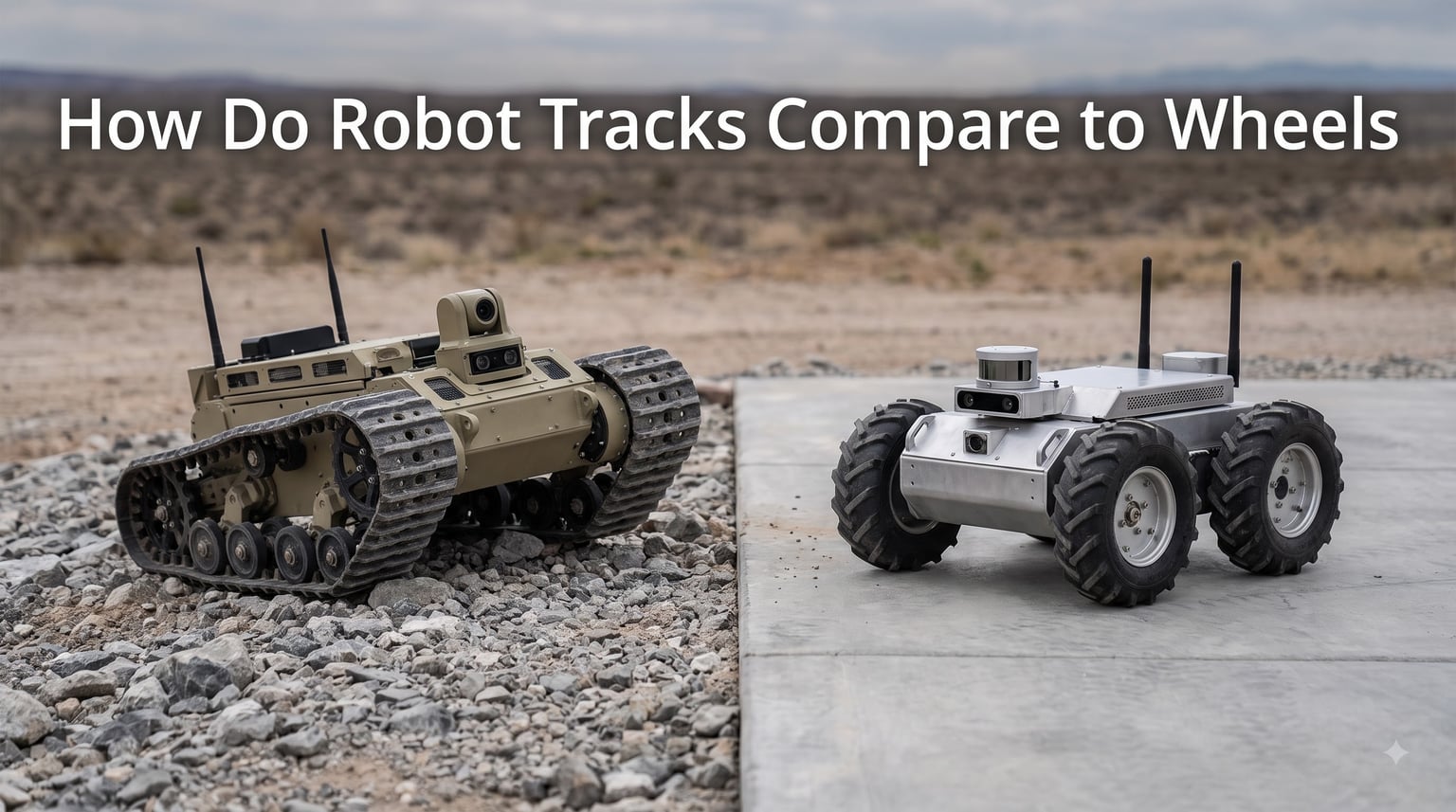
When you set out to build a mobile robot, one of the first decisions you face is how it moves. The debate over robot tracks vs wheels has been alive in robotics forums, university labs, and DIY workspaces for decades. I have built robots with both systems and watched hobbyists, students, and engineers agonize over this same choice.
The short answer is that neither system is universally better. Tracks excel at distributing weight, gripping loose surfaces, and climbing obstacles. Wheels win on speed, efficiency, simplicity, and cost. The right choice depends entirely on what terrain your robot will face and what you need it to accomplish.
In this guide, I break down exactly how do robot tracks compare to wheels across every dimension that matters. I cover the mechanics, terrain performance, energy consumption, cost, maintenance, and real-world use cases so you can make an informed decision for your next build. If you are new to robot design, our guide on robot chassis fundamentals pairs well with this article since the chassis you choose directly affects which locomotion system works best.
Table of Contents
Robot Tracks vs Wheels: Quick Comparison
Here is a side-by-side snapshot of how tracks and wheels stack up across the key categories. I go into each of these in depth throughout the article.
Terrain capability: Tracks handle soft, uneven, and steep surfaces far better. Wheels perform best on flat, solid ground.
Speed: Wheels are significantly faster. Tracks top out much lower due to friction and mechanical losses in the drive system.
Energy efficiency: Wheels use less power. Skid steering on tracks wastes energy every time the robot turns.
Ground pressure: Tracks spread weight over a large contact area. Wheels concentrate it on small patches.
Cost: Wheels are cheaper to buy and simpler to integrate. Tracks cost more and need additional components like idlers and tensioners.
Maintenance: Wheels are low-maintenance. Tracks require tension adjustments, debris cleaning, and eventual belt replacement.
Maneuverability: Tracks can pivot in place using skid steering. Wheels offer smoother, more precise directional control.
Obstacle climbing: Tracks climb over steps and gaps more effectively. Wheels struggle once obstacles exceed roughly one-third of their diameter.
A peer-reviewed study published in ScienceDirect found that tractive efficiency of a tracked robot was measurably higher than that of a comparable wheeled robot, confirming what builders report in forums. But that advantage comes at a real cost in complexity and power draw.
How Robot Tracks Work
Robot tracks, also called continuous tracks or tank treads, use a flexible reinforced belt looped around a set of wheels. A toothed drive wheel, powered by a motor, engages with the belt and pulls it forward as it rotates.
The belt also passes over idler wheels that guide it and maintain its path. Together, the drive wheel, idlers, and belt form a loop that continuously lays track surface in front of the robot and picks it up behind. This is what gives tracks their signature look and their ability to spread weight over a long, wide contact patch.
The large contact area is the entire point of the design. By spreading the robot’s weight over many times more surface than a wheel would, the ground pressure drops dramatically. That is why tanks do not sink in mud the way wheeled vehicles do.
Track Tension and Why Tracks Stay On
A common question I see in forums is how tank tracks not fall off. The answer comes down to three things working together: tension, tooth engagement, and proper alignment.
A tensioning system, usually an adjustable idler wheel, keeps the belt tight enough that it cannot slip off the drive wheel. The drive wheel has teeth that mesh with matching holes or lugs on the inside of the track, similar to how a timing belt works on a bicycle chain. Idler wheels on the opposite end guide the belt and keep it tracking straight.
When tension drops, the belt loosens, and derailment becomes likely. Debris caught between the drive teeth and belt can also cause the track to jump off. This is one of the most frustrating failure modes tracked robot owners report.
How Robot Wheels Work
Wheeled robots use individual wheels mounted directly or indirectly to motors. Each wheel rotates independently, and movement comes from the friction between the tire and the ground surface.
The mechanics are straightforward. A motor spins the wheel, the tire grips the surface, and the robot moves. There are no belts, no idler wheels, and no tensioning systems to worry about. This simplicity is the single biggest reason most hobbyist and indoor robots use wheels.
Steering on wheeled robots takes several forms. Differential drive, where two powered wheels turn at different speeds, is the most common for small robots. Ackermann steering mimics a car and works well for larger platforms. Mecanum and omni wheels allow sideways and diagonal movement for applications that need omnidirectional control. If you want to dig into movement capabilities, our guide on mobility and degrees of freedom in robot design covers this in detail.
Advantages of Robot Tracks
Tracks bring a set of strengths that no wheel configuration can fully replicate. Here is where they shine.
Superior traction on loose and soft surfaces: Sand, mud, gravel, snow, and loose soil are where tracks dominate. The large contact area prevents sinking, and the tread pattern grips surfaces that wheels would spin on.
Low ground pressure: A tracked robot spreads its weight across a long, wide footprint. This means it can cross soft ground, fragile surfaces, or even snow without bogging down. For agricultural and inspection robots, this is often a requirement, not a luxury.
Excellent obstacle climbing: Tracks can wrap over obstacles and pull the robot up and over. Stairs, curbs, logs, and gaps that stop a wheeled robot cold are often manageable for a tracked one.
Stability on slopes: The wide stance and large contact patch give tracked robots a stable platform on inclines. This matters for search and rescue robots, agricultural robots, and military platforms.
Pivot turning: Skid steering lets a tracked robot rotate in place by driving one track forward and the other backward. This zero-radius turn is valuable in tight spaces.
Fewer motors needed: A tracked robot typically needs only two motors, one per track. A comparable four-wheel-drive wheeled robot needs four motors or a more complex drive train, which can make tracks more economical on the motor side.
Disadvantages of Robot Tracks
Tracks come with real trade-offs that you need to weigh carefully.
Lower top speed: The mechanical losses in the belt system, combined with higher friction from the large contact patch, mean tracked robots are slow. If speed matters to your application, tracks will hold you back.
Higher power consumption: Skid steering forces one track to drag sideways against the ground during every turn. This wastes significant energy. On straight runs, the belt system adds rolling resistance compared to wheels. For more on managing power budgets, our article on battery selection considerations is worth reading.
Mechanical complexity: Tracks need drive wheels, idler wheels, tensioners, belts, and proper alignment of all these components. More parts means more potential failure points and more design effort.
Derailment risk: A thrown track stops a tracked robot dead. Tension must be maintained, debris must be cleared, and alignment must be correct. Forum posts are full of builders fighting this exact problem.
Turning precision: Skid steering is inherently imprecise compared to wheeled steering. The amount of slip during a turn varies with surface conditions, making exact heading control harder.
Vibration and noise: The continuous flexing of the belt and the engagement of drive teeth generate vibration and noise. This can affect sensor performance and is rarely mentioned but consistently reported by builders.
Advantages of Robot Wheels
Wheels are the default choice for most robots for good reason. Here is what they do well.
Speed and efficiency: Wheels roll with minimal resistance, allowing higher top speeds and lower energy use per meter traveled. This translates directly to longer battery life, which matters for any mobile platform.
Simplicity: A wheel, a motor, and a mounting bracket is all you need per drive wheel. No belts, no tensioners, no idlers. This makes design, assembly, and troubleshooting far easier.
Precise control: Wheeled robots with encoders can achieve precise positioning and repeatable turns. This is why nearly all indoor service robots, warehouse robots, and competition robots use wheels.
Lower cost: Standard wheels and tires are mass-produced and inexpensive. The supporting hardware, like hubs and mounts, is simpler and cheaper than track system components.
Quiet operation: Wheels produce far less noise and vibration than tracks. For home robots and indoor applications, this is a major advantage.
Availability of components: Wheels in every size, material, and tread pattern are readily available from countless suppliers. Affordable track components for small robots are much harder to source, a common complaint in DIY forums.
Disadvantages of Robot Wheels
Wheels have clear limitations that make them unsuitable for certain applications.
Poor performance on soft ground: Wheels concentrate weight on small contact patches. On sand, mud, or snow, they sink and spin. Adding more driven wheels helps, but it never matches what tracks offer.
Limited obstacle climbing: A wheel can typically climb an obstacle no taller than about one-third of its diameter. Tracks can climb obstacles significantly taller because they wrap over the leading edge.
Higher ground pressure: Even with large, soft tires, the contact patch is small compared to a track. This limits where wheeled robots can operate effectively.
Reduced slope stability: On steep inclines, especially with loose surfaces, wheeled robots are more prone to sliding or tipping than tracked ones.
More motors for all-wheel drive: If you need four-wheel drive for better traction, you need four motors and the controller channels to drive them. This adds cost and complexity.
Terrain Performance: Tracks vs Wheels
Terrain is the single biggest factor in the tracks versus wheels decision, and the difference is dramatic.
Soft surfaces (mud, sand, snow): Tracks win decisively. The distributed weight prevents sinking, and the tread grips loose material. Wheeled robots bog down and often get stuck. Multiple Reddit builders report that their wheeled designs sank in grass after rain while tracked versions handled it easily.
Rough, uneven ground: Tracks handle rocks, roots, and ruts better because they bridge gaps and maintain contact with the surface. Wheels drop into holes and can get stuck or tipped.
Stairs and steps: Tracks can climb stairs if the tread and geometry are right. Wheels almost never can, unless the robot is specifically designed with very large wheels or a climbing mechanism.
Smooth indoor surfaces: Wheels win. They are faster, quieter, more precise, and more efficient on tile, concrete, carpet, and wood floors. Tracks work indoors but offer no advantage and add drawbacks.
Slopes and inclines: Tracks provide better traction and stability on slopes, especially when the surface is loose. NASA chose wheels for Mars rovers because the reliability and efficiency advantages outweighed the traction benefits of tracks for that specific mission profile.
Wet or icy surfaces: Neither system is great on ice, but tracks generally provide more grip due to larger contact area and aggressive tread patterns. Wheeled robots benefit from specialized tires but still struggle compared to tracks.
Energy Efficiency and Power Consumption
Energy consumption is where the gap between tracks and wheels becomes quantifiable. Wheeled robots are more efficient, and the difference affects battery life, runtime, and overall system design.
On flat ground, a wheel rolls with minimal resistance. The contact patch is small, and a good tire deforms only slightly under load. A track, by contrast, has a long contact patch with high friction. The belt itself flexes continuously as it moves around the drive and idler wheels, absorbing energy.
Turning is where tracks lose the most efficiency. Skid steering requires one track to drag sideways against the ground while the other pushes forward. The track does not want to slide sideways, so the motor draws significant current to force it. This energy is entirely wasted as heat.
For battery-powered robots, this matters a lot. A wheeled robot that runs for 90 minutes might see 50 to 60 minutes of runtime with the same battery if converted to tracks. The exact difference depends on the robot’s weight, the surface, and how often it turns.
If runtime is a priority, wheels are the better choice. Our guide on power system design for mobile robots goes deeper into wiring and power distribution for both locomotion types.
Cost and Mechanical Complexity
Cost is a major factor for hobbyists and students, and the comparison is not as simple as you might expect.
On the component level, wheels are cheaper. A quality wheel with a tire costs a fraction of what a comparable track belt, drive sprocket, and idler wheel set costs. Standard RC car wheels are available for a few dollars each, while small robot tracks can cost significantly more per set.
However, tracks can be more economical on the motor side. A two-track robot needs only two drive motors. An equivalent four-wheel-drive robot needs four motors, four motor controllers, and more wiring. For a robot that needs good traction, the motor savings on a tracked design can partially offset the higher track cost.
For DIY builders, cost goes beyond parts. Custom track design and fabrication is difficult. Finding affordable small-scale track components is a common pain point in forums. Wheels are available everywhere in every size, making them far more accessible for builders on a budget.
Mechanical complexity also affects your time. A wheeled robot can be assembled and running in an afternoon. A tracked robot requires careful alignment, tension adjustment, and testing before it works reliably.
Torque requirements also differ between the two systems. Tracks need more torque to overcome rolling resistance and to skid-steer. Our guide to understanding torque requirements helps you calculate what your motors need for either system.
Maintenance and Reliability Over Time
Over the life of a robot, maintenance requirements diverge sharply between tracks and wheels.
Wheeled robots are low-maintenance. Bearings may need occasional lubrication, and tires eventually wear out, but that is about it. Most wheeled robots run for long periods with minimal attention.
Tracked robots demand more care. The belt stretches over time, requiring tension adjustment. Debris, mud, and small rocks get caught in the track mechanism and must be cleaned out regularly. Drive teeth can wear or break. The belt itself eventually needs replacement.
The derailment problem is the most critical reliability issue. A thrown track immobilizes the robot completely until it is reinstalled and retensioned. In competitive or mission-critical applications, this is a serious risk.
Forum builders consistently report that wheels are more reliable in the long run. Track jamming can stop a robot mid-mission, while a wheel failure is relatively rare and usually gradual rather than catastrophic.
That said, well-designed and well-maintained track systems can be very reliable. Military and industrial tracked robots prove this every day. The key is investing in quality components and committing to regular maintenance.
Hybrid Locomotion: Combining Tracks and Wheels
Some robots blend both systems to get the best of both worlds. Hybrid locomotion is an emerging approach that real platforms are already using.
NASA’s ATHLETE robot uses wheels on the end of adjustable legs. It rolls on wheels for efficiency on flat ground and can lift its wheels to step over obstacles when needed. The AZIMUT project uses wheels that can rotate to act as tracks or legs depending on the terrain.
At the hobbyist level, some builders create robots with wheel-track conversion kits. These use wheels for normal operation and deploy small track segments or flippers when the robot encounters rough terrain.
Hybrid systems are more complex and expensive than either pure approach, but they offer versatility that neither can match alone. For robots that must operate across mixed environments, from warehouse floors to outdoor yards, hybrids are worth considering.
The trade-off is added weight, complexity, and failure points. Each additional mechanism is something else that can break. For most builds, a well-chosen single system is more practical than a hybrid.
How to Choose Between Tracks and Wheels
I use a simple decision framework when advising builders on this choice. Work through these questions in order.
Step 1: What surface will the robot operate on? If it is mostly flat and solid, like indoor floors, pavement, or short carpet, wheels are the right call. If it is loose, soft, or uneven, like mud, sand, gravel, grass, or rocky ground, tracks are the better choice.
Step 2: Does the robot need to climb obstacles or stairs? If yes, tracks handle this far better. If no, wheels offer no disadvantage and several advantages.
Step 3: How important is runtime and battery life? If maximizing runtime on a single charge is critical, wheels are more efficient. Tracks will cut your runtime significantly.
Step 4: What is your budget and skill level? If you are a beginner or working with a tight budget, wheels are simpler and cheaper to implement. Tracks require more design effort, more components, and more money.
Step 5: How precise does movement need to be? If you need repeatable, precise positioning, like for a competition robot or an autonomous navigation project, wheels with encoders are more accurate. Skid steering on tracks is harder to control precisely.
Step 6: Will the robot carry heavy loads? Tracks distribute weight better and can carry heavier payloads relative to their size. If load capacity matters, factor this in.
Most builds answer these questions clearly. When the answers are mixed, consider which factor matters most to your specific project.
Real-World Applications: When Each System Wins
Looking at how professionals choose confirms the principles above.
Where tracks win: Military robots like PackBot use tracks for obstacle navigation and stability on debris. Agricultural robots use tracks to avoid sinking in soft soil. Bomb disposal robots use tracks to climb stairs and navigate rubble. Search and rescue robots need tracks to reach victims across collapsed structures.
Where wheels win: Warehouse robots like those from Amazon’s fulfillment centers use wheels for speed and precision on flat floors. Mars rovers use wheels for reliability and efficiency over long distances. Home cleaning robots like Roomba use wheels for quiet, efficient indoor operation. Competition robots in events like RoboCup use wheels for speed and precise control.
The NASA question: People often ask why Mars rovers use wheels instead of tracks. The answer comes down to reliability. A thrown track on Mars would be a mission-ending failure with no way to fix it. Wheels are simpler, lighter, and far less likely to fail catastrophically. The slight traction advantage of tracks was not worth the risk.
Combat robots: In fighting robot competitions, opinions are split. Some builders use tracks for the larger contact area and pushing power. Others avoid them because a damaged track means immediate immobilization. Most competitive builders favor wheels for their reliability under combat stress.
FAQs
Are tank tracks better than wheels?
Tank tracks are not universally better. They excel on soft, loose, or uneven terrain where their large contact area prevents sinking and provides superior traction. Wheels are better for speed, energy efficiency, precise control, and flat surfaces. The right choice depends on your terrain, budget, and application.
How do tank tracks not fall off?
Tank tracks stay on through three mechanisms working together. A tensioning system keeps the belt tight, drive wheel teeth mesh with matching holes in the track to prevent slipping, and idler wheels guide the belt along its path. Proper tension and alignment are essential, since a loose track or debris in the drive teeth can cause derailment.
Why might a wheeled robot be more practical for home use?
Wheeled robots are more practical for home use because they are simpler to build and maintain, cheaper to source parts for, quieter during operation, more energy efficient on indoor surfaces, and easier to control precisely on flat floors. Tracks add complexity, noise, and cost with no real advantage indoors.
Are tracks more expensive than wheels?
Track components generally cost more than comparable wheels, since you need drive sprockets, idler wheels, tensioners, and the track belt itself. However, tracks can offset some cost because a two-track robot needs only two motors, while an all-wheel-drive robot needs four. Overall, wheels remain the cheaper and simpler option for most builds.
Which is better for rough terrain, tracks or wheels?
Tracks are significantly better for rough terrain. Their large contact area distributes weight to prevent sinking in mud, sand, or snow, and their ability to wrap over obstacles makes them superior at climbing rocks, stairs, and gaps. Wheeled robots struggle once terrain becomes soft or uneven, though large aggressive-tread tires can help in moderate conditions.
Wrapping Up the Tracks vs Wheels Debate
The robot tracks vs wheels comparison comes down to matching your locomotion system to your real-world needs. Tracks deliver unmatched traction, obstacle climbing, and stability on challenging terrain. Wheels deliver speed, efficiency, simplicity, and cost savings on everything else.
After years of building and testing both systems, I recommend wheels for most indoor, beginner, and budget-conscious projects. I recommend tracks when your robot must cross soft ground, climb obstacles, or maintain traction on slopes. The decision framework above will guide you to the right answer for your specific build.
Whichever you choose, the chassis, power system, and motor selection all flow from this single decision. Start there, and the rest of your design will fall into place. If you want to explore how locomotion affects what your robot can do with tools and manipulators, our guide on end effector selection for mobile robots is a great next read.