
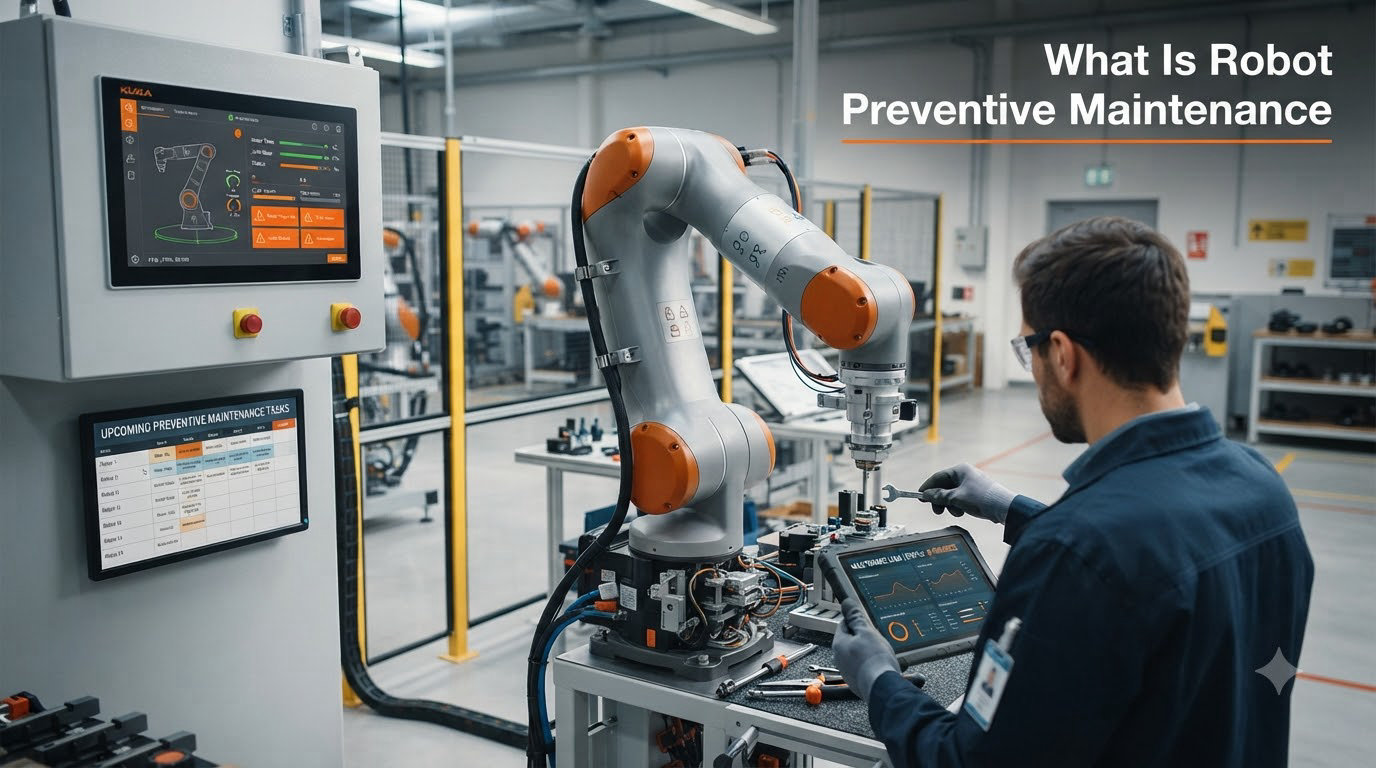
Robot preventive maintenance is a proactive approach to keeping industrial robots running at peak performance through scheduled inspections, cleaning, lubrication, calibration, and part replacement. I have spent the last decade working with manufacturing teams that depend on robotic automation, and I can tell you from firsthand experience: a well-planned preventive maintenance program is the single biggest difference between a profitable cell and one that bleeds money through unplanned downtime.
If you operate welding, assembly, or material handling robots, this guide will give you the full picture. I will walk you through what robot preventive maintenance actually is, why it matters, the five core types of maintenance, and the exact checklists our team uses on the production floor. By the end, you will have a clear framework to build or refine your own program for 2026 and beyond.
Table of Contents
What Is Robot Preventive Maintenance?
Robot preventive maintenance is the practice of performing scheduled servicing tasks on industrial robots to prevent failures before they happen. It includes visual inspections, lubrication, calibration checks, software backups, and the replacement of wear parts at fixed intervals based on operating hours or calendar time.
Unlike reactive maintenance, where you fix things after they break, preventive maintenance is all about staying ahead of failure. The approach is systematic and time-based. You service a robot every 1,920 servo hours, every 3,850 servo hours, or every 12 months, whichever comes first. This way, the components that wear out get replaced while the robot is still running well, rather than after a breakdown has already cost you a shift of production.
Most major OEMs, including FANUC, Yaskawa, ABB, and KUKA, publish their own preventive maintenance schedules. The schedules typically cover the same core components: servo motors, joint bearings, encoders, bellows, power supplies, cables, and the control cabinet. When you follow those schedules, your robot maintains its original repeatability and accuracy for hundreds of thousands of operating hours.
Why Robot Preventive Maintenance Matters
Robot preventive maintenance matters because unplanned downtime is brutally expensive. Industry data consistently shows that a single hour of downtime on an automotive production line can cost anywhere from $10,000 to $250,000, depending on the operation. Even a small machine shop loses thousands per hour when a robot cell goes dark.
Preventive maintenance also extends the useful life of the robot itself. A well-maintained industrial robot can run productively for 20+ years and over 100,000 operating hours. Skip the maintenance, and that same robot can develop bearing failures, encoder drift, or gearbox backlash that forces an early retirement. I have seen $80,000 robots scrapped at year eight because the maintenance team could not get a slot in the schedule.
Other benefits I have observed in real facilities include better product quality (because the robot stays in calibration), lower energy consumption, fewer safety incidents, and easier compliance with audits. There is also a strong ROI argument: a typical preventive maintenance program costs 3-5% of the robot’s purchase price per year, while a single major repair can easily run 15-20% of the original price.
5 Types of Preventive Maintenance
There are five main types of preventive maintenance used in modern robotics programs. Each has its place, and the best operations tend to combine several of them.
- Scheduled (Time-Based) Maintenance: Servicing at fixed calendar intervals, such as every 3 months or 12 months. Easy to plan and budget for, and forms the foundation of most programs.
- Usage-Based Maintenance: Servicing triggered by accumulated operating hours, cycles, or servo hours. This approach is more accurate because it tracks actual wear rather than just wall-clock time.
- Condition-Based Maintenance: Servicing driven by real-time sensor data, such as vibration analysis, temperature monitoring, or current draw. It is the most efficient type but requires instrumentation.
- Planned (Predictive) Maintenance: Using historical data and machine learning to forecast when a component will fail, then scheduling service just before that point.
- Total Productive Maintenance (TPM): A philosophy where every operator takes ownership of basic maintenance, like cleaning and inspection, freeing the maintenance team to focus on technical work.
Most facilities I work with use a hybrid model. They rely on scheduled and usage-based maintenance as the backbone, layer in condition monitoring for critical assets, and gradually add predictive analytics as their data infrastructure matures.
Common Components That Need Regular Maintenance
Every industrial robot has a handful of components that take the most abuse. These are the parts your preventive maintenance program should focus on first.
Servo Motors: The heart of every robot. They convert electrical signals into precise motion, and they generate heat in the process. During a preventive check, you look for oil leaks, listen for bearing noise, and verify the encoder is reading correctly. Most OEMs recommend a full servo inspection every 3,850 servo hours.
Joint Bearings and Gearboxes: The mechanical joints of the robot rely on bearings and, in most cases, planetary gearboxes. Our team checks for backlash (you can read more about this in our guide on backlash in robot gearing) and verifies the lubrication status. If you want a deeper look at how these gear systems work, the planetary gearbox guide is a good resource.
Encoders: These sensors tell the controller where each axis is at any moment. Even a tiny amount of contamination on the encoder disk can throw off positioning. Preventive maintenance includes cleaning, calibration verification, and replacement of backup batteries that keep the absolute encoder position during power-off.
Bellows and Boots: The flexible covers that protect the robot’s axes from dust, coolant, and weld spatter. Inspect them every shift in harsh environments and replace them at the first sign of tearing.
Power Supplies and Control Cabinet: The control cabinet houses the drives, power supplies, and the controller. Dust buildup here is one of the leading causes of overheating and failure. Clean filters, vacuum out debris, and verify that fans are spinning freely.
Cables and Connectors: Robot dress packs carry power, signal, and air. Cables flex millions of times per year, so inspect for chafing, kinks, and broken strands. Replace any cable that shows wear before it fails mid-cycle.
Daily Robot Inspection Checklist
Daily checks are quick, usually 5-10 minutes per robot, and they catch the small problems before they become big ones. Here is the checklist our team uses on the production floor.
- Visual inspection of the entire arm for oil leaks, physical damage, or loose covers.
- Listen for unusual noises during motion, especially grinding, clicking, or knocking.
- Verify all warning lights and indicators on the teach pendant and controller are normal.
- Check that all safety circuits, light curtains, and e-stops are functional.
- Confirm the brake on each axis is holding properly when the robot is stopped.
- Back up the controller memory and program files at the end of each shift.
- Check fluid levels: gear oil, hydraulic fluid, and lubricant reservoirs.
- Inspect bellows and dress pack cables for wear or contamination.
- Verify compressed air pressure is within specification.
- Look at the most recent error log and clear any non-critical faults.
Operators can do most of these tasks in less time than it takes to grab a coffee. I have seen plants cut their unplanned downtime by 40% just by sticking to this daily routine.
Weekly and Monthly Maintenance Tasks
Weekly and monthly tasks go a little deeper than daily checks. They usually require a trained technician and a planned downtime window of 30 minutes to 2 hours per robot.
Weekly tasks include cleaning the controller cabinet filters, inspecting the teach pendant cable and screen, verifying the calibration of the end-effector tool, and running a controlled motion test through the full work envelope. If the robot has a lubrication system, this is a good time to confirm it is dispensing correctly.
Monthly tasks add a more thorough inspection. The technician checks backlash in each axis with a dial indicator, tests the battery voltage for encoder backup, inspects the grounding system, and runs diagnostic routines on each servo drive. Software updates, if any are available from the OEM, are also applied during monthly maintenance windows.
For robots in harsh environments, like welding cells with heavy spatter or food processing with washdown requirements, monthly inspections are often the minimum. Be sure to check your OEM’s manual for environment-specific recommendations.
Periodic and Annual Maintenance Schedule
Beyond daily, weekly, and monthly tasks, every robot needs a periodic deep-dive. The most common benchmark is 3,850 servo hours or 12 months, whichever comes first. This is the major service interval that virtually every OEM specifies.
At the periodic service, the technician typically replaces the lubricant in each axis, inspects and replaces the batteries that back up the encoders, checks all cable connections, calibrates the robot using the OEM’s master calibration routine, and replaces any wear parts identified during inspection. On some robot models, this is also when the reducer oil gets changed.
For facilities that want to track usage accurately, servo-hour tracking is the gold standard. Most modern controllers display total servo hours on the teach pendant. Our team logs these hours in a simple spreadsheet and triggers service when the threshold is reached. Some operations also use a Computerized Maintenance Management System (CMMS) to automate this tracking.
Annual maintenance is also a great time to review the overall health of the robot cell. Look at accuracy drift, cycle time trends, and spare parts consumption. If the robot is starting to show its age, this is when you plan for refurbishment rather than waiting for a catastrophic failure. Proper planning here is also tied to understanding the robot’s payload capacity and how it relates to wear.
Preventive vs Predictive vs Reactive Maintenance
Choosing the right maintenance strategy is one of the most important decisions for any robotics operation. Here is how the three main approaches compare.
Reactive maintenance means you fix the robot only after it breaks. It has the lowest upfront cost but the highest total cost of ownership because of unplanned downtime, emergency repair fees, and secondary damage. According to a forum discussion I read on r/IndustrialMaintenance, this approach is essentially gambling that nothing serious will go wrong, and the house always wins.
Preventive maintenance schedules service at fixed intervals. It costs more upfront in parts and labor, but it dramatically reduces the risk of catastrophic failure. The trade-off is that you sometimes replace parts that still have useful life, which is why some companies push back on the cost.
Predictive maintenance uses sensors and analytics to service the robot only when data suggests failure is imminent. It is the most efficient approach but requires an investment in instrumentation and analytics. One user on Reddit put it well: predictive maintenance is better than preventive, but it can dissolve into reactive maintenance if your supply chain cannot deliver parts quickly when the model says they are needed.
For most operations, a layered strategy works best. Use preventive maintenance for the foundation, add condition-based sensors on critical assets, and gradually expand predictive analytics as your team builds expertise.
How Often Do Robots Need Maintenance?
Most industrial robots need some form of maintenance every day, every week, every month, and every 3,850 servo hours. The exact schedule depends on the robot model, the application, the operating environment, and the OEM’s recommendations.
As a general rule of thumb, expect to spend 5-10 minutes per day on operator-level checks, 30-60 minutes per month on technician-led inspection, and 4-8 hours every 3,850 servo hours for the major periodic service. Heavy-duty applications like high-payload welding or high-speed material handling tend to fall on the shorter end of the interval range.
Signs Your Robot Needs Immediate Maintenance
Even the best preventive maintenance program will not catch every issue. Watch for these warning signs and call a technician right away if you notice them.
- Unusual noises, such as grinding, squealing, or knocking, especially from the joints.
- Position drift or repeatability issues, where parts are no longer landing in the correct spot.
- Visible oil leaks around the reducers, gearboxes, or axis seals.
- Error codes that reappear after being cleared.
- Excessive vibration during motion, particularly at specific points in the work envelope.
- Slow or jerky motion that was not present the previous shift.
- Overheating servo motors or warm drive cabinets.
If you see any of these, pull the robot out of production and run a diagnostic. It is far cheaper to address a problem during a planned service window than to keep running until something fails catastrophically.
Frequently Asked Questions
What are the 5 types of preventive maintenance?
The five main types are scheduled (time-based) maintenance, usage-based maintenance, condition-based maintenance, planned (predictive) maintenance, and total productive maintenance (TPM). Most robotics operations combine several of these into a layered strategy.
How often do robots need maintenance?
Most industrial robots need daily operator checks, weekly and monthly technician inspections, and a major periodic service every 3,850 servo hours or 12 months. Heavy-duty applications may require more frequent service based on operating hours and environmental conditions.
What is included in robot preventive maintenance?
A complete robot preventive maintenance program includes scheduled visual inspections, lubrication, calibration checks, encoder battery replacement, bellows and dress pack inspection, control cabinet cleaning, software backups, and the replacement of wear parts at OEM-recommended intervals.
What is the difference between preventive and predictive maintenance?
Preventive maintenance follows a fixed schedule based on time or usage hours. Predictive maintenance uses sensor data and analytics to forecast failures and service the robot just before a problem is expected. Predictive is more efficient but requires more investment in monitoring technology and supply chain readiness.
How long does it take to become a robotic technician?
Becoming a robotic technician typically takes 1-2 years of formal training, including an associate degree or technical diploma in mechatronics, industrial maintenance, or robotics. Many technicians also complete OEM-specific certification programs, which can add another 6-12 months of specialized training.
Final Thoughts on Robot Preventive Maintenance
Robot preventive maintenance is the foundation of a reliable, profitable automation program. By scheduling inspections, lubrication, calibration, and part replacement at OEM-recommended intervals, you can extend the life of your robots, cut unplanned downtime, and keep product quality consistent. Start with the daily checklist, build out the periodic service schedule, and layer in condition monitoring as your team gains confidence. Your robots, and your production manager, will thank you.