
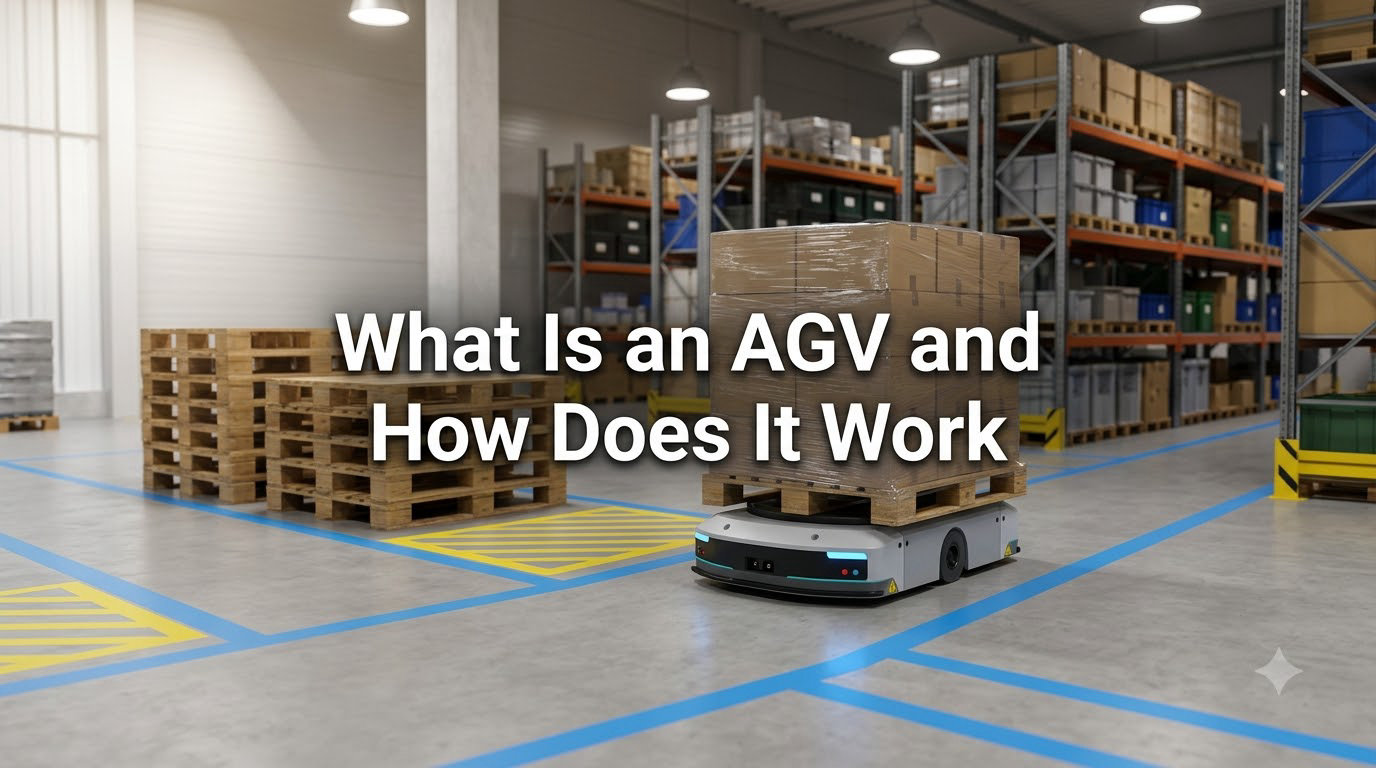
An AGV (Automated Guided Vehicle) is a self-guided industrial vehicle with an internal navigation system that allows it to move through its environment and autonomously transport materials or goods without a human operator. In this guide, I’ll walk you through exactly how an AGV works, the navigation technologies that power it, the most common types used in warehouses and factories, and where this technology is heading in 2026.
After spending weeks reviewing manufacturer specs, integrator case studies, and field reports from the Smashing Robotics community, I’ve put together what I think is the most practical explainer on this topic. By the end, you’ll know how to evaluate an AGV solution for your own facility.
Table of Contents
What Is an AGV? Definition and Core Concept
An automated guided vehicle (AGV) is a portable, self-powered robot used to move loads, parts, or materials within a controlled industrial environment. The vehicle follows a predetermined path using onboard sensors and a guidance system, with no human driver in the loop. Most AGVs operate in warehouses, distribution centers, and manufacturing plants where repetitive transport tasks dominate the workflow.
The term “automated guided vehicle” was first coined in the 1950s when Barrett Electronics introduced the first wire-guided tow truck. Today, an AGV is a much broader category that includes anything from a small unit-load cart to a 20-ton automated forklift.
Key Characteristics of an Automated Guided Vehicle
Every AGV shares a few defining traits. First, it uses an internal navigation system rather than relying on a human driver. Second, it follows a fixed or semi-fixed route inside a defined facility. Third, it carries a load, whether that is a pallet, a tote, a roll of fabric, or a partially assembled product.
AGVs are also connected. Modern units report position, battery state, and task status back to a fleet management system, often over Wi-Fi or 5G. That connectivity is what turns a single robot into a scalable fleet.
How Does an AGV Work? The Operating Mechanism
AGVs navigate using technologies like magnetic tape, laser guidance, or vision systems, following predetermined paths while sensors detect obstacles for safe operation. At a high level, every AGV has the same five-step operating cycle: receive a task, plan a path, drive, verify position, and either dock, drop the load, or signal completion.
The AGV Operating Cycle
Step 1: A warehouse management system (WMS) or operator sends a job to the AGV, usually as a “pick up at point A, drop at point B” instruction. Step 2: The AGV’s controller references a stored map of the facility and calculates a path that avoids restricted zones. Step 3: Drive motors and a steering system follow that path while safety scanners monitor the corridor.
Step 4: Encoders, LiDAR, and sometimes cameras correct drift in real time so the AGV stops within a few millimeters of the target. Step 5: The vehicle either drops the load with a roller deck, lifts a pallet, or signals the next station that it has arrived. The cycle then repeats.
Core Components Inside an AGV
Every AGV has a chassis, one or more drive motors, a battery (most commonly lithium-ion today), a guidance sensor, a safety-rated laser scanner, and an onboard controller. Higher-end units add 3D cameras, inertial measurement units, and an onboard computer for edge AI.
The fleet manager is just as important. It assigns jobs, balances battery state across the fleet, and reserves elevators or automatic doors. Without fleet software, a single AGV is just a clever cart. With it, you have a logistics team that never sleeps.
Types of AGVs Used in Industry
There is no single AGV design that fits every job. Engineers classify them by the load they carry, the way they move, and the role they play in the workflow. Here are the most common types you’ll see in 2026.
Common AGV Variants by Function
Unit load AGVs carry a single item, such as a pallet or a large container, between two fixed points. Tow AGVs (sometimes called tuggers) pull a train of carts behind them, which makes them ideal for assembly line delivery. Forklift AGVs automate the classic pallet-moving job, picking and placing loads on racks without a driver.
Assembly line AGVs shuttle parts between workstations in a fixed sequence, often replacing older overhead conveyors. Cart AGVs handle small totes in picking operations, and hybrid AGV/AMR units can switch between fixed routes and free navigation depending on the area. The hybrid category is growing fast because it solves a real pain point: AGVs are great for long predictable runs, while autonomous mobile robots (AMRs) shine in dynamic picking zones.
AGV Navigation Technologies Compared
Navigation is what separates one generation of AGV from the next. Older systems required physical infrastructure, while newer ones rely on maps and sensors. The right choice depends on your accuracy needs, your budget, and how often your floor layout changes.
Choosing the Right Navigation Method
Magnetic tape and magnetic strip guidance are the simplest and cheapest. You stick a magnetic path on the floor and the AGV follows it. It is reliable, easy to install, and very hard to repurpose. Wire guidance, where a thin wire is embedded in the floor, is the original method from the 1950s and is still used in clean factories.
Laser guidance uses reflective targets placed on walls or columns. The AGV’s spinning laser measures angles to these targets and triangulates its position. It is accurate to about 10 mm, which is enough for most pallet work. LiDAR-based natural navigation skips the reflectors entirely. The AGV builds a map of the facility and matches what its LiDAR sees against that map in real time.
Vision-based navigation uses 2D or 3D cameras and AI to read the environment. It is the most flexible but also the most demanding on processing power. Inertial navigation adds gyroscopes and accelerometers for short-term precision, often combined with another method to correct drift.
AGV vs AMR: What’s the Difference?
AGVs follow fixed paths defined by infrastructure, while AMRs (Autonomous Mobile Robots) build a map and plan their own routes around obstacles. This single design choice has cascading effects on cost, flexibility, and ease of deployment.
Side-by-Side Comparison
AGVs need a known, structured environment. They are best when routes rarely change, payloads are heavy, and you want predictable, repeatable behavior. AMRs thrive in dynamic spaces where people, carts, and unexpected obstacles appear. They cost more per unit but need almost no infrastructure.
If you run a high-volume distribution center with fixed pick faces, AGVs usually win on cost per move. If you run a hospital or a small-batch manufacturer with shifting layouts, AMRs are easier to scale. Many sites in 2026 now run hybrid fleets: AGVs handle the long predictable runs from receiving to staging, and AMRs complete the last mile to picking shelves.
Applications and Use Cases for AGVs
AGVs are deployed wherever material flow is repeatable. The three largest application areas are warehousing, manufacturing, and distribution. In a typical warehouse, AGVs move pallets from receiving docks to reserve rack locations and back to outbound staging. In automotive plants, they deliver parts to assembly lines in a strict sequence.
Distribution centers use them for cross-docking and order replenishment. E-commerce fulfillment operations rely on cart AGVs to feed goods-to-person stations. Outside the obvious cases, you’ll also find AGVs in hospitals delivering meals and linens, in printing plants moving paper rolls, and in ports moving containers between cranes and trucks.
Benefits and Limitations of AGVs
Like any industrial technology, AGVs deliver clear wins but also come with trade-offs. Anyone evaluating a fleet should look at both sides of the balance sheet.
Key Benefits
The biggest benefit is consistent, 24/7 operation. An AGV does not get tired, distracted, or sick. It also improves safety by removing forklift traffic from pedestrian zones, and it boosts accuracy by stopping in the same spot every time. Over a multi-year horizon, total cost of ownership often beats manual forklift fleets because labor, damage, and insurance costs drop.
Modern AGVs integrate directly with WMS and ERP systems, which means every move is logged in real time. That data is gold for continuous improvement.
Disadvantages of Automated Guided Vehicles
The disadvantages of automated guided vehicles include high upfront cost, the need for infrastructure changes, and limited flexibility if your layout changes often. A magnetic tape or wire-guided AGV can take days to re-route, and traditional units struggle in mixed-traffic areas unless you add extensive safety zones.
Positioning accuracy is also a known pain point. Most AGVs hold about 10 mm of repeatability without a fixed reference, and they lose performance in highly reflective or featureless environments. Battery life, charging dwell time, and integration with legacy PLCs are all real engineering challenges that need a budget.
Safety Standards and Best Practices
Safety is non-negotiable in any AGV deployment. The global benchmark is ISO 3691-4, which covers driverless industrial trucks and their systems. Compliant AGVs carry redundant safety laser scanners, emergency stops on every side, audible and visual warning devices, and a safety-rated PLC that can override the main controller.
In the field, the most reliable safety scanners come from SICK and Omron, and engineers I trust recommend pairing them with light curtains at the docking points. Before any AGV goes live, conduct a full risk assessment that includes pedestrian traffic patterns, floor conditions, and emergency egress. Keep in mind that the cheapest scanner in your spec sheet is rarely the right choice for a busy aisle.
Future Trends in AGV Technology
Three trends are reshaping AGVs in 2026. First, vision-only navigation is finally mature enough to replace laser reflectors in many sites, which cuts installation time dramatically. Second, AI-based fleet orchestration lets AGVs negotiate traffic with AMRs in real time, so mixed fleets no longer need segregated lanes.
Third, edge computing and 5G are pushing decision-making onto the vehicle itself, reducing dependence on a central server. Add digital twins for simulation and you can validate a new layout in software before cutting a single strip of magnetic tape.
Frequently Asked Questions
What are the disadvantages of automated guided vehicles?
The main disadvantages of automated guided vehicles are high upfront cost, the need for installed infrastructure like magnetic tape or reflectors, limited flexibility when facility layouts change, and roughly 10 mm of positioning repeatability without a fixed reference. Integration with legacy WMS or ERP systems can also add engineering hours and cost.
Can you give me an example of an AGV?
A common example is the automated forklift AGV used in distribution centers. It picks a pallet from the inbound dock, drives itself to a reserve rack location, and places the pallet on the rack. Tow AGVs that pull trains of carts in automotive assembly lines and unit-load AGVs that move single pallets in warehouses are also widely deployed examples.
How much do AGVs typically cost?
A simple magnetic-tape guided cart AGV can start in the low five figures, while a heavy-duty automated forklift with laser guidance often lands in the six-figure range. Total project cost depends on fleet size, navigation technology, charging infrastructure, and integration with your warehouse management system. Most vendors quote per vehicle plus fleet software and integration.
What is the difference between an AGV and an AMR?
An AGV follows a fixed path defined by infrastructure such as magnetic tape, wires, or reflectors, and works best in structured, predictable layouts. An AMR (Autonomous Mobile Robot) builds a map of its environment and plans its own route around obstacles, which makes it more flexible in dynamic spaces. AGVs usually win on cost per move in high-volume sites, while AMRs win on deployment speed and adaptability.
Conclusion
So, what is an AGV and how does it work in practice? An automated guided vehicle is a self-guided industrial robot with an internal navigation system that moves loads along fixed or semi-fixed paths using magnetic, laser, vision, or LiDAR guidance. It is the workhorse of modern warehouse automation and a key building block of any lights-out operation.
If you’re evaluating AGVs for your own site, start by mapping your material flow, pick the navigation method that matches your accuracy and flexibility needs, and budget for integration and safety as carefully as for the vehicles themselves. The technology is mature, the standards are clear, and 2026 is a great time to start a pilot.