
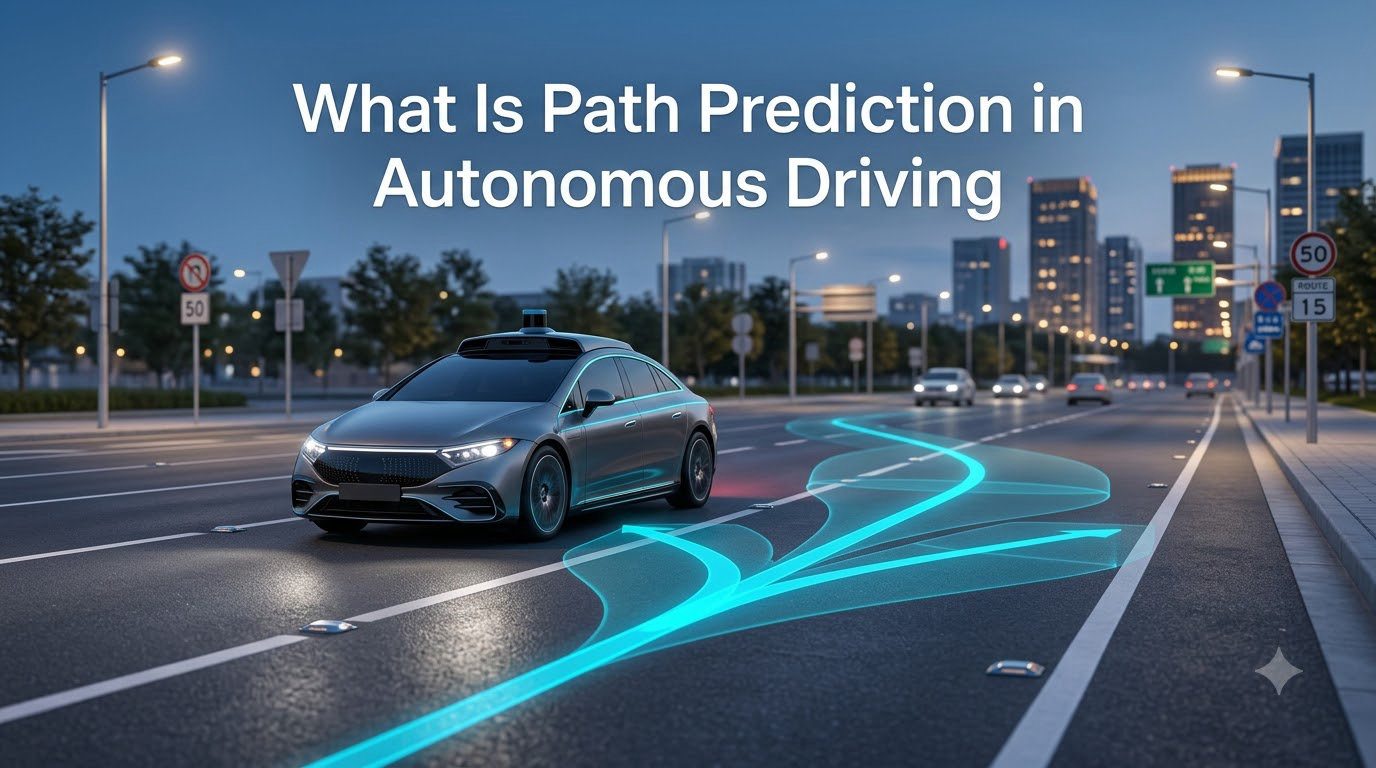
Path prediction in autonomous driving is the process by which a self-driving car forecasts the future trajectories of itself and surrounding road users using sensor data, AI, and machine learning models. In plain terms, it is the part of the autonomous stack that answers the question: where will that car, cyclist, or pedestrian be in 3, 5, or 8 seconds from now? I have spent years tracking this field, and I can tell you that this single capability quietly determines whether a robotaxi glides through an intersection or slams on its brakes.
This guide explains what path prediction in autonomous driving really is, how it works step by step, the AI and sensor technologies behind it, where the technology still struggles, and where it is heading. You will come away with a clear mental model of how modern self-driving cars anticipate the road ahead.
Table of Contents
What Is Path Prediction in Autonomous Driving
Path prediction in autonomous driving is a specific subfield of motion forecasting focused on estimating the most likely future positions of every dynamic object around a vehicle. It takes the current state of the road, including vehicle speeds, headings, lane positions, and pedestrian movements, and outputs probability distributions of where those agents will be in the next few seconds.
It is not the same as path planning. Path planning decides the route the autonomous vehicle will take. Path prediction figures out what everyone else is going to do so the planner can pick a safe route. Without good prediction, even a perfect planner would be driving blind to the actions of other drivers.
Think of it this way. When you drive through a four-way stop, you do not just plan your own path. You watch the other driver’s eyes, the angle of their wheels, and their creeping speed to guess whether they will go before you. Path prediction in autonomous driving is the machine version of that same skill, executed at 10 to 30 times per second across dozens of objects at once.
Path Prediction vs Path Planning vs Perception
These three terms often get conflated, so here is a clean separation:
- Perception answers: what is around the car right now? It detects cars, lane lines, signs, and pedestrians in the current frame.
- Path prediction answers: where will those objects be in the near future? It outputs predicted trajectories for the next 3 to 8 seconds.
- Path planning answers: what should our car do next? It generates a safe and comfortable trajectory for the autonomous vehicle based on perception and prediction outputs.
Path prediction sits between perception and planning, and its accuracy directly limits how aggressively or conservatively the vehicle can plan. If prediction is shaky, planning has to be defensive. If prediction is sharp, planning can be smooth and human-like.
How Path Prediction Works Step by Step
Path prediction in autonomous driving follows a predictable pipeline. Here is the same flow I have seen deployed across the major AV programs, broken into six steps.
Step 1: Sensor Data Collection
The vehicle continuously sweeps its environment with cameras, LIDAR, radar, and ultrasonic sensors. Each sensor type contributes a different slice of the scene. Cameras capture color and texture, LIDAR provides precise depth, and radar measures velocity of distant objects even through rain or fog.
Step 2: Perception and Object Detection
Perception models turn raw sensor data into structured objects. Every detected car, truck, bicycle, or pedestrian becomes a tracked entity with attributes like position, velocity, heading, and object class. This step also reads traffic lights and road signs.
Step 3: Tracking and State Estimation
Tracking algorithms stitch object detections across frames so each agent has a continuous history. A car seen in frame 1 and frame 2 must be recognized as the same car, with its speed and acceleration updated. This short-term motion history becomes a strong input for prediction.
Step 4: Scene Understanding and Context
Before predicting motion, the system reasons about context. Is the vehicle ahead approaching a turn-only lane? Is a pedestrian standing on a curb near a crosswalk? HD maps, lane geometry, and traffic rules feed this contextual layer so predictions are not just physics, they are social.
Step 5: Trajectory Forecasting
This is the core of path prediction in autonomous driving. AI models output one or more plausible future paths for each tracked object, often as probability distributions rather than single lines. The vehicle ahead might have a 70% chance of continuing straight and a 30% chance of turning right.
Step 6: Planner and Control Loop
Predicted trajectories are handed to the planner, which picks a safe maneuver, and to the controller, which steers, accelerates, and brakes. If prediction changes, planning and control update on the next cycle, usually within 100 milliseconds.
Key Technologies Behind Trajectory Prediction
Modern path prediction in autonomous driving depends on a stack of sensing, mapping, and compute technologies. Here are the main building blocks.
Sensors That Feed the Prediction Pipeline
- Camera: Provides 2D visual context, lane markings, traffic light state, and pedestrian intent cues. Most AVs use multiple cameras for 360-degree coverage.
- LIDAR: Sends laser pulses to build a 3D point cloud. LIDAR is exceptional at precise localization and object shape.
- Radar: Measures radial velocity directly using the Doppler effect. Radar works through fog, rain, and dust, making it critical for highway prediction.
- Ultrasonic: Short-range sensors used at low speeds for parking and tight maneuvering.
No single sensor covers every situation, which is why sensor fusion matters. A camera can read a brake light, radar can confirm the vehicle is slowing, and LIDAR can verify the gap is shrinking. Fused together, they produce predictions that are far more reliable than any single source.
HD Maps and Localization
Predictions improve dramatically when the system knows the static world in advance. HD maps store lane geometry, stop lines, crosswalks, and speed limits at centimeter accuracy. The vehicle localizes itself against the map, and prediction models use map context to anticipate maneuvers like turns at intersections.
Compute Hardware
Path prediction in autonomous driving must run in real time, often on embedded GPUs or custom AI accelerators in the trunk or behind the windshield. The latest AV compute platforms deliver hundreds of trillions of operations per second, enough to run multiple prediction models in parallel.
Machine Learning and AI Models Used in Path Prediction
Early AV systems used physics-based models that simply projected each object’s current velocity forward in a straight line. Modern systems use deep learning to capture the social, contextual, and interactive nature of driving. Here are the AI architectures that dominate path prediction in autonomous driving today.
Recurrent Neural Networks (LSTM and GRU)
Long Short-Term Memory networks and Gated Recurrent Units were the workhorses of trajectory prediction for years. They handle sequences of past positions and learn temporal patterns like acceleration, braking, and lane changes. LSTM-based models are still common in production stacks because they are efficient and well understood.
Convolutional and Graph Neural Networks
Scenes can be represented as bird’s-eye-view grids or as graphs where vehicles are nodes and interactions are edges. Convolutional networks read grid scenes, while graph neural networks model how nearby agents influence each other. Both approaches have produced state-of-the-art results on benchmark datasets.
Transformers and Attention Mechanisms
Transformers, the architecture behind large language models, are now applied to driving scenes. Self-attention lets the model weigh the influence of every agent and map element when predicting a single trajectory. Transformers excel at long-range dependencies, which matters when a traffic light two blocks away affects behavior now.
Foundation Models for Trajectory Prediction
A 2025 survey on large foundation models for trajectory prediction in autonomous driving highlights a new direction: pre-training one massive model on diverse driving data, then fine-tuning it for specific vehicles or regions. The hope is the same generalization we see in language models, but for motion forecasting across cities, countries, and weather conditions.
Probabilistic and Multi-Modal Outputs
Most state-of-the-art models do not output a single line. They output multiple plausible trajectories with associated probabilities. This is critical because real driving is multi-modal: a vehicle approaching a fork can plausibly go left, right, or straight. The planner needs the full distribution to make safe decisions under uncertainty.
Types of Prediction Methods Compared
There are three broad families of approaches to path prediction in autonomous driving, and the industry uses a blend of all three in production.
Physics-Based Models
These models assume each agent continues its current motion according to simple dynamics. They are fast, predictable, and work well for short horizons under 1 second. They fail when agents make decisions, like turning or yielding.
Rule-Based and Maneuver Models
These models classify each agent into a maneuver, such as lane change, turn, or stop, then follow a hand-crafted trajectory for that maneuver. They are interpretable but brittle when drivers do unexpected things.
Learning-Based Models
Deep learning models learn patterns from millions of miles of real and simulated driving. They capture social interactions and contextual cues that rule-based systems miss. They require large datasets and careful validation.
Hybrid Approaches
Most production AV stacks combine all three. A learning model proposes trajectory candidates, a physics layer checks feasibility, and a rule layer enforces traffic law. Hybrid systems aim for both accuracy and safety guarantees.
Multi-Agent Prediction in Complex Traffic
Real driving is not a single agent. It is dozens of agents influencing each other in dense traffic. Path prediction in autonomous driving has to model these interactions or it will miss the social physics of merging, yielding, and roundabouts.
Joint vs Independent Prediction
Independent prediction forecasts each agent on its own. Joint prediction models the scene as a coupled system, where every agent’s future depends on every other agent. Joint models are more accurate in busy scenes but far more compute-intensive.
Pedestrian and Cyclist Prediction
Pedestrians and cyclists are particularly hard. They move slowly, change direction suddenly, and respond to social cues like eye contact. Modern pedestrian predictors use skeleton pose estimation and attention mechanisms to read body language, like a person rotating their shoulders before stepping off the curb.
Occlusion and Hidden Agents
Sometimes the most important agent is the one you cannot see, like a pedestrian about to emerge from behind a parked truck. Prediction systems use map context and learned priors to infer the presence of hidden agents and assign risk to their likely positions.
Real-World Applications and Industry Examples
Path prediction in autonomous driving is not academic. It runs in production robotaxis, consumer ADAS features, and autonomous trucks today. Here is how the major players approach it.
Waymo
Waymo uses deep neural networks for perception and prediction, then layers its Responsibility-Sensitive Safety formal model on top. The neural nets propose trajectories, and the RSS layer enforces safe-distance constraints regardless of what the network predicts. This combination is a textbook example of a hybrid stack.
Tesla
Tesla’s Full Self-Driving software uses a vision-only stack that runs neural networks directly on camera feeds, without LIDAR. The company has published work on end-to-end prediction models that take raw video and HD map data and output trajectories directly. Tesla leans heavily on fleet-scale data collection to train these models.
Mobileye
Mobileye combines neural networks with formal verification methods to mathematically prove the safety of certain maneuvers. Their prediction stack uses both camera and radar fusion, and they have been vocal about redundancy as a path to safety.
Robotaxis and Autonomous Trucks
Robotaxi services like Waymo and Cruise, plus autonomous trucking programs from Aurora, Kodiak, and others, all rely on accurate path prediction. For trucks, prediction matters even more because a fully loaded semi cannot stop quickly, so the planner needs early, accurate forecasts of cut-ins and slowdowns.
Challenges and Limitations of Current Systems
Despite the progress, path prediction in autonomous driving is far from solved. These are the open problems the research community is actively working on.
Long-Tail Edge Cases
Most driving is routine, but safety depends on the rare 0.01% cases: a stroller rolling into the street, a mattress falling off a truck, a person running a red light. Models trained on common scenarios can fail on these outliers, and collecting enough examples to train on is impractical.
Human Behavior Modeling
Humans are not always rational. A driver might wave another driver through an intersection, or change their mind halfway through a lane change. Capturing these social and emotional signals remains difficult. Reddit threads on r/SelfDrivingCars and r/teslamotors are full of users reporting exactly these scenarios as the hardest ones for AVs.
Real-Time Latency
Predictions must arrive within milliseconds. A model that takes 500ms to produce a forecast is useless for a car moving at highway speed. The constant pressure is to compress models or design lighter architectures without losing accuracy.
Cross-Region Generalization
A model trained in Phoenix may struggle in Mumbai. Different road geometries, driving cultures, and weather patterns force operators to either collect more regional data or build more general foundation models. The latter is an active research direction.
Validation and Certification
How do you prove a prediction model is safe enough? Regulators and safety bodies are still working this out. Simulation helps, but simulation cannot cover every real-world edge case, and regulators want evidence that goes beyond millions of simulated miles.
The Future of Path Prediction in Autonomous Vehicles
Path prediction in autonomous driving is moving fast. Here are the trends I expect to define the next few years.
Foundation Models for Trajectory Forecasting
Drawing inspiration from large language models, researchers are training single massive models on huge driving datasets. The hope is the same generalization jump: a foundation model that performs well across cities, vehicles, and weather with minimal fine-tuning.
Vehicle-to-Everything Communication
V2X lets vehicles share intent directly with each other and with infrastructure. If a car broadcasts its planned trajectory, prediction becomes almost trivial. Widespread V2X deployment is still years away, but the prediction stack is being designed to take advantage of it when it arrives.
Better Simulation and Synthetic Data
Edge cases are hard to collect in the real world, so the industry is investing in photorealistic simulation and generative AI to produce them synthetically. Synthetic data will never fully replace real data, but it is becoming a key complement.
Tighter Integration with Planning
The traditional pipeline is perception, then prediction, then planning. Newer end-to-end architectures are starting to merge these stages, so the planner informs the predictor and vice versa. Joint optimization can reduce compounding errors and produce more human-like behavior.
Regulation and Standards
As prediction accuracy becomes a regulatory metric, expect to see standards bodies define benchmark datasets and minimum accuracy thresholds. This will push the industry toward shared evaluation tools, much like how ImageNet shaped computer vision.
Frequently Asked Questions
What is path planning for autonomous driving?
Path planning is the part of the autonomous driving stack that decides the route and maneuvers the vehicle should take to reach its destination safely. It uses outputs from perception and path prediction to choose a trajectory. Path planning answers what our car should do, while path prediction answers what other road users are likely to do.
How can trajectory prediction be used in autonomous driving?
Trajectory prediction is used to forecast the future positions of other vehicles, pedestrians, and cyclists so the autonomous vehicle can avoid collisions, plan safe lane changes, and time merges. It is also used by ADAS features like automatic emergency braking, adaptive cruise control, and blind-spot monitoring. Without trajectory prediction, the vehicle would only react to the present moment instead of anticipating the next 3 to 8 seconds.
What are the 6 levels of autonomous driving?
The 6 levels of autonomous driving, defined by the Society of Automotive Engineers, are: Level 0 with no automation, Level 1 with driver assistance like cruise control, Level 2 with partial automation like lane centering, Level 3 with conditional automation where the car drives itself in some situations, Level 4 with high automation where no driver is needed in a defined area, and Level 5 with full automation in all conditions. Path prediction is most critical at Levels 3 and above, where the vehicle must anticipate other road users without a human fallback.
How accurate is path prediction in current self-driving cars?
Accuracy varies by scenario and horizon, but state-of-the-art models can predict the position of surrounding vehicles within roughly 1 meter at a 3-second horizon and 3 to 5 meters at a 5-second horizon on standard benchmarks. Production systems combine multiple models and safety layers because no single model is accurate enough on its own. Performance drops sharply for pedestrians, cyclists, and rare maneuvers, which is why prediction remains an active research area.
What is the difference between path prediction and motion forecasting?
Path prediction and motion forecasting are often used interchangeably, but motion forecasting is the broader academic term that includes predicting any moving agent, including pedestrians and robots, in any environment. Path prediction is typically reserved for vehicle-on-road scenarios inside an autonomous driving context. In practice, the two terms describe the same underlying problem of estimating future trajectories from current observations.
Final Thoughts on Path Prediction in Autonomous Driving
Path prediction in autonomous driving is the quiet skill that makes self-driving cars feel less like robots and more like attentive drivers. It blends physics, machine learning, sensor fusion, and social reasoning to anticipate what other road users will do in the next few critical seconds.
If you want to go deeper, start with the 2025 arXiv survey on trajectory prediction progress and limitations, then explore the open-source Argoverse and nuScenes datasets. Both are widely used in the research community and let you experiment with real prediction models.
For most readers, the practical takeaway is this: every time you read about a self-driving car handling a tricky situation smoothly, the credit belongs as much to the prediction system as to the planner or the sensors. Path prediction in autonomous driving is the reason the car knew what was about to happen before it happened.