
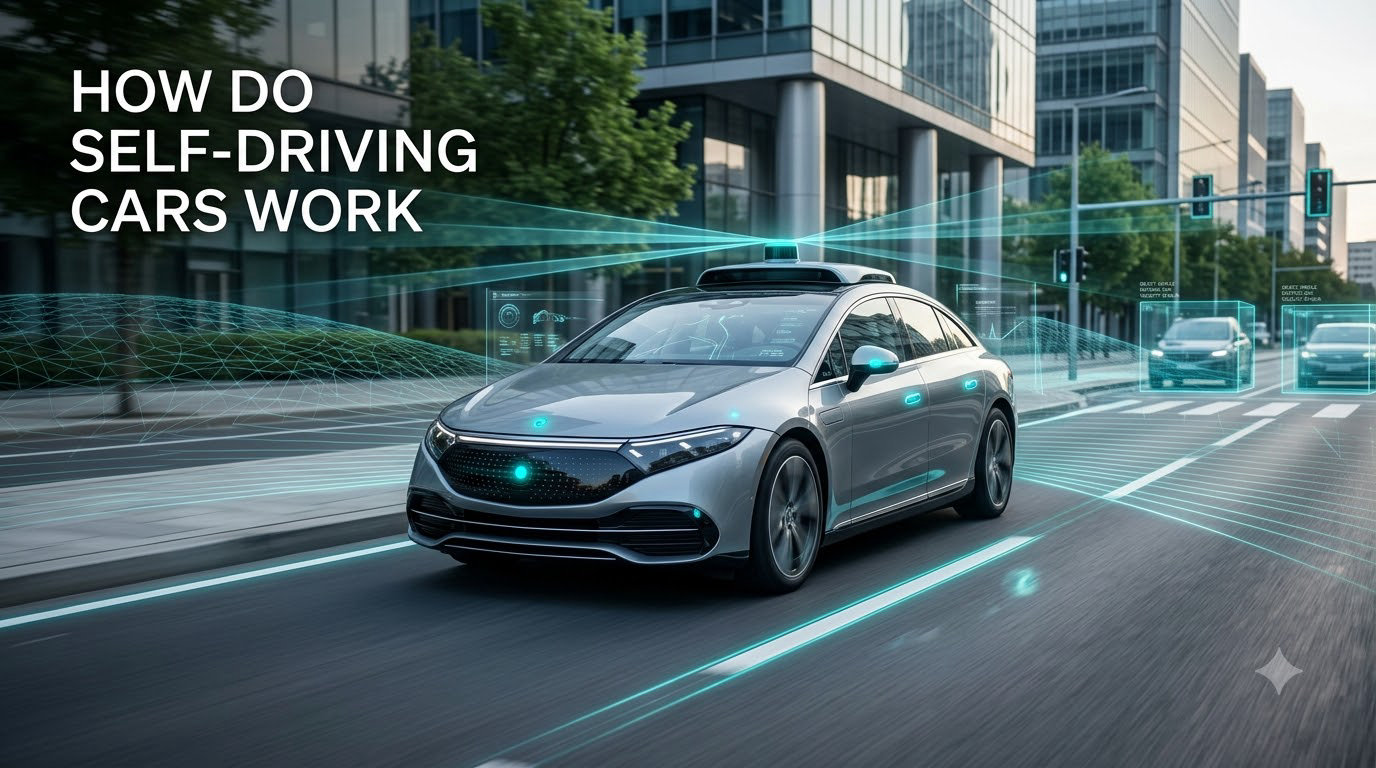
Self-driving cars are vehicles that use a combination of powerful sensors, artificial intelligence, and high-definition maps to navigate roads without a human driver. I have spent weeks digging into how this technology actually works, and the short answer is that the car continuously senses its surroundings, processes that data through AI, and then controls steering, acceleration, and braking through mechanical actuators.
Our team has researched the engineering behind autonomous vehicles for 2026, and in this guide I will walk you through the exact step-by-step process these cars follow. You will learn about the SAE levels of automation, the sensor stack that replaces human eyes, and how machine learning turns raw data into driving decisions. We will also cover the real limitations and what happens when something goes wrong.
For a deeper look at the mechanical side of robotics that powers vehicle control systems, our servo motor guide covers the actuators at the heart of steering and braking.
Table of Contents
How Do Self Driving Cars Work: A Step-by-Step Breakdown
Every autonomous vehicle follows the same basic loop: sense, think, act. The car collects data from multiple sensors, runs that data through AI algorithms to understand the environment, and sends commands to the vehicle’s mechanical systems.
Here is the exact sequence a self-driving car follows every fraction of a second:
- Sense: Cameras, LiDAR, radar, and ultrasonic sensors scan the road, other vehicles, pedestrians, and road signs.
- Perceive: AI software fuses the sensor data to identify objects, predict their movement, and build a real-time model of the world.
- Plan: The system calculates a safe path to the destination, adjusting for traffic, speed limits, and obstacles.
- Act: Electronic commands are sent to the steering, throttle, and brakes to follow that path.
This loop runs 10 to 100 times per second, depending on the system. Modern autonomous cars use over 100 million lines of code to make this process work reliably across millions of driving scenarios. To understand how all these sensors connect to a central computer, our guide on how development boards communicate with sensors explains the underlying data flow.
The 6 SAE Levels of Automation Explained
The SAE (Society of Automotive Engineers) defines six levels of driving automation, from Level 0 to Level 5. Most cars on the road today sit at Level 1 or 2, and only a handful of test programs have reached Level 4.
Here is what each level means in practice:
- Level 0 – No Automation: The human driver controls everything. Examples include most base-model cars from the early 2000s.
- Level 1 – Driver Assistance: The car can assist with either steering or speed, but not both at the same time. Adaptive cruise control is a Level 1 feature.
- Level 2 – Partial Automation: The car can handle steering and speed simultaneously, but the driver must stay alert. Tesla Autopilot and GM Super Cruise fall here.
- Level 3 – Conditional Automation: The car drives itself in specific conditions, but the human must be ready to take over. Honda’s Legend was the first production car certified at this level.
- Level 4 – High Automation: The car drives itself within a defined area without any human input. Waymo’s robotaxi service in Phoenix and San Francisco operates at this level.
- Level 5 – Full Automation: The car can drive anywhere a human can, in any condition, with no steering wheel or pedals. No production vehicle has reached this level.
One of the most common points of confusion on Reddit and driver forums is the difference between Level 3 and Level 4. The key distinction is responsibility: at Level 3, the human must take over if asked, while at Level 4, the car handles every situation within its operating domain or safely stops itself.
The Sensor Stack: How Self-Driving Cars See the World
Autonomous vehicles rely on four main sensor types, each with specific strengths. No single sensor is good enough on its own, so self-driving cars use sensor fusion to combine their data.
Here is a comparison of the core sensor types:
- Cameras: Provide high-resolution color images and read traffic lights, signs, and lane markings. They struggle in low light, glare, and heavy rain. Most systems use 8 to 12 cameras arranged around the vehicle.
- LiDAR: Fires laser pulses to build a 3D point cloud of the surroundings, accurate to within 2 centimeters. Works in darkness but can be disrupted by heavy snow or fog. A typical roof-mounted unit spins at 10 Hz and generates 1.5 million data points per second.
- Radar: Uses radio waves to measure the speed and distance of objects. Excellent in poor weather and works at long range (up to 250 meters). Lower resolution than LiDAR but very reliable.
- Ultrasonic Sensors: Short-range sensors used for parking and low-speed maneuvering. They detect objects within a few meters and are cheap to produce.
Sensor fusion is what makes self-driving technology robust. The AI cross-checks data from multiple sensors, so if a camera is blinded by sun glare, the radar and LiDAR can still detect surrounding objects. This redundancy is critical for safety and is one reason the sensor suite costs between $50,000 and $200,000 per vehicle in current robotaxi deployments.
For a closer look at how mechanical end-effectors interact with the physical world, our robotic grippers guide explores a related robotics concept.
How AI Turns Sensor Data Into Driving Decisions
The software stack that processes sensor data is the most complex part of any autonomous vehicle. Modern systems use deep neural networks trained on petabytes of real driving data, combined with rule-based systems for safety-critical functions.
There are three main stages of AI processing inside a self-driving car:
- Perception: Convolutional neural networks identify pedestrians, cyclists, vehicles, and lane markings. The system tracks each object’s position, speed, and predicted trajectory. This stage uses computer vision models trained on millions of labeled images.
- Prediction: Machine learning models forecast how other road users will behave in the next 3 to 8 seconds. Will that pedestrian step into the crosswalk? Will the car ahead change lanes? The prediction system assigns probabilities to each possible action.
- Planning: A motion planning algorithm chooses the safest, most efficient path. It balances speed, comfort, and safety, then outputs specific steering angles, throttle positions, and brake pressures.
The entire stack runs on powerful onboard computers, often with multiple GPUs consuming 500 to 2,000 watts of power. The system must respond within 100 milliseconds to avoid a collision, which is why edge computing hardware is so important.
Challenges and Limitations of Self-Driving Technology
Despite years of progress, self-driving cars still face significant technical and social challenges. Our team found that the biggest problems fall into three categories: edge cases, weather, and public trust.
The single biggest problem is handling long-tail edge cases. Construction zones with temporary signs, emergency vehicles, hand signals from police officers, and unusual vehicle types all present situations the AI has rarely seen during training. These scenarios are rare individually but happen constantly across a global fleet.
Weather also limits current systems. LiDAR struggles in heavy snow because falling flakes reflect the laser pulses. Cameras lose effectiveness in fog, heavy rain, or direct sun glare. This is a common question in forums: how do self-driving cars work in rain or snow? The honest answer is that most current Level 4 systems are restricted to sunny, clear conditions and geofenced areas.
Public trust is the third hurdle. Surveys consistently show that more than 60% of Americans are afraid to ride in a fully self-driving car, even though autonomous vehicles have lower per-mile accident rates than human drivers in controlled studies. Building that trust requires transparent safety data and honest acknowledgment of current limitations.
Real-World Applications and Future Outlook
Self-driving technology is already deployed in limited commercial use. Waymo operates fully driverless taxi services in Phoenix, San Francisco, Los Angeles, and Austin, completing more than 20 million paid rides by 2026. Cruise ran a similar service before pausing operations in late 2023.
The most common use cases today include:
- Robotaxi services: Driverless ride-hailing in geofenced urban areas.
- Autonomous trucking: Long-haul routes on highways, where the driving environment is more predictable.
- Last-mile delivery: Small autonomous vehicles for groceries and food.
- Mobility access: Providing transportation for elderly and disabled users who cannot drive.
The societal impact could be significant. The World Economic Forum estimates that widespread autonomous vehicle adoption could save more than 1 million lives per decade by reducing human error, which causes 94% of traffic accidents. Other projections suggest a 30% reduction in urban CO2 emissions through smoother driving patterns and fewer idling cars.
One unique angle most articles miss is the software engineering scale required. Modern autonomous systems run on over 100 million lines of code, more than the combined code in a Boeing 787, the International Space Station, and Facebook. This complexity explains why testing and validation take years and why even small edge cases can take months to resolve.
Frequently Asked Questions
What is the biggest problem with self-driving cars?
The biggest problem is handling rare edge cases that the AI has not seen during training. Construction zones, emergency vehicles, unusual road layouts, and unpredictable pedestrian behavior all present situations that require human-level judgment. Combined with weather limitations and the cost of the sensor suite, these edge cases are the main reason fully driverless systems are still restricted to geofenced areas.
Can you sit in the driver seat of a Waymo?
Yes, you can sit in any seat of a Waymo vehicle, including the driver seat. However, in fully driverless rides there is no one in the driver seat at all, because the car operates without a human backup. You can still choose to sit there during your trip, but the steering wheel moves on its own and the car handles all controls.
What happens if a self-driving car gets in an accident?
When a self-driving car is involved in a crash, the vehicle’s sensors and software record the seconds leading up to the event. Most operators are required to report crashes to state regulators and the NHTSA. Liability depends on whether a human was in control at the time, with current laws generally holding the operator or manufacturer responsible in Level 4 systems.
How much will a driverless car cost?
Today, robotaxi rides cost roughly $2 to $3 per mile, similar to human-driven ride-hailing in some markets. For personal ownership, consumer vehicles with Level 3 automation (such as certain Mercedes and Honda models) start around $100,000. Industry analysts expect prices to drop as sensor costs fall, with widespread Level 4 personal vehicles potentially arriving in the late 2020s.
Final Thoughts on How Self Driving Cars Work
Self-driving cars work by combining sensors, AI, and actuators into a continuous sense-think-act loop. The car sees the world through cameras, LiDAR, and radar, interprets that data with deep learning, and controls the vehicle through electronic commands.
While the technology has made huge progress in 2026, full Level 5 autonomy remains out of reach. Real-world deployments are limited to geofenced areas and clear weather, and edge cases continue to challenge even the best systems. For now, the most realistic path forward is gradual rollout of Level 3 and Level 4 features in specific use cases, while engineers continue to close the gap with human driving ability.
If you want to dig deeper into the mechanical and electronic systems behind modern vehicles, our planetary gearbox guide covers the drivetrain side, and our GPIO pins article explains the electronics that tie sensors to processors.