
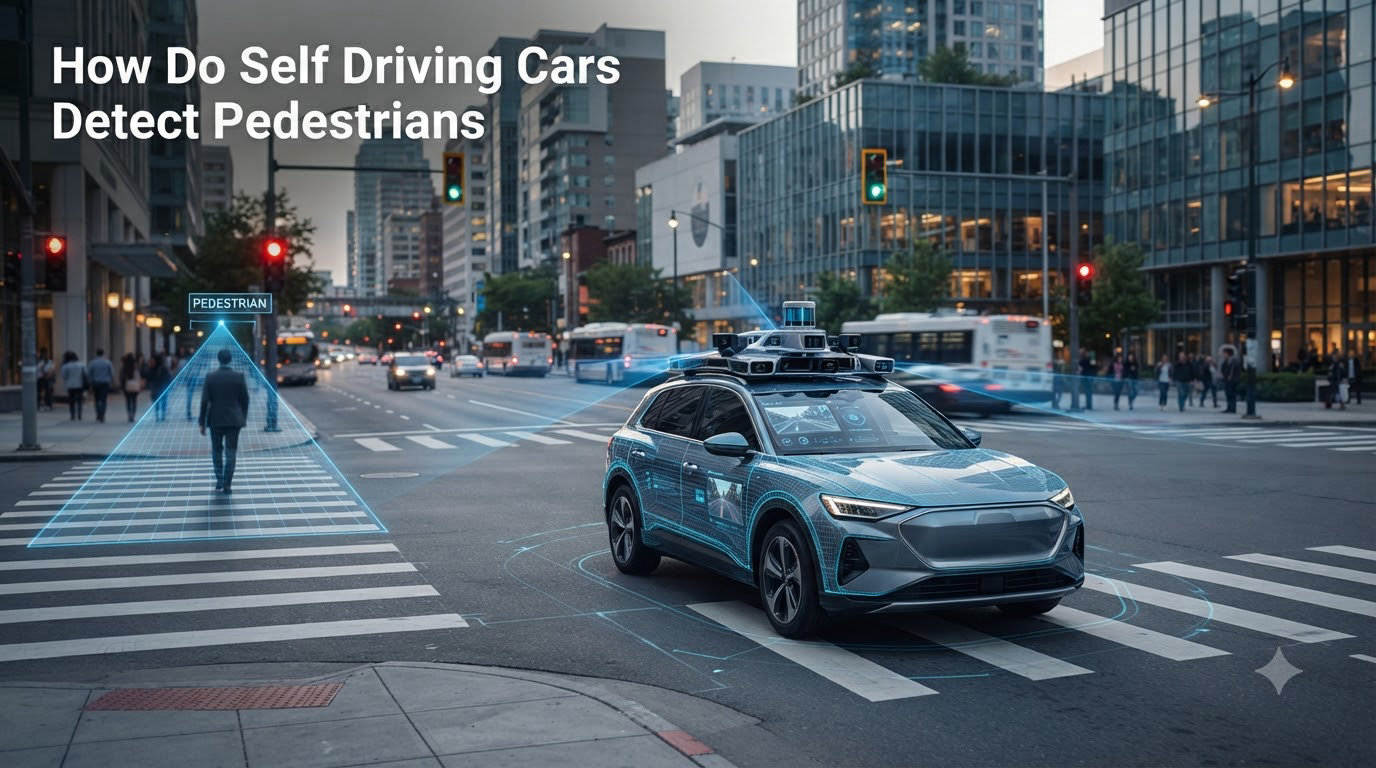
Self-driving cars detect pedestrians using a layered combination of LiDAR, cameras, and radar sensors that feed real-time data into AI systems trained to identify human shapes, predict movement, and trigger braking or steering. No single sensor handles the job alone; modern autonomous vehicles stack these inputs and fuse them into a single, reliable picture of who is standing in front of, beside, or behind the car.
Our team has spent weeks reading peer-reviewed research, real-world crash data, and engineering blogs from Waymo, Tesla, and academic labs. In this guide, I’ll walk you through the exact sensor stack, the machine learning that turns raw photons and radio waves into pedestrian predictions, and the failure cases that keep engineers up at night. Whether you’re researching autonomous vehicles for a robotics project, writing about robotic manipulators and want context, or just curious about the cars sharing your street, you’ll get a clear picture of the technology here.
Table of Contents
How Do Self Driving Cars Detect Pedestrians: The Core Sensor Stack
Self-driving cars detect pedestrians by combining three primary sensor types, each with distinct strengths. LiDAR builds a 3D point cloud of everything around the vehicle, cameras capture color and texture so neural networks can classify objects, and radar measures the velocity of moving objects even in poor weather. Together, these sensors create overlapping fields of view that no single technology can match.
Most Level 4 autonomous vehicles carry between 20 and 40 individual sensors. A typical Waymo Jaguar I-PACE, for example, mounts 5 LiDAR units, 29 cameras, and 6 radar units. Tesla’s vision-only approach strips out LiDAR and radar, relying on 8 surround cameras. The exact mix matters less than the principle: redundancy lets the car keep working when one sensor gets blinded by sun glare, fog, or mud.
Each sensor streams data to onboard computers running at hundreds of trillions of operations per second. The car doesn’t just record “a shape ahead” – it categorizes the shape as a person, estimates the distance, tracks the speed, and predicts what the person will do in the next two to three seconds. That cycle happens 10 to 30 times every second.
Why Multiple Sensors Matter for Pedestrian Safety
Pedestrians are the most unpredictable objects on the road. A child chasing a ball behaves nothing like an adult waiting at a crosswalk, and both behave nothing like a cyclist. The sensor triad – LiDAR, cameras, radar – exists because no single technology can reliably tell these apart in every condition. Cameras struggle in darkness. LiDAR struggles in heavy snow. Radar struggles to tell a pedestrian from a lamppost. Fusing them cancels the blind spots.
LiDAR: Building a 3D Map of Pedestrians
LiDAR (Light Detection and Ranging) sends out millions of laser pulses per second and measures how long each one takes to bounce back. The result is a dense 3D point cloud, essentially a live wireframe sculpture of the world around the car. Each point has X, Y, and Z coordinates, and the spacing between points tells the car how far away an object is.
For pedestrian detection, LiDAR excels at measuring shape and distance. A person standing 50 meters ahead produces a recognizable cluster of points – taller than they are wide, with a clear head and shoulder profile. Modern pedestrian detection algorithms trained on these point clouds can classify humans with 95%+ accuracy in clear conditions. LiDAR also works in complete darkness, since it generates its own light rather than relying on the sun.
Top-mounted spinning LiDAR units (like the Waymo Honeycomb or Velodyne VLP-32C) provide 360-degree coverage out to roughly 200 meters. Shorter-range units around the bumper fill in blind spots at close range. A pedestrian stepping off a curb at 10 meters looks very different in the point cloud than one at 100 meters, and the car’s software maintains separate detection models for each range band.
LiDAR Limitations You Should Know
LiDAR loses accuracy in heavy rain, snow, and fog because water droplets scatter the laser pulses. It also has trouble with certain dark, light-absorbing materials (some black clothing reflects too few photons to register clearly). And it cannot read color or texture – that part of the job is left entirely to cameras. A LiDAR alone cannot tell a pedestrian from a mannequin.
Camera-Based Detection and Computer Vision
Cameras are the eyes of a self-driving car, and computer vision is the brain that interprets what those eyes see. A typical autonomous vehicle carries 8 to 29 cameras covering front, rear, and side views. Each camera captures 30 to 60 frames per second at high resolution, and onboard AI processes every frame to find pedestrians.
The dominant technique is a convolutional neural network (CNN), often a real-time object detector like YOLO (You Only Look Once) or a region-based model like Faster R-CNN. These networks were trained on millions of labeled images – photos where human annotators drew boxes around every pedestrian and tagged “person.” After enough training, the network learns to draw its own boxes around people in new images, even ones it has never seen.
Tesla’s approach is unique. Since 2021, Tesla has used a pure vision system, meaning the car relies on cameras alone for pedestrian detection. Tesla’s rationale: humans drive with two eyes, so a car should be able to drive with cameras. The system uses a transformer-based neural network called HydraNet that processes all 8 camera feeds simultaneously. Tesla argues LiDAR is a crutch and that vision, given enough training data, can solve perception end-to-end. The debate is fierce, and we’ll come back to it in the challenges section.
How Object Detection Actually Works
When a camera frame arrives, the neural network first proposes candidate regions, areas of the image that might contain objects. Each candidate is then classified as “pedestrian,” “cyclist,” “vehicle,” “background,” or one of dozens of other categories. The output is a bounding box with a class label and a confidence score. If the score exceeds a threshold (often 0.7 or higher), the detection is passed to the tracking and prediction systems.
Tracking adds a temporal layer. By comparing detections across consecutive frames, the system maintains a persistent identity for each pedestrian, so the car knows “the person on the corner is the same person I saw 0.5 seconds ago” and can compute their velocity. Modern trackers like SORT and DeepSORT handle this in real time even with dozens of pedestrians in view.
Radar Sensors for Pedestrian Detection
Radar (Radio Detection and Ranging) has been in cars since the late 1990s, originally for adaptive cruise control. Modern automotive radar operates at 76-77 GHz and can detect objects out to 250 meters. For pedestrian detection, radar contributes two key data points: distance and radial velocity, measured via the Doppler effect.
Pedestrians are tricky radar targets because they are small and move slowly. A standing person reflects only a tiny fraction of the radar signal that a car returns, and a person walking at 1.4 m/s has almost the same radial velocity as a stationary object directly ahead. Still, modern 4D imaging radar, which adds elevation to the usual range, azimuth, and velocity, can resolve pedestrians well enough to be a useful redundancy layer.
Where radar truly shines is weather. Radar waves pass through rain, fog, snow, and dust with minimal degradation, so when LiDAR and cameras struggle, radar keeps reporting object positions. In the safety stack, radar acts as the always-on backup sensor that confirms “yes, there is still something there” even when visibility is poor.
Sensor Fusion: Combining Data for Reliable Detection
Sensor fusion is the process of combining LiDAR, camera, and radar data into a single coherent model of the world. Instead of trusting any one sensor, the car’s computer weights the inputs based on current conditions and confidence. This is where pedestrian detection becomes truly robust.
The most common fusion technique is a Kalman filter, a mathematical algorithm that predicts where a pedestrian should be in the next frame and then corrects that prediction based on new sensor data. Extended versions (Extended Kalman Filters, Unscented Kalman Filters) handle the nonlinear motion patterns of walking humans. Modern systems use more sophisticated approaches: deep-learning fusion networks, attention-based transformers, and probabilistic graphical models.
When all three sensors agree – LiDAR says “pedestrian at 35 meters,” camera says “pedestrian at 35 meters,” radar says “object at 35 meters” – the system has high confidence. When sensors disagree, the fusion engine must decide which to trust. A camera in a sun glare situation gets down-weighted, a LiDAR in heavy snow gets down-weighted, and radar takes the lead. The vehicle’s sensor communication infrastructure has to handle this re-weighting in real time without missing a single cycle.
The Role of Sensor Redundancy in Safety
Redundancy is what separates a research prototype from a roadworthy autonomous vehicle. SAE Level 3 and above requires that no single sensor failure can cause a pedestrian collision. If the forward camera fails, the car must still detect pedestrians using LiDAR and radar. If LiDAR dies, cameras and radar must catch the pedestrian. This is why most autonomous fleets carry so many sensors: 29 cameras, 6 radars, 5 LiDARs are not luxuries, they are safety requirements.
AI and Machine Learning in Pedestrian Detection
AI is the layer that turns raw sensor data into a labeled, tracked, predicted world. Without machine learning, a self-driving car would be a very expensive collection of rangefinders. With it, the car understands the scene.
Training a pedestrian detection model requires huge labeled datasets. Tesla has reported training data drawn from billions of miles of real-world driving. Academic datasets like KITTI, CityPersons, and EuroCity Persons provide benchmarks with hundreds of thousands of annotated pedestrians. Models are typically trained on GPU clusters for weeks, then optimized to run on the car’s inference hardware at 30+ frames per second.
The most important model types for pedestrian detection are convolutional neural networks (CNNs) for image-based detection, point cloud networks (PointNet, VoxelNet) for LiDAR-based detection, and graph neural networks (GNNs) for fusing multi-sensor data. The newest generation uses transformer architectures, the same family of models behind large language models, to handle sensor fusion with attention mechanisms. These networks learn which sensors to trust in which situations, and they adapt over time as more driving data is collected.
How AI Decides When to Brake
Once the perception system identifies a pedestrian, the planning system decides what to do. A pedestrian standing on the sidewalk 20 meters ahead may not require braking. A pedestrian stepping into the crosswalk at 10 meters requires gentle deceleration. A pedestrian running across the road at 5 meters may require emergency braking and a steering maneuver. The AI weighs distance, closing speed, pedestrian pose, road context, and traffic law before issuing a control command.
This is also where low-level control hardware comes in. The decision must travel from the perception computer, through the vehicle’s CAN bus or Ethernet backbone, to the brake-by-wire system, all within a few milliseconds. Modern vehicles handle this in under 10 ms, but shaving every millisecond matters when a child is in the road.
Pedestrian Intent Prediction: The Next Frontier
Detecting a pedestrian is only half the job. Predicting what the pedestrian will do next is the other half, and it is the part most algorithms still struggle with. Pedestrian intent prediction uses pose estimation, gaze direction, motion history, and contextual cues (like the presence of a crosswalk or a group of friends) to forecast whether a person will cross, wait, or change direction.
Modern intent models use recurrent neural networks (RNNs) and graph neural networks to model the social dynamics of pedestrian groups. People walking in groups tend to move together, respect personal space, and respond to leaders. A person standing at a crosswalk looking at their phone is more likely to step into the road than a person facing away from traffic. These micro-cues matter, and the best autonomous vehicle systems are now training dedicated intent-prediction models that output probability distributions over future trajectories 2 to 3 seconds into the future.
Industry data shows that intent prediction is where the largest safety gains still live. Tesla FSD has been criticized for sometimes ignoring pedestrians in crosswalks when “no visible intent to cross” is detected, which raises real questions about how intent models should be designed. A pedestrian has the right to step off a curb regardless of how still they are standing.
EyeDAR and Emerging Detection Technologies
One emerging technology worth watching is EyeDAR, an approach that pairs automotive-grade cameras with modulated laser illuminators. EyeDAR mimics some of LiDAR’s depth capabilities while keeping the price and form factor of cameras. It is not yet in production vehicles, but several startups are pursuing variations of the concept, and it could provide a third option between expensive LiDAR and pure camera systems.
Other emerging tools include thermal cameras, which detect pedestrian body heat at night, and 4D radar with sub-degree angular resolution. Combined, these technologies promise to fill the gaps where today’s sensors fail. None has reached the maturity of LiDAR, cameras, and standard radar, but each is climbing the readiness curve.
Challenges and Limitations of Current Systems
Despite decades of progress, pedestrian detection in self-driving cars is far from solved. The honest list of unsolved problems is long, and ignoring it would be misleading.
First, weather. Heavy rain, snow, and fog reduce the accuracy of every sensor. LiDAR scatters in fog, cameras get blinded by snowflakes, and radar works but cannot reliably classify the objects it sees. Self-driving cars operate best in dry, clear conditions, which is the opposite of the conditions where most pedestrian fatalities occur.
Second, lighting. Cameras are useless at night without infrared or strong headlights. Even modern HDR cameras struggle with oncoming headlight glare and shadows. LiDAR handles darkness fine but is itself degraded by direct sun, which can saturate its detectors. Engineers solve this with sensor placement, lens coatings, and HDR algorithms, but extreme lighting remains a stress test.
Third, the dark skin detection bias. A 2019 study by the Georgia Institute of Technology found that pedestrian detection systems were nearly 5% less accurate at detecting people with darker skin tones. The cause is skewed training data: most labeled pedestrian datasets over-represent light-skinned individuals. Researchers and companies are working to balance training data, but the issue is real and not yet fully resolved.
Fourth, jaywalkers and sudden movements. A pedestrian stepping out from behind a parked car, a child running across the street, a wheelchair user moving unpredictably, all of these violate the assumptions baked into detection models. The best systems train on edge cases specifically, but edge cases are by definition rare and hard to source.
Fifth, occlusion. A pedestrian partially hidden by a truck, a stroller, or another pedestrian is harder to detect. Multi-sensor fusion helps, but no current system reliably handles all occlusions.
Why Human Drivers Are Still a Useful Baseline
For all the engineering, a self-driving car’s pedestrian detection is still compared to a human driver’s. Humans have roughly 130 million photoreceptors per eye, binocular vision, color perception, and a lifetime of social context. AI has gigapixel cameras, 360-degree sensors, and millions of training hours. The competition between these two perception systems is closer than most people assume, and the places where AI still loses are exactly the places where more research is needed.
Real-World Safety Performance: Waymo, Tesla, and Beyond
Safety data is finally arriving, and it is mostly encouraging. Waymo has published results from over 100 million fully autonomous miles. Their internal data, validated by Swiss Re, shows a 93% reduction in pedestrian-injury crashes compared to human drivers. That is a striking number, and it has held up across multiple years of analysis.
Tesla’s FSD data is harder to interpret, because FSD is a driver assistance system, not a fully autonomous one. A human is always behind the wheel, so crash attribution is messy. Still, Tesla’s quarterly safety reports suggest that Autopilot-equipped vehicles experience fewer pedestrian collisions per mile than the US average, even after adjusting for highway driving.
Academic studies provide a more cautious picture. The Insurance Institute for Highway Safety (IIHS) has found that current pedestrian automatic emergency braking (AEB) systems reduce pedestrian crashes by about 27% to 35% in daylight, but only by roughly 12% at night. That gap is exactly where sensors struggle, and it tells us where the next generation of detection systems has to improve.
The Vision Zero initiative, a global push to eliminate traffic fatalities, depends heavily on these systems getting better. Cities, insurers, and regulators are all watching the data closely, and a single high-profile failure can reset public trust by years. Engineers working on perception know this and design their systems to fail safely, even when the perception itself is imperfect.
Frequently Asked Questions
What sensors do self-driving cars use to detect pedestrians?
Self-driving cars use a triad of sensors: LiDAR to measure distance and shape with laser pulses, cameras to classify objects with computer vision, and radar to track velocity through weather. Most production autonomous vehicles combine all three for redundancy. The car’s AI fuses the data to identify pedestrians reliably in a range of conditions.
How does Tesla detect pedestrians without LiDAR?
Tesla uses a pure vision system with 8 surround cameras feeding a transformer-based neural network called HydraNet. The system processes all camera feeds at 36 frames per second, runs object detection on every frame, and tracks pedestrians across frames to predict their movement. Tesla argues that cameras plus enough training data can outperform LiDAR at a fraction of the cost.
Can self-driving cars detect pedestrians at night?
Yes, but with reduced accuracy. LiDAR works in total darkness because it generates its own light. Radar works regardless of lighting. Cameras struggle without infrared illumination or strong headlights. Modern systems combine LiDAR, radar, and HDR cameras to maintain detection rates above 90% at night, but the best results still come in daylight conditions.
How accurate is pedestrian detection in self-driving cars?
In clear daytime conditions, leading systems achieve 95% to 99% accuracy at distances up to 100 meters. Accuracy drops in poor weather, low light, and crowded scenes. Independent testing by the IIHS found that current automatic emergency braking systems reduce pedestrian crashes by 27% to 35% in daylight and about 12% at night.
What is the biggest problem with self-driving car pedestrian detection?
The biggest unsolved problem is pedestrian intent prediction. Detecting a pedestrian is largely solved; predicting whether they will step into the road, wait, or change direction is much harder. Edge cases like jaywalkers, occluded pedestrians, and children also remain challenging, as do detection biases related to skin tone that stem from imbalanced training data.
Conclusion
How do self driving cars detect pedestrians? The short answer is that they layer LiDAR, cameras, and radar into a single perception system and let machine learning turn raw sensor data into a real-time map of every person nearby. Each sensor covers a weakness in the others, and sensor fusion gives the car the redundancy it needs to operate safely.
The technology is impressive but not finished. Weather, lighting, occlusions, and intent prediction still trip up the best systems in 2026. Real-world data from Waymo and others is encouraging, but the engineering work continues. If you are building or researching in this space, the next breakthroughs will come from better intent models, more balanced training data, and tighter integration between perception and planning. The pedestrian at the crosswalk is depending on it.