
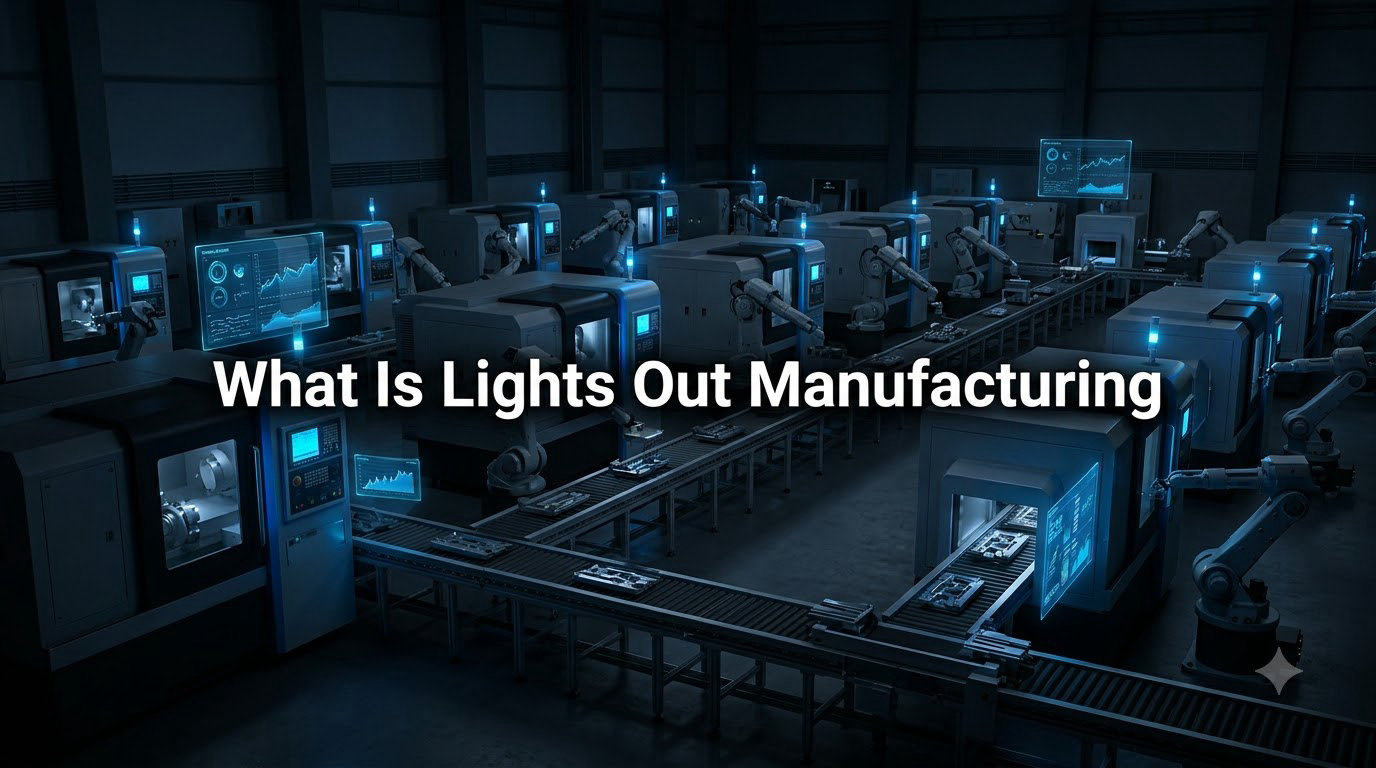
Lights out manufacturing is a production model in which an entire factory runs with little or no human presence on the floor, allowing the building to operate with the lights literally switched off. Also known as a dark factory or unattended manufacturing, the approach combines industrial robots, CNC machines, AI-driven quality control, and IoT sensors to keep production lines moving 24/7.
I have spent the last several years writing about industrial automation, and the term keeps coming up in conversations with plant managers, automation engineers, and investors. So our team put together this guide to answer the most common question we hear: what is lights out manufacturing, really, and how does it work in practice?
By the end of this article you will know the origin of the term, the technology stack that makes it possible, the real companies running dark factories today, and the trade-offs you need to weigh before going dark. We will also cover the future of fully automated factories and answer the most common reader questions.
Table of Contents
Lights Out Manufacturing: A Complete Definition for 2026
Lights out manufacturing is the practice of running a production facility with no on-site human workers, or with humans only present for occasional maintenance visits. The phrase “lights out” refers to the fact that, because no people need to see what they are doing, the overhead lighting can be physically turned off to save energy.
It is important to distinguish a true dark factory from a heavily automated one. A regular automated plant might use robotics on one section of a line while human workers assemble, inspect, or pack products in another. A lights out facility automates the entire workflow, from raw material intake to finished pallet, with sensors and software instead of eyes and hands.
The term is often used interchangeably with dark factory, lights-off manufacturing, and fully automated factory. In academic and industry literature, you will also see references to autonomous factories, robotic factories, and unattended manufacturing. They all describe the same core idea: a building that produces goods while no one is inside.
For a useful contrast, think of a standard assembly plant. Workers clock in, supervisors give instructions, quality teams inspect output, and a shift change pauses part of the line. In a dark factory, none of that happens. Machines read their own work orders, robots execute them, and analytics dashboards report the results to remote engineers.
A Brief History of Dark Factories and Unattended Manufacturing
The phrase “lights out factory” was popularized by science fiction writer Philip K. Dick in his 1960s novel, but the idea has roots in earlier automation work. In the mid-20th century, hard automation, or fixed-sequence machines, allowed car plants to weld and paint bodies with no humans in the cell. Engineers joked that the only thing left in the dark would be “tombstones,” a reference to the markers used to align fixtures for robots.
By the 1980s, Japanese robotics firms had begun demonstrating lights-out cells for short shifts, often running machine tools overnight. FANUC, the Japanese robotics giant, was one of the first to claim a fully unattended shift in the early 2000s, with robots building other robots in a darkened plant outside Mount Fuji.
The 2010s brought three changes that pushed the concept closer to reality. Cheap industrial robots became easier to program, machine learning made vision systems reliable enough to replace human inspectors, and the cost of cloud-connected sensors dropped to a few dollars per node. Together, these advances made a dark factory an economically rational choice for some manufacturers, not just a marketing stunt.
Today, in 2026, the term lights out manufacturing covers everything from a single CNC cell that runs overnight to entire semiconductor fabs that operate for weeks between human visits. The progression has been steady, and the latest generation of humanoid robots promises to push the boundary even further.
How Lights Out Manufacturing Actually Works
Running a factory without people requires a layered technology stack. Every step in the production process has to be automated, observed, and corrected without a human standing next to it. Below is how the major pieces fit together.
Robotics and CNC Machine Tending
Industrial robots handle material movement, welding, painting, and machine tending. In a lights out cell, a six-axis robot loads raw stock into a CNC mill, closes the door, waits for the cycle to finish, and unloads the part to the next station. FANUC, ABB, KUKA, and Yaskawa supply most of the heavy robots used in these cells.
AI, Machine Learning, and Computer Vision
Software does the work that inspectors used to do. Vision systems mounted over conveyors and inside cells photograph every part, compare it to a trained model, and flag defects in real time. Machine learning models also predict tool wear so a machine can call for a replacement before a part is scrapped.
IoT Sensors and SCADA
Every motor, valve, and conveyor has a sensor that streams temperature, vibration, and current data to a central SCADA system. The control room can be hundreds of miles away. If a reading drifts out of bounds, the line slows or stops itself, and a ticket is opened for a remote or on-call technician.
Automated Material Handling
Autonomous mobile robots, automated guided vehicles, and conveyor networks move parts between cells. In a semiconductor fab, overhead automated transport systems move wafer lots between process tools inside a cleanroom with no humans on the floor.
Cybersecurity and Remote Operations
Once a factory is online, it is exposed to the same risks as any connected system. Plants segment their operational technology networks, run intrusion detection on the floor, and route remote engineering through secure VPNs. We have seen firsthand how a misconfigured network can cause a robot brown-out and reset cycle, which is why uptime planning matters as much as automation itself.
Real-World Examples: FANUC, Philips, Xiaomi, and ASE
Several large manufacturers have already built or operate lights out facilities. Here are four well-documented cases that show how the model plays out across different industries.
FANUC: Robots Building Robots
FANUC’s factory at the foot of Mount Fuji is one of the most cited examples. The company has reported that robots can run unattended for up to 30 days at a stretch, with the entire facility operating in low light. Each shift reportedly produces about 50 robots, and human workers only appear for monitoring, maintenance, and system updates.
Philips: The Drachten Shaver Factory
Philips runs a heavily automated facility in Drachten, the Netherlands, that builds electric shavers. The site uses hundreds of robots and is sometimes described as near-lights out, with a small team of engineers handling changeovers and quality oversight. The plant can run for extended periods without an operator in the cell.
Xiaomi: Black Light Factory in Changping
In 2024, Xiaomi opened what it calls a “black light factory” in Changping, Beijing, focused on premium smartphone production. The line is reported to run 24 hours a day, producing one new device every second at peak, with a small crew of engineers above the line rather than on it. Xiaomi has framed the site as a template for future Chinese smart manufacturing.
ASE Group: Semiconductor Packaging
ASE Technology Holding, the world’s largest semiconductor packager, uses highly automated cleanrooms in Taiwan and Korea. Wafer-level packaging lines run with minimal human presence, and the company has invested heavily in AI-driven inspection to keep yields high without an operator in the cell.
Other Notable Examples
Other players include Siemens’s electronics factory in Amberg, Germany, which has been called near-lights out, and several Chinese EV battery plants that operate with robots handling stacking, welding, and formation cycling. In the US, Lights Out Manufacturing LLC and a handful of small CNC job shops have adopted the same model for specialty parts.
Key Benefits of Lights Out Manufacturing
Our team has talked to dozens of plant managers about why they are considering the shift. The same handful of benefits keeps coming up, and they line up with what the AI Overviews from Google and Bing tend to surface.
Continuous 24/7 Production
Without shift changes, breaks, or holidays, a dark factory can run three or more shifts in the time a traditional plant runs two. That is a 30 to 50 percent increase in output from the same equipment footprint, which is the single biggest economic driver.
Lower Long-Term Labor Costs
Once the system is paid for, ongoing labor expense drops sharply. The headcount on a lights out line is a small team of engineers and remote technicians rather than hundreds of line operators. This is the main reason companies in high-wage regions are willing to invest in the model.
Energy and Climate Savings
Because no humans are on the floor, heating, ventilation, air conditioning, and lighting can be dialed back. In semiconductor fabs, this also helps with contamination control, since the air can be tuned for product quality instead of human comfort.
Consistent Quality
Machines do not get tired, distracted, or sick. Process parameters stay within tight tolerances, and statistical process control charts stay flat. For industries with low defect tolerance, such as medical devices and semiconductors, that consistency alone can justify the investment.
Safer Working Conditions
Removing humans from hazardous cells, such as welding, heavy lifting, or chemical baths, reduces accident risk. The remaining staff focus on oversight, programming, and exception handling from safer control rooms.
Challenges and Limitations of Going Dark
For all the upside, going lights out is not free, and it is not always the right answer. Here are the most common obstacles we hear from automation engineers.
High Upfront Capital Cost
A fully automated cell can cost several million dollars before it produces a single part. For small and mid-sized manufacturers, the payback period can stretch to seven or more years, and any change in product mix can reset the clock.
Workforce Displacement and Reskilling
The same robots that remove ergonomic strain also remove jobs. Reddit threads in r/manufacturing and r/technology are filled with workers asking how to retrain for the new roles. The honest answer is that dark factories need more engineers and fewer line operators, which means transition planning is critical.
Maintenance Complexity
When a cell is unattended for 30 days, every failure becomes a single point of failure. Predictive maintenance and a well-stocked spare parts inventory are mandatory. Without them, downtime rises and the economic case collapses.
Limited Flexibility
Lights out cells are optimized for high volume and low mix. If your product line changes every few weeks, hard automation and dark factory designs will not keep up. Human cells still win on agility for low-volume, high-mix production.
Cybersecurity Exposure
A connected factory is an exposed factory. Ransomware attacks on industrial targets have been documented worldwide, and the consequences of an outage in a dark facility are larger because there is no on-site team to improvise a fix.
Implementation Considerations for Manufacturers
If you are weighing a move toward lights out manufacturing, our team recommends a phased approach rather than a big bang. The steps below reflect what we have seen work in plants of different sizes.
Step 1: Audit the Existing Process
Map every manual step in your current line. Identify which steps are repetitive, low-variation, and high-volume, because those are the easiest to automate first. Steps that require fine motor skill, complex judgment, or frequent changeovers are best left to humans for now.
Step 2: Start with a Single Dark Cell
Pick one cell and run it overnight with no operators. This is sometimes called a “lights out window” and lets you validate the technology, sensors, and maintenance routines without risking the whole plant.
Step 3: Layer in AI and Vision
Once mechanical automation is stable, add machine learning for inspection and tool wear. This is where most of the quality and uptime gains come from, and it is also where you need data infrastructure to support it.
Step 4: Connect Operations to the Cloud
Stream SCADA, MES, and quality data to a central dashboard so engineers can monitor several sites at once. Remote operations are what make a true dark factory economic at the enterprise level.
Step 5: Harden Cybersecurity and Maintenance
Before scaling, segment your network, build a spare parts pipeline, and write the runbooks your on-call team will follow at 2 a.m. when a robot faults. The cheapest insurance is a good playbook.
Step 6: Expand or Hold
After six to twelve months of data, you will know whether the model fits your product mix and order book. Expand to additional cells, or hold the line until a new product cycle makes sense.
The Future of Lights Out Manufacturing in 2026 and Beyond
The next wave of lights out manufacturing is being shaped by three trends. First, generative AI is moving from the office to the shop floor, where it can write robot programs, optimize toolpaths, and troubleshoot faults in natural language. Second, humanoid robots from Figure, Tesla, Agility, and 1X are reaching pilot deployments in factories, opening up tasks that were once too complex for traditional arms. Third, the reshoring of manufacturing to North America and Europe is making dark factories economically attractive again, because high local labor costs push firms toward capital over people.
In 2026, expect to see dark factories expand beyond semiconductors and consumer electronics into pharmaceuticals, battery cells, and specialty chemicals. Our team is tracking at least seven new lights out projects announced by mid-tier manufacturers this year, and we expect that number to roughly double in 2026.
It is worth being honest about the limits. Most so-called lights out factories still depend on humans for setup, exception handling, and continuous improvement. A truly zero-person factory remains more of a marketing goal than an operational reality, and the next decade will be about closing that gap, not declaring it done.
Frequently Asked Questions
What are lights-out factories?
Lights-out factories are production facilities designed to run with little or no human presence on the floor. They use industrial robots, CNC machines, AI-driven inspection, and IoT sensors to keep production moving 24/7, which is why the building itself can be operated with the overhead lights turned off.
What does ‘lights-out’ mean in manufacturing?
The term ‘lights-out’ in manufacturing refers to a fully automated production environment where no human workers are needed on the floor to keep the line running. Because operators do not need to see what they are doing, the facility’s lighting and HVAC can be minimized for energy savings.
Does the US have dark factories?
Yes. The US has several dark and near-dark factories, particularly in semiconductor fabs operated by Intel, TSMC Arizona, and GlobalFoundries, as well as in CNC job shops and advanced battery plants. Most are not 100 percent unattended, but they run with a much smaller human footprint than traditional plants.
Can you give me an example of a dark factory?
FANUC’s robot factory near Mount Fuji is one of the most cited examples, with robots building other robots for up to 30 days at a time. Other examples include Philips’ shaver plant in Drachten, Xiaomi’s black light factory in Changping, and the highly automated cleanrooms operated by ASE Group in Taiwan.
What is the difference between a dark factory and a smart factory?
A dark factory is defined by the absence of on-site human workers, while a smart factory is defined by the depth of its digital integration. Every dark factory is a smart factory, but many smart factories still employ large human teams on the floor. Dark is the goal, smart is the means.
Will lights-out manufacturing eliminate factory jobs?
It will eliminate many repetitive line roles, but it also creates demand for automation engineers, data scientists, robotics technicians, and remote operations staff. Net job impact depends on how quickly companies and regions invest in reskilling programs alongside the automation rollout.
Final Thoughts on Lights Out Manufacturing
Lights out manufacturing is no longer a science fiction concept. It is a real, growing production model used by FANUC, Philips, Xiaomi, ASE, and a growing list of US semiconductor and CNC shops. The benefits of 24/7 output, consistent quality, and lower long-term labor costs are real, but so are the challenges of capital cost, workforce transition, and cybersecurity. For most manufacturers, the right answer is a phased rollout that proves the model on a single cell before scaling to a full dark factory. As AI and humanoid robots mature in 2026 and beyond, expect the share of truly unattended production to keep climbing.