
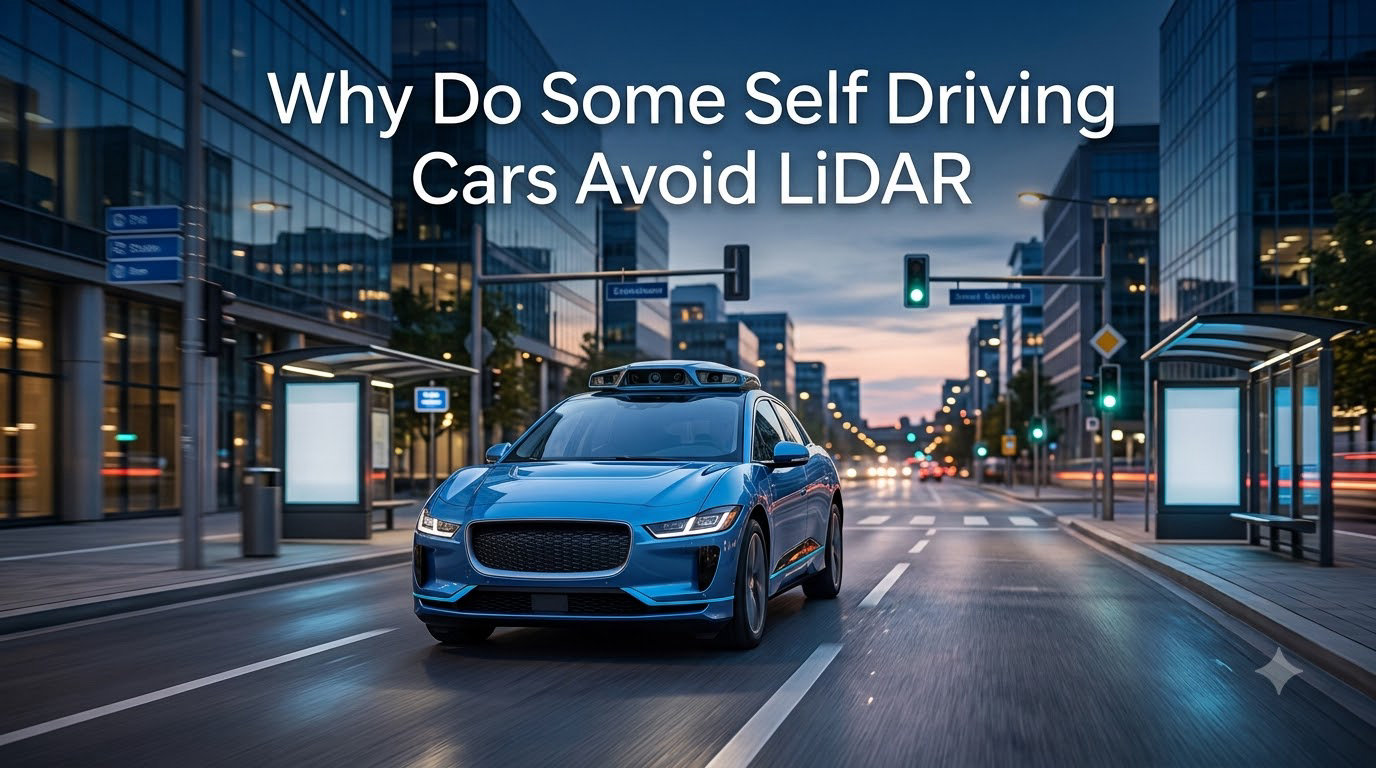
When I first watched a Waymo drive itself through a Phoenix intersection, I counted five sensors on the roof before the car even left the parking lot. A month later, I sat in a Tesla running the latest FSD build and there was nothing spinning on top. That contrast is the entire debate around self driving cars LiDAR, and it is the question this guide answers.
Some of the most ambitious autonomous vehicle programs in the world rely on LiDAR, while others insist cameras alone can do the job. I have spent the last few months digging through engineering blogs, NHTSA filings, and Reddit threads to figure out why this split exists, and what it actually means for safety. Here is what I found.
Table of Contents
What Is LiDAR and How Does It Work in Self Driving Cars
LiDAR stands for Light Detection and Ranging. It is an active sensor that fires laser pulses, usually at 905nm or 1550nm wavelengths, and times how long each photon takes to bounce back from surrounding objects. The result is a point cloud, a 3D map of the world measured in centimeters, refreshed up to 20 times per second.
Modern automotive LiDAR units can resolve objects at 200 meters or more in clear conditions. A single frame from a top-mounted unit on a robotaxi contains hundreds of thousands of points, each tagged with precise x, y, and z coordinates. The onboard computer turns that point cloud into a live 3D model the driving software can query directly: how far is that pedestrian, what lane is that truck in, is that dark shape a curb or a tire in the road.
The technology is not new. Airborne LiDAR has been mapping forests and coastlines for decades. What changed around 2017 was cost. A spinning roof-mounted unit from Velodyne once sold for $75,000. Today, solid-state designs from companies like Luminar, Innoviz, and Hesai are landing in the low thousands per unit, and the cost curve keeps dropping.
Two flavors matter for self driving cars LiDAR conversations. Mechanical units spin a laser array to sweep a 360-degree field of view, which is what you see on early Waymo cars. Solid-state units have no moving parts, use MEMS mirrors or optical phased arrays, and are small enough to hide behind a windshield. Both produce the same kind of data, but the solid-state form is what makes mass-market adoption plausible.
Why Some Self Driving Cars Avoid LiDAR
Five reasons keep coming up in engineering discussions, and none of them is the whole story on its own.
Cost pressure. A car company shipping a million vehicles a year cannot absorb a $4,000 sensor on every unit and still hit a margin. Cameras cost dollars. Even cheap LiDAR costs hundreds, and a redundant sensor stack (LiDAR plus radar plus cameras plus ultrasonics) easily clears a thousand dollars per vehicle. For a driver-assist product sold to consumers, that math is brutal.
Integration and aesthetics. Early LiDAR units were bulky spinning tubes bolted to the roof. They looked like police lights, they caught in car washes, and they did not survive highway debris well. Even modern units are larger than a camera, which complicates packaging behind bumpers and windshields.
The Musk philosophy. Elon Musk has called LiDAR a crutch and compared it to using a crutch when your legs work fine. His argument is evolutionary. Humans drive with two eyes and a brain, so a camera plus a sufficiently smart neural net should also be able to drive. The philosophy is appealing because it promises a path to consumer-priced autonomy without a sensor stack that adds cost and weight.
Supply chain and scaling. Tesla makes more electric vehicles per year than Waymo, Cruise, and Pony.ai combined operate. Even if LiDAR costs $200 per unit, scaling to 2 million vehicles a year means sourcing 8 million sensors. No LiDAR maker is at that capacity yet, and depending on a single specialty supplier for a safety-critical component is a known industry risk.
A different goal. Tesla is selling a driver-assist product, Full Self Driving, that the driver supervises. Waymo is operating a robotaxi service with no driver. The reliability bar is not the same. A driver can take over when the system gets confused. An empty taxi cannot. That gap changes which sensor choices make sense.
LiDAR vs Cameras vs Radar: A Direct Comparison
Each sensor has strengths the others cannot match, which is exactly why most non-Tesla programs run all three.
Depth perception. LiDAR measures distance directly with centimeter accuracy. Cameras infer depth from parallax, motion, and learned patterns. In a well-lit scene, modern neural nets estimate depth almost as well, but in low-contrast scenes (a white truck on a snow-covered road) the camera guess can be off by meters. Radar also measures distance directly, but at lower resolution.
Resolution and classification. Cameras win here. A 4K camera at 60 fps can read a speed limit sign, classify a cyclist versus a scooter, and detect the color of a traffic light. LiDAR sees a blob of points. It can tell a pedestrian from a tree but cannot read text on a street sign or recognize a school zone flasher.
Weather performance. Heavy rain, fog, and snow scatter laser light, which degrades LiDAR range. Cameras suffer too, especially when droplets cover the lens. Radar is largely unaffected by weather, which is why every modern ADAS package includes it. Waymo’s third-generation system, for example, layers 29 cameras, 5 LiDARs, and 6 radars on each vehicle.
Night and lighting. LiDAR is active, so it sees in pitch darkness the same as in daylight. A camera without headlights is blind. This is where the gap is hardest to close with software alone, and it is one of the failure cases I will cover in the next section.
Range and speed. A long-range automotive LiDAR can spot a small obstacle at 250 meters, which at highway speed buys the car about 7 seconds of reaction time. A forward camera can see farther, but only in good light and only for things with enough texture to recognize.
For more on how this kind of sensor processing pipeline gets built, my colleague wrote up the role of FPGA processing in autonomous vehicles on the site, which is worth a read if you want the hardware side of this.
Tesla’s Camera-Only Approach Explained
Tesla dropped radar in 2021 and ultrasonic sensors in 2022, going all in on what the company calls Tesla Vision. Eight cameras, twelve ultrasonic sensors were removed, and the full perception stack now runs on the in-house Hardware 4 computer with neural nets trained on billions of miles of fleet data.
Musk’s core argument is that the world is designed for human eyes. Traffic lights, lane lines, road signs, and crosswalks are all built to be visible to a pair of cameras. If you can train a system on enough examples, the argument goes, the network will learn the same shortcuts a human driver does, including estimating depth from monocular cues like motion parallax and known object sizes.
The early data is mixed. Tesla FSD works impressively in well-mapped suburbs in clear weather. In fog, heavy rain, or in a parking garage with flickering fluorescent lights, users on r/SelfDrivingCars regularly post clips of the system hesitating or making wrong assumptions. Tesla’s own safety disclosures show that FSD still requires driver supervision, and the robotaxi launch in Austin in 2026 is limited to geo-fenced areas with low speed limits and a remote operator on standby.
Compare that to Waymo, which has driven over 220 million rider-only miles with no driver in the car at all. The gap is not just engineering philosophy. It is the operational reality of what each system can safely handle without a human in the loop.
For context on the commercial trucking side, where LiDAR is the standard, see our coverage of autonomous trucking technology milestones, which goes deeper on how that industry has chosen its sensor stack.
Waymo’s Multi-Sensor Strategy and the Nines Reliability Framework
Waymo co-CEO Dmitri Dolgov made the case for a multi-sensor stack in unusually direct terms in 2026. Cameras are great, he said, but a safety-critical system cannot rely on a single sensing modality. His reasoning is captured in a framework Waymo calls the nines.
Driver-assist products like Tesla FSD are around 99% reliable, which sounds good until you scale it. At 99% reliability, a human driver would crash roughly every few months. To reach full autonomy where a car drives itself for hundreds of thousands of miles between interventions, you need four nines (99.99%) or five nines (99.999%). Each additional nine cuts the failure rate by a factor of ten.
Here is the part most people miss. The nines framework is multiplicative. If your camera system alone is 95% reliable in fog, adding a LiDAR that is 90% reliable in fog gets you to 99.5% reliability in fog, because the failure modes are different. A point cloud still works when a camera is blinded by glare, and a camera still works when laser light scatters off fog droplets. This is what engineers mean by sensor fusion, and it is the reason Waymo refuses to drop any sensor class.
The Waymo Driver system runs roughly 29 cameras, 5 LiDARs, and 6 radars per vehicle. The cost is high, the integration is complex, and the roof unit is still visible. But the result is a system that has racked up 220 million rider-only miles, with safety data showing 94% fewer serious-injury crashes per mile compared to a human baseline.
Real-World Failure Cases That Shaped the Debate
Abstract percentages only matter when they connect to real situations. Three cases keep coming up in technical reviews of sensor performance.
Dust storm in Phoenix. In a 2024 incident, a vehicle running vision-only struggled to distinguish a dense haboob from a solid wall. Multi-sensor vehicles in the same conditions could still resolve road edges using radar penetration and LiDAR returns through the lighter dust layers. Both approaches eventually stopped the car safely. Only one of them had a confident read on where the road was.
Pitch-black street in San Francisco. A Waymo engineering blog described a test where the car pulled into a residential alley with no streetlights, no headlights, and no moon. The cameras saw nothing. The LiDAR returned a clean point cloud of every parked car, every trash can, and every curb. A vision-only system without a backup would have to guess from inertia alone.
Fog and heavy rain. Both modalities degrade. Cameras see less through fog. LiDAR pulses scatter and lose range. Radar keeps working. Without radar in the stack, even a sensor-fusion vehicle loses one of its last reliable senses in a storm. This is why even the most aggressive LiDAR-skeptics usually keep radar.
These cases are not common, which is exactly the problem. If they happened every day, the engineering community would have built for them. They happen once in a million miles, and on that one mile, they matter more than the other 999,999.
The Future of Sensor Technology in Autonomous Vehicles
Three things to watch over the next two years.
Solid-state LiDAR cost curve. Companies like Luminar, Valeo, and Hesai are pushing per-unit pricing below $500 for production volumes. Once that drops below $200, the cost objection that motivates the camera-only approach largely disappears for premium vehicles.
Level 4 versus Level 5. Level 4 autonomy, where the car drives itself in a defined area, is shipping today in geo-fenced robotaxi services. Level 5, where the car drives itself anywhere a human can, does not exist yet. The sensor choice for Level 4 does not have to work for Level 5, which is why Waymo can use its current stack and Tesla can promise a future one.
Regulation. The real fork in the road may be regulators, not engineers. If the EU and US NHTSA require redundant sensing for any system that operates without a driver, the camera-only approach is locked out of the robotaxi market regardless of how good the neural net gets. If regulators accept demonstrated safety statistics, Waymo’s data wins the argument without needing legislation.
Most engineers I have read on this topic expect a hybrid future. Cameras for classification and reading signs, LiDAR for absolute depth, radar for weather, and a single neural net that fuses all three. That is the stack most robotaxi operators, most trucking programs, and a growing number of premium consumer vehicles already use.
Frequently Asked Questions
Do any self-driving cars use LiDAR?
Yes. Waymo, Cruise, Pony.ai, Aurora, and most commercial autonomous trucking programs rely on LiDAR as part of a multi-sensor stack that also includes cameras and radar. LiDAR provides direct depth measurement that cameras cannot match, especially in low light and adverse weather.
Why is Tesla not using LiDAR?
Tesla’s stated reasons are cost, supply chain scaling, and the philosophy that cameras plus a sufficiently smart neural net can replicate human driving without a laser sensor. Tesla dropped radar in 2021 and ultrasonic sensors in 2022, going all in on its camera-only Tesla Vision system.
Is LiDAR better than cameras for self-driving cars?
Each sensor has different strengths. LiDAR gives precise, active depth measurement that works in total darkness. Cameras deliver higher resolution, can read signs, and recognize objects at long range in good light. Most autonomy experts argue the two are complementary, not competitors, which is why nearly every non-Tesla self-driving program uses both.
Do Waymo cars use LiDAR or cameras?
Waymo cars use both, plus radar. The current Waymo Driver system runs 29 cameras, 5 LiDARs, and 6 radars per vehicle, which is why the company has been able to operate 220 million rider-only miles without a driver in the car.
Is LiDAR necessary for self-driving?
LiDAR is not strictly required for any specific SAE level of autonomy, but it is widely viewed as necessary for Level 4 and Level 5 systems that operate without a human driver. Camera-only systems can support Level 2 driver-assist, like Tesla FSD, but have not yet demonstrated the reliability required for full Level 4 robotaxi service.
Does Tesla FSD use LiDAR?
No. Tesla FSD relies entirely on eight cameras and the in-house Hardware 4 computer. There is no LiDAR, no radar, and no ultrasonic sensor on current Tesla FSD vehicles.
Conclusion
The split between LiDAR and camera-only self driving cars comes down to a different bet on what reliability looks like at scale. Tesla bets that vision plus a billion miles of fleet data can build a system good enough for unsupervised driving. Waymo bets that no single sensor is reliable enough on its own, and that layering cameras, LiDAR, and radar is the only way to reach the four or five nines of safety that driverless operation demands.
Neither side has won yet. Watch solid-state LiDAR pricing, the next round of NHTSA rules, and how many rider-only miles each system can log without a serious incident. Those numbers will tell you who was right about self driving cars LiDAR before the marketing ever does.