
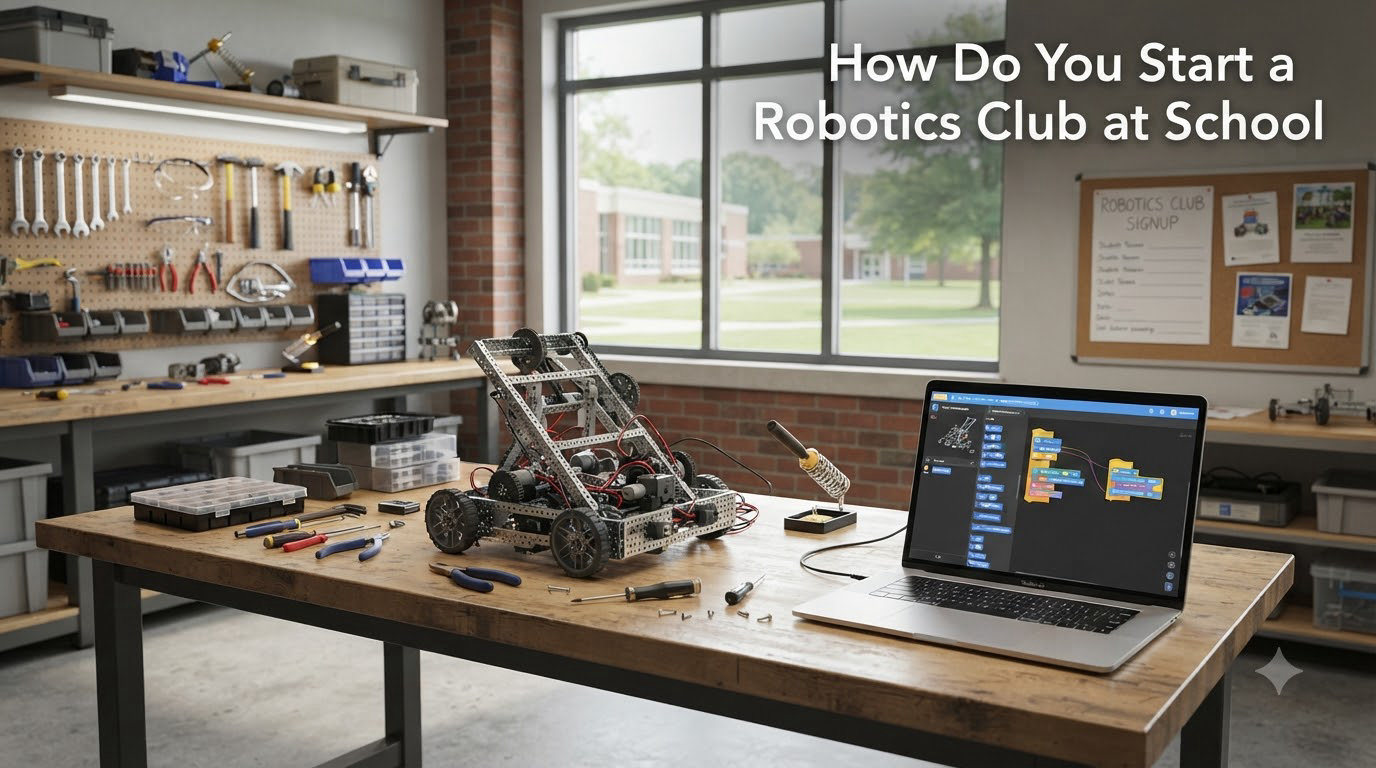
Starting a robotics club at school is one of the most rewarding things I have seen teachers and students do together. A robotics club gives kids hands-on STEM experience, teaches real problem-solving, and creates a community around shared curiosity about how things work. Whether you are a teacher, parent, or student with a big idea, this guide walks through exactly how to turn that idea into a functioning club.
I have spent weeks reading every forum thread, teacher blog, and program guide I could find, and I pulled together the steps that actually work in real schools. By the end of this article, you will know how to get school approval, recruit members, pick the right robotics platform for your age group, find funding, and run meetings that keep students coming back.
Table of Contents
How Do You Start a Robotics Club at School: A Step-by-Step Guide
If you only have five minutes, here is the short version. Starting a robotics club at school comes down to six steps: get school approval, find an advisor, recruit members, pick a robotics platform, plan meetings, and secure funding. I will walk through each one in detail below, but the order matters. Approval first, then people, then the gear.
Most clubs I have researched took between four and twelve weeks to get off the ground. The fastest ones had a champion inside the school who handled paperwork quickly. The slowest ones waited months for an administrator to respond. Your job is to make the path easy for everyone involved.
Step 1: Get School Approval and Administrative Buy-In
Before anything else, you need written approval from your school. This step scares people, but it is mostly paperwork. Your principal or activities director needs to know what the club is, who supervises it, where it meets, and roughly what it costs. A one-page proposal covers all of this.
Your proposal should include the club mission, meeting schedule, target members, advisor name, estimated budget, safety plan, and a list of any competitions you plan to enter. Schools love clubs that connect to existing curriculum standards and look good on college applications, so mention those links early. If you can reference STEM learning outcomes or emerging tech skills, even better.
Submit your proposal through the formal club-approval process. Most schools have a form. Bring two printed copies to your administrator and follow up by email within a week. Schools move faster when you are polite and persistent without being pushy.
Step 2: Find an Advisor or Mentor
Every school club needs a faculty advisor. This is the adult who is officially responsible and who opens the room. If you are a teacher reading this, you can be the advisor even with no robotics background. Many successful club advisors started with zero experience and learned alongside their students.
If you are a student trying to start the club, ask a science, technology, engineering, or math teacher to sponsor you. Most teachers say yes when a student brings them a plan instead of just an idea. Offer to handle the logistics so the advisor only needs to show up and supervise.
Outside mentors are also powerful. Look for parents who work in engineering, local college robotics clubs, retired engineers, or employees at nearby tech companies. Many companies have formal mentorship programs. An outside mentor can run technical sessions while the teacher handles school-side logistics.
Step 3: Recruit Members and Build Interest
Recruiting is where most new clubs stall. The trick is to make the first announcement about fun and curiosity, not about commitment. Flyers that say “Build a robot, no experience needed” outperform flyers that list technical jargon.
Run a short demo or info session during lunch or right after school. Show a video of a robot completing a challenge. Bring in a working robot if you can borrow one. Let students hold the parts and ask questions. Hands-on demos convert better than any slide deck.
For your founding cohort, aim for 6 to 12 students. Big enough to split into teams, small enough that one advisor can manage. As one teacher on Reddit put it, “Twelve engaged students beat thirty bored ones every single time.”
Step 4: Choose a Robotics Platform by Age Group
Choosing the right platform is the single biggest decision you will make. The wrong platform kills motivation because students spend all their time troubleshooting the tool instead of building. The right platform gets out of the way and lets them learn.
For elementary students (grades 3 to 5), I recommend LEGO Education SPIKE Prime or LEGO WeDo. The blocks snap together, the programming is drag-and-drop, and the kits are designed for short attention spans. A starter class set runs a few hundred dollars and supports up to six students.
For middle school (grades 6 to 8), VEX IQ is my top pick. It scales from snap-together builds to more complex mechanisms, and the VEX IQ competition is the largest middle school robotics competition in the world. VEX also works well for high school beginners.
For high school (grades 9 to 12), the choice gets richer. FIRST Tech Challenge uses a reusable kit, Android-based programming, and runs regional competitions. For more advanced clubs, Arduino and Raspberry Pi kits teach real electrical engineering and Python coding. If you want to learn about GPIO pins and microcontrollers, Arduino is the standard starting point.
Here is a quick platform reference:
- Elementary (grades 3-5): LEGO WeDo, LEGO SPIKE Prime, Sphero indi
- Middle school (grades 6-8): VEX IQ, LEGO SPIKE Prime, LEGO Mindstorms
- High school beginners (grades 9-10): VEX V5, FIRST Tech Challenge, Arduino starter kits
- High school advanced (grades 11-12): FIRST Robotics Competition, Raspberry Pi, custom builds
Step 5: Plan Activities and Meeting Structure
Plan your first six meetings before you recruit anyone. Students stay when they know what comes next. A standard meeting runs 60 to 90 minutes and follows a predictable rhythm: warm-up, skill-building, project work, and clean-up.
For the first meeting, focus on team building, not building robots. Have students interview each other, sketch a dream robot, and watch a short video of a real competition. The first meeting should make everyone feel like they belong.
By the third meeting, students should be touching hardware. Start with a kit challenge. Build a robot that can push a block across a table. By the sixth meeting, your club should have a clear project goal, whether that is preparing for a competition, building a class showcase robot, or entering a local STEM fair.
What do students actually do in a robotics club? They design mechanisms, write code, test sensors, debug failures, document their work, present to peers, and iterate. Roughly 30 percent of club time is building, 30 percent is programming, 20 percent is testing, and 20 percent is teamwork and planning.
Step 6: Secure Funding and Budget
Funding is the second most common reason new clubs fail, right behind lack of interest. A realistic starting budget for a small club is between 500 and 2,000 dollars, which covers a basic kit, a laptop, and entry fees for one local event.
Here are funding sources that actually work:
- School activity fund: ask your principal for a startup allocation
- PTA or parent organization: most PTAs have discretionary grants
- Local businesses: many will sponsor STEM clubs for tax benefits and goodwill
- Robotics-specific grants: FIRST, VEX, and Recology both run grant programs for new teams
- Crowdfunding: GoFundMe, DonorsChoose, and Kickstarter work well for new clubs
- Tech company foundations: Google, Microsoft, and Texas Instruments all fund school STEM
How much does it cost to start a FIRST robotics team? FRC registration runs around 6,000 dollars for a new team, plus 4,000 to 12,000 for the kit. FIRST Tech Challenge is far cheaper at 300 dollars registration plus a kit around 1,500 dollars. FIRST LEGO League is the most affordable at 250 dollars plus a 500 dollar reusable kit.
For clubs with absolutely no budget, start with free tools. Use Scratch for block-based coding, run simulations in TinkerCAD, and borrow laptops from the school library. Free clubs can still learn real skills, and many later attract funding once they have results to show.
Age-Specific Recommendations for Starting a Robotics Club
Different age groups need very different things from a robotics club. A high school club that tries to run like an elementary club will bore the teens. An elementary club that runs like a high school team will lose the kids in week two. Match the experience to the developmental stage.
For elementary clubs, the advisor does most of the kit prep. Sessions run 45 to 60 minutes. Goals focus on exploration, not competition. The single best investment is a class set of LEGO Education kits because they are forgiving, durable, and familiar.
For middle school clubs, students can start managing their own sub-teams. Sessions run 60 to 75 minutes. Competition is a strong motivator at this age. VEX IQ competitions are designed for middle schoolers and have regional events that are easy to reach.
For high school clubs, students can run the club almost entirely on their own. Sessions run 90 to 120 minutes. Goals shift toward college applications, internships, and serious engineering skills. FRC and FTC are the main competitive paths, but a non-competitive build club is also valid.
Choosing the Right Competition Program
Competition is optional, but it gives a club deadlines, structure, and a reason to push past the easy stuff. The three big programs are FIRST, VEX, and LEGO Education. Each one has its own age range, season, and flavor.
FIRST runs four programs. FIRST LEGO League is for elementary and middle school, FIRST Tech Challenge is for grades 7 to 12, and FIRST Robotics Competition is for high schoolers with bigger budgets. The FRC build season is intense: six weeks from kickoff to bag-and-tag.
VEX runs VEX IQ for elementary and middle school, and VEX Robotics Competition for middle and high school. VEX events are huge, with the VEX Worlds championship drawing thousands of teams. VEX kits are reusable year to year, which helps with budget.
LEGO Education’s own competitions include FIRST LEGO League and the LEGO Education Ambassador programs. These are gentler entry points, often run through schools rather than regional events.
For clubs that do not want to compete, that is fine too. You can still have a robotics club that builds class projects, demos at school events, and enters local science fairs. Many long-running clubs skip competition entirely and thrive.
Common Pitfalls and How to Avoid Them
After reading dozens of forum threads, I saw the same problems come up over and over. Here is what to watch for.
The first pitfall is the lone technical founder. When one student or teacher knows everything and does everything, the club collapses the moment that person graduates or moves. Build shared knowledge from day one. Document your builds, share code in a shared folder, and rotate who leads each meeting.
The second pitfall is buying the wrong kit. The flashiest kit is rarely the right one. Match the kit to your age group, your budget, and your skill level. You can always upgrade next year.
The third pitfall is overcommitting to competition. If your club is not ready to compete, do not register. Use the first year to build skills, then compete in year two. Forcing a competition-ready team out of a brand new club burns out your best students.
The fourth pitfall is ignoring the social side. Robotics clubs that bond as a team outperform clubs that only bond over a robot. Make time for snacks, team names, and celebrations when something works.
Handling Student Turnover and Long-Term Sustainability
Every school club loses members every year as students graduate. Robotics clubs that survive this transition do three things: they document everything, they build a leadership pipeline, and they recruit early each year.
Documentation means recorded videos, written guides, a shared drive of code, and a parts inventory. If your club can rebuild its robot from scratch using only the documentation, you have done it right.
A leadership pipeline means having underclassmen shadow upperclassmen in year one, then take over in year two. A typical high school club has a president, a build lead, a programming lead, and a documentation lead. Rotate these roles so multiple students learn each one.
Recruit early each year. Start talking to incoming students the year before they arrive if you can. Many middle schools now let eighth graders shadow high school clubs. Capture interest while it is high.
Connecting to Curriculum and College Applications
Robotics clubs map directly to Next Generation Science Standards, Common Core math, and ISTE technology standards. If you are pitching the club to an administrator or a grant, lead with this. A robotics club is not an extra expense; it is a delivery mechanism for standards you are already required to teach.
For college applications, a sustained robotics commitment is gold. Selective colleges love seeing depth, leadership, and impact. Encourage students to take on real roles: treasurer, build lead, outreach coordinator. Document their contributions in a portfolio they can submit with applications.
Does a robotics club look good for college? Yes, especially if the student stays for multiple years, takes on leadership, and connects the experience to a stated academic interest. A four-year robotics member who applies as an engineering major has a strong story to tell.
Involving Parents and the Community
Parents want to help, but they often do not know how. Make the asks specific. Instead of “Can you help?” try “Can you drive the team to the regional competition on March 14?” or “Can you donate snacks for the Saturday build session?”
Community involvement makes the club more resilient. Partner with a local engineering firm for a mentor, a community college for a workspace, or a maker space for tool access. These partnerships cost little and provide huge value.
Demo days for parents and the wider school community are also important. A robot that lives in a closet never gets more members. A robot that rolls across the stage at a school assembly recruits the next cohort on the spot.
What to Do in Your Very First Meeting
Your first meeting sets the tone for everything that follows. Here is a 60-minute plan that works at any age.
Spend the first 10 minutes on introductions. Go around the circle and have each person share their name, grade, and one thing they would build if they had a robot. Spend the next 15 minutes watching a 5-minute video of a real robotics competition, then discussing what stood out. Spend 25 minutes on a hands-on icebreaker: a marshmallow-and-spaghetti tower, a paper airplane contest, or a quick LEGO build challenge. Spend the final 10 minutes explaining when the next meeting is and what to expect.
Do not hand out kits on day one. Day one is about belonging. Kits come on day two.
Resources to Help You Get Started
Here is a short list of resources I found genuinely useful while researching this guide.
FIRST Inspires offers free curriculum and a team startup guide. VEX has a library of free online courses through VEXcode. LEGO Education has teacher training and lesson plans. The REC Foundation runs both VEX competitions. Local maker spaces often have open houses and equipment you can use for free. YouTube channels like PLTW and Mark Rober show what high-quality robotics looks like.
For teachers with no robotics background, the CS-STEM network from Carnegie Mellon and the Arduino Education platform both have free self-paced courses. You can learn alongside your students. That is not a weakness; it is a teaching style.
Frequently Asked Questions
What do you need to start a robotics club at school?
You need a faculty advisor, written approval from administration, a meeting space, a starter robotics kit appropriate for your age group, a small budget of 500 to 2,000 dollars, and at least 6 to 12 interested students. Most clubs also benefit from a parent liaison and at least one outside mentor with technical experience.
What do students do in a robotics club?
Students design, build, program, and test robots. They learn mechanical engineering, coding, electronics, and teamwork. Roughly 30 percent of club time is hands-on building, 30 percent is programming, 20 percent is testing and iteration, and 20 percent is planning, documentation, and team building. Many clubs also prepare for competitions or science fairs.
How much does it cost to start a robotics club?
A small non-competitive club can start for as little as 500 dollars with a used kit and a school laptop. A competitive VEX IQ team typically costs 1,500 to 3,000 dollars. A FIRST Tech Challenge team runs 2,000 to 4,000 dollars. A FIRST Robotics Competition team costs 6,000 to 15,000 dollars in the first year. Grants and sponsorships can cover most of these costs.
How do you start a robotics club with no experience?
Start by partnering with a teacher who is willing to learn alongside you. Pick a forgiving platform like LEGO SPIKE Prime or VEX IQ. Use free online curricula from FIRST or LEGO Education. Recruit 6 to 10 students who are curious, not already experts. Plan your first six meetings before you recruit. Document everything so the next cohort can build on what you learn.
What is the best robotics platform for beginners?
For elementary school, LEGO SPIKE Prime and LEGO WeDo are the best beginner platforms. For middle school, VEX IQ offers the best balance of capability and support. For high school beginners, VEX V5 or Arduino starter kits are strong choices. The best platform is the one that matches your age group, fits your budget, and has active community support in your region.
Is a robotics club worth it for college applications?
Yes, especially if you stay for multiple years and take on a leadership role. Selective colleges value sustained commitment, technical depth, and real impact. A robotics club member who leads a build subteam, mentors younger students, or competes at the regional level has a strong application story, particularly for engineering, computer science, or other STEM majors.
How do you fund a school robotics club?
Combine school activity funds, PTA grants, local business sponsorships, and STEM-specific grants from organizations like FIRST, VEX, and DonorsChoose. Crowdfunding through GoFundMe works well for clubs with engaged parents. Many tech companies, including Google, Texas Instruments, and Boeing, run STEM grant programs specifically for school robotics clubs.
Final Thoughts on Starting Your Robotics Club
Starting a robotics club at school is one of the highest-leverage things you can do for students. You give them a place to fail safely, to learn by doing, and to discover whether engineering is their calling. The students who join your club in year one will go on to lead the club in year three, and the cycle you start now will run for years.
Pick a start date, write your one-page proposal, and book a meeting with your principal. Everything else flows from there. If you want a head start on the future your students are walking into, take a look at how edge AI is changing robotics and what physical AI infrastructure platforms are shaping the field. The club you start today is the first step into that world.