
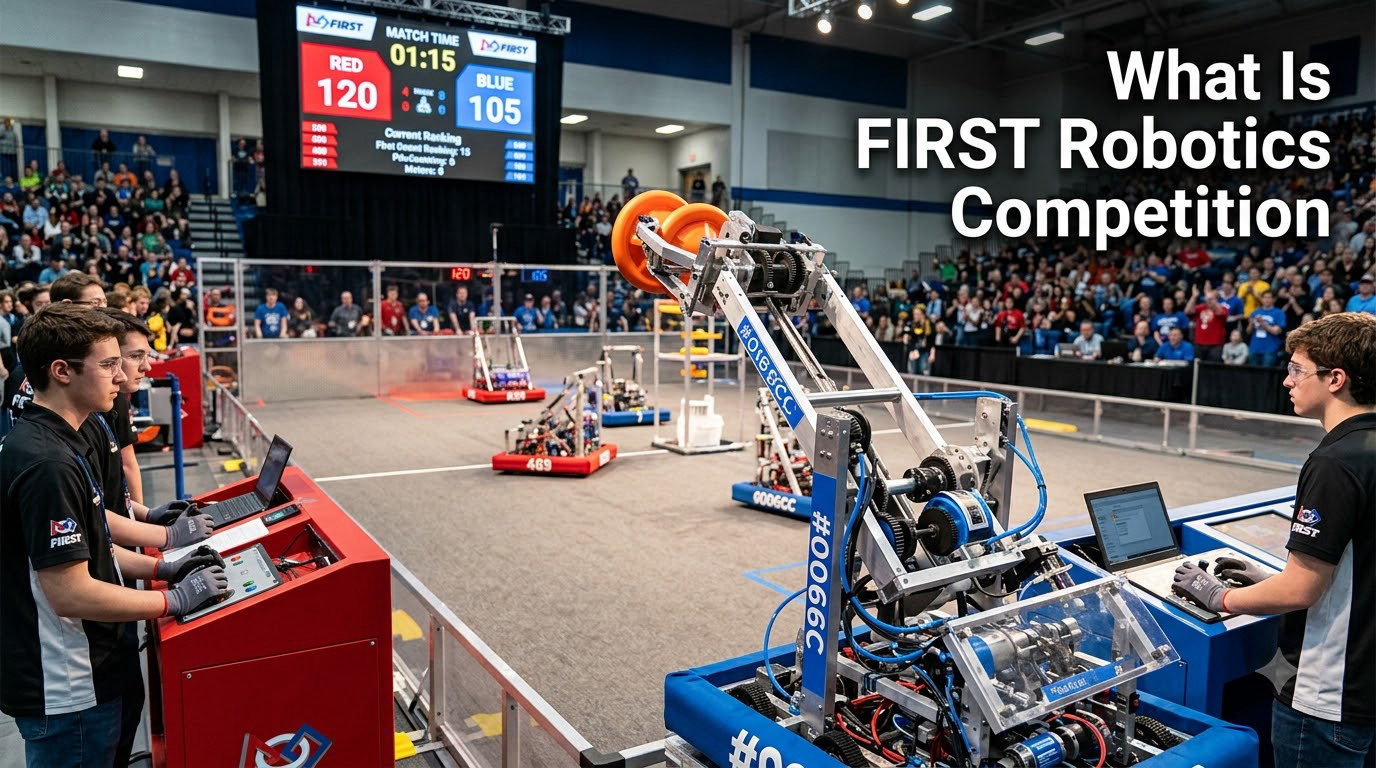
The FIRST Robotics Competition (FRC) is an international high school robotics program where teams of students, guided by adult mentors, design, build, and program industrial-sized robots to compete in a sports-style game. Operated by the nonprofit FIRST (For Inspiration and Recognition of Science and Technology), the program reaches more than 93,000 students across 35-plus countries every year, making it one of the largest STEM competitions for high schoolers on the planet.
I have followed competitive robotics for years, and FRC stands out because it goes far beyond technical skills. Students learn engineering, programming, project management, fundraising, and teamwork in a six-week sprint that feels more like a startup launch than a school club. If you have ever wondered what FIRST Robotics Competition actually is, how it works, and whether it is worth the time commitment, this guide breaks it all down.
Table of Contents
What Is FIRST Robotics Competition and Who Runs It
FIRST Robotics Competition is the flagship high school program of FIRST, a public charity founded in 1989 by inventor and entrepreneur Dean Kamen. Kamen, known for creating the Segway and numerous medical devices, started FIRST to transform how young people view science and technology. The organization now runs four age-based programs, with FRC sitting at the top for grades 9 through 12.
Each FRC team is a mini engineering company. Students handle design, fabrication, programming, strategy, business planning, and outreach. Adult mentors (often engineers, teachers, or parents) provide guidance but do not build the robot. That student-led model is intentional. FIRST believes young people learn best when they own the work and the failures that come with it.
By the numbers, the program in 2026 includes:
- Over 93,000 high school students on roughly 3,900 teams
- Participation from more than 35 countries
- Over 35 million in available college scholarships directly tied to FIRST participation
- A reported 92% of alumni going on to college, with significant numbers pursuing STEM majors
Strategic partners include NASA, Qualcomm, Boeing, Google, and General Motors. That sponsor list matters because it signals to students that the skills they practice in FRC match what real engineering teams use every day.
How the FIRST Robotics Competition Works
An FRC season follows a strict annual rhythm that builds excitement from summer planning all the way to the FIRST Championship in late April. Here is the flow.
Kickoff and Game Reveal in January
On the first Saturday of January, FIRST broadcasts a live global kickoff event. All registered teams watch at the same time as the new game is unveiled. The game manual, scoring rules, and field drawings drop simultaneously. No team has advance access, so the entire field of 3,900-plus teams starts the clock at the same moment.
The new game changes every year. Past games have included tasks like shooting foam balls, stacking totes, placing gears, climbing ropes, and shooting power cells. Each game mixes an autonomous period (robot runs on pre-programmed code) with a teleoperated period (drivers control the robot) and usually a final 30-second endgame with bonus objectives.
Six-Week Build Season
From kickoff day, teams have roughly six weeks to design, prototype, build, wire, program, and test an industrial-sized robot weighing up to about 120 pounds. That is a tight window for a serious machine. Most teams meet 20 to 30 hours per week during build season, often including weekends and late nights. Some teams pull 40-plus hours in the final two weeks before Stop Build Day.
The pressure is real, and that is the point. Students learn to manage deadlines, scope cuts, and team burnout the same way professional engineers do.
Kit of Parts and Robot Construction
Every team receives a Kit of Parts from FIRST at kickoff. The kit includes motors, sensors, a roboRIO controller (the robot’s brain donated by National Instruments), pneumatic components, wiring, structural pieces, and a few game-specific items. Teams can also purchase additional parts, machine custom fabrications, and even 3D print their own components.
Common robot subsystems you will see in FRC include:
- West Coast or swerve drive trains for movement
- Intakes for picking up game pieces
- Shooter mechanisms or manipulators for scoring
- Pneumatic systems for fast actuation
- Vision systems using cameras for tracking
- Custom electronics boards for sensor integration
Competition Day and Match Play
Matches are played in alliances of three robots per side. Two alliances of three teams each face off in 2-minute-30-second matches. The blue alliance plays the red alliance, and the highest score wins. Alliance partners change throughout the event, which forces teams to cooperate with strangers. The top eight teams at each regional pick their playoff alliance partners in a draft-style selection process.
Most matches feel like a fast-paced, full-contact sport. Robots block, defend, climb, and score in a blur. Bring hearing protection, because the crowds are loud.
Core Values: Gracious Professionalism and Coopertition
FIRST is not just about robots. Two cultural pillars shape every interaction in the program: Gracious Professionalism and Coopertition. These terms were coined by Woodie Flowers, the late MIT professor and FIRST’s national advisor.
Gracious Professionalism Explained
Gracious Professionalism is a way of doing work that is both excellent and kind. It means competing fiercely on the field while helping rivals off the field. In practice, that looks like a top team lending spare parts to a struggling rookie, sharing CAD files, or walking a new team through a programming problem at 2 a.m. on Stop Build Day.
The standard is high quality work delivered with empathy. It rejects the “win at all costs” attitude that poisons many competitive spaces.
Coopertition in Action
Coopertition blends cooperation and competition. The term means that even when you are competing against another team, you can still help them improve. Many FRC games include moments where opposing alliances can score bonus points together, rewarding teams that collaborate.
Off the field, Coopertition shows up when teams share battery carts, lend out tools, or help a rival debug code after a match. Our team has witnessed a top-ranked team spend an entire lunch break teaching a rookie alliance partner how to tune their shooter. That spirit is what makes FRC feel different.
More Than Robots Philosophy
FIRST describes its impact as More Than Robots. The program explicitly measures success in life skills, not trophies. According to FIRST’s own surveys, 92% of participants report increased problem-solving skills, 84% report improved time management, and many alumni say FRC taught them how to learn from failure. That philosophy is why mentors, parents, and college admissions officers all pay attention to FRC.
The FRC Build Season Timeline
For students considering joining, the build season is the most intense part of the year. Here is how those six weeks typically unfold.
Week 1: Strategy and Design
Teams read the game manual cover to cover, brainstorm robot concepts, and start CAD modeling. The goal is to lock in a basic strategy and a rough robot design by the end of the week. Many teams make scope cuts in week one, accepting they cannot do everything the game rewards.
Weeks 2-3: Prototyping and Fabrication
Prototypes get built and tested. Drive trains often get assembled first because they are critical to every strategy. Machinists in the team cut custom parts. Programmers start on autonomous routines.
Weeks 4-5: Assembly and Integration
Subteams converge. The robot comes together, wiring gets installed, and code starts talking to hardware. This is the hardest phase because integration always surfaces unexpected bugs.
Week 6: Practice, Practice, Practice
The final week is about driving practice, autonomous tuning, and contingency plans. Teams build bumpers, finalize code, run practice matches against other local teams, and pray nothing major breaks. On the Tuesday before the first competition, teams bag their robot and seal it with a tamper-proof tag. That night is called Stop Build Day, and it is both a relief and a gut punch.
Competition Season: March Through April
After Stop Build Day, teams compete at regional or district events. District teams play multiple district events to earn ranking points, then qualify for their district championship. Top performers advance to the FIRST Championship, held in late April in Houston and Detroit.
How to Join or Start an FRC Team
Joining FRC is more accessible than most people think. Here is what you need to know.
Finding an Existing Team
The easiest way in is to find a team near you. FIRST maintains a team finder on its website where you can search by zip code. High schools, community centers, 4-H clubs, and homeschool groups all sponsor FRC teams. Reach out to a coach, attend a meeting, and ask to shadow a build session. Most teams welcome curious newcomers, especially if you bring skills in design, writing, fundraising, social media, or any trade.
Starting a New Team
No team in your area? You can start one. You will need:
- At least 10 student members
- Two or more adult mentors (one technical, one non-technical)
- A meeting space with basic tools
- A sponsoring organization (school, library, nonprofit)
- Registration with FIRST (annual fees apply)
FIRST provides a rookie kit and a mentor network to help new teams survive year one. The learning curve is steep, but the community is generous.
Cost Overview
FRC is more expensive than smaller programs like FTC or FLL. Expect a first-year team to spend between $5,000 and $15,000 on tools, robot parts, registration, and travel. Returning teams often run $3,000 to $10,000 per season, depending on how much they fabricate and how far they travel. Sponsorship, grants, and parent fundraising cover most of this for established teams.
Time Commitment You Should Expect
Off-season (May through December) is light. Most teams meet two to four hours per week. Build season (January through February) is intense. Plan on 15 to 30 hours per week, with the heaviest weeks in the final two. Competition season (March through April) includes travel days and weekend events.
No Prior Experience Required
This is worth repeating: you do not need to know how to code, weld, or design robots before joining. FRC is designed to teach those skills. Alumni consistently say the most important traits are reliability, curiosity, and the willingness to learn by doing.
Frequently Asked Questions
What do you do in the FIRST Robotics Competition?
You design, build, and program an industrial-sized robot (up to about 120 pounds) with a team of high school students and adult mentors. Each January, a new game is revealed and teams have six weeks to build their robot before competing in regional and championship events across alliances of three robots per match.
Does FIRST Robotics look good for college?
Yes. College admissions officers recognize FRC as a rigorous STEM activity that demonstrates teamwork, leadership, and problem-solving. FIRST also partners with colleges and universities to offer over $35 million in scholarships exclusively for FIRST alumni.
How many teams go to the FIRST Robotics world championship?
Roughly 600 to 800 teams qualify for the FIRST Championship each year, depending on regional and district slot allocations. Teams earn their spot by winning awards, ranking highly at events, or earning enough district points throughout the season.
How do you qualify for the FIRST Robotics world championship in 2026?
Most teams qualify by winning or placing highly at a regional event, or by accumulating enough ranking points in district competition. Award winners (Impact, Engineering Inspiration, Dean’s List, and more) also earn championship slots. Check your local event for the specific qualification paths available.
What is the build season in FRC?
The build season is a six-week period beginning at kickoff in early January. During build season, teams design, prototype, fabricate, wire, and program their robot from scratch. On Stop Build Day, typically the third week of February, robots are bagged and tagged and cannot be worked on until the first competition.
What is Coopertition in FIRST?
Coopertition is a portmanteau of cooperation and competition. It means teams compete fiercely on the field while helping rivals off the field, sharing parts, tools, and knowledge. Many games include bonus scoring opportunities that reward opposing alliances for working together, putting the philosophy into practice.
Why FIRST Robotics Competition Matters
FIRST Robotics Competition is the closest thing high school students get to running a real engineering company under pressure. Over a six-week build season, students learn to design, fabricate, program, and ship a 120-pound robot while managing deadlines, budgets, and team dynamics. They also learn to lose, debug at 2 a.m., and help a rival team succeed at the same time.
If you are a high schooler curious about STEM, FRC is one of the best ways to figure out whether engineering, programming, or robotics is for you before you pick a college major. If you are a parent or mentor, FRC offers a rare window into how young people handle real responsibility. And if you are an educator or sponsor, FRC delivers measurable workforce skills, scholarship pathways, and a generation of students who understand what collaboration actually looks like.
Visit firstinspires.org to find a team near you, register a new team, or apply for one of more than 35 million in available FIRST scholarships. The next build season starts the first Saturday of January, and there is room for anyone willing to show up and put in the work.