
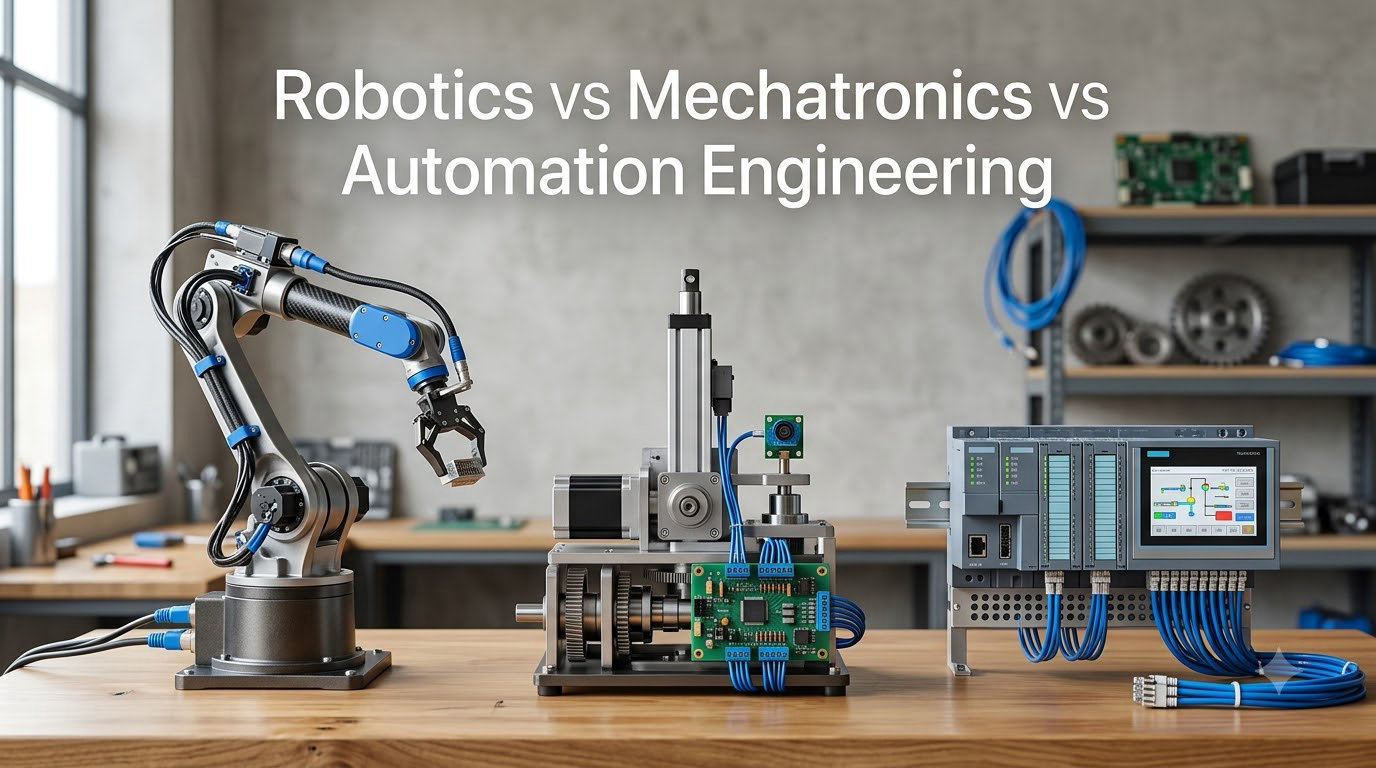
Robotics, mechatronics, and automation engineering are three closely related but distinct engineering disciplines, and choosing between them is one of the most common dilemmas for students and career changers. Our team has spent weeks comparing curricula, job postings, and salary data across all three fields to bring you a clear, no-fluff breakdown of how they actually differ.
In this guide, you will learn what each field focuses on, where the disciplines overlap, what real salaries look like, and which path fits your goals. We will also address the most common Reddit questions and unpack why most comparison articles leave out automation engineering entirely.
If you have been searching for an honest robotics vs mechatronics vs automation engineering comparison that treats all three fields equally, you are in the right place.
Table of Contents
What Is Robotics Engineering?
Robotics engineering is the branch of engineering that designs, builds, and programs robots and autonomous systems capable of performing tasks with little or no human intervention. Robotics engineers focus heavily on perception, decision-making algorithms, kinematics, and the software that makes a machine behave intelligently in the real world.
Core Focus of Robotics Engineering
At its core, robotics is about creating machines that sense their environment, make decisions, and act. A robotics engineer typically works on robot operating systems (ROS), computer vision, motion planning, and machine learning models. The field sits at the intersection of mechanical design, electrical hardware, and software, but the center of gravity leans toward software and AI.
According to data shared across industry sources, robotics is one of the fastest-growing engineering specializations, with industrial robot installations exceeding 500,000 units per year globally. Big players like FANUC, ABB, KUKA, and Yaskawa dominate industrial robotics, while newer entrants like Path Robotics and GrayMatter Robotics are pushing the field into AI-driven manufacturing. You can see this trend in our coverage of HII’s $900M agreement with Path Robotics and GrayMatter.
Key Skills in Robotics Engineering
Most robotics engineering roles expect proficiency in Python, C++, and ROS, along with experience in computer vision, SLAM (simultaneous localization and mapping), and reinforcement learning. A strong math background in linear algebra, probability, and control theory is also common.
Our team regularly speaks with hiring managers, and one pattern is clear: robotics roles in 2026 increasingly demand AI literacy. Engineers who can combine classical control theory with modern machine learning are landing the highest-paying positions.
What Is Mechatronics Engineering?
Mechatronics engineering is an interdisciplinary field that combines mechanical engineering, electrical engineering, computer science, and control engineering to design smart, integrated products and systems. A mechatronics engineer builds the bridge between physical hardware and intelligent software, often working on embedded systems rather than full robots.
Core Focus of Mechatronics Engineering
Mechatronics originated in Japan in the late 1960s as a way to describe products that blended mechanics and electronics, and the term was officially trademarked by Yaskawa Electric in 1969. Today, mechatronics engineers work on everything from automotive anti-lock braking systems to 3D printers, drones, and consumer electronics.
The defining feature of mechatronics is the integration mindset. A mechatronics engineer does not just design a mechanical part or write firmware in isolation. They think about how sensors, actuators, microcontrollers, and mechanical structures work together as a unified system. This is why Reddit users consistently say that mechatronics engineers can absolutely work in robotics. It is exactly what they are trained to do.
Where Mechatronics Is Used
Mechatronics shows up in autonomous vehicles, surgical robots, smart home devices, and precision manufacturing tools. Any product that needs a microcontroller talking to motors and sensors in real time is a mechatronics project at heart.
For example, the miniaturized actuators being developed under HEBI Robotics’ NASA SBIR grant for space applications are fundamentally mechatronics challenges: tightly integrated mechanical, electronic, and control systems that must survive extreme environments.
What Is Automation Engineering?
Automation engineering focuses on designing, programming, and optimizing systems that perform tasks with minimal human intervention, typically in industrial and manufacturing settings. Automation engineers work with PLCs (programmable logic controllers), SCADA systems, industrial robots, and the entire stack of control hardware and software that keeps a factory running.
Core Focus of Automation Engineering
Where robotics focuses on intelligent machines and mechatronics focuses on integrated products, automation engineering focuses on processes. An automation engineer asks: how do we make this entire production line faster, safer, and more reliable? They design control systems, program PLCs, and integrate robotic cells into broader manufacturing workflows.
This distinction matters because most comparison articles completely skip automation engineering, leaving readers with a false binary between robotics and mechatronics. In reality, automation engineering is a major engineering discipline in its own right, and it often offers the most stable, well-paying jobs in manufacturing-heavy regions.
Automation vs Robotics and Mechatronics
Robotics builds the robot. Mechatronics builds the integrated product. Automation engineering deploys fleets of machines and processes to run a factory or plant. The three fields overlap heavily in practice, but the day-to-day work looks different: a robotics engineer writes perception algorithms, a mechatronics engineer tunes a sensor-fusion loop, and an automation engineer programs the PLC coordinating ten robotic arms on an assembly line.
Robotics vs Mechatronics vs Automation Engineering: Key Differences
The three fields differ in focus, typical industries, core tools, and the kind of problems engineers solve every day. Robotics is software and AI heavy, mechatronics is hardware and systems heavy, and automation is process and control heavy.
Side-by-Side Comparison
Here is a quick reference table for the robotics vs mechatronics vs automation engineering comparison. We use this internally when advising students on which major to pick.
| Dimension | Robotics Engineering | Mechatronics Engineering | Automation Engineering |
|---|---|---|---|
| Primary Focus | Designing intelligent robots | Integrating mechanical, electrical, and software systems | Optimizing automated processes and control systems |
| Core Tools | ROS, Python, C++, ML frameworks | Microcontrollers, CAD, MATLAB/Simulink | PLCs, SCADA, ladder logic, industrial robots |
| Typical Industries | AI, autonomous vehicles, space, defense | Consumer electronics, automotive, robotics, medical devices | Manufacturing, oil and gas, pharmaceuticals, utilities |
| Software vs Hardware | Software-leaning | Balanced | Hardware and control-leaning |
| Typical Entry Role | Robotics software engineer, perception engineer | Mechatronics design engineer, embedded systems engineer | Control systems engineer, automation engineer |
How the Three Fields Overlap
Real engineering projects rarely fit neatly into one box. A self-driving car, for example, draws on robotics (perception and planning), mechatronics (sensors, actuators, and embedded control), and automation (manufacturing the car itself). The three fields are best thought of as overlapping circles rather than separate silos.
This overlap is exactly why Reddit users on r/robotics and r/ROS consistently say that mechatronics engineers can transition into robotics roles. The skills transfer; only the application changes.
Applications and Industries for Each Field
Each field has signature industries where it dominates. Understanding these helps you see which path aligns with the kind of work you actually want to do.
Where Robotics Engineers Work
Robotics engineers cluster around AI-first companies, autonomous vehicle startups, humanoid robot labs, and space agencies. NASA hires robotics specialists for Mars rovers and space station assistants, and the private space industry is hiring aggressively. Surgical robotics companies like Intuitive Surgical (da Vinci) and medical device makers also employ large robotics teams.
The rise of physical AI infrastructure platforms in 2026 is creating entirely new robotics roles, as our coverage of the 5 Physical AI infrastructure platforms shaping robotics shows.
Where Mechatronics Engineers Work
Mechatronics engineers end up in automotive (ABS, ESC, electric powertrains), consumer electronics (smart thermostats, wearables), medical devices (insulin pumps, MRI machines), and precision manufacturing. Any company that makes a “smart” physical product needs mechatronics talent.
Universities are also expanding mechatronics programs. The University of Florida’s robotics lab for industrialized construction is a good example of how interdisciplinary programs now blend mechatronics, robotics, and construction engineering.
Where Automation Engineers Work
Automation engineers are the backbone of Industry 4.0. They work in automotive plants, food and beverage facilities, pharmaceutical manufacturing, logistics warehouses, and energy utilities. Companies like Siemens, Rockwell Automation, Schneider Electric, and Honeywell are major employers.
With the global industrial automation market projected to exceed $400 billion by 2026, automation engineers are seeing one of the strongest job markets of any engineering discipline.
Salary Comparison: Robotics, Mechatronics, and Automation Engineers
Salary data varies by source, but the general ranking is consistent: robotics engineers tend to earn the most at the high end, automation engineers earn strong mid-range salaries, and mechatronics engineers fall in between, with significant variation by industry.
Entry-Level Salaries
Based on aggregated data from Glassdoor, Levels.fyi, and Payscale, entry-level salaries in the United States in 2026 look roughly like this:
- Robotics Engineer (entry): $75,000 to $95,000
- Mechatronics Engineer (entry): $70,000 to $90,000
- Automation Engineer (entry): $70,000 to $88,000
Entry pay is fairly similar across the three fields. The real divergence happens mid-career.
Mid-Career and Senior Salaries
At the 5 to 10 year mark, robotics engineers at AI-first companies frequently clear $150,000, and senior perception or motion planning engineers at autonomous vehicle companies report total compensation above $250,000. Mechatronics engineers in medical devices or aerospace commonly reach $120,000 to $160,000, while senior automation engineers in heavy industry or pharmaceutical manufacturing often earn $110,000 to $145,000 plus bonuses.
Location matters: roles in Silicon Valley, Boston, Seattle, and Austin pay a premium of 20 to 40 percent over the national average.
Career Paths and Job Outlook for Each Field
All three fields have strong job markets, but the trajectory and the kinds of roles you can grow into differ significantly.
Career Paths by Discipline
Robotics engineers often grow into roles like senior robotics engineer, robotics architect, research scientist, or VP of robotics. Some pivot into AI/ML leadership or found startups. Mechatronics engineers typically advance into senior embedded systems engineer, systems architect, or technical lead, with strong demand in product-focused companies. Automation engineers commonly move into controls engineering manager, plant automation director, or Industry 4.0 consultant roles.
Job Market Outlook Through 2026 and Beyond
The job outlook is favorable for all three. The World Economic Forum’s Future of Jobs report lists automation and robotics engineering among the fastest-growing roles. Demand is being driven by reshoring of manufacturing, AI integration in factories, autonomous vehicle deployment, and the new wave of humanoid robots entering commercial use.
Our take: if you are picking based on job security alone, automation engineering is arguably the safest bet because every factory needs it. If you are picking based on growth and upside, robotics has the most momentum. Mechatronics is the most flexible foundation that lets you pivot into either.
Which Engineering Field Should You Choose?
The right choice depends on what kind of work makes you lose track of time. Use the quick rules below to narrow your decision.
Choose Robotics If…
You love writing code that makes physical things move and perceive the world. You enjoy AI, computer vision, and complex algorithms, and you are excited by humanoid robots, autonomous vehicles, and space exploration. Pick robotics.
Choose Mechatronics If…
You want to understand the full stack from circuits to firmware to mechanical design. You like building smart products and are not sure yet whether you want to focus on AI or hardware. Mechatronics gives you the most flexibility to pivot later.
Choose Automation If…
You enjoy optimizing processes, programming PLCs, and making factories run better. You want a stable, well-compensated career in manufacturing, energy, or pharmaceuticals, and you prefer solving practical problems over publishing research papers. Automation is your best fit.
For more context on where robotics and AI are heading, our edge AI in robotics guide is a useful next read.
Frequently Asked Questions
Which is best, mechatronics or robotics and automation?
The best choice depends on your interests. Robotics is best for software and AI-focused work on intelligent machines. Mechatronics is the most flexible foundation for building smart integrated products. Automation engineering is best for stable, well-paid careers optimizing industrial processes and factories.
What is better, robotics or mechatronics?
Neither is universally better. Robotics is better for students who want to focus on AI, perception, and autonomous systems. Mechatronics is better for students who want a broad, flexible foundation across mechanical, electrical, and software engineering. Both fields can lead to high-paying careers.
Can a mechatronics engineer work as a robotics engineer?
Yes. Mechatronics engineers can absolutely work in robotics roles because mechatronics curricula already cover the mechanical, electrical, and software foundations used in robotics. Many robotics teams actively recruit mechatronics graduates, especially for embedded and systems-level positions.
What is the salary difference between mechatronics and robotics?
Entry-level salaries are similar, typically $70,000 to $95,000. At mid-career, robotics engineers at AI-first companies often outpace mechatronics engineers, with total compensation commonly reaching $150,000 to $250,000. Mechatronics engineers in medical devices or aerospace typically earn $120,000 to $160,000 at the same stage.
Is Tony Stark a mechatronics engineer?
Fictional character classifications aside, Tony Stark’s work in the Marvel universe spans nearly every engineering discipline, including mechanical, electrical, software, and AI. If forced to pick one label, mechatronics is the closest fit because his Iron Man suits require tight integration of mechanical, electronic, and control systems.
Does NASA hire mechatronics engineers?
Yes. NASA actively recruits mechatronics engineers for roles involving robotics, satellite systems, planetary rovers, and instrument design. The agency’s work on miniaturized actuators, robotic arms, and autonomous systems relies heavily on mechatronics skills.
Will AI replace mechatronic engineers?
AI will change the tools mechatronic engineers use, but it is unlikely to replace them. Mechatronics work requires hands-on hardware integration, physical prototyping, and cross-disciplinary problem solving that AI cannot fully automate. Engineers who learn to use AI as a productivity tool will become more valuable, not less.
Who are the big 4 in robotics?
The big 4 in industrial robotics are FANUC, ABB, KUKA, and Yaskawa. Together they account for the majority of industrial robot installations worldwide. In the broader robotics industry, you can also add major players like Boston Dynamics, Universal Robots, and NVIDIA for AI-driven robotics software.
Final Verdict on Robotics vs Mechatronics vs Automation Engineering
The robotics vs mechatronics vs automation engineering decision is really a question of which layer of the engineering stack you want to live in. Robotics is about intelligent machines, mechatronics is about integrated products, and automation is about optimized processes.
All three fields are in demand, all three pay well, and all three share a common foundation in math, programming, and systems thinking. Pick the one whose day-to-day work excites you most, and remember that the boundaries between these fields are more porous than university brochures suggest.
Whichever path you choose, the next few years are going to be an exciting time to be an engineer. Physical AI, humanoid robots, and Industry 4.0 are reshaping the field, and the engineers who understand all three disciplines will have the most options.