
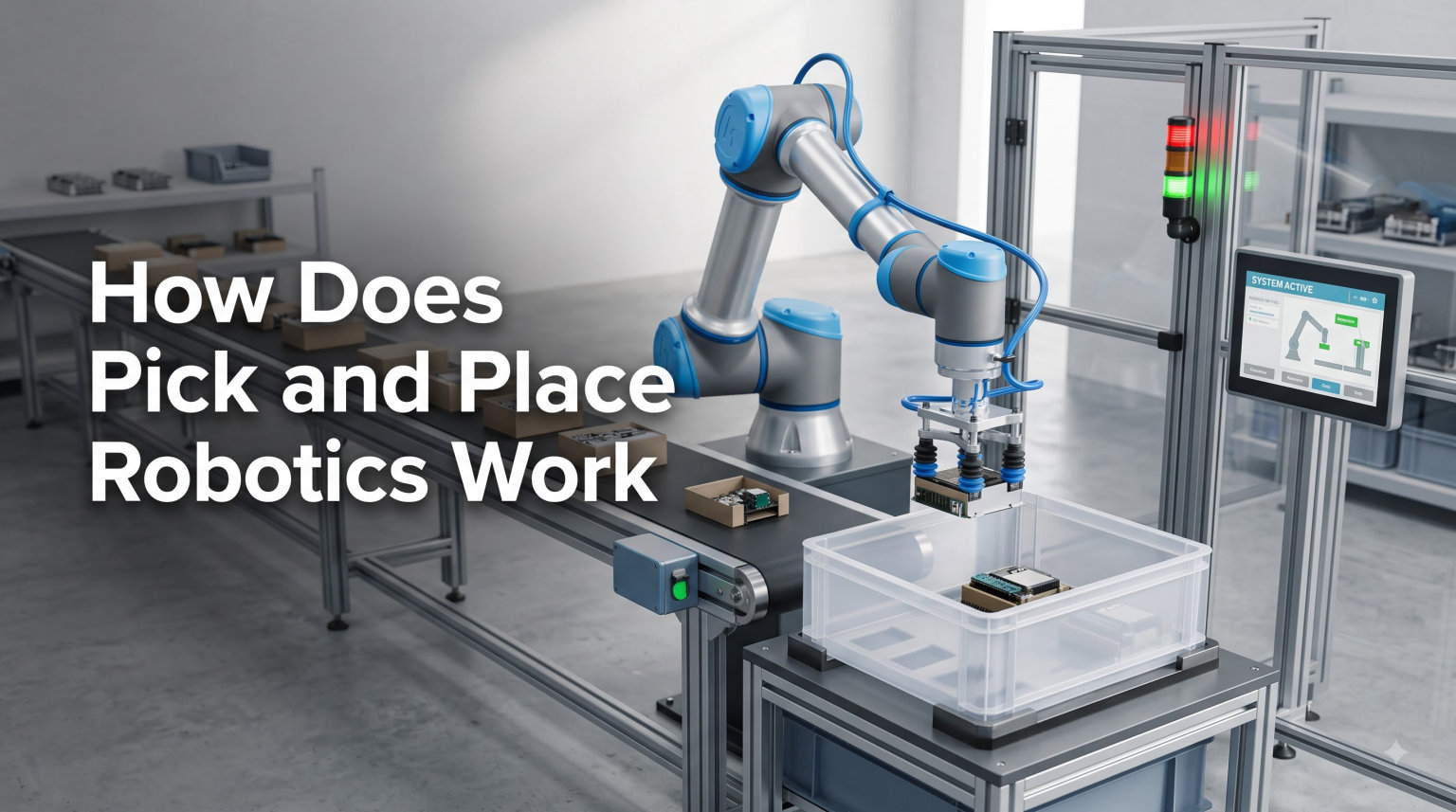
A pick and place robot is an automated machine that picks objects from one location and places them in another, using a robotic arm fitted with an end effector such as a gripper or vacuum cup. Pick and place robotics work by combining a robotic arm, an end effector, sensors for positioning, and a controller that directs the arm to grip an object, move it along a programmed path, and release it at the target location.
I have spent years watching these machines run on factory floors, and the way they weave together mechanics, vision, and software still impresses me. This guide explains every layer of the system, from the simplest mechanical arm to AI-driven picking cells. You will come away knowing how a pick and place robot actually moves an object, why different arm types matter, and where this technology is heading in 2026.
Table of Contents
What Is a Pick and Place Robot?
A pick and place robot is a class of industrial robot designed to move parts or products from one place to another. The phrase covers everything from a 3-axis Cartesian gantry in a bakery to a high-speed delta robot on a pharmaceutical line.
The core idea is simple. Instead of a human hand lifting, moving, and setting down a part, the robot does the same three actions with a programmed sequence. Modern pick and place systems repeat that sequence thousands of times per shift with sub-millimeter precision.
Pick and place robots first appeared in heavy manufacturing during the 1980s, when Japanese automakers deployed SCARA arms for assembly tasks. Since then, the category has expanded into packaging, food handling, electronics, and warehouse logistics. According to our team’s review of the 2026 industrial automation market, pick and place cells now represent one of the fastest-growing slices of the robotics sector.
You will also see the term used for PCB assembly machines in electronics manufacturing. Those surface-mount pick and place devices place tiny components onto printed circuit boards at rates of tens of thousands per hour. They share the same operating principles as their larger industrial cousins, just at a smaller scale and higher speed.
How Pick and Place Robots Work Step by Step
Every pick and place robot, regardless of size or arm type, follows the same four-step operating cycle. Understanding this cycle is the key to understanding how pick and place robotics work in practice.
- Detect and locate. Sensors or machine vision cameras identify the target object and calculate its position and orientation in space.
- Approach and grip. The arm moves to the object’s location and the end effector closes, vacuums, or otherwise secures it.
- Move along a planned path. The controller guides the arm to the drop point, using inverse kinematics to coordinate every joint.
- Release and retract. The end effector opens or vents, the arm returns to a ready position, and the cycle restarts.
The detection step is what separates modern pick and place robots from their 1980s ancestors. Older systems relied on fixed jigs and hard-coded coordinates. Today, machine vision lets a robot pick randomly oriented parts off a moving conveyor at line speeds above 100 parts per minute.
During the move phase, the controller constantly recalculates joint angles. The mathematics behind this calculation is inverse kinematics, which translates a desired end-effector position into a set of motor commands. We cover that topic in detail elsewhere, but the short version is that every smooth motion you see from a pick and place robot is the output of a kinematic solver running thousands of times per second.
Cycle time is the most-cited performance metric for these machines. It is the total time for one complete pick and place cycle, usually measured in seconds or fractions of a second. A high-speed delta robot can complete a full cycle in under 0.3 seconds, while a heavy-payload 6-axis arm may take 2 to 4 seconds for a more complex move.
Key Components of a Pick and Place Robot
Pick and place robots look like simple machines on the outside, but they combine several specialized subsystems. Each one plays a role in how pick and place robotics work end to end.
Robotic Arm
The arm is the skeleton of the system. It provides reach, payload capacity, and the degrees of freedom the application requires. Most arms are built from rigid aluminum or steel links driven by servo motors at each joint.
The choice of arm kinematics dictates what the robot can do. A SCARA arm excels at vertical pick and place, while a delta arm dominates high-speed sorting. A 6-axis arm trades speed for flexibility, reaching into tight spaces and approaching parts from any angle.
End Effector
The end effector is the hand of the robot. It is the part that physically interacts with the object being moved, and it is the most application-specific component in any pick and place cell.
Common end effector types include:
- Mechanical grippers with two or more fingers that close on the part
- Vacuum grippers that use suction cups and a pump to lift smooth objects
- Magnetic grippers for ferrous metal parts
- Soft or adaptive grippers made of compliant materials for delicate or irregularly shaped items
If you want a deeper look at how these devices actually grab and release parts, our guide to how robotic grippers work walks through the mechanics in detail.
Sensors and Vision System
Vision is what allows a pick and place robot to handle variation. A 2D or 3D camera identifies each part’s location, and the controller uses that data to update the arm’s path in real time.
Force-torque sensors add a layer of feedback during contact. They detect the moment the gripper touches the part, which lets the controller grip gently without crushing fragile items. Many modern systems also rely on FPGA motor control in robotics for the deterministic, microsecond-level timing these vision loops demand.
Controller and Software
The controller is the brain. It runs the kinematic solver, processes sensor data, and synchronizes the arm, end effector, and conveyor. Programming is often done with a teach pendant or a graphical interface, where operators record waypoints and the system turns them into motion code.
Modern pick and place controllers also expose APIs for factory-level software. That integration lets a robot receive picking commands from a warehouse management system or vision pipeline running on a separate server.
Conveyor and Positioning Hardware
Most pick and place cells include a conveyor that brings parts into the robot’s workspace. The conveyor’s speed must be matched to the robot’s cycle time, and a vision system upstream tracks each part so the robot knows exactly when to act.
Types of Pick and Place Robots
There is no single pick and place robot that fits every job. Our team has tested and worked with the four most common configurations, and each has clear strengths.
| Robot Type | Speed | Payload | Repeatability | Best For |
|---|---|---|---|---|
| SCARA | Medium-high | Up to 20 kg | +/- 0.01 mm | Electronics assembly, vertical pick and place |
| Delta | Very high (up to 300 picks/min) | Up to 8 kg | +/- 0.05 mm | Food, pharma, packaging sorting |
| 6-axis articulated | Medium | Up to 1,000+ kg | +/- 0.02 mm | Heavy parts, complex placement angles |
| Collaborative (cobot) | Medium | Up to 35 kg | +/- 0.03 mm | Shared workspaces, low-volume runs |
SCARA Robots
SCARA stands for Selective Compliance Assembly Robot Arm. SCARAs move stiffly along the vertical axis and compliantly in the horizontal plane, which makes them ideal for vertical insertion tasks like placing components into a circuit board or a fixture.
Delta Robots
Delta robots use three arms mounted in parallel to a fixed base. The resulting spider-like structure is extremely fast and light, which is why delta robots dominate high-speed packaging and food sorting lines.
6-Axis Articulated Robots
A 6-axis robot has the same six degrees of freedom as a human arm. Six-axis arms are slower than SCARAs or deltas, but they can reach into confined spaces and place parts at almost any orientation.
Collaborative Robots (Cobots)
Collaborative robots, or cobots, are designed to share workspace with humans without safety cages. They run at lower speeds and have built-in force limits. Cobots are a good fit for low-volume or mixed-product environments where full automation is not economical.
Industries and Applications for Pick and Place Robots
Pick and place robots are now standard in any industry that handles discrete parts at volume. The use cases keep expanding as vision and gripper technology improve.
Electronics Assembly
The PCB pick and place machine is the original high-volume pick and place system. Modern machines place components as small as 01005 (0.4 mm x 0.2 mm) at rates exceeding 80,000 components per hour.
Packaging and Palletizing
Packaging lines use pick and place robots to load products into boxes, trays, and pallets. At the end of a line, a 6-axis arm often stacks finished cases onto a pallet for shipment.
Food and Beverage
Delta robots with washdown-rated vacuum grippers pick baked goods, chocolates, and produce. Their stainless steel construction and high speed make them perfect for food-grade applications.
Pharmaceuticals
Pharmaceutical pick and place systems handle vials, blister packs, and syringes under strict cleanroom conditions. The combination of high speed and traceability makes robots a strong fit for this regulated industry.
E-Commerce Fulfillment
Warehouse pick and place robots, often mounted on mobile bases, retrieve individual items from bins and place them into order totes. The category has grown rapidly as e-commerce order volumes have scaled.
Benefits and Limitations of Pick and Place Automation
Pick and place robotics deliver clear wins, but the technology is not a perfect fit for every situation. Here is what our team has observed after deploying and auditing dozens of cells.
Key Benefits
- Speed: A delta robot can perform 150 to 300 picks per minute, far above human capacity
- Repeatability: Modern systems hold +/- 0.01 mm to +/- 0.05 mm across millions of cycles
- Uptime: Industrial cells routinely exceed 95% uptime in 24/7 operation
- Labor savings: Robots handle monotonous, injury-prone tasks and free workers for higher-value roles
Common Limitations
- Vision challenges: Tracking moving parts on a conveyor requires careful setup, and transparent or reflective parts remain difficult for many 2D vision systems
- Programming complexity: Precision insertion and multi-robot synchronization can demand significant engineering time
- Capital cost: A complete pick and place cell, including arm, end effector, vision, conveyor, and safety hardware, can run from the low five figures into the high six figures
- Changeover overhead: Switching a cell to a new product can take hours if grippers and fixtures must be swapped
Reddit users in r/robotics and r/PLC frequently report that vision tracking at high line speeds and tight-tolerance insertion are the two biggest day-to-day headaches. Both problems are solvable, but they require tuning the vision pipeline and arm susceptibility settings carefully.
AI, Machine Vision, and the Future of Pick and Place
The next leap in pick and place robotics is coming from software rather than mechanics. AI and machine learning are letting robots handle parts that would have been impossible just a few years ago.
Adaptive Gripping with Machine Learning
Machine learning models can predict the best grip points on unfamiliar objects. Instead of programming each new part, the robot looks at the object with a 3D camera and decides in real time how to grab it without slipping or crushing.
Self-Learning Through Reinforcement
Researchers have demonstrated pick and place systems that improve through reinforcement learning. The robot tries a move, measures success, and adjusts its policy. Over thousands of trials, the system learns strategies that human engineers would not have written explicitly.
Better 3D Vision
New structured-light and time-of-flight sensors give pick and place robots much richer 3D data. Combined with AI-based scene understanding, these systems can pick from cluttered bins, a task called bin picking that was unreliable until recently.
Edge AI and On-Robot Inference
Running AI directly on the robot controller reduces latency and removes the network dependency of cloud-based vision. This is a major win for high-speed lines where every millisecond counts.
The result is a future where pick and place robots adapt to new products with minimal programming. For high-mix manufacturers, that capability could be the difference between profitable automation and a stranded investment.
Frequently Asked Questions
How does a pick and place robot work?
A pick and place robot works by following a four-step cycle. First, sensors or machine vision detect the target object. The arm then moves to the part and the end effector grips, vacuums, or otherwise secures it. The controller guides the arm along a planned path to the drop point, and finally the end effector releases the object so the arm can return to its ready position.
What is pick and place robotics used for?
Pick and place robotics is used for moving parts or products from one location to another in manufacturing, packaging, palletizing, electronics assembly, food handling, pharmaceutical processing, and e-commerce fulfillment. Any application with repetitive transfers of discrete items is a strong candidate.
What are the main components of a pick and place robot?
The main components are the robotic arm, the end effector (gripper, vacuum, or magnetic), the sensor or vision system, the controller that runs the kinematic solver, and the supporting conveyor or positioning hardware. Each component must match the application’s payload, speed, and accuracy requirements.
How fast is a pick and place robot?
Pick and place robot speed depends on the type. Delta robots can reach 150 to 300 picks per minute, SCARA robots typically achieve 60 to 120 picks per minute, and 6-axis articulated robots run slower at 20 to 60 picks per minute because their motions are more complex.
How much does a pick and place robot cost?
A small cobot-based pick and place cell starts in the low five figures USD. Industrial SCARA and delta systems range from the mid-five figures to the low six figures. A fully integrated multi-robot line with vision, conveyors, and safety hardware can run from a few hundred thousand USD up to several million.
What is the difference between a SCARA and a delta robot?
A SCARA robot has a rigid vertical axis and is built for vertical pick and place tasks like electronics assembly with high repeatability. A delta robot uses three arms in parallel and is built for very high speed on tasks like food sorting and packaging. SCARAs handle heavier payloads; deltas win on raw pick rate.
Final Thoughts on How Pick and Place Robotics Work
Pick and place robotics work by combining a robotic arm, an end effector, sensors, and a controller into a single repeating cycle of detect, grip, move, and release. The mechanical design determines speed and reach, while the vision system determines how much variation the robot can tolerate.
SCARA, delta, 6-axis, and collaborative robots each carve out a niche based on speed, payload, and flexibility. Choosing the right configuration for your application starts with cycle time targets and the geometry of the parts you handle.
Looking ahead, machine vision and on-robot AI are pushing pick and place robotics into more variable, high-mix environments. If you are planning a new cell, start with the parts, then choose the arm, then layer in the vision and gripper. That order keeps the engineering grounded in the actual application rather than the latest spec sheet.
For a closer look at the gripper side of the system, read our guide to how robotic grippers work. It is a natural next step once you have the full pick and place picture in mind.