
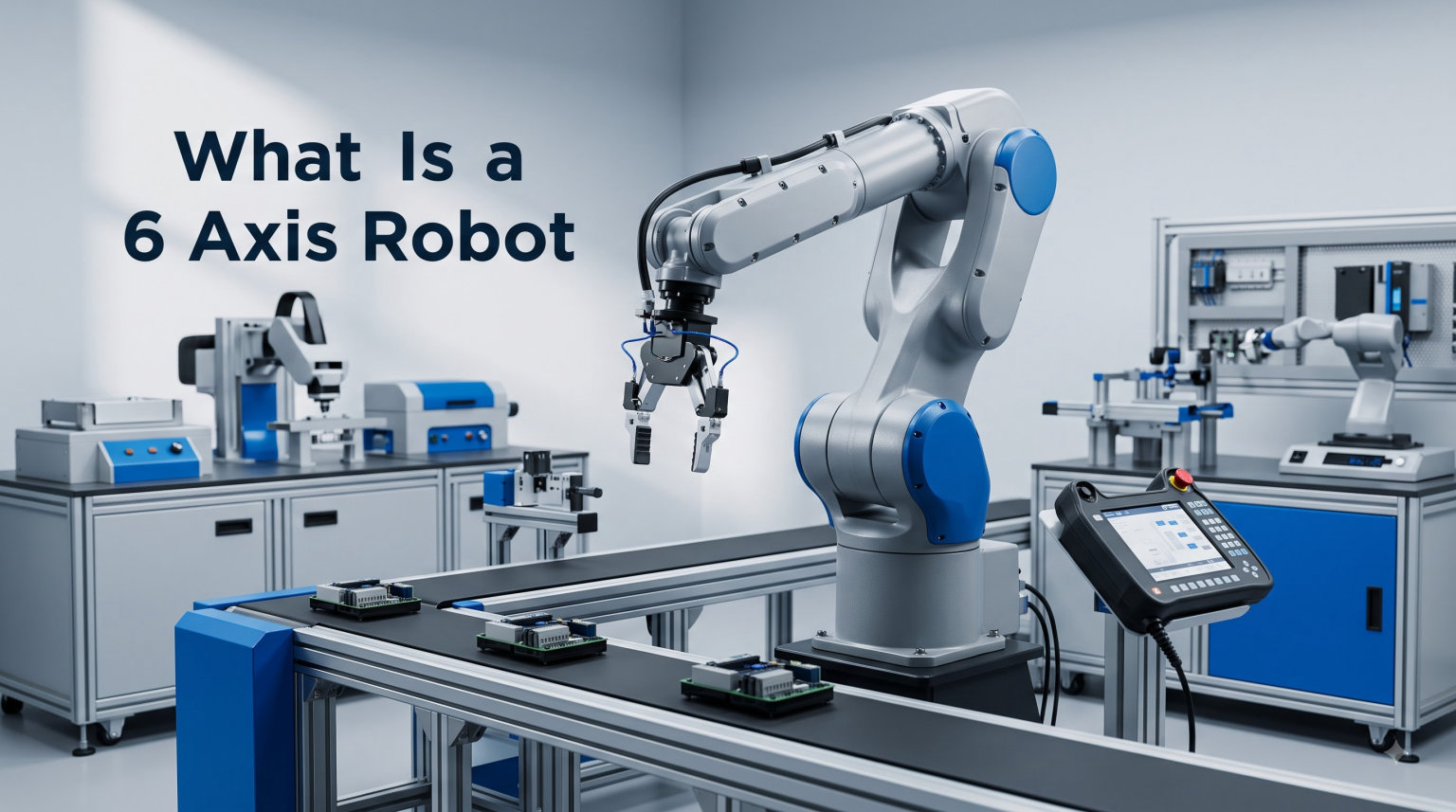
If you have ever watched a car chassis glide through a welding bay or seen a robot delicately assemble a circuit board, you were almost certainly looking at a 6 axis robot in action. It is the workhorse of modern automation and the most widely deployed type of industrial robot on the planet.
A 6 axis robot is a mechanical arm with six independent motorized joints, giving it six degrees of freedom in robotics and the ability to move, rotate, and orient its tool at almost any angle within its work envelope. Think of it as a digital arm modeled after the human shoulder, elbow, and wrist. In this guide I will walk you through every axis, the industries that depend on these robots, and how to decide if a 6 axis robot is the right fit for your project.
Table of Contents
What Is a 6 Axis Robot and How Does It Work?
A 6 axis robot is a type of articulated robotic arm with six rotary joints, also called an articulated robot or vertically articulated robot. Each joint is driven by a servo motor, and together they let the end of the arm reach any point within its workspace at any orientation. This combination of position plus orientation is what sets a 6 axis robot apart from simpler 3, 4, or 5 axis designs.
Inside each joint, you will typically find a planetary gearbox in robot joints coupled to a servo motor, with encoders feeding position data back to the controller. The controller runs inverse kinematics math to convert a target pose into joint angles, then commands each servo to move in sync. This happens thousands of times per second, which is why modern 6 axis robots can repeat the same motion to within 0.02 mm.
The end of the arm is fitted with an end effector, which is the generic term for whatever tool the robot is using. Common end effectors include welding torches, grippers, paint sprayers, and dispensing needles. The 6 axis robot is sometimes called a 6 DOF robot, where DOF stands for degrees of freedom.
The 6 Axes Explained: A Complete Breakdown
Every 6 axis robot is built around the same six joints, generally named the base, shoulder, elbow, and three wrist axes. Here is what each axis does.
- Axis 1 (Base rotation): Rotates the entire arm left and right around a vertical axis. This is the broadest swing and lets the robot reach stations laid out in a circle.
- Axis 2 (Shoulder): Tilts the lower arm forward and backward. Combined with Axis 1, it covers the upper hemisphere of the work envelope.
- Axis 3 (Elbow): Extends or retracts the upper arm, giving the robot forward reach and the ability to drop down into tight spaces.
- Axis 4 (Wrist roll): Rotates the wrist assembly around the forearm axis, which is critical for tasks like turning a part or maintaining a torch angle.
- Axis 5 (Wrist pitch or bend): Tilts the wrist up and down, allowing the end effector to approach the workpiece from above, below, or the side.
- Axis 6 (Tool rotation or yaw): Spins the end effector around the tool axis. This is the joint that handles fine rotation, like twisting a screw or orienting a dispensing nozzle.
The first three axes handle positioning. They put the wrist in the right spot. The last three axes handle orientation. They aim the tool exactly where it needs to be. That split is what makes a 6 axis robot so much more capable than a 4 axis robot, which can position but not fully orient the tool.
Each axis is driven by its own servo motor in robot joints, and most modern 6 axis robots use absolute encoders so the arm never loses its home position, even after a power cycle.
6 Axis Robot Applications and Industries
The 6 axis robot arm shows up wherever a task demands flexibility, reach, and precision at the same time. Automotive was the original proving ground, but adoption has spread across nearly every major industry.
Common applications include:
- Welding: Arc welding and spot welding on car bodies, frames, and heavy equipment. The 6 axis design holds the torch at a constant angle as the geometry changes.
- Material handling: Loading and unloading CNC machines, moving parts between conveyors, and tending presses.
- Assembly: Tightening fasteners, inserting components, and snap-fitting parts on electronics and appliance lines.
- Pick and place: Picking randomly oriented parts from bins using vision guidance and placing them on a conveyor or fixture.
- Painting and coating: Spraying consistent layers on curved surfaces, where the wrist must follow complex contours.
- Palletizing and packaging: Stacking boxes, wrapping pallets, and packing products into cases.
- Dispensing: Applying adhesives, sealants, or gasketing material with a continuous bead.
- Machine tending: Operating lathes, mills, and injection molding machines around the clock.
Outside heavy industry, smaller 6 axis robots are also used in pharmaceutical labs, food processing, and education. Hobbyists have even built 3D printed 6 axis arms for under a few hundred dollars, often running ROS for research and learning.
6 Axis vs 4 Axis vs 5 Axis Robots: Key Differences
The number of axes determines what a robot can and cannot do. More axes mean more flexibility, but also more cost, more programming complexity, and a larger footprint. Here is how the most common configurations stack up.
A 4 axis robot, often a SCARA-style design, has three positioning axes plus one wrist rotation. It is fast, precise, and inexpensive, but it cannot tilt the tool to reach over obstacles. A 5 axis robot adds a second wrist axis, giving it better access to angled surfaces but still missing true tool orientation control. A 6 axis robot adds the final wrist axis, which is the joint that lets the end effector spin freely in any direction.
In practice, 4 and 5 axis robots dominate high speed pick and place and simple palletizing, while 6 axis robots take over wherever the task involves complex paths, obstacles, or varying tool angles. Painting, complex welding, and multi-sided assembly almost always require a 6 axis robot.
6 Axis vs SCARA Robots: When to Choose Each
SCARA stands for Selective Compliance Assembly Robot Arm. It is a 4 axis design optimized for vertical assembly tasks where stiffness in the up-down direction matters more than full orientation.
Pick a SCARA when your task is top-down assembly, screw driving, or fast pick and place on a flat surface, and the work envelope is small. SCARA robots are faster, cheaper, and more accurate at these jobs than a 6 axis robot.
Pick a 6 axis robot when the workpiece is large, the path is curved, or the tool needs to approach from multiple angles. If the part has cavities, the robot needs to reach inside, or the operation is welding, painting, or polishing, a 6 axis robot is the only practical choice.
How 6 Axis Robots Are Programmed
Programming a 6 axis robot falls into two broad camps: teach pendant programming and offline programming. Teach pendant programming is the most common in industry. An operator physically guides the arm through each waypoint using a handheld controller, then saves the pose. The controller builds a trajectory from those saved points.
Offline programming runs on a PC using a 3D simulation of the work cell. The programmer clicks waypoints in the virtual environment, and the software generates the robot code without taking the real arm out of production. This is the standard approach for complex welding paths and large installations.
For hobbyists and researchers, ROS (Robot Operating System) is the most common entry point. Open source packages like MoveIt handle the inverse kinematics, so the programmer just specifies the target pose. This is also where I see a lot of the community content from reddit.com/r/robotics users, who build their own 6 axis arms and run them on Arduino, ESP32, or ROS 2.
Cost and Buying Considerations for 6 Axis Robots
Price varies wildly depending on reach, payload, brand, and whether you buy new, refurbished, or DIY. Here is what the market looks like in 2026.
Small hobby and education 6 axis arms start around $400 to $2,000. These are popular for learning and university labs. Mid range industrial 6 axis robots with 5 to 10 kg payload and 700 to 1400 mm reach typically run from $25,000 to $60,000 new, and roughly 40 to 60 percent of that price on the refurbished market. Heavy duty automotive robots with 100 kg or more of payload and reach over 2 meters can exceed $150,000.
Beyond the robot itself, plan for end effectors, integration hardware, safety fencing, and programming time. A fully integrated welding cell often costs three to five times the price of the bare arm. When comparing options, look at repeatability (typically 0.02 to 0.1 mm), reach, payload, and the controller ecosystem, since the controller is what you will live with for the next 10 to 20 years.
Frequently Asked Questions
What does 6 axis robot mean?
A 6 axis robot is a mechanical arm with six independent motorized joints, giving it six degrees of freedom. It can position its tool anywhere within its work envelope and orient that tool at almost any angle, much like a human arm.
How much does a 6 axis robotic arm cost?
Hobby and education 6 axis arms run from $400 to $2,000. Mid range industrial 6 axis robots with 5 to 10 kg payload cost $25,000 to $60,000 new, while heavy duty automotive arms can exceed $150,000. Refurbished units typically run 40 to 60 percent of new price.
What is the difference between a 5 axis and a 6 axis robot?
A 5 axis robot has five joints and cannot fully rotate the end effector around the tool axis. A 6 axis robot adds that final wrist rotation, allowing the tool to spin freely and reach into tight spaces. This makes 6 axis robots better for complex welding, painting, and multi-sided assembly.
What are the key differences between a 4 axis and a 6 axis robot?
A 4 axis robot, often a SCARA design, has three positioning joints plus one wrist rotation. It is fast and accurate for top down pick and place, but cannot tilt the tool around obstacles. A 6 axis robot adds shoulder, elbow, and two more wrist joints for full flexibility in any direction.
How accurate is a 6 axis robot?
Most industrial 6 axis robots offer repeatability between 0.02 mm and 0.1 mm. High end models used in precision assembly and machining can reach 0.01 mm or better. Real world accuracy depends on payload, temperature, calibration, and how the cell is integrated.
Final Thoughts on 6 Axis Robots
A 6 axis robot is the most flexible type of robotic arm you can buy today, and that flexibility is exactly why it dominates modern manufacturing. Six motorized joints give the arm the reach, dexterity, and orientation control needed for everything from arc welding to precision assembly.
If you are evaluating one for your own project, start with the task. Top down assembly on a flat surface is usually a SCARA job. Anything curved, angled, or three dimensional is where a 6 axis robot earns its keep. Once you know the reach, payload, and repeatability you need, the rest of the decision comes down to controller ecosystem and long term support.