
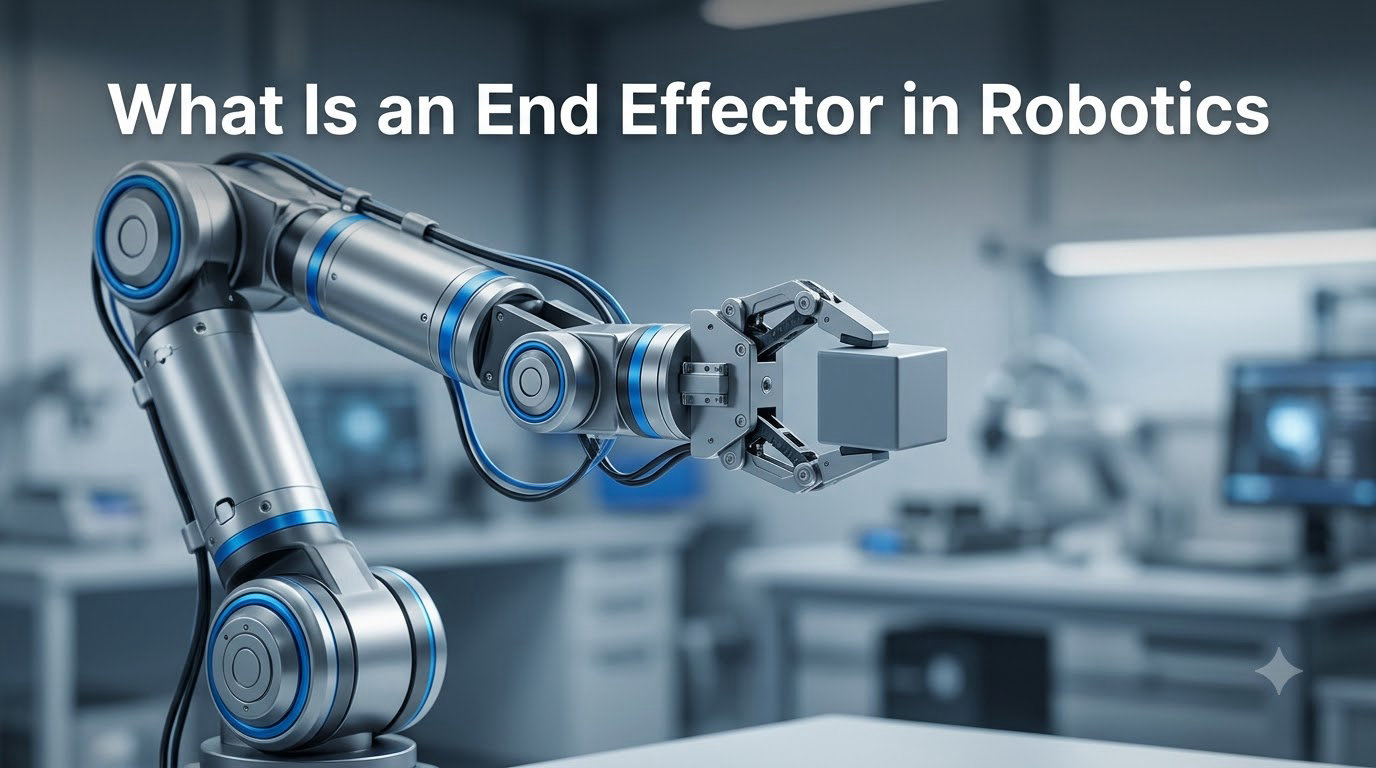
An end effector in robotics is the device attached to the end of a robotic arm that interacts with the environment, typically a gripper, sensor, or specialized tool. It is the part of the robot that actually performs work, whether that is picking up a box, welding a seam, or inspecting a surface. Without the end effector, a robotic arm is just a moving piece of metal. With one, it becomes a complete automation solution.
I have spent years working with industrial robots, and I can tell you that the end effector is where most of the real engineering happens. The arm gets all the attention, but the tool at the end of it is what makes or breaks a deployment. In this guide, I will walk you through everything you need to know, from basic definitions to selecting the right end effector for your project in 2026.
This article covers the three main types of end effectors, the most common gripper designs, sensor integrations, process tools, force compliance technology, industry applications, and what to look for when choosing one. I have also included practical examples from real automation projects I have worked on or studied, plus answers to the questions I hear most often from engineers and students.
Table of Contents
What Is an End Effector in Robotics?
An end effector is a peripheral device mounted at the end of a robotic arm, also called the wrist, that allows the robot to interact with its environment. The term is sometimes interchangeable with “end-of-arm tooling” (EOAT) or “tool head.” In manufacturing, you will hear both “end effector” and “EOAT” used to describe the same class of equipment.
The end effector is the business end of any robot. Every motion your arm makes, every coordinate you program, every cycle you optimize, ultimately serves to position the end effector exactly where it needs to be. Think of a robotic arm as the body and the end effector as the hand. The hand is what actually grabs the coffee cup.
Modern robotics traces the term back to the 1960s and 1970s, when industrial robots first began appearing on assembly lines. The word “effector” comes from engineering terminology, meaning something that produces an effect. The “end” refers to the distal end of the kinematic chain, the last link. So literally, an end effector is the device that produces an effect at the end of the arm.
From a systems perspective, the end effector sits between the robot’s last joint and the workpiece. It receives mechanical power, pneumatic pressure, electrical signals, or vacuum from the robot, and converts those inputs into useful action. A simple two-finger gripper just opens and closes. A welding torch at the end of a six-axis arm can produce thousands of spot welds per shift.
The Three Main Types of End Effectors
End effectors fall into three major categories: grippers, sensors, and process tools. This classification appears across academic literature, manufacturer catalogs, and industry standards. Some end effectors combine elements of multiple categories, like a vacuum gripper with an integrated camera, but most fit cleanly into one of these buckets.
Let me break down each type so you can see how they differ.
Grippers
Grippers are the most common type of end effector. They physically grasp, hold, and release objects. Grippers handle a massive range of payloads, from a few grams of medical sample to several hundred kilograms of automotive body panels. They are the workhorses of pick-and-place, machine tending, and assembly operations.
Sensors
Sensor end effectors collect data about the environment rather than modifying it. They include cameras for vision, force/torque sensors for tactile feedback, and proximity sensors for part detection. They are often paired with a gripper to enable closed-loop control and adaptive behavior.
Process Tools
Process tools perform manufacturing operations directly. Welding torches, paint sprayers, drills, grinders, and cutting heads all fall into this category. Unlike grippers, they do not hold an object, they transform it. A welding gun fuses metal. A dispenser applies adhesive. These tools often replace human hands in hazardous or repetitive tasks.
Gripper Types Explained
Grippers are where most newcomers start, and they are also where the most engineering variety exists. I have used all four main types in industrial settings, and each has clear strengths and weaknesses depending on your application.
Mechanical Grippers
Mechanical grippers use two or more jaws that physically clamp onto an object. They are driven by pneumatics, hydraulics, or electric motors. Two-finger parallel grippers are by far the most common, with angular or three-finger designs available for specialized work.
Mechanical grippers excel at handling rigid parts with predictable shapes. They deliver high gripping force, repeatability within a few thousandths of an inch, and low cost. Drawbacks include limited ability to handle delicate or irregularly shaped objects, and mechanical wear on the jaws over time.
Force closure is the engineering principle behind mechanical gripping. The gripper applies a clamping force that, combined with friction between the jaws and the object, generates enough friction force to counteract gravity and acceleration. As a rule of thumb, you need roughly 2-3 times the weight of the part in gripping force, depending on the coefficient of friction between the jaws and the material.
Vacuum Grippers
Vacuum grippers use suction cups and a vacuum source to lift objects. They are ideal for smooth, flat, or slightly curved surfaces like glass, sheet metal, cardboard boxes, and plastic panels. A single cup can lift from a few ounces to several hundred pounds depending on diameter and vacuum level.
The main advantage of vacuum grippers is their ability to handle a wide variety of part sizes with the same tool. You can grip a small electronics box one moment and a large refrigerator door panel the next by using a different cup layout. The main limitation is that the surface must be smooth, clean, and non-porous for the vacuum seal to hold.
Berneroulli grippers are a clever variant that uses the Bernoulli principle. Compressed air flows over a curved surface, creating a low-pressure zone that lifts the object while also providing a cushion of air. This lets the gripper handle delicate items like thin wafers or circuit boards without crushing them.
Magnetic Grippers
Magnetic grippers use either permanent magnets or electromagnets to attract ferromagnetic materials. They are extremely simple, with no moving parts, and they work in dirty or oily environments where vacuum grippers would fail. They are common in metal stamping, steel handling, and machine tending operations.
Permanent magnet grippers stay on even when power is lost, which is a major safety advantage. Electromagnetic grippers can be turned on and off quickly, which is better for fast cycle times. The obvious limitation is that they only work with magnetic materials like iron, steel, and some nickel alloys.
Servo-Electric Grippers
Servo-electric grippers use a servomotor to control finger position, speed, and force with precision. They are clean, quiet, and energy-efficient compared to pneumatic grippers. They also provide feedback on grip force and part presence, which is critical for handling delicate components or running multiple part types on the same line.
Servo grippers dominate in electronics assembly, pharmaceutical packaging, and lab automation. They eliminate the need for compressed air, which simplifies installation and reduces operating costs. The trade-off is higher upfront cost and more complex setup compared to pneumatic grippers.
Specialty Grippers
Beyond the four main types, there are some specialty grippers worth knowing about. Electrostatic grippers use electric charge to hold thin, flexible materials like film or paper. Needle grippers penetrate soft materials like foam or textiles. Soft grippers, sometimes called adaptive grippers, use compliant materials that conform to irregular shapes. Each solves a specific problem that the other gripper types cannot.
Sensors in End Effectors
Sensor end effectors give robots the ability to see, feel, and understand their environment. Without sensors, robots are blind. They execute pre-programmed paths regardless of what is actually in front of them. Sensors close that loop and enable adaptive behavior.
Vision Sensors
Vision sensors, primarily 2D and 3D cameras, allow the robot to identify parts, check orientation, and inspect quality. A 2D camera is enough for many pick-and-place tasks. A 3D camera adds depth perception for bin picking, where parts are jumbled in a container and the robot must figure out which one to grab first.
Force/Torque Sensors
Force/torque sensors measure the forces and moments applied to the end effector. They enable assembly tasks that require precise force feedback, like inserting a peg into a hole or tightening a bolt to a specific torque. They are also essential for polishing, grinding, and finishing operations where the robot must maintain consistent contact pressure.
Proximity and Presence Sensors
Proximity sensors confirm whether an object is in the gripper. A simple inductive or capacitive sensor can verify part presence after the gripper closes. This catches errors before a downstream process fails, saving costly scrap and downtime.
Tactile Sensors
Tactile sensors provide distributed pressure sensing across the gripper surface, similar to human fingertips. They allow the robot to detect slip, adjust grip force in real time, and handle delicate objects without crushing them. Tactile sensing is becoming more common in collaborative robots and advanced manipulation research.
Other Sensor Types
Light sensors, magnetic sensors, and range sensors also appear in specialized end effectors. Lidar laser scanners mounted on the end effector can capture 3D scans of curved surfaces for inspection or reverse engineering. I have seen this more often in research labs than in production, but adoption is growing quickly in 2026.
Process Tools as End Effectors
Process tools turn a robotic arm into a mobile manufacturing station. Instead of picking up an object, the tool transforms it. Welding, painting, cutting, and dispensing are the most common applications.
Welding End Effectors
Welding torches are the most widely deployed process tool end effector. Spot welding guns dominate automotive body assembly, where robots produce thousands of welds per vehicle. MIG and TIG welding torches are increasingly automated for custom fabrication. Laser welding and laser cutting heads are growing fast for high-precision work.
Painting and Coating
Paint spray guns and powder coating applicators are mounted on robots to deliver consistent, repeatable finishes. Robotic painting eliminates human exposure to volatile organic compounds and produces uniform coverage even on complex geometries. Bell and electrostatic applicators are common in automotive paint shops.
Cutting, Grinding, and Deburring
Cutting wheels, grinding discs, and deburring brushes are mounted on force-controlled robots for material removal. These applications require precise force control to maintain consistent cut depth without damaging the workpiece. Compliance devices, which I will explain next, are essential here.
Dispensing
Adhesive, sealant, and chemical dispensing tools apply precise beads of material along programmed paths. They are used in electronics assembly, automotive sealing, and packaging. Robotic dispensing reduces waste and improves consistency over manual application.
Specialty Process Tools
Surgical tools, agricultural pickers, and even 3D printing heads are all process tool end effectors. Surgical robots use specialized end effectors to hold scalpels, forceps, and suture needles. Agricultural robots use specialized grippers to harvest fruit without bruising it. The category is broad and growing every year.
Force Compliance Technology
Force compliance is one of the most important advancements in end effector design. It allows the robot to absorb small variations in part position or geometry without losing accuracy or damaging the part. There are two main approaches: active and passive compliance.
Active Compliant Technology
Active compliance uses sensors and real-time control to adjust the end effector’s position or force in response to feedback. A force/torque sensor detects resistance, and the robot controller adjusts the arm’s position to maintain the desired contact force. This is the most flexible approach and enables adaptive assembly, polishing, and chamfering tasks.
Passive Compliant Technology
Passive compliance uses mechanical elements, usually springs, elastomers, or floating mechanisms, to absorb position errors without active control. A simple RCC (Remote Center Compliance) device lets a peg “wiggle” slightly to align with a hole during insertion. Passive devices are simpler, cheaper, and more reliable than active systems, but they are limited to specific tasks.
In my experience, passive compliance is the right choice for high-volume, narrow-scope operations like peg-in-hole insertion. Active compliance is better for variable tasks where the robot must adapt to different parts or conditions. Both have their place in modern robotics.
How to Choose the Right End Effector
Selecting the right end effector is one of the most consequential decisions in any robotics project. The wrong choice can cut throughput, increase scrap, and force expensive redesigns. Here is the framework I use when consulting with automation teams.
Step 1: Define the Task
Start with the precise function. Are you picking a part, welding a seam, inspecting a surface, or applying adhesive? Each task points to a different category of end effector. A clear task definition eliminates 80% of options right away.
Step 2: Characterize the Object
Document the object’s weight, dimensions, material, surface finish, and fragility. A 2 kg steel block with a flat surface is a vacuum gripper candidate. A delicate glass lens weighing 50 grams needs a soft or servo gripper with force feedback. Object characteristics drive the technical requirements.
Step 3: Calculate Payload and Force
Add the weight of the end effector itself to the weight of the object. This total plus any acceleration forces must stay well within the robot arm’s rated payload. As a safety margin, I never run an arm at more than 70-80% of its rated payload, especially under dynamic motion.
Step 4: Define Speed and Cycle Time
Cycle time targets drive gripper choice. Pneumatic grippers are fast but less precise. Servo grippers are slower but offer precise control. Vacuum grippers are very fast for lightweight parts. If your cycle is under 2 seconds, you are in single-digit gripper options, and you probably need custom engineering.
Step 5: Consider the Environment
Cleanroom, food-grade, explosive, or outdoor environments all impose constraints. Food and pharmaceutical applications require stainless steel and washdown-rated designs. Explosive environments require ATEX-certified components. Ignoring environment ratings is a common and costly mistake.
Step 6: Plan Integration and Tool Changing
Decide whether the robot will use one end effector or multiple. If multiple, you need a tool changer that allows automatic swapping. This adds cost and complexity but multiplies the robot’s flexibility. I have seen robot cells where the end effector change takes longer than the actual work, so design the change process carefully.
Step 7: Budget Honestly
Off-the-shelf grippers cost from a few hundred to a few thousand dollars. Custom end effectors can run from $5,000 to $50,000 or more. Do not skip engineering hours, either. A poorly specified end effector that fails in production costs far more than its purchase price. Based on community feedback from robotics forums, most experienced engineers agree that custom work is often the only practical choice for non-standard payloads.
Applications Across Industries
End effectors are not limited to one industry. Let me walk you through the most common application areas and what types of end effectors dominate each.
Manufacturing and Assembly
Manufacturing is the largest market for end effectors. Automotive plants use thousands of welding guns and grippers. Electronics assembly lines use vacuum and servo grippers for pick-and-place and PCB handling. Consumer goods manufacturers use grippers for packaging, sorting, and palletizing.
Welding and Metal Fabrication
Welding torches, cutting heads, and grinding tools dominate this segment. Heavy-duty fabrication shops use six-axis robots with high-payload welding end effectors to produce structural components, pressure vessels, and heavy equipment parts.
Food and Packaging
Food and packaging operations rely on vacuum grippers, soft grippers, and specialized hygienic end effectors. Robots handle primary packaging (placing items into trays), secondary packaging (boxing), and palletizing. Stainless steel and washdown-rated designs are essential here.
Pharmaceutical and Medical
Pharmaceutical and medical applications use precision servo grippers and sterile-process end effectors. Robots handle vials, syringes, and surgical instruments. Surgical robots use specialized end effectors for minimally invasive procedures, and rehabilitation robots use end effectors to assist patient movement.
Logistics and Warehousing
Logistics robots use vacuum grippers for box handling and specialized grippers for tote and case picking. E-commerce fulfillment centers deploy thousands of pick-and-place robots, each with a custom end effector optimized for the specific SKU mix. This is one of the fastest-growing segments of end effector demand in 2026.
Space and Exploration
The Canadarm on the Space Shuttle used a special end effector called the End Effector or Latching End Effector to grapple payloads in orbit. Mars rovers use specialized end effectors to collect samples and instruments. Space applications demand extreme reliability and the ability to operate in vacuum, temperature extremes, and high radiation.
Future Trends and AI Integration
End effector technology is evolving rapidly. Here are the trends I am watching most closely.
AI-Powered Grip Control
Machine learning models are now integrated directly into grippers. Vision systems paired with neural networks can identify arbitrary objects in cluttered bins and plan grip strategies in real time. Google, Amazon, and major robotics companies have demonstrated this capability, and it is moving from research labs into production.
Soft Robotics
Soft grippers made from elastomers and flexible materials conform to objects of varying shapes without precision geometry. They are ideal for handling food, delicate items, and irregular shapes. The technology is maturing fast, and I expect commercial adoption to accelerate through the rest of 2026.
Modular and Reconfigurable Designs
Modular end effectors let users swap fingers, cups, and sensors quickly without tools. This dramatically reduces changeover time in high-mix production. Industry standards for modular connections are still emerging, but the direction is clear.
Self-Sensing and Tactile Intelligence
New tactile sensors detect slip, pressure distribution, and even texture with high resolution. Combined with smart grippers, they let robots handle objects with human-like dexterity. This is the technology that will eventually enable fully autonomous manipulation in unstructured environments.
Edge Computing and Real-Time Control
Edge computing brings AI inference directly to the end effector, reducing latency and enabling faster cycle times. Real-time control loops running on local processors can adjust grip force, position, and trajectory in milliseconds. This is essential for high-speed applications and for handling fragile or unpredictable objects.
Frequently Asked Questions
What is an end effector in robotics?
An end effector in robotics is a device attached to the end of a robotic arm, also called the wrist, that allows the robot to interact with its environment. It is the part of the robot that performs the actual work, typically a gripper, sensor, or specialized tool. The term is also called end-of-arm tooling (EOAT) or tool head.
What is an end effector in short answer?
An end effector is the device at the end of a robotic arm that interacts with the environment, usually a gripper or tool. It is essentially the robot’s hand.
What is an example of an end effector?
Common examples of end effectors include two-finger mechanical grippers for pick-and-place, vacuum suction cups for handling sheet metal or cardboard, magnetic grippers for steel parts, welding torches for joining metal, paint sprayers for finishing, and cameras or force sensors for inspection. Surgical robots use specialized end effectors to hold scalpels or forceps.
What are the three types of end effectors?
The three main types of end effectors are grippers, sensors, and process tools. Grippers grasp and hold objects. Sensors collect data like vision, force, or proximity. Process tools perform manufacturing operations such as welding, painting, cutting, or dispensing. Many end effectors combine elements of multiple categories.
Conclusion
An end effector in robotics is the device that turns a moving arm into a useful robot. It is the gripper that picks your part, the torch that welds your seam, the camera that inspects your product, and the tool that dispenses your adhesive. Choosing the right end effector is what makes the difference between a robotic system that works and one that delivers real productivity gains.
In 2026, the end effector market is expanding faster than ever, driven by advances in AI, soft robotics, and modular tooling. If you are planning a robotics project, start by defining your task clearly, characterizing your objects, and matching the end effector to the requirements. When in doubt, talk to integrators and review case studies from similar applications. The right end effector pays for itself many times over through reliability, throughput, and quality.