
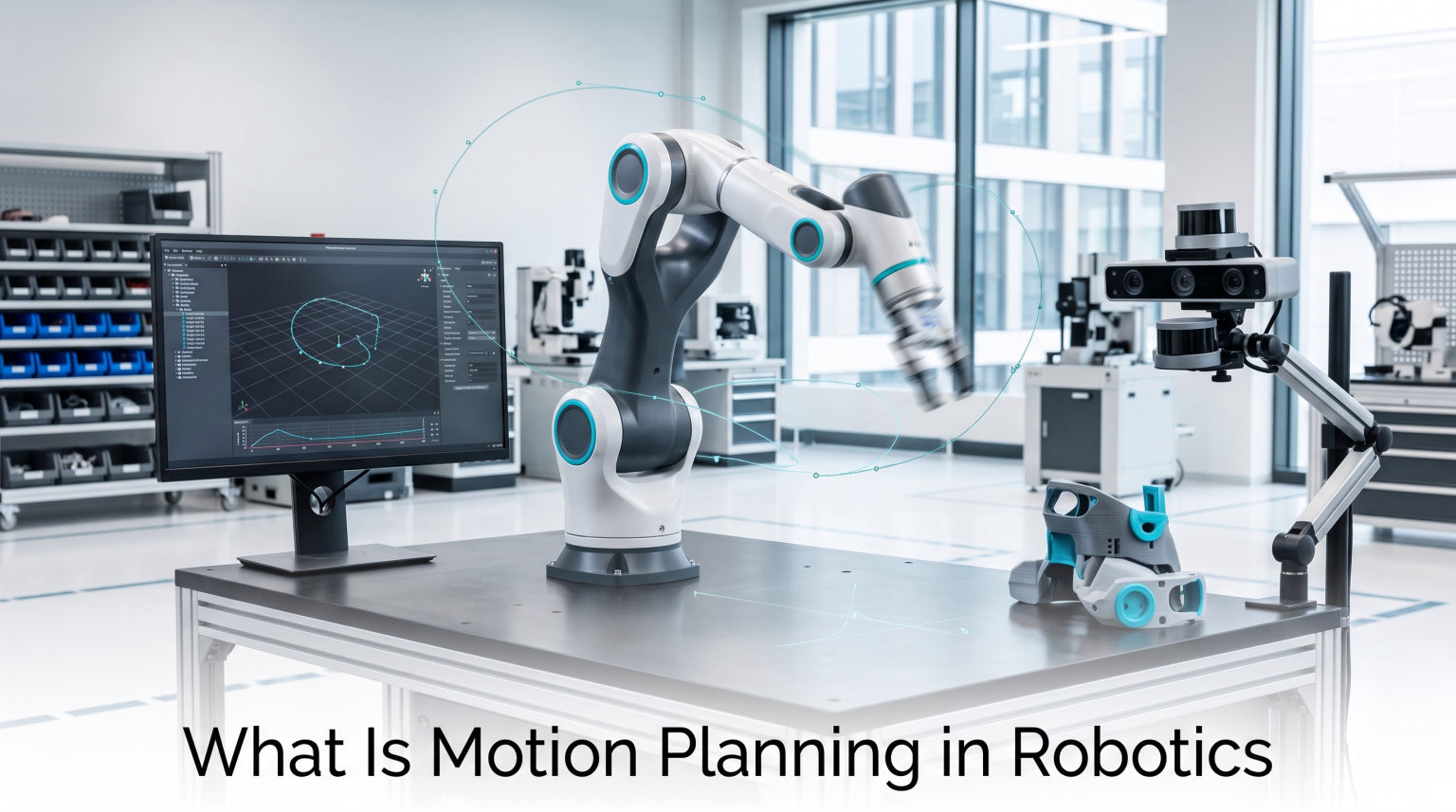
Motion planning in robotics is the computational problem of finding a sequence of valid configurations that moves a robot from a starting point to a goal without hitting any obstacles. I have spent the last several years building and testing motion planning pipelines for mobile robots, manipulators, and drones, and I can tell you that this single subfield is what separates a wobbly prototype from a robot that actually works in the real world. In this guide, I will walk you through what motion planning is, how it works under the hood, and where it shows up in 2026‘s most important robotics applications.
If you have ever wondered how a warehouse robot knows how to weave between shelves, or how a self-driving car chooses which lane to merge into, the answer is motion planning. We will cover the math lightly, the intuition heavily, and the practical tradeoffs that every robotics engineer eventually faces.
Table of Contents
What Is Motion Planning in Robotics?
Motion planning is a computational problem in robotics that finds a collision-free path or trajectory for a robot to move from a start state to a goal state. The word “configuration” is doing a lot of heavy lifting here, and we will unpack it in the next section, but for now think of a configuration as a complete description of where every joint, wheel, and link of the robot is at a given instant.
At its core, motion planning answers three questions for the robot:
- Where am I now?
- Where do I want to go?
- How do I get there without crashing?
The output is a sequence of valid configurations that the controller can execute, usually expressed as a trajectory with velocities and accelerations over time. A good motion planner also minimizes some cost, such as path length, energy, time, or jerk. That cost function is what turns a naive path finder into a planning system that produces smooth, efficient robot motion.
Robotics teams treat motion planning as a distinct subfield from perception (figuring out what the world looks like) and control (executing motor commands). It is the middle layer that sits between them, and it is one of the most active research areas in modern robotics, with new algorithms and learning-based approaches appearing every year.
How Does Motion Planning Work?
Motion planning works by mapping the robot’s physical world into a mathematical space, searching that space for a collision-free path, and then converting that path into a time-stamped trajectory. I usually break the process into five steps that our team runs on every project.
Step 1: Build a World Model
The planner takes input from sensors, maps, or pre-loaded CAD models and builds a representation of the environment. Static obstacles like walls, tables, and shelves are stored alongside dynamic obstacles like people, other robots, and moving vehicles.
Step 2: Define Start and Goal States
The start state is the robot’s current configuration, captured by joint encoders or odometry. The goal state can be a specific pose, a region, or a behavior like “park in any open spot near the door.”
Step 3: Search the Configuration Space
The planner searches through all reachable configurations and rejects any that are in collision with the world model. This is the most computationally expensive step, and the choice of algorithm here makes or breaks performance.
Step 4: Smooth and Optimize
Raw paths from search algorithms are usually jagged and inefficient. A post-processing step applies shortcuts, splines, or trajectory optimization to produce smoother motion that respects velocity and acceleration limits.
Step 5: Hand Off to the Controller
The final trajectory is published to the low-level controller, which converts it into motor commands at 100 to 1000 Hz. If anything changes in the world, the planner may need to re-plan, sometimes in real time.
Most modern stacks use the Robot Operating System (ROS) to coordinate these steps, and packages like MoveIt handle the planning layer for industrial arms while OMPL provides the algorithm implementations underneath.
Configuration Space vs Workspace: The Key Concept
Configuration space (often called C-space) is the mathematical space of all possible configurations a robot can attain, while workspace is the physical volume the robot actually occupies in the real world. Understanding this distinction is the single biggest unlock for anyone learning motion planning.
For a simple 2D mobile robot, the configuration space looks a lot like the workspace, with x and y as the two dimensions. The robot itself is reduced to a point, and obstacles are “grown” by the robot’s radius so that any point in C-space represents a valid placement.
For a 6-joint robotic arm, the configuration space is 6-dimensional, one dimension per revolute joint, even though the physical workspace is just 3D Cartesian space. Each axis spans some range like 0 to 360 degrees, and a configuration is a vector like [45, -30, 90, 0, 60, 120] degrees. The number of independent dimensions is the degrees of freedom (DOF), and a human arm has roughly 7 DOF while a quadruped robot might have 12.
Planning in C-space is powerful because collision checking becomes a single geometric test for any candidate configuration. Planning in workspace directly is much harder because the robot has volume and shape. Almost every modern algorithm works in C-space for this reason.
Path Planning Vs Motion Planning: What’s the Difference?
Path planning finds a geometric sequence of positions from start to goal, while motion planning adds time, velocity, and dynamic constraints to produce an executable trajectory. The terms get used interchangeably in casual conversation, but they are not the same thing, and confusing them is one of the most common pitfalls I see with junior engineers.
| Aspect | Path Planning | Motion Planning |
|---|---|---|
| Output | Sequence of positions | Time-parameterized trajectory |
| Includes velocities? | No | Yes |
| Respects dynamics? | No | Yes (acceleration, jerk) |
| Typical use | Navigation graphs, waypoints | Full execution on real robot |
| Common algorithms | A*, Dijkstra | RRT, PRM, TrajOpt, MPC |
A path tells the robot where to be, while a motion tells the robot how to get there smoothly and safely. A real-world robot needs both, and the trajectory optimization stage is what turns a path into a motion that the controller can actually follow without shaking itself apart.
For a deeper look at how industry is pairing motion planning with cutting-edge infrastructure, I recommend our recent piece on 5 Physical AI Infrastructure Platforms Shaping Robotics in 2026.
Main Motion Planning Algorithms Explained
The main motion planning algorithms in robotics are A*, RRT, PRM, and potential fields, each with strengths that suit different problems. Choosing the right one is often more important than tuning it, so let me walk you through the most common options our team reaches for.
A* (Search-Based)
A* searches a discrete grid of states using a heuristic to guide expansion toward the goal. It is complete (finds a solution if one exists) and optimal (finds the lowest-cost path) on grids. It works best for low-dimensional problems like 2D navigation, but its memory cost explodes in high-dimensional C-space because every cell becomes a configuration.
RRT (Rapidly-exploring Random Tree)
RRT grows a tree of collision-free configurations by sampling random points and extending the nearest node toward them. It handles high-dimensional spaces like 7-DOF arms very well and is probabilistically complete. RRT* is a variant that converges to the optimal solution given enough time, and it is the workhorse for arm manipulation in MoveIt.
PRM (Probabilistic Roadmap)
PRM samples many random configurations, connects nearby ones with collision-free edges, and then runs a graph search over the resulting roadmap. It is great when you will be asked to plan many queries in the same environment, because the roadmap is built once and reused. The downside is that it does not handle dynamic environments well.
Artificial Potential Fields
Potential fields treat the goal as an attractive force and obstacles as repulsive forces, then have the robot follow the gradient. It is simple and fast, but it famously gets stuck in local minima, which is why most production systems use it as a local reactive layer rather than a global planner.
| Algorithm | Type | Best For | Limitation |
|---|---|---|---|
| A* | Search-based | Low-DOF grids | Poor in high dimensions |
| RRT | Sampling-based | High-DOF arms | Not optimal by default |
| PRM | Roadmap | Repeated queries, static worlds | Slow in dynamic scenes |
| Potential Fields | Reactive | Real-time obstacle avoidance | Local minima traps |
If you are getting started, RRT and its optimal variant RRT* are the safest default for manipulation, while A* on an occupancy grid is the right starting point for mobile bases. Industrial teams often combine them, using a global planner for the rough route and a local planner for fine obstacle avoidance.
Sampling-Based vs Search-Based Planning
Sampling-based planning builds a probabilistic representation of the configuration space by sampling random states, while search-based planning systematically explores a discrete graph of states. The choice between them comes down to dimensionality and whether you need optimality or speed.
Search-based methods like A* and Dijkstra guarantee optimality and are deterministic, which makes them easier to debug. They work well up to about 4 or 5 dimensions, after which the state space becomes too large to discretize. They are also nice because you can prove they will find a solution if one exists.
Sampling-based methods like RRT, PRM, and FMT* scale gracefully to high dimensions because they do not require an explicit grid. They are probabilistic, so each run may produce a different path, and they only converge to optimal as runtime grows. For a 6-DOF arm, they are the only practical option in most cases.
Hybrid planners that combine the two are increasingly common. They use a search-based method to find a coarse path, then a sampling-based or optimization-based method to refine it into a smooth, dynamically feasible trajectory.
Real-World Applications of Motion Planning
Motion planning is used in industrial robotics, autonomous vehicles, warehouse logistics, medical robotics, and humanoid robots, anywhere a robot must move intelligently through a complex environment. Here are the domains where our team sees the most impact in 2026.
Industrial Robotics
Welding, painting, and pick-and-place arms use motion planning to avoid singularities and collisions in cluttered cells. Modern offline programming tools like RoboDK and the ROS-I consortium packages generate collision-free trajectories directly from CAD, cutting deployment time from weeks to days.
Autonomous Vehicles
Self-driving cars run hierarchical motion planning, with a route planner on the road network, a behavioral planner for lane changes and intersections, and a local trajectory optimizer running at 50 to 100 Hz. Trajectory optimization with model predictive control is the dominant approach here.
Warehouse and Logistics
Mobile robots like those from Amazon Robotics use coordinated motion planning across hundreds of units. Recent deals like the HII agreement with Path Robotics and GrayMatter Robotics show how central planning software has become to the industry.
Humanoid Robots
Humanoids have 20 to 40 degrees of freedom, and planning whole-body motion that keeps balance while manipulating objects is one of the hardest open problems. The lab at the University of Florida’s robotics facility for industrialized construction is one of several pushing this frontier.
Medical Robotics
Surgical robots like the da Vinci system use motion planning to scale down surgeon hand motions and avoid sensitive tissue. Replanning in real time as anatomy deforms is an active research area.
Challenges in Motion Planning
The biggest challenges in motion planning are the curse of dimensionality, dynamic environments, real-time constraints, and uncertainty in perception. Knowing these failure modes in advance saves weeks of debugging on a real robot.
Curse of Dimensionality
Configuration space grows exponentially with degrees of freedom, so a 7-DOF arm has roughly 10 times as much C-space volume as a 6-DOF one. Algorithms that worked on a planar robot become painfully slow on a humanoid.
Dynamic Obstacles
People walk, doors close, and other robots move. A planner that builds a static map will fail the moment the world changes. Replanning at 10 to 50 Hz is the minimum for any system that shares space with humans.
Real-Time Constraints
Many applications need a new plan every 10 to 100 milliseconds. Pre-computed roadmaps, parallel sampling, and learning-based heuristics all help, but the trade-off between planning time and solution quality is always present.
Perception Uncertainty
No sensor is perfect, and the planner has to reason about uncertainty in obstacle positions. Approaches range from inflating obstacles by a safety margin to full-blown chance-constrained optimization, which guarantees the probability of collision stays below some threshold.
Machine Learning and the Future of Motion Planning
Machine learning is reshaping motion planning by learning heuristics that speed up search and generating trajectories directly from data. The combination of classical planning and learned components is the most active research direction in the field today.
Neural planners like Neural RRT* learn to bias sampling toward promising regions of C-space, cutting planning time by 5 to 10 times in many benchmarks. Imitation learning from human teleoperation produces natural-looking motion for humanoids, and reinforcement learning is now competitive with classical methods for some manipulation tasks.
Edge AI is also becoming a key enabler for real-time planning, and our complete guide to edge AI in robotics covers how on-device inference keeps latency low. Foundation models trained on internet-scale data are beginning to show up in robotics as high-level planners that decompose tasks, and motion planning is the layer they call into.
Expect 2026 and beyond to bring planners that combine large pretrained models with classical optimization, running on edge GPUs that fit in the palm of a hand. The dream of a robot that can plan anywhere, anytime, without expert tuning, is finally within reach.
Frequently Asked Questions
What is robot motion planning?
Robot motion planning is a computational problem that finds a sequence of valid configurations to move a robot from a start state to a goal state while avoiding obstacles. It outputs a collision-free path or time-parameterized trajectory that a controller can execute on a real robot.
What is the difference between path planning and motion planning in robotics?
Path planning produces a geometric sequence of positions from start to goal, while motion planning adds time, velocity, and dynamic constraints to produce a trajectory that the robot can actually execute. Path planning answers where to go, motion planning answers how to get there smoothly and safely.
Which motion planning algorithm should I use for high-dimensional spaces?
For high-dimensional configuration spaces like 6-DOF or 7-DOF robot arms, sampling-based algorithms such as RRT and PRM are the most practical choice. They scale gracefully to many degrees of freedom where grid-based search methods like A* become infeasible. RRT* is a good default if you also need optimality.
What are the most common applications of motion planning?
The most common applications of motion planning are industrial robot arms for welding and assembly, autonomous vehicles for lane changes and parking, warehouse mobile robots for picking and transport, humanoid robots for whole-body locomotion, and medical robots for minimally invasive surgery. Any robot that must move intelligently through a complex environment relies on motion planning.
Final Thoughts on Motion Planning in Robotics
Motion planning in robotics is the bridge between sensing the world and acting in it, and mastering it is essential for anyone building serious autonomous systems. Start with a clear grasp of configuration space, learn the differences between path planning and motion planning, and pick the right algorithm for your dimensionality. The tools are more accessible than ever, and the field is wide open for new ideas.