
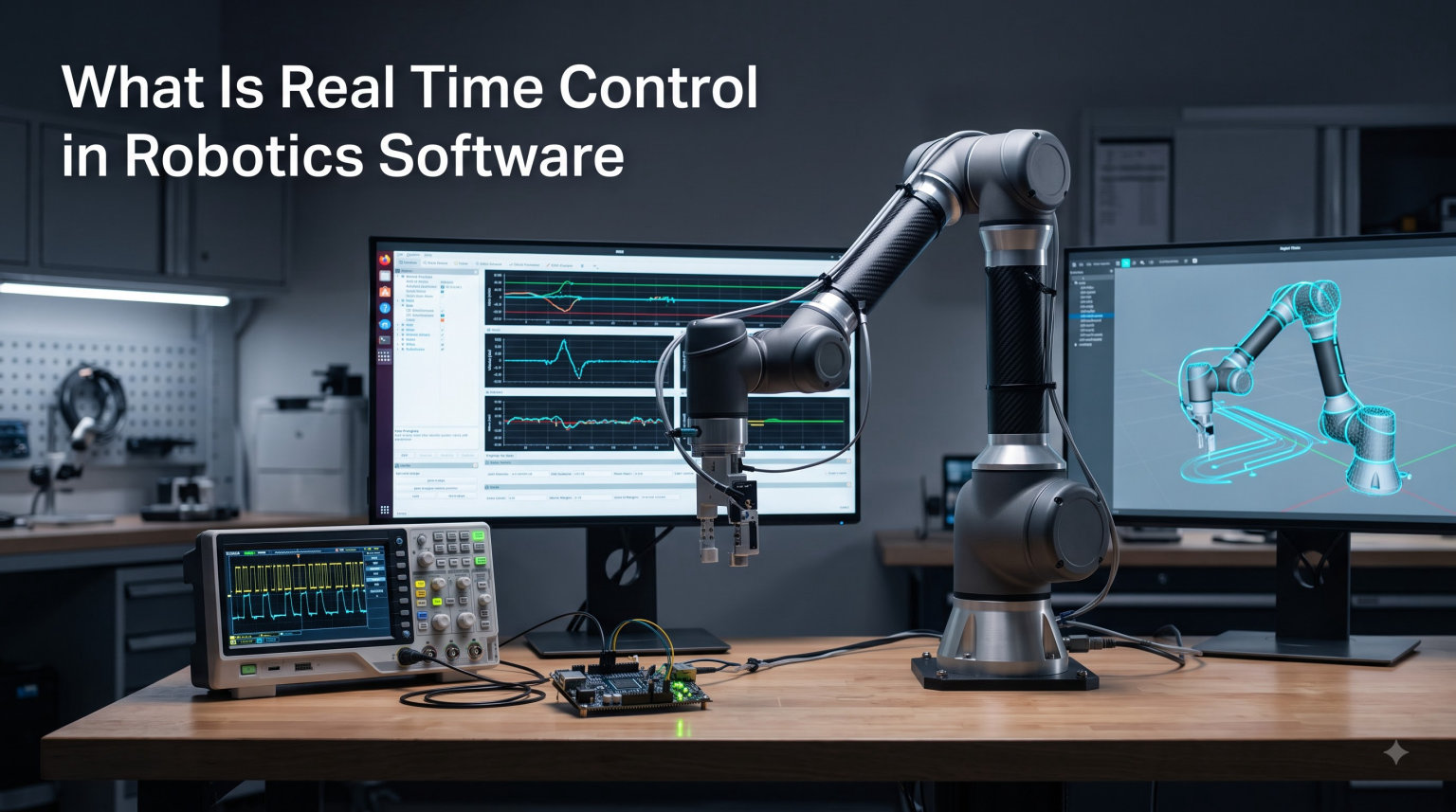
Real time control in robotics software is a control approach where the system must read sensors, compute responses, and command actuators within strict, guaranteed time deadlines. Unlike best-effort control, a missed deadline in a real-time robot controller is treated as a system failure, not just a slowdown. This deterministic behavior is what lets industrial arms, drones, and surgical robots operate safely and repeatably.
In this guide, I’ll walk you through exactly what real-time control means in robotics, the difference between hard and soft real-time systems, how a real-time operating system (RTOS) makes it possible, and the control loop architecture behind it all. Our team has spent years building and debugging real-time robot controllers, and I’ll share what actually matters in practice.
Table of Contents
What Is Real Time Control in Robotics Software
Real time control in robotics software is the discipline of guaranteeing that a robot’s control responses occur within bounded time limits, typically measured in microseconds to milliseconds. A robot running real-time control doesn’t just respond quickly, it responds predictably, every single cycle.
The key word here is deterministic. When you send a command to a real-time controlled motor, you can predict within microseconds exactly when the next control update will happen. That predictability is what separates real-time control from ordinary software control, which might respond in 1 ms one moment and 50 ms the next under load.
Why does this matter for robots? Imagine a welding arm moving at high speed along a seam. If the controller misses a single 1 ms deadline, the torch drifts off the path and ruins the part. Now scale that to a self-driving car avoiding a pedestrian, or a surgical robot suturing tissue. Timing failures become safety failures.
Real-time control software typically operates on a fixed control cycle, often called the sample period. Common values are:
- 1 kHz (1 ms) for industrial servo motors
- 100 Hz to 500 Hz for collaborative robot arms
- 50 Hz to 250 Hz for quadcopter flight controllers
- 10 Hz to 50 Hz for slow manipulator positioning
Every component in the real-time control chain, from sensor reading to actuator command, must complete inside that window. Anything that can’t meet the deadline runs on a lower-priority thread, gets offloaded to a coprocessor, or simply isn’t allowed in the real-time path.
Types of Real-Time Systems: Hard vs Soft Real-Time
Not all real-time systems are the same. The robotics world splits them into two categories, and the distinction is critical when you’re choosing hardware or designing safety logic.
Hard real-time means a missed deadline is a total system failure. The result is not just degraded, it’s catastrophic. Hard real-time systems are used in safety-critical robotics where timing violations could cause injury, death, or destruction of expensive equipment.
Soft real-time means a missed deadline is undesirable but tolerable. The system continues to function, just with reduced quality. Soft real-time is common in consumer robotics, human-robot interaction, and prototype development where occasional hiccups don’t compromise safety.
Here are concrete robotics examples for each category:
- Hard real-time: automotive airbag deployment, robotic surgical systems, CNC tool paths, industrial welding robots, anti-collision braking in autonomous vehicles
- Soft real-time: robot vacuum mapping, drone camera gimbals, voice-controlled service robots, hobby arm motion, gesture recognition
Firm real-time is a third, less common category. Missed deadlines produce zero-value results, meaning the late data gets discarded. A vision system that delivers a slightly delayed object detection frame is firm real-time, the frame is useless if it’s late, but nothing crashes if it arrives past the deadline.
Most real-world robots actually run a mix. The motor current loop is hard real-time at 20 kHz. The trajectory planner is soft real-time at 100 Hz. The user interface is best-effort. Designing the priority and timing boundaries between these layers is one of the most important jobs in robotics software.
The Role of RTOS in Real-Time Robot Control
A real-time operating system (RTOS) is the software foundation that makes deterministic control possible on a robot. Unlike a general-purpose OS like desktop Linux or Windows, an RTOS uses a priority-based scheduler that guarantees high-priority tasks run before their deadlines, even under heavy system load.
The RTOS’s job is to manage interrupts, schedule tasks, and lock down worst-case execution times. When a sensor interrupt fires, the RTOS immediately preempts whatever else was running and gives the real-time control task a known, bounded amount of CPU time to finish its work. This is how you get a guaranteed response within 50 microseconds, every time.
Common RTOS options used in robotics include:
- FreeRTOS: open-source, lightweight, runs on microcontrollers like STM32 and ESP32, popular for motor controllers and sensor nodes
- RT Linux (PREEMPT_RT patch): a real-time variant of Linux used in research robots and ROS2 systems, gives you full Linux tooling with much better determinism
- QNX: commercial RTOS used in automotive, surgical robots, and the Canadarm on the ISS
- VxWorks: commercial RTOS found in aerospace robots, military UAVs, and NASA rovers
- Zephyr: open-source RTOS gaining ground in IoT and small robots, backed by the Linux Foundation
For more on the hardware that often runs these RTOSes, our BeagleBone PRUs enable real-time control without Linux overhead, and our FPGAs are widely used in robotics for deterministic real-time control at speeds no CPU can match.
What about ROS and ROS2? The original ROS (Robot Operating System) is not real-time. It runs on top of regular Linux and can suffer unpredictable delays. ROS2 was redesigned with real-time support at its core, using DDS for deterministic communication and supporting RT Linux. If you’re building a new robot in 2026 and need real-time guarantees, ROS2 with the Cyclone DDS implementation and a PREEMPT_RT kernel is the most common starting point.
How a Real-Time Control Loop Works in Robotics
Every real-time controlled robot runs some form of a closed-loop control cycle. The classic version is a sense-compute-actuate loop that repeats at a fixed rate, often called the control period or sample time.
Here’s the step-by-step flow inside one control cycle:
- Sense: read sensors, encoders, IMUs, force/torque sensors, cameras, at a known time stamp
- Compute: run the control algorithm (typically a PID controller or model-predictive controller) using the fresh sensor data and the desired setpoint
- Actuate: send the computed output to the motor drivers, valves, or other actuators
- Wait: block until the start of the next control period, then repeat
A PID controller is the workhorse of real-time robot control. It continuously calculates an error value as the difference between a desired setpoint and a measured process variable, then applies a correction based on proportional, integral, and derivative terms. At 1 kHz, a well-tuned PID on a servo motor can hold position to within a few encoder counts.
The sensors and actuators are the real-time boundary. If your sensor read takes 200 microseconds and your actuator write takes 50 microseconds, you have 750 microseconds left inside a 1 ms control period for the compute step. Exceed that and you’ve missed a deadline. This is why real-time robot code is so disciplined about memory allocation, no malloc on the real-time path, ever.
Common sensors in real-time robot control loops include rotary encoders, inertial measurement units, LIDAR, force-torque sensors, and current shunts. Common actuators are brushless DC motors, servo motors, hydraulic cylinders, and pneumatic valves. Each pairing has its own latency and bandwidth characteristics that the control loop must respect.
Sensor fusion is the next layer up. An IMU alone drifts. A wheel encoder alone slips. Combine them with a Kalman filter running at 200 Hz and you get a stable pose estimate the low-level PID can trust. This fusion itself runs in real-time, but at a slower rate than the raw motor loop.
Real-World Applications of Real-Time Control in Robotics
Almost every commercial robot you can name relies on real-time control at some level. Here are the most common application categories I see in my own work and across the industry.
Industrial automation is the classic use case. Robotic arms on automotive assembly lines, packaging machines, and CNC mills all run real-time control loops at 1 kHz to 20 kHz to hit positional accuracy measured in fractions of a millimeter. A typical 6-axis arm might have six independent real-time loops, one per joint, coordinated by a higher-level trajectory generator.
Collaborative robots, or cobots, run soft real-time control for safety. They monitor force/torque sensors and motor currents at 1 kHz, and if a human gets too close, the safety controller cuts torque within milliseconds. The motion planning itself is soft real-time at 100 Hz, which is fast enough to look smooth but doesn’t need hard guarantees.
Autonomous drones and quadcopters are some of the most demanding real-time systems out there. A flight controller running PX4 or ArduPilot loops at 8 kHz on the inner rate-control PID, and 1 kHz on the attitude loop, all hard real-time. If the inner loop hiccups, the drone flips out of the sky. This is also why drone pilots in our forums report that Wi-Fi control for robot communication needs careful tuning to avoid latency spikes during maneuvers.
Surgical robots and telesurgery systems are extreme examples. The da Vinci system runs hard real-time control with redundant processors and watchdogs, because a single missed deadline during a suture is unacceptable. Even small jitter of a few hundred microseconds can show up as visible tremor at the tool tip.
Autonomous vehicles use hierarchical real-time control. The brake controller runs hard real-time at 200 Hz. The lane-keeping controller runs at 50 Hz. The path planner runs at 10 Hz. Each layer has different deadlines, and they all coordinate through shared state protected by real-time locks. End effectors and grippers in these systems also rely on real-time sensor feedback for end effector control to grasp objects without crushing them.
Implementation Challenges and Best Practices
Building a real-time robot controller is harder than it looks, even for experienced teams. The most common pitfalls come from breaking the deterministic assumptions of the real-time path.
Priority inversion is the classic gotcha. A low-priority task holds a lock that a high-priority real-time task needs, so the real-time task blocks while a medium-priority task runs. The fix is priority inheritance, where the lock holder temporarily inherits the higher priority until it releases. Every serious RTOS implements this, but only if you use its synchronization primitives correctly.
Jitter is the enemy of stable control. Your control loop might run at 1 kHz on average, but if it sometimes takes 0.5 ms and sometimes 1.5 ms, the controller gains you tuned for 1 ms are suddenly wrong. Profile the worst-case execution time of every real-time function, and add at least 30 percent headroom for safety.
Memory allocation on the real-time path is forbidden in most production codebases. Use pre-allocated memory pools or static buffers. A single page fault or cache miss in the real-time thread can blow your deadline. Disable swap, lock memory with mlock, and run the real-time process on an isolated CPU core if you can.
Testing matters more in real-time than in almost any other area of software. Use hardware-in-the-loop test rigs, inject faults deliberately, and measure timing with an oscilloscope on a GPIO pin toggled at the start and end of each control cycle. A loop that passes unit tests can still fail miserably in the real world.
Frequently Asked Questions
What are real-time controls in robotics?
Real-time controls in robotics are control systems that must respond to sensor inputs and produce actuator commands within strict, guaranteed time deadlines. The focus is on deterministic timing, not just speed, so the worst-case response time is bounded and predictable.
What is the difference between hard and soft real-time in robotics?
Hard real-time means a missed deadline is a total system failure, used in safety-critical robots like surgical systems and automotive braking. Soft real-time means a missed deadline is undesirable but tolerable, used in applications like robot vacuums and cobot motion planning where occasional delays are acceptable.
What are examples of real-time systems in robotics?
Common examples include industrial robotic arm servo loops at 1 kHz, drone flight controllers at 8 kHz, CNC machine tool paths, automotive airbag deployment, surgical robot motion control, and force/torque safety monitors in collaborative robots. Each runs a control loop with bounded deadlines.
Do robots need a real-time operating system?
Not always, but any robot with hard real-time requirements does. Hobby robots and prototypes can often run on regular Linux with soft real-time behavior. Industrial, medical, and autonomous vehicles typically need an RTOS like FreeRTOS, RT Linux, QNX, or VxWorks to guarantee deadlines.
How does ROS2 support real-time control?
ROS2 was designed with real-time in mind. It uses the DDS communication standard for deterministic messaging, supports the PREEMPT_RT Linux kernel patch, and works with real-time DDS implementations like Cyclone DDS. The original ROS does not offer these guarantees and is not suitable for hard real-time applications.
Final Thoughts on Real-Time Control in Robotics
Real time control in robotics software is what makes a robot trustworthy. Without deterministic timing, you can’t build safe industrial arms, stable drones, or precise surgical tools. With it, you can build machines that repeat the same motion a million times, react to the world in microseconds, and earn the trust of the people who use them.
If you’re just getting started, my advice is to begin with a soft real-time project on a small board like an Arduino or Raspberry Pi Pico running FreeRTOS. Profile your control loop, measure the jitter, and learn the discipline of keeping the real-time path clean. Once you’ve shipped a soft real-time robot that works, you’ll have the foundation to take on the harder problems in hard real-time control.