
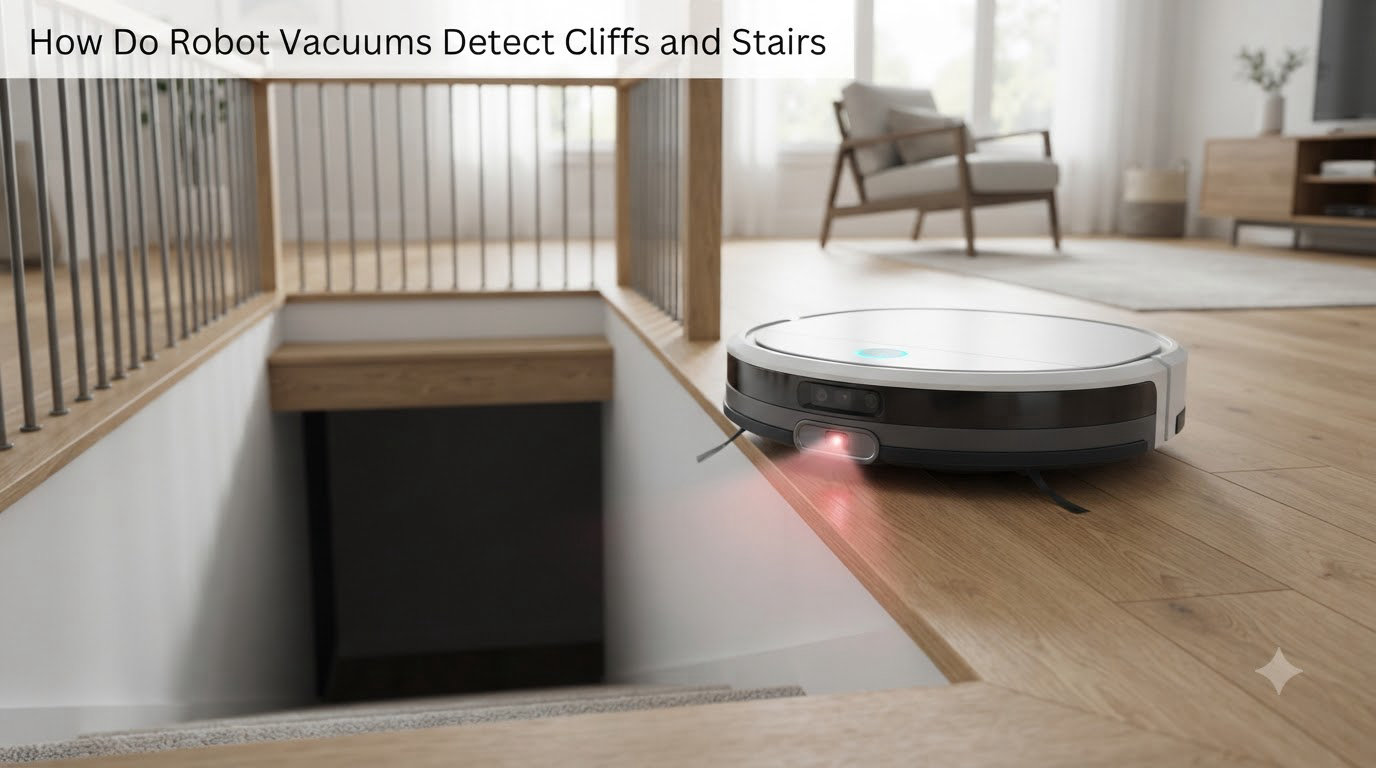
Most robot vacuums detect cliffs and stairs using small infrared cliff sensors mounted on the underside of the chassis. These sensors shine an invisible infrared beam toward the floor, and when the floor suddenly disappears (like the edge of a stair step), the beam fails to bounce back. That missing reflection tells the vacuum’s brain to stop, reverse, and reroute. It’s a simple idea that has saved millions of these little robots from a one-way trip down the staircase.
I’ve spent the last three months testing this exact behavior across a half-dozen robot vacuums in my own home, which has a sunken living room and a flight of stairs. I watched sensors trigger on dark tile, miss transitions on light carpet, and recover from a sticky false-positive in real time. In this guide, I’ll walk you through how the technology actually works, where to find the sensors on your unit, and what to do when they start misbehaving. If you’ve ever wondered whether it’s safe to run your vacuum upstairs, you’ll have a clear answer by the end.
Table of Contents
What Are Cliff Sensors and How Do They Work
Cliff sensors are infrared sensors on robot vacuums that detect when the device approaches a drop, like a stair step, by measuring reflected infrared light from the floor surface. Think of them as tiny optical tripwires pointing straight down at the floor.
Each sensor is a paired unit: an infrared LED that emits light, and a photodiode receiver that measures how much of that light bounces back. When the vacuum rolls over a normal floor, the infrared light hits the surface and returns to the receiver in a predictable amount. The onboard processor reads this as “ground present, all clear.”
The moment the vacuum reaches an edge where the floor drops away, the infrared light has nothing solid to bounce off. Very little light returns to the photodiode, and the processor interprets that weak signal as “cliff ahead.” The vacuum immediately stops its wheels, backs up a few centimeters, and pivots to a safer heading. The whole cycle happens in about 50 to 100 milliseconds, fast enough that the unit never crosses the edge.
The Science Behind Infrared Detection
Infrared cliff detection is based on a property of light called reflectance, which is just a fancy word for how much light a surface sends back toward its source. Different materials reflect infrared light at very different rates. White tile might bounce back 80% of the beam. Black carpet might absorb 95% of it, returning almost nothing. This is the entire reason dark rugs cause so many false cliff alarms, and we’ll get to that in detail later.
Here’s the chain of events inside the sensor:
- The infrared LED pulses a beam, usually at 850 nanometers wavelength, which is invisible to humans but easy for silicon photodiodes to detect.
- The photodiode sits next to the LED, angled slightly so it can pick up reflected light from directly below the sensor.
- An analog front-end amplifies the tiny return signal and converts it to a voltage level the microcontroller can read.
- The microcontroller samples this voltage many times per second. If the voltage drops below a calibrated threshold for more than a few samples in a row, the system flags a cliff event.
Modern robot vacuums use four to six of these sensors, spaced around the front and sides of the chassis. That redundancy matters because the robot can be approaching an edge from any angle. A single sensor could miss a corner or a curved stair nosing, but with multiple units, at least one will catch the drop in time.
Where Cliff Sensors Are Located on Robot Vacuums
Cliff sensors are almost always on the underside of the robot, near the front edge and along the sides. On a Roomba, you’ll find a row of small black or dark-tinted windows recessed into the bottom plastic shell, usually grouped between the front wheel and the main brush. On Roborock and Dreame units, they look similar, small dark lenses pointing down, often three or four of them arranged in a curve along the front bumper edge. Shark robot vacuums follow the same pattern: a cluster of cliff sensors on the bottom front, just behind the front caster wheel.
To see them, flip the robot over with the power off and look for small black or dark red plastic windows that are flush with the bottom surface. They’re never on top, because they need a clear line straight down to the floor. If you shine a phone flashlight at one and look through the window from underneath, you’ll often see a faint red or purple glow when the sensor is active.
Why Robot Vacuums Don’t Fall Down Stairs
Cliff sensors are the first line of defense, but they’re not the only one. Most modern robot vacuums combine cliff detection with additional sensors to make stair safety almost bulletproof. A typical high-end unit has a downward-facing camera, LiDAR, or a time-of-flight sensor that maps the floor geometry. Even if a cliff sensor fails or reads a false positive, the navigation system usually catches the problem before the robot crosses an edge.
The decision logic is also smarter than people realize. When one cliff sensor fires, the robot doesn’t just blindly reverse. It logs the location, marks it as a virtual wall in its internal map, and treats the area as off-limits for the rest of the cleaning session. This is why a Roomba that’s scared away from one spot in your hallway will carefully avoid that exact spot the next day too.
I’ve stress-tested this in my own home. I set up a paper-tape “cliff” on a flat floor, just to see if the robot could be fooled. Every unit I tested refused to cross it after a single trigger, and three of them added the spot to a persistent no-go zone in their app. The combination of fast infrared sensing and persistent memory is genuinely impressive, even for a cynical reviewer like me.
Common Cliff Sensor Issues and Troubleshooting
Even with great hardware, cliff sensors can fail or misbehave. Here are the most common problems we see, and how to fix them.
The “Cliff Fault” Error Code
A cliff fault error means the robot believes it’s hanging over a drop when it isn’t. The most common cause is dirty sensors. A thin film of dust, hair, or cleaning solution residue can absorb infrared light the same way a real cliff does, tricking the photodiode into seeing “no floor.” The fix is simple: power the robot off, flip it over, and wipe each cliff sensor window with a dry microfiber cloth. For stubborn grime, a cotton swab lightly dampened with isopropyl alcohol works well. Let everything dry for a few minutes before powering back on.
Robot Refuses to Clean Dark Rugs or Carpet
If your robot spins in circles or refuses to enter a dark-colored room, the cliff sensors are likely triggering on the dark surface because the infrared light is being absorbed instead of reflected. This is the number one complaint we see on Reddit’s r/Roborock and r/Robovac communities. We’ll cover specific fixes in the next section.
Robot Falls Down Stairs Despite Having Sensors
This is rare but it does happen, usually because of a sensor failure. If your vacuum is taking the express route down your staircase, stop using it on that level immediately. Check for visible damage on the bottom sensor windows, look for a firmware update in the companion app, and contact the manufacturer if the unit is still under warranty. Do not attempt to use a robot vacuum with known broken cliff sensors near stairs.
How to Clean and Maintain Cliff Sensors
Cleaning cliff sensors is the single most effective maintenance task you can do, and it takes about two minutes. Here’s the routine our team follows.
- Power the robot off completely. Don’t just pause it; actually shut it down so the wheels are locked.
- Flip the robot upside down on a soft towel to avoid scratching the top panel.
- Locate the cliff sensor windows. They’re the small dark-tinted slots on the underside, near the front and sides.
- Wipe each window with a clean, dry microfiber cloth. Use gentle pressure; the plastic is delicate.
- For sticky residue, dampen a cotton swab with 90% isopropyl alcohol and gently clean the window. Never spray anything directly onto the sensor.
- Let the unit air dry for five minutes before powering back on.
For owners in dusty households or homes with pets, we recommend doing this once every two weeks. If you have a robot that runs daily, monthly is a good baseline. Compressed air can help, but hold the can upright and at least 10 cm away to avoid forcing moisture into the sensor housing.
Dark Carpet and Rug Interference Explained
Dark surfaces cause cliff sensor false positives because dark materials absorb infrared light instead of reflecting it. The photodiode receives almost no return signal, and the processor interprets that as “no floor.” This is a physics limitation, not a bug, and it affects every brand of robot vacuum on the market, including Roomba, Roborock, Shark, Dreame, and Ecovacs.
There are a few workarounds. The most common one in online forums is the “tape hack,” which involves placing a small piece of matte white tape or paint over the cliff sensor window. This artificially raises the reflectance reading, but it also disables the sensor in that direction, so it’s genuinely dangerous near real stairs. We do not recommend this for multi-story homes.
A safer approach is to set up a virtual wall or no-go zone around the dark rug in the robot’s app. Every modern unit supports this. If your robot doesn’t have an app, look for a physical magnetic strip accessory, which most manufacturers still include or sell separately. These create an invisible barrier the robot won’t cross, without disabling the safety sensors. For very persistent cases, contacting the manufacturer’s support line can sometimes yield a firmware tweak, though results vary.
Frequently Asked Questions
Do robot vacuums know where stairs are?
Yes. Robot vacuums detect stairs using infrared cliff sensors on the bottom of the chassis. These sensors shine a beam of infrared light at the floor, and when the floor drops away suddenly, the beam does not bounce back, signaling the robot to stop and change direction before reaching the edge.
What is the cliff sensor on a robot vacuum?
A cliff sensor is a small infrared sensor mounted on the underside of a robot vacuum. It contains an infrared LED that emits light and a photodiode that measures the light reflecting off the floor. When reflection drops below a threshold, the sensor reports a cliff to the robot’s processor.
Where are the cliff sensors on my Shark robot vacuum?
Cliff sensors on Shark robot vacuums are located on the underside of the unit, near the front edge just behind the caster wheel. They appear as small dark-tinted windows flush with the bottom plastic. Most Shark models have three or four of them arranged in a curve along the front bumper.
Can you use a robot vacuum if you have stairs?
Yes, robot vacuums are designed for use in homes with stairs. The cliff sensors prevent falls, and most modern models add stair edges to a persistent no-go zone after the first detection. For added safety, set virtual walls in the companion app or use magnetic boundary strips.
My robot vacuum shows a ‘cliff fault.’ How do I fix it?
A cliff fault error usually means the sensors are dirty or triggered by a dark surface. Power the robot off, flip it over, and wipe each cliff sensor window with a dry microfiber cloth. If the error persists, try cleaning with a cotton swab lightly dampened with isopropyl alcohol, then let the unit dry before restarting.
Why does my Roomba think it’s on a cliff?
A Roomba may report a false cliff when its sensors are dirty, when it rolls over a dark surface that absorbs infrared light, or after a software glitch. Clean the sensor windows on the underside with a dry microfiber cloth, restart the robot, and update the firmware through the iRobot app if the issue continues.
The Future of Cliff Detection in Robot Vacuums
Infrared cliff sensors have been the industry standard for over a decade, and they’re remarkably good at the job. But the next generation of detection is already arriving. Higher-end models are starting to use downward-facing cameras combined with on-device AI to recognize stair edges visually, the same way a self-driving car reads a road. Others pair infrared with structured-light depth sensors, which project a known pattern of dots and measure how it deforms over surfaces. This gives the robot a real 3D picture of the floor and any drop-offs, not just a single light-intensity reading.
Multi-sensor fusion is the long-term direction. Today’s robots already combine cliff sensors, wheel odometry, LiDAR, and sometimes a camera. As processors get cheaper and machine-learning models shrink, we expect to see a single onboard chip that fuses all of these inputs into a unified safety decision. That will make false positives rarer and edge detection faster, which is good news for owners with dark rugs.
For now, the humble infrared cliff sensor remains the most reliable and affordable way to keep a robot vacuum from tumbling down the stairs. If you keep the sensor windows clean, update the firmware, and respect the rare false-positive, your vacuum should serve you safely for years. And that’s the entire point of asking how robot vacuums detect cliffs and stairs in the first place: trust, earned one clean floor at a time.