
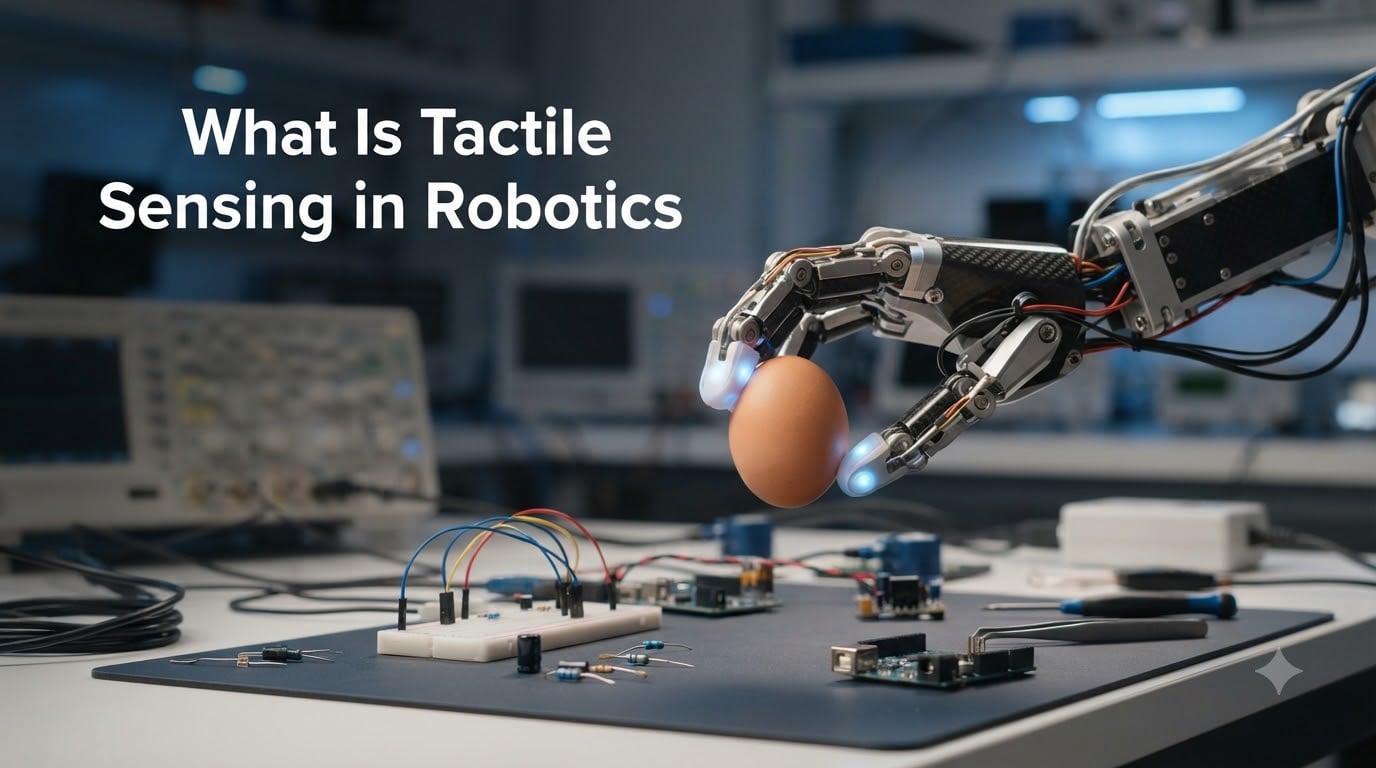
Tactile sensing in robotics is the technology that gives robots a working sense of touch. It lets machines measure force, pressure, vibration, texture, and slip when they physically contact an object, much like our skin does for us.
When I first read about a robotic hand that could hold a strawberry without crushing it, I assumed it was pure vision magic. It turns out the real breakthrough was touch. A camera can see the strawberry, but only a tactile sensor can feel how much force the fingers are applying in real time.
In this guide, I will walk you through what tactile sensing in robotics actually means, how the sensors work, the main types used today, and where they show up in real applications. If you are a developer, researcher, or just robotics-curious, this should give you a clear picture without drowning you in equations.
We will also look at the honest limitations, the costs, and the future of tactile sensing, including how AI is changing what these sensors can do.
Table of Contents
What Is Tactile Sensing in Robotics
Tactile sensing in robotics is a sensing modality that captures physical contact information between a robot and its environment. It typically measures one or more of the following: contact force, pressure distribution, vibration, temperature, surface texture, and slip.
In simple terms, a tactile sensor is the robot’s equivalent of human skin. It sits on fingertips, grippers, or other contact surfaces, and reports what is happening at the point of touch back to the robot’s controller.
Tactile Sensing vs Visual Sensing in Robots
Vision tells a robot what an object looks like. Tactile sensing tells the robot what the object feels like. That distinction matters more than it sounds.
A camera can identify a raw egg, but it cannot tell whether the gripper is about to crack it. A tactile sensor can. This is why the most capable manipulation systems today combine both modalities, and why tactile sensing is sometimes called the missing piece of physical AI.
Vision-only systems also struggle with occlusion, glare, and transparent or reflective objects. Once contact is made, touch sensors keep working regardless of lighting or visual clutter.
Why Robots Need a Sense of Touch
Humans rely on touch for almost every physical task, from threading a needle to handing a coffee cup to a friend. Robots need the same ability, and for three core reasons:
- Dexterous manipulation: picking up irregular, soft, or fragile items without damaging them.
- Real-time control: adjusting grip force the instant a slip is detected.
- Safe collaboration: stopping or yielding when unexpected contact happens with a human coworker.
Without tactile feedback, a robot is essentially operating blind the moment it touches something. That works fine for rigid parts in a structured factory cell, but it falls apart in homes, hospitals, and warehouses, which is where the industry is heading.
How Tactile Sensors Work in Robots
Tactile sensors work by converting mechanical deformation from physical contact into measurable electrical signals, a process called transduction. The robot’s processor reads those signals and decides what to do next.
There is no single way to do this. Different sensor families use different physics, which is why you see terms like piezoresistive, capacitive, and optical tactile sensors. We will cover each of these in detail in the next section.
The Transduction Process Explained
At a high level, every tactile sensor follows the same three-step pipeline:
- Mechanical deformation: pressure, shear, or vibration deforms the sensor’s active material.
- Signal conversion: the deformation changes an electrical property, such as resistance, capacitance, or light intensity.
- Output reading: the controller reads the changed property as a number, often as a force value, a pressure map, or a vibration trace.
Modern sensors pack hundreds or thousands of these sensing points into a small area, creating a high-resolution tactile image of the contact patch.
From Physical Contact to Electrical Signal
Most tactile sensors are wired into the robot through standard interfaces, such as I2C, SPI, USB, or EtherCAT, depending on the form factor. The sensor outputs a stream of values, and the robot’s software interprets them.
For simple sensors, that interpretation can be a direct threshold check. For more advanced systems, the tactile data feeds into a machine learning model that recognizes objects, predicts slip, or classifies textures, which we will come back to when discussing the future of tactile sensing.
Types of Tactile Sensors Used in Robotics
There are several types of tactile sensors used in robotics, and each has strengths and tradeoffs. The most common categories are piezoresistive, capacitive, optical, and Hall-effect sensors.
Choosing the right one depends on what you actually need to measure, what your robot can power, and what your budget allows. Let me walk you through the main options.
Piezoresistive Tactile Sensors
Piezoresistive sensors change their electrical resistance when force is applied. They are simple, inexpensive, and durable, which is why they show up in a lot of research and entry-level products.
They are great for basic force and pressure mapping, but they tend to suffer from hysteresis and lower spatial resolution compared to newer designs. They also consume more power than some alternatives.
Capacitive Tactile Sensors
Capacitive sensors measure changes in capacitance between two electrodes when a force deforms the middle dielectric material. They offer high sensitivity, good spatial resolution, and low power draw.
You will find capacitive tactile sensors in advanced research grippers and in products like Pressure Profile Systems’ tactile arrays. The main downside is sensitivity to electromagnetic interference and the need for careful calibration.
Optical Tactile Sensors
Optical tactile sensors, sometimes called vision-based tactile sensors, use a camera to look at a deformable surface from the inside. The most famous example is GelSight, where a piece of clear gel with a reflective coating deforms on contact, and an internal camera captures the deformation pattern.
This category has exploded in research since 2026 because it produces extremely high-resolution tactile images at relatively low cost. The tradeoffs include bulky form factors, the need for controlled internal lighting, and more complex data processing.
Hall-Effect and Other Tactile Sensors
Hall-effect sensors detect magnetic field changes caused by deformation of a magnet embedded in an elastomer. They are robust, work well in harsh environments, and are common in industrial applications.
Other types worth knowing about include piezoelectric sensors (great for vibration and dynamic touch), MEMS-based sensors, and barometer-style arrays. For force-torque sensing at the wrist, six-axis force torque sensors like those from Bota Systems handle a different but related job, and they often pair with fingertip tactile sensors in dexterous hands.
Key Applications of Tactile Sensing in Robotics
Tactile sensing shows up anywhere a robot needs to handle uncertainty, deformable objects, or close contact with people. Here are the main application areas where tactile sensors make a real difference.
Grasping and Slip Detection
Slip detection is one of the most cited benefits of tactile sensing in robotics. The sensor can detect micro-vibrations or pressure shifts that signal an object is starting to slip, then trigger an instant grip adjustment.
This is what lets a robot gently hold a glass bottle, a piece of fruit, or a tool without crushing it or dropping it. In industrial settings, slip detection also reduces product damage on conveyor lines.
Precision Manipulation of Fragile Objects
Tasks like placing a balloon, threading a wire, or assembling a delicate gearbox require force feedback that pure vision cannot provide. Tactile sensors let robots feel the contact and apply just enough force.
Research labs have used capacitive and optical tactile sensors to manipulate raw eggs, paper-thin films, and even living insects without harming them. That level of finesse was almost impossible in commercial robotics a decade ago.
Collaborative Robots and Human-Robot Safety
Collaborative robots, or cobots, share workspaces with humans. Tactile skins and sensor arrays on the robot detect unexpected contact and stop the arm before injury occurs.
This goes beyond the standard collision sensors built into cobot joints. Full-body tactile sensing is an active research area, and several humanoid platforms now include tactile skins on the arms, chest, and hands as a safety layer.
Surgical and Medical Robotics
In minimally invasive surgery, surgeons rely on tiny instruments that can press, pull, and suture inside the body. Adding tactile feedback to surgical robots gives surgeons a sense of tissue stiffness and tool contact that they would otherwise lose through the robotic interface.
Several surgical robotics companies and research groups are working on tactile sensing for this exact reason, including efforts focused on tumor identification through stiffness mapping.
Tactile Sensing vs Human Touch
Human skin contains around 200,000 mechanoreceptors per hand, and the brain processes their signals in real time. Today’s best tactile sensors pack thousands of sensing points into a fingertip, which is impressive progress but still orders of magnitude behind biology.
The gap is not just density. Human touch also covers temperature, pain, and proprioception (knowing where your fingers are without looking). Robotic systems typically handle each of these with separate sensors and software stacks.
That said, the gap is closing fast. Vision-based tactile sensors and event-driven neuromorphic approaches are pushing resolution and response time closer to human levels each year.
Challenges and Limitations of Tactile Sensing
Tactile sensing is not a solved problem, and anyone who tells you otherwise has not tried to ship a product. Here are the main pain points the community talks about, drawn from real discussions on r/robotics and other forums.
- Cost: High-resolution tactile sensors are still expensive for industrial use, especially when scaled across multi-fingered hands.
- Reliability: Sensor performance varies between units and drifts over time. There is no industry-standard qualification process yet.
- Data volume: High-resolution tactile arrays generate large amounts of data that need to be processed in real time.
- Integration: Converting raw tactile signals into useful world models, such as recognizing objects or predicting slip, remains a research challenge.
- Durability: Soft and compliant sensors wear out faster than rigid electronics, especially under repeated contact.
These are the same challenges called out in academic reviews, including the 2022 Science Robotics outlook paper that surveyed the field. They are also why the industry has not standardized on a single sensor type the way it has for cameras and IMUs.
The Future of Tactile Sensing in Robotics
The future of tactile sensing in robotics is tied to three big shifts: AI integration, vision-based tactile sensing, and large-scale dexterous data.
First, machine learning has turned raw tactile signals into something much more useful. Models now classify textures, identify objects, and predict slip from tactile streams alone, which is something a hand-coded algorithm could never do reliably.
Second, vision-based tactile sensors are becoming the default for high-precision fingertips. As one Reddit thread put it, the rise of GelSight-style sensors is “structural, not hype.” They offer resolution that other methods cannot match at a reasonable cost.
Third, large tactile datasets and tactile foundation models are starting to mirror the data revolution that powered modern computer vision. Expect the next few years to bring pre-trained tactile models you can fine-tune on your own gripper, much like we fine-tune vision-language models today.
For a broader view of how AI is reshaping robot hardware, our edge AI in robotics guide and the physical AI infrastructure roundup are good companions. We have also covered real-world deployments, like the recent HII agreement with Path Robotics and GrayMatter Robotics, where tactile and force feedback are central to the proposed manufacturing systems.
Frequently Asked Questions
What is tactile sensing in robotics?
Tactile sensing in robotics is a technology that gives robots the physical sense of touch. It uses sensors on grippers, fingertips, or skin to measure force, pressure, vibration, texture, temperature, and slip during direct contact with objects or surfaces.
How do tactile sensors work in robots?
Tactile sensors work by converting mechanical deformation from physical contact into measurable electrical signals. The process, called transduction, uses methods such as piezoresistive materials, capacitive electrodes, optical cameras, or Hall-effect elements. The robot’s processor then reads those signals to control grip, detect slip, or recognize objects.
What are the main types of tactile sensors used in robotics?
The main types of tactile sensors used in robotics are piezoresistive, capacitive, optical (vision-based), Hall-effect, and piezoelectric sensors. Each uses a different physical principle to convert touch into a signal, and each has different strengths in sensitivity, resolution, durability, and cost.
Do robots have touch sensors?
Yes, many modern robots have touch sensors. Industrial robots often use force-torque sensors at the wrist, while advanced research and humanoid platforms add tactile arrays on fingertips, palms, and even full-body skin. Adoption is growing quickly, especially in collaborative and manipulation robots.
Why is tactile sensing important for robots?
Tactile sensing is important for robots because it enables dexterous manipulation, real-time slip detection, safe human-robot collaboration, and reliable handling of fragile or deformable objects. It complements vision by providing feedback that cameras cannot, especially once contact begins or lighting conditions are poor.
Final Thoughts on Tactile Sensing in Robotics
Tactile sensing in robotics is no longer a research curiosity. It is a working technology that is changing how robots grasp, collaborate, and interact with the physical world. From slip detection on a production line to surgical robots that can feel tissue stiffness, touch has become a core part of the robotic sensing stack.
If you are exploring this space, start by clarifying the job you need the sensor to do. A simple force sensor might be enough for a cobot safety stop, while a high-resolution optical array is the right call for in-hand manipulation research. Match the sensor to the task, and you will save yourself months of frustration.
The field is moving fast. I will keep updating this page as new sensors, datasets, and standards emerge, so bookmark it and check back in as the tactile sensing landscape keeps evolving through 2026 and beyond.