
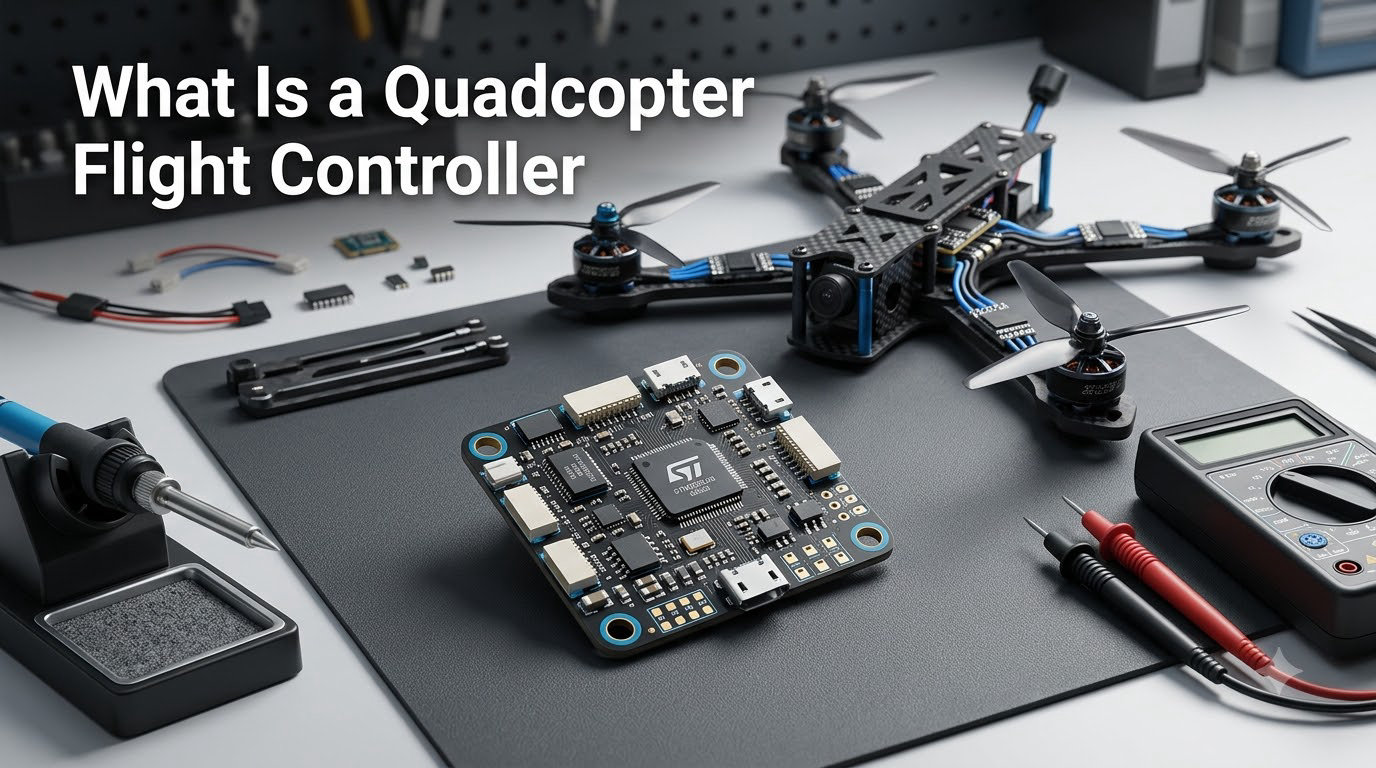
A quadcopter flight controller (often shortened to FC) is the small onboard computer that keeps a drone stable in the air. It reads sensor data thousands of times per second, compares the drone’s actual movement to your stick inputs, and adjusts each of the four motor speeds so the quadcopter flies the way you want it to.
Without a flight controller, a quadcopter is just four motors and four propellers spinning in fixed patterns. It would tip over in under a second. The FC is the part that turns raw spinning blades into a flying machine.
In this guide I will break down what a quadcopter flight controller actually does, the sensors it uses, how the PID loop works, the firmware options you will run into, and how to pick the right FC for your build. By the end you will understand the system better than most hobbyists do after their first year of flying.
Table of Contents
What Is a Quadcopter Flight Controller
The quadcopter flight controller is the central circuit board that sits in the middle of the frame. It carries a processor (an STM32 chip in most modern boards), one or more sensor chips, and the firmware that ties everything together.
Think of the flight controller as the brain of the quadcopter. Your radio receiver tells it what you want the drone to do. The sensors tell it what the drone is actually doing. The processor runs the math, and the flight controller outputs new throttle commands to each electronic speed controller (ESC) hundreds of times per second.
A modern FC also handles radio links, battery voltage monitoring, GPS, telemetry, and on-screen display data. It is not just a stabilizer. It is the full mission computer for a multirotor.
Most boards in 2026 are built around ARM Cortex-M4 (F4), Cortex-M7 (F7), or Cortex-M7 with double-precision FPU (H7) processors. More processing power means faster loop times, which matters most for aggressive FPV racing and freestyle.
The Four Forces of Flight Behind Every Quadcopter
Before we go deeper into the FC, it helps to understand the physics it is trying to manage. Every quadcopter, no matter how advanced, fights four forces in 2026:
- Lift – the upward force created by the propellers pushing air down.
- Weight – the gravitational pull pulling the drone toward the ground.
- Thrust – the forward (or any directional) force created by tilting the lift vector.
- Drag – the air resistance working against the drone’s motion.
A quadcopter in a stable hover has lift equal to weight and thrust equal to drag. The moment a pilot tilts the drone, the lift vector tilts with it, and now some of that lift is pointing forward. That is thrust. The flight controller’s job is to constantly adjust all four motors so these forces stay balanced, even when the wind pushes back.
This is also why a quadcopter needs two clockwise (CW) and two counter-clockwise (CCW) propellers. By Newton’s third law, every spinning propeller tries to rotate the drone in the opposite direction. Mixing two CW and two CCW props cancels the yaw torque, so the FC only has to fight pitch and roll.
Why a Quadcopter Needs a Flight Controller
Human reaction time is around 200 milliseconds. A quadcopter can go from stable to crashed in 60. Even the best pilot in the world cannot manually adjust four motor speeds fast enough to keep the drone level.
That is the problem a quadcopter flight controller solves. It samples the gyroscope at 8 kHz or higher, runs the PID math at 8 kHz, and updates ESC commands at 8 kHz. The whole loop happens faster than any human can blink, which is why even a beginner can hover a well-tuned drone on day one.
The FC also lets the drone do things a human cannot. It can hold altitude against a gust of wind. It can return to the launch point when the radio signal drops. It can fly a pre-programmed survey grid with centimeter accuracy. None of that is possible without a flight controller running the math.
Sensors Inside a Quadcopter Flight Controller
Modern FCs pack a surprising amount of sensing into a board the size of a credit card. Each sensor feeds the PID loop with a specific piece of information.
Gyroscope. Measures angular velocity around all three axes. The gyro is the primary sensor for stabilization. It tells the FC how fast the drone is rotating, not where it is pointed.
Accelerometer. Measures linear acceleration, including the constant pull of gravity. The accelerometer is what lets the FC know which way is “down” so it can auto-level when you release the sticks.
IMU (Inertial Measurement Unit). A combined chip that contains a gyroscope and an accelerometer, often plus a magnetometer. Most “gyros” on modern boards are actually full IMUs.
Barometer. Measures air pressure to estimate altitude. It is how altitude hold and GPS rescue know when to stop climbing. It is accurate to roughly one meter.
Magnetometer (compass). Detects the Earth’s magnetic field to give an absolute heading. Required for GPS waypoint navigation and return-to-home to know which direction the drone is facing.
GPS module. Sits on a separate board connected by a wire. It reports latitude, longitude, speed, and heading. The FC uses it for position hold, waypoint missions, and rescue modes.
Together, these sensors give the FC a complete picture of how the quadcopter is moving through the air. Without any one of them, some flight modes simply would not work.
How the PID Loop Stabilizes a Quadcopter
The PID loop is the heart of every quadcopter flight controller. PID stands for Proportional, Integral, Derivative, and it is a control algorithm that has been used in engineering since the 1920s.
Here is how each term works in plain language:
- P (Proportional) – how hard the FC should react based on how far off the drone is from where it should be. A bigger error means a bigger correction. Too much P and the drone oscillates.
- I (Integral) – how the FC reacts to small errors that build up over time. It remembers past mistakes and applies a slow steady correction. Too much I and the drone feels sluggish or wobbles at low throttle.
- D (Derivative) – how the FC reacts to how fast the error is changing. It damps sudden movements and keeps the drone from over-correcting. Too much D and the motors get hot and noisy.
The FC runs this calculation for each of the three axes (pitch, roll, yaw) hundreds of times per second. The output is a new motor command for each of the four ESCs. Tuning PID is the art of finding values that respond quickly without oscillating.
For most beginners, the stock PID profile that ships with Betaflight or ArduPilot works well enough. The FC will fly your quadcopter before you ever touch a tuning slider, and that is the beauty of modern firmware.
Firmware Options: Betaflight, ArduPilot, and iNav
The hardware is only half the story. The firmware is what makes a quadcopter flight controller actually do something, and the three main options target very different users.
Betaflight. The default for FPV racing and freestyle. Runs on F4, F7, and H7 boards. Updates monthly, supports the newest protocols like DShot and RPM filtering, and is what 90 percent of FPV pilots run in 2026.
ArduPilot. The choice for autonomous flight, surveying, mapping, and professional work. Runs on Pixhawk-class hardware like the Cube Orange. Slower to update but far more capable when you need GPS waypoints, mission planning, or precision landing.
iNav. A middle ground that adds GPS features to Betaflight-style boards. Good for long-range cruisers and planes, less common for quads in 2026.
For an FPV pilot, Betaflight is the right answer almost every time. For a survey drone or anything autonomous, ArduPilot wins. Choosing the wrong firmware is a common beginner trap, and the forums are full of frustrated posts from people who tried to run ArduPilot on a 20-gram racing board.
Common Flight Modes Explained
Every quadcopter flight controller exposes flight modes that change how the drone responds to your stick inputs. Here are the ones you will actually use:
Angle (stabilized) mode. The drone self-levels when you center the sticks. Best for beginners and most cinematic flying. The FC uses the accelerometer to know which way is up.
Acro (manual) mode. No self-leveling. The drone does whatever you tell it and stays at that angle when you center the sticks. Required for racing and freestyle tricks. Many jurisdictions require an acro mode toggle or a separate acro switch.
Horizon mode. A hybrid. Self-levels when sticks are centered but allows flips and rolls when you push the sticks to the corners. A good transition mode between Angle and full Acro.
Position hold. Requires GPS. The drone locks its latitude and longitude and fights wind to stay in one spot. Common on camera drones and ArduPilot builds.
Return-to-home (RTH). The drone climbs to a safe altitude, flies back to the launch point, and lands. Triggered by low battery, lost radio signal, or a pilot command. Standard on consumer camera drones in 2026.
GPS rescue. The Betaflight equivalent of RTH for FPV drones. Uses GPS and barometer to fly back when the radio signal drops. A real lifesaver for long-range pilots.
Choosing the Right Quadcopter Flight Controller
Picking an FC in 2026 comes down to three things: what you want to fly, what processor generation you need, and what features matter to you.
For FPV racing and freestyle. Look for an F7 or H7 board with at least 20×20 mounting holes, 16 MB or 32 MB of flash for Blackbox logging, and a built-in OSD chip. Speedybee, Holybro, and Mamba all make solid options in this category.
For long-range and GPS rescue. You want a board with a barometer already soldered on, a UART free for the GPS module, and good support in Betaflight’s GPS rescue mode. Many F7 boards in the Kakute and Speedybee lines fit this bill.
For autonomous and professional work. Skip the F4/F7/H7 boards entirely. Look at Pixhawk Cube Orange, Holybro Pix32 v6, or any board running ArduPilot. These have redundant sensors, better vibration handling, and the processing power for real computer-vision missions.
Processor generation matters. F4 is fine for casual flying. F7 is the sweet spot for 2026. H7 is only worth the premium if you need the fastest loop times or you are running complex on-board software.
Whatever you choose, buy from a vendor with active firmware support. An obsolete FC with no firmware updates becomes a brick the day a Betaflight release drops compatibility.
Frequently Asked Questions
What is a quadcopter flight controller?
A quadcopter flight controller is the central onboard computer that stabilizes and controls a quadcopter. It reads gyroscope and accelerometer data thousands of times per second, runs a PID control loop, and sends corrected speed commands to each of the four ESCs so the drone flies the way the pilot wants it to.
What does a drone flight controller do?
A drone flight controller does five main jobs: reads sensor data, interprets pilot inputs from the radio receiver, runs the PID control loop to calculate motor corrections, outputs new throttle commands to each ESC, and manages flight modes like angle, acro, position hold, and return-to-home.
Do I need a flight controller for a drone?
Yes. Every quadcopter, from a 27-gram toy to a 25-kg surveying rig, needs a flight controller. Without one, no human can adjust four motor speeds fast enough to keep the drone level. The FC is what makes multirotor flight physically possible for anyone.
Which flight controller is best for a quadcopter?
The best quadcopter flight controller depends on the use case. For FPV racing and freestyle, an F7 board running Betaflight is the standard in 2026. For autonomous surveying, a Pixhawk Cube running ArduPilot is the reference platform. Hobbyists should match the FC to their firmware and frame size, not chase the most expensive option.
What is the difference between a drone and a quadcopter?
A drone is the broad category for any unmanned aerial vehicle, including fixed-wing, single-rotor helicopter, and multirotor designs. A quadcopter is a specific type of drone that uses four rotors. Every quadcopter is a drone, but not every drone is a quadcopter.
How does a quadcopter flight controller stabilize flight?
A quadcopter flight controller stabilizes flight by running a PID control loop at 8 kHz or faster. The gyro reports the drone’s current rotation rate, the PID algorithm compares it to the pilot’s commanded rotation, and the FC adjusts each motor speed up or down to correct any error before the drone tips over.
Final Thoughts on Quadcopter Flight Controllers
The quadcopter flight controller is the single most important part of any drone build. Pick the right FC for your use case, keep its firmware up to date, and the rest of the build becomes much easier. Spend time on forums reading what other pilots fly, choose a board with active community support, and do not overpay for an H7 if an F7 will do the job.
If you are building your first quadcopter in 2026, start with a 20×20 F7 board running Betaflight, pair it with a quality FPV camera and video transmitter, and fly in angle mode until your thumbs learn the controls. That is the path most successful pilots took, and it is the path I still recommend to anyone who asks.