
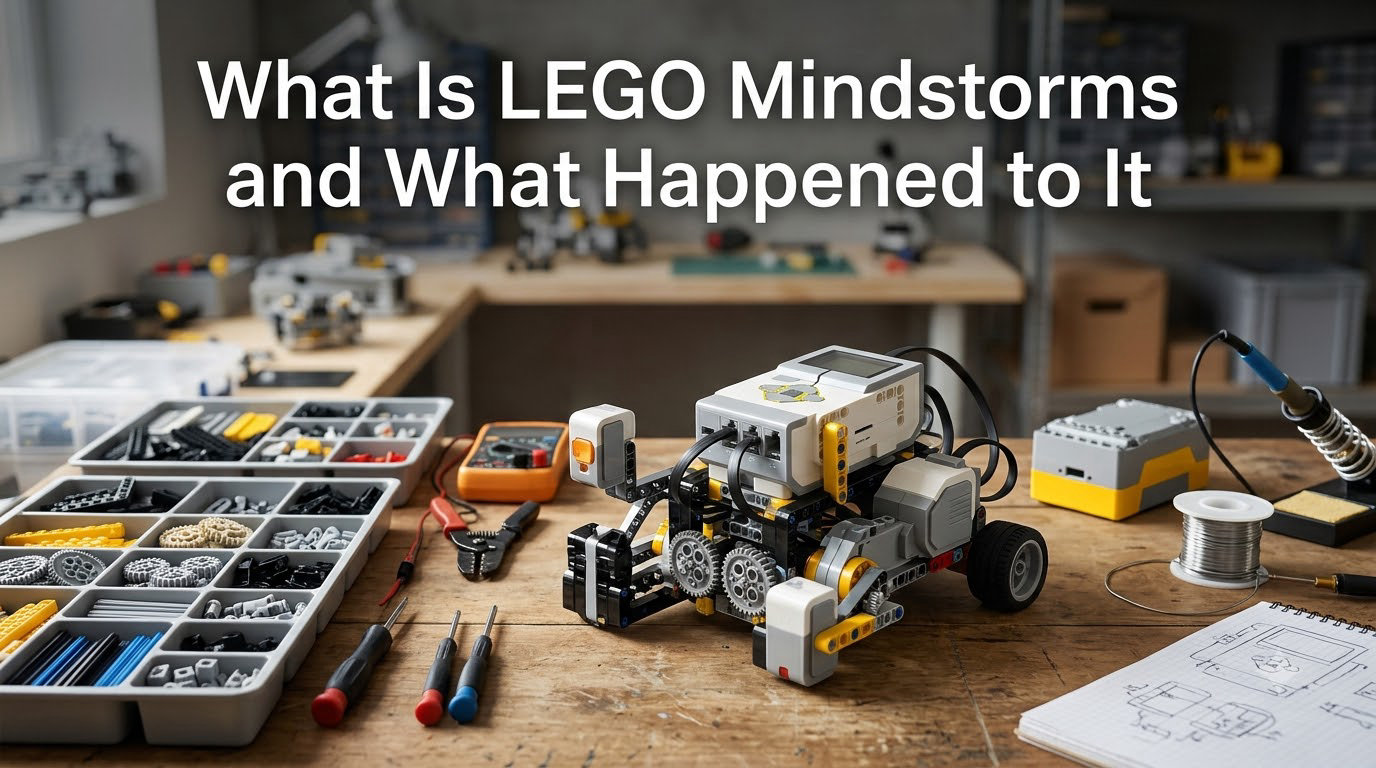
LEGO Mindstorms is a discontinued line of programmable robotics kits built on LEGO Technic bricks, introduced on September 1, 1998 and officially retired on December 31, 2022. For 24 years it was the gold standard in educational robotics, shaping how an entire generation learned to code, build, and tinker. If you have ever wondered what LEGO Mindstorms actually was, why LEGO pulled the plug, and what took its place, you are in the right place.
In this guide I will walk you through the full story. I will cover the origin of the name, the four major product generations, the programming environments that powered each one, the real reasons LEGO discontinued the line in late 2022, and the SPIKE Prime platform that replaced it. I will also answer the most common questions readers ask after the news broke, and offer a few thoughts on whether a used Mindstorms kit is still worth your money in 2026.
Table of Contents
What Is LEGO Mindstorms Exactly?
LEGO Mindstorms is a robotics platform that combines LEGO bricks, motors, sensors, and a programmable “brick” (a small computer) so you can build and code your own robots. Instead of just snapping pieces together, you wire a real microcontroller to motors, touch sensors, ultrasonic sensors, and color sensors, then write software that tells the robot how to behave.
Every kit shipped with the same core ingredients: a programmable brick, a handful of motors, a sensor pack, hundreds of LEGO Technic parts, and a drag-and-drop programming environment. You built the body out of LEGO, connected the motors and sensors to the brick, and then wrote the software on a PC or Mac. When you were done, the brick would run your program on its own, no computer connection required.
What made Mindstorms special was the combination. It was approachable enough for a 10-year-old, powerful enough to run line followers, robotic arms, Rubik’s cube solvers, and even full FIRST Robotics competition prototypes. That is why so many engineers, roboticists, and educators trace their start to a Mindstorms kit on the kitchen table.
The History and Evolution of LEGO Mindstorms
Mindstorms went through four major generations over 24 years. Each one raised the bar on processing power, sensor count, and programming flexibility.
Robotics Invention System (1998)
The original kit, called the Robotics Invention System (RIS), shipped in September 1998. Its heart was the RCX brick, a yellow LEGO controller with an 8-bit Hitachi H8 microcontroller running at 16 MHz. It had three sensor ports, three motor ports, an IR transmitter, and ran on six AA batteries. Programming was done with RCX Code, a visual block-based environment on Windows.
The RIS came with two motors, a touch sensor, a light sensor, and roughly 700 LEGO pieces. The instruction manual walked you through a handful of starter builds, but the real value was in the open-ended Technic parts. Hobbyists quickly figured out how to add more sensors, swap the firmware, and even replace the IR tower with a serial cable.
Mindstorms NXT (2006)
Eight years later, LEGO released Mindstorms NXT, the second generation. The new brick had a 32-bit ARM7 processor, 256 KB of flash memory, Bluetooth, and four sensor ports with support for a brand new digital sensor family. The NXT kit shipped with three servo motors, an ultrasonic sensor, a touch sensor, and a light sensor, plus about 600 LEGO pieces.
The software, NXT-G, was built on National Instruments’ LabVIEW and offered a cleaner visual programming experience. The platform took off in classrooms and the FIRST LEGO League (FLL) competition switched to NXT the same year.
Mindstorms NXT 2.0 (2009)
The NXT 2.0 refresh in 2009 added a color sensor, more pieces, and updated instructions. It was the same underlying hardware, just repackaged for a new generation of users.
Mindstorms EV3 (2013)
EV3 was the biggest leap yet. The new brick had an ARM9 processor, 16 MB of flash, a microSD slot, an infrared remote, Wi-Fi support via a USB dongle, and Linux under the hood. It shipped with three servo motors, a touch sensor, a color sensor, an IR sensor, and roughly 600 LEGO pieces. The EV3 programming environment, EV3-G, kept the LabVIEW-based visual blocks but added more flow control, sensor fusion, and on-brick file management.
EV3 also became a darling of the open-source community. The ev3dev project, leJOS for EV3, and RobotC all let users program the brick in Python, Java, and C. That flexibility kept EV3 alive in research labs and hobby workshops long after it was last manufactured.
Mindstorms Robot Inventor (2020)
Robot Inventor, kit 51515, was the final Mindstorms release. It launched in late 2020 with a new hub featuring a 4-channel motor controller, a 6-axis gyroscope and accelerometer, and a rechargeable battery. The kit shipped with four motors, a distance sensor, a color and light sensor, and 949 pieces.
It was the first Mindstorms kit to ship with a SCRATCH-based programming app plus full Python support out of the box. The hub was also compatible with the SPIKE Prime ecosystem, hinting at where LEGO was heading.
Discontinuation (2022)
On October 26, 2022, the Brickset database and several retail partners noticed that Mindstorms sets were being delisted. LEGO confirmed shortly after that the Mindstorms line would be retired on December 31, 2022, ending 24 years of production. Kits, apps, and firmware remained available to existing owners, but no new sets would ship.
Seymour Papert and the Name Behind LEGO Mindstorms
The Mindstorms name is not random. It comes from Seymour Papert’s 1980 book “Mindstorms: Children, Computers, and Powerful Ideas,” which argued that children learn best when they construct physical objects in the real world. Papert was a South African-born mathematician who co-founded the MIT Media Lab with Marvin Minsky.
Before LEGO, Papert had spent two decades developing the Logo programming language with his colleague Cynthia Solomon. Logo let children steer a “turtle” on the floor using simple commands, and it became the philosophical foundation for constructionism, the learning theory that physical making teaches you to think.
When LEGO partnered with the MIT Media Lab in the mid-1990s, the project was originally called “Robotic Invention by LEGO” and the brick was named “Cybermaster.” The Mindstorms name was a nod to Papert’s book, and it stuck. Papert himself remained involved as a consultant until his death in 2016.
How LEGO Mindstorms Was Programmed
One of the most underrated things about Mindstorms was the depth of the software ecosystem. Over the years, the supported languages covered everything from drag-and-drop blocks to raw C.
RCX kits shipped with RCX Code and a Logo-based environment. NXT introduced NXT-G, a LabVIEW-powered visual programming suite that became the default. EV3 kept EV3-G as the entry point but added RobotC, leJOS (Java), ev3dev (Python), and a LabVIEW toolkit for advanced users.
Robot Inventor was the first to ship with the official LEGO Education MINDSTORMS Robot Inventor App, which used SCRATCH 3.0 blocks and offered a Python editor for text-based coding. That dual entry point, visual blocks for beginners and Python for everyone else, was a big reason Robot Inventor won over home-school and classroom users.
The community also kept an unofficial ecosystem alive. On GitHub you can still find ev3dev kernels, Pybricks firmware, and SCRATCH 3 extensions that talk to the EV3 over Bluetooth. That open source scaffolding is a big part of why used Mindstorms kits still hold their value in 2026.
Why Did LEGO Discontinue Mindstorms in 2022?
The short answer: LEGO consolidated its educational robotics line behind SPIKE Prime. The longer answer involves a few overlapping reasons that came together in late 2022.
First, Mindstorms and SPIKE Prime were competing for the same classroom buyer. Both targeted middle schoolers, both ran on the same Technic ecosystem, and both used the same visual programming environment. Running two parallel product lines was redundant.
Second, SPIKE Prime was the more modern platform. It had a faster hub, better sensors, a unified app, and tighter integration with the LEGO Education teacher portal. Selling two overlapping kits to schools made no commercial sense once SPIKE Prime had matured.
Third, LEGO had been quietly pivoting Mindstorms toward hobbyists for several years. After the FIRST LEGO League moved to SPIKE Prime in 2020, the institutional pull on Mindstorms had weakened. Cutting the Mindstorms line let LEGO double down on SPIKE in schools while letting hobbyists migrate to Robot Inventor, which had always been more of a consumer product.
There was no public scandal, no recall, no falling-out with partners. The discontinuation was a quiet strategic move, and most of the public only learned about it when retail listings started vanishing in late 2022.
What Replaced LEGO Mindstorms?
The direct successor to LEGO Mindstorms is LEGO Education SPIKE Prime, with SPIKE Essential covering younger students.
SPIKE Prime launched in 2020 for middle school classrooms. Its hub is a programmable brick with a 5×5 LED matrix, six ports, a gyroscope, and a rechargeable battery. The kit includes motors, sensors, and roughly 528 Technic pieces. It programs with the SPIKE App, which combines SCRATCH blocks, word blocks, and a Python editor.
SPIKE Essential is the smaller, simpler cousin aimed at elementary school students. It shares the same app and a similar visual environment but with fewer ports and more guided lesson plans.
For hobbyists who still want a Mindstorms-style build experience, the Robot Inventor (51515) kit remains the closest thing on the market, even though LEGO stopped making it. The hub is essentially the same hardware platform as SPIKE Prime, which means most SPIKE Prime sensors and motors work with it.
Outside the LEGO ecosystem, competitors have filled the gap. The Hummingbird Bit by Birdbrain, the mBot by Makeblock, and the VEX IQ platform all target the same educational robotics space, though none of them have the Mindstorms brand recognition or the Technic-compatible parts library.
Where to Find LEGO Mindstorms Now
You can still buy LEGO Mindstorms kits, just not from LEGO directly. The most reliable sources are the secondary market and the used retail channel.
For new-old-stock EV3 and Robot Inventor sets, BrickLink and eBay are the usual starting points. BrickLink is run by the LEGO group and has detailed condition ratings on sealed boxes and used parts. Expect to pay a premium compared to the original retail price, especially for the larger NXT 2.0 and EV3 Education kits.
For broken or incomplete kits, the Mindstorms community on Reddit, the FLL forums, and Discord often has spare parts for sale or trade. The unofficial Brickit app and a set of digital calipers will help you identify compatible motors and sensors from third-party sellers.
Software is still available too. LEGO keeps the EV3 Lab, the EV3 Programming App, and the Robot Inventor App available for download from the official Mindstorms website. ev3dev and Pybricks are open source, and you can find the GitHub repositories for both projects by searching the project names.
Is LEGO Mindstorms Still Worth Buying in 2026?
If you are an educator, hobbyist, or FIRST Robotics alumni, a used Mindstorms kit is still a solid investment. The EV3 in particular has more than a decade of community documentation, third-party firmware, and printable part libraries behind it. For under $200 you can pick up a complete EV3 Education kit with extra sensors, motors, and a charger.
If you are a parent buying your first robotics kit, I would look at SPIKE Prime first. It has the same heritage as Mindstorms, runs on a more modern app, and is fully supported by LEGO. You will not get the 24 years of community lore, but you will get a product that LEGO is still actively investing in.
If you are a hobbyist or a former FIRST LEGO League student who wants a piece of nostalgia that still works, the Robot Inventor is the most modern Mindstorms kit on the market. Pair it with a copy of Pybricks and you have a surprisingly capable little robot that you can program in MicroPython.
The Legacy of LEGO Mindstorms
It is hard to overstate how much Mindstorms shaped educational robotics. The FIRST LEGO League, which started using RCX kits in 1998, has since engaged more than 600,000 students in 110 countries. Generations of engineers, programmers, and designers point to a Mindstorms kit as the reason they got into robotics.
Outside of FIRST, the Mindstorms community kept the platform alive long past its commercial peak. Projects like leJOS, ev3dev, Pybricks, and Dexter Industries’ dIMU sensor turned Mindstorms into a credible research platform. Academic papers in robotics, machine learning, and assistive technology regularly cite Mindstorms as a test bed, and the EV3 is still in use in university courses in 2026.
That is the real legacy. LEGO Mindstorms was not just a toy. It was an open-ended platform that invited an entire generation to learn by building, and the open-source community kept the lights on long after the retail line went dark.
Frequently Asked Questions
What has replaced LEGO Mindstorms?
LEGO Education SPIKE Prime is the direct replacement. It targets the same age group, uses a similar hub-and-sensor architecture, and runs on a shared SPIKE app that supports both visual blocks and Python.
Why did they discontinue LEGO Mindstorms?
LEGO retired Mindstorms on December 31, 2022 to consolidate its educational robotics line behind SPIKE Prime. Running two overlapping platforms for the same classroom audience was no longer commercially necessary once SPIKE Prime had matured.
Is there a new version of LEGO Mindstorms?
No new Mindstorms kits are in production. The last official release was the Robot Inventor 51515 in 2020, and LEGO has stated that the line is discontinued. Used and new-old-stock sets are still available through BrickLink and eBay.
Do LEGO Mindstorms still exist?
The sets, software, and apps are still around and supported for existing owners. LEGO continues to host downloads for the EV3 Lab, EV3 Programming App, and Robot Inventor App. New retail kits are no longer being manufactured, but the community around Mindstorms remains active.
What did LEGO replace Mindstorms with?
LEGO replaced Mindstorms with two platforms: SPIKE Prime for middle school classrooms and SPIKE Essential for elementary school learners. Both run on the same LEGO Education SPIKE app and share a common sensor ecosystem.
What is the rarest LEGO in history?
Outside the Mindstorms line, the rarest LEGO sets include the 2007 Ultimate Collector Series Star Wars Millennium Falcon, the 2000 Mr. Gold minifigure from Series 5, and the original 1978 Red Sail Boat. Mindstorms-wise, the sealed 1998 Robotics Invention System in mint condition is considered a collector’s item.
Final Thoughts on LEGO Mindstorms
LEGO Mindstorms may be gone, but the platform it created is not. SPIKE Prime, the open-source community, and the generations of students who learned to build with it are the real legacy. Even though the production line ended in 2022, the Mindstorms kits, software, and community are still teaching kids to think like engineers.
Whether you are a former FIRST LEGO League student reliving your childhood, a teacher looking for a used kit on a tight budget, or a curious parent wondering what all the fuss was about, LEGO Mindstorms is still worth your time. The bricks still work, the software still runs, and the lessons still teach. That is a pretty good run for a 24-year-old robot.