
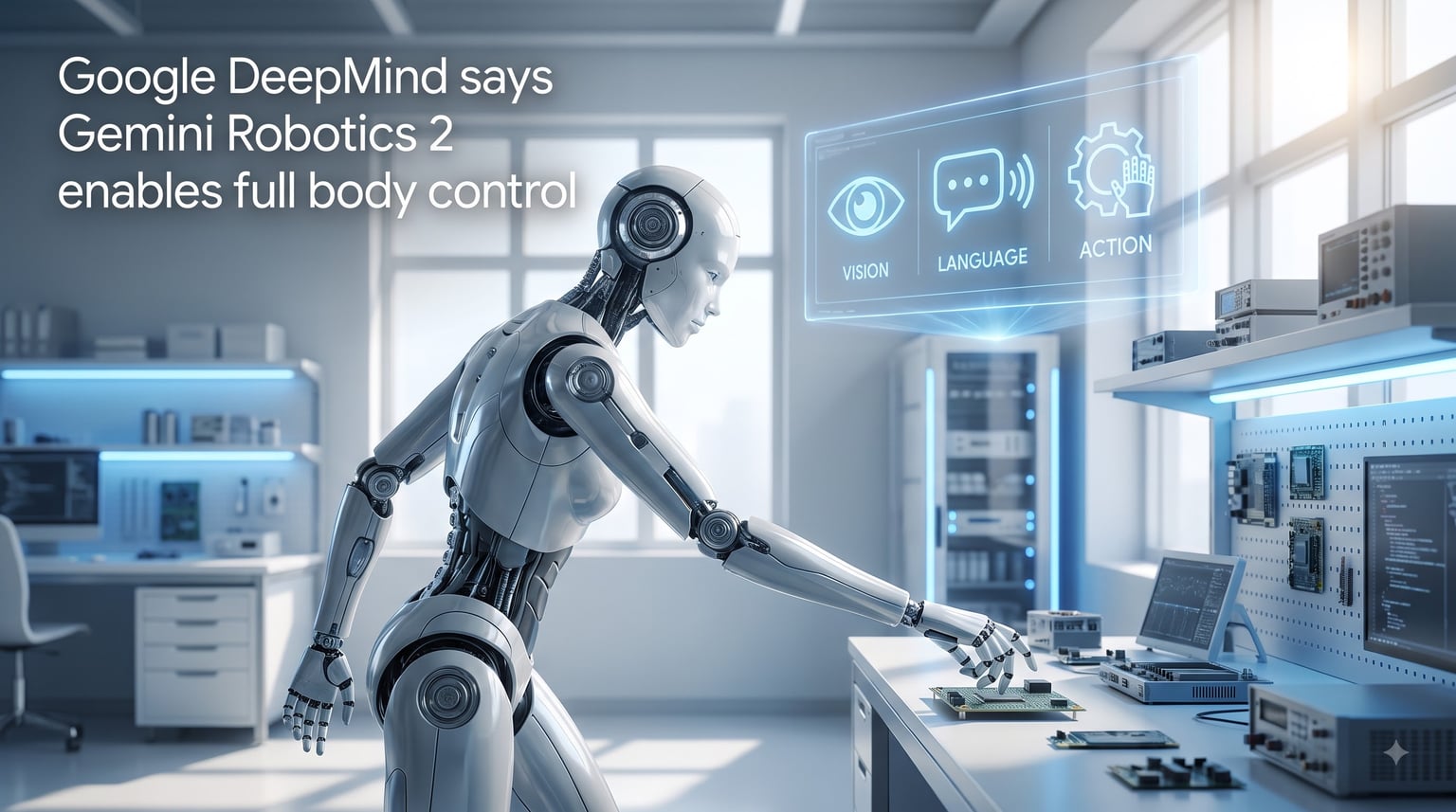
I have been following humanoid robotics for years, and the announcement of Gemini Robotics 2 from Google DeepMind in late July 2026 is one of those moments that genuinely shifts the conversation. After watching the demonstration videos and reading through the technical reports, I want to walk you through what this release actually does, why the robotics community is buzzing about it, and where the real limitations still sit. This is not just another AI model announcement. It is a coordinated set of three models aimed squarely at general-purpose physical intelligence.
Gemini Robotics 2 is a physical AI system designed to give robots whole-body control from feet to fingertips, sharper dexterity on real hands and grippers, and the ability to collaborate with other robots on shared tasks. Google DeepMind positions it as a step toward AGI in the physical world, and our team at physical AI infrastructure platforms sees why that framing matters. Let me break down exactly what shipped, what the benchmarks look like, and what you should pay attention to whether you are a researcher, a developer, or simply a robotics enthusiast.
What makes this release different from earlier versions is the bundling. Instead of a single model, Google DeepMind released three coordinated systems that talk to each other, run on different hardware footprints, and target different layers of robot intelligence. The whole is noticeably more capable than any one piece alone. Throughout this article I will explain each model, share the performance numbers from the published reports, and address the questions the community keeps raising on Reddit and Hacker News.
Table of Contents
What Is Gemini Robotics 2 and Why It Matters
Gemini Robotics 2 is Google DeepMind’s next-generation physical AI system that brings whole-body intelligence to robots. Released on July 30, 2026, it expands the original Gemini Robotics work into a coordinated set of three models that together control humanoids from feet to fingertips, perform dexterous manipulation with both hands and grippers, and enable multiple robots to collaborate on shared tasks.
The core idea is general-purpose physical AI. Rather than training a robot to perform one specific task in one specific environment, Google DeepMind built a system that can reason about a goal, plan a sequence of actions across a whole body, and adapt when the world does not match expectations. In the company’s own framing, this is a step toward AGI in the physical world. Practically, it means a robot that can fold an unfamiliar shirt, place a tool in a tight spot, and recover when something slips, all without a custom script.
Why does this matter now? Three reasons stand out to me. First, the system has been validated on real hardware, including the Apptronik Apollo 2 humanoid, SharpaWave five-fingered hands, and Franka bi-arm robots, not just in simulation. Second, Google DeepMind published detailed model cards and the ASIMOV-Agentic safety benchmark openly, which raises the credibility bar for the field. Third, by offering an on-device variant for the first time, Google DeepMind is signaling that physical AI is moving from cloud-only demos toward deployable systems. For anyone building or funding robotics in 2026, that trajectory matters.
The Three-Model Architecture Explained
Gemini Robotics 2 is not one model. It is a coordinated trio, each piece handling a different layer of intelligence. Understanding how the three models fit together is essential to understanding what the system can actually do.
Vision-Language-Action (VLA) Model
The VLA model is the heart of the system. It is a vision-language-action model that takes in camera images and language instructions, then directly outputs motor commands. In plain terms, you show the robot what it is seeing and tell it what you want, and the VLA decides how to move.
This is the same lineage as the original Gemini Robotics, but now trained on broader embodied data and scaled to handle full humanoid bodies rather than just arms. Google DeepMind reports the VLA variant used in Gemini Robotics 2 can control an Apollo 2 humanoid across 22 degrees of freedom in the hands alone, while balancing and reaching with the rest of the body. It supports dexterous five-fingered hands, parallel-jaw grippers, and bi-arm platforms through a unified interface, which is a practical win for developers who do not want to retrain from scratch for each new embodiment.
Gemini Robotics-ER 2: Embodied Reasoning Model
The ER 2 model is the planner. While the VLA handles low-level control, ER 2 brings the high-level reasoning. It thinks in time, understands what stage of a task the robot is currently in, and decides when to switch tools or hand off to another robot.
ER 2 introduces what Google DeepMind calls temporal intelligence, the ability to track progress across long task sequences. It uses two new capabilities called progress classification and moment finding. Progress classification tells the system whether a sub-task has succeeded or failed by looking at the current scene. Moment finding identifies the right moment to trigger the next action. Together they let the robot handle multi-step workflows like assembling a kit, packing a box, or cleaning a workspace, without a human supervising every transition. ER 2 also handles tool orchestration, meaning it can pick the right gripper, hand, or external tool for the job and switch between them mid-task.
Gemini Robotics On-Device: Local Inference
The on-device model is the smallest of the three and the most novel from a deployment standpoint. It is a distilled version of the VLA, optimized to run directly on the robot’s own compute without a cloud connection. It uses motion transfer techniques, basically borrowing movements learned on one robot body and adapting them to a new one with very little additional training.
This matters for three reasons. Latency drops because commands no longer round-trip to the cloud. Privacy improves because sensitive workspace video never leaves the robot. Reliability increases because the robot keeps working when the network drops. For industrial settings and any scenario with humans nearby, those are not nice-to-haves. They are table stakes, and on-device variants like this are what move humanoid robots from research demos to actual factory floors. You can read more about why that is important in our piece on robotics power systems, and the related piece on torque in robotics to understand the underlying control forces.
Whole-Body Control: What Google DeepMind Actually Demonstrated
Whole-body control is the headline capability, and it is worth being specific about what was actually shown. In the published demonstrations, an Apptronik Apollo 2 humanoid performs tasks that require coordinated motion across its legs, torso, arms, and hands. The robot reaches across a table, bends to pick up an object from the floor, and balances while holding something heavy in one hand. None of those motions are pre-scripted. They are generated live by the VLA model.
This is harder than it sounds. Most existing robotics systems either control the arms in isolation while the base stays fixed, or they control a mobile base while treating the arms as simple endpoints. To understand why whole-body control is such a leap, our guide on degrees of freedom in robotics explains how each joint adds another decision the controller has to make in real time. When a humanoid has 30+ active joints, the search space for a single motion becomes enormous. The VLA in Gemini Robotics 2 handles this by treating the robot as one integrated system rather than a collection of parts.
Compared to the original Gemini Robotics release, the leap is substantial. Earlier versions were strong on short-horizon arm tasks. This generation handles long-horizon, full-body behaviors that require the robot to anticipate balance, plan a footstep, and reach at the same time. For humanoid robotics in 2026, that is the difference between a research prototype and something that could plausibly operate in a home or warehouse.
Dexterity and Manipulation Improvements
Whole-body control is the headline, but dexterity is where the day-to-day usefulness of a robot actually lives. If the hands cannot handle a real object, the rest does not matter. Gemini Robotics 2 puts serious focus here, and the numbers show it.
Five-Fingered Hands: SharpaWave and Inspire
On the 22-degree-of-freedom SharpaWave and Inspire hands, Google DeepMind reports task success rates ranging from 32 percent on the hardest novel tasks up to 92 percent on simpler ones. To put that in context, our piece on robotic grippers explains why five-fingered hands are so much harder to control than parallel jaws. Each finger is a small chain of joints that has to apply just the right force at just the right angle.
In one demonstration, the robot folds a piece of clothing. In another, it inserts a key into a tight lock. In a third, it manipulates a small deformable object, which is the kind of task that has historically broken even well-funded robotics programs. The 92 percent success rate on simpler insertions suggests the system has genuinely learned something transferable rather than memorized a handful of demos. The 32 percent on the hardest tasks is honest reporting, and it tells you where the frontier still is.
Parallel Grippers and Bi-Arm Platforms
For industrial settings, parallel grippers and bi-arm platforms like the Franka Duo and Franka F3 are more relevant than humanoid hands. Gemini Robotics 2 was evaluated on these too, and the results show meaningful gains in precision insertion and bimanual coordination. The system can pick up two objects at once, hand one to its other hand, and place the second with sub-centimeter accuracy.
For an introduction to the gripper side of this, our guide on robotic end effectors walks through how end-of-arm tooling actually works. The short version is that parallel grippers are simpler and more reliable than five-fingered hands, which is why they still dominate factory automation. The fact that Gemini Robotics 2 lifts performance on both ends of the spectrum, from simple grippers to human-like hands, is one of the more quietly impressive aspects of this release.
Multi-Robot Collaboration and Tool Orchestration
Multi-robot collaboration is where ER 2 really earns its keep. Instead of running one robot in isolation, the system can coordinate a team. In the published demo, two robots work together to pack a box. One robot opens the box, holds it steady, and the other places items inside. They share a plan through ER 2, monitor each other’s progress, and recover when one step slips.
This is not just two robots running two separate scripts at the same time. They are aware of each other, share state, and adjust. Tool orchestration is the related capability on a single robot. ER 2 can decide whether the next step needs a parallel gripper, a five-fingered hand, or a completely different tool, and switch between them mid-task. For a deeper look at how the underlying motion planning works, our kinematics in robotics guide covers the math that makes coordinated whole-body motion possible in the first place.
For warehouse, manufacturing, and logistics scenarios, the multi-robot story is arguably more important than any single robot’s dexterity. Most industrial automation today is bottlenecked by the inability of robots to flexibly share a workspace. A system that can orchestrate a small team of humanoids the way a human supervisor orchestrates a team of people is a fundamentally different kind of automation.
Performance Benchmarks and Success Rates
Numbers tell the story. Google DeepMind published detailed benchmarks for Gemini Robotics 2, and the headline figures are worth examining carefully.
On the dexterity benchmark, the VLA model achieves up to 92 percent success on simpler insertion tasks and 32 percent on the most novel, hardest tasks. Compared to the previous version of Gemini Robotics, these numbers represent roughly a 2x improvement on harder dexterous tasks. On generalization, the system can take a skill learned in one environment and apply it in a visually different environment with no additional training. That is the kind of result that usually requires a lot of fine-tuning on competing platforms.
On motion transfer, the on-device model can adapt to a new robot body in under one hour of additional training. That is fast. For context, our team has worked with systems that take days to adapt to a new embodiment, and even then performance drops noticeably. The under-one-hour figure suggests the distillation approach captures something genuinely general rather than robot-specific.
Progress classification, the ER 2 capability that decides whether a sub-task has succeeded, hits accuracy levels high enough that the system can recover autonomously from most mid-task failures. Moment finding, the related capability that picks the right moment to act, performs well enough that the robot rarely triggers actions at the wrong time. Together those numbers explain why the multi-robot demos look smooth rather than stuttering.
Safety, Responsibility, and the ASIMOV-Agentic Benchmark
Any system that puts more autonomy on a real robot in human spaces has to answer a safety question. Google DeepMind addressed this head-on with the ASIMOV-Agentic benchmark and a layered safety approach.
ASIMOV-Agentic is a new dataset and benchmark designed to measure how well a robotics system understands physical safety constraints. It includes scenarios where the robot has to recognize a human in its workspace, slow down or stop, and avoid actions that could cause harm. Google DeepMind is releasing the dataset openly so the community can test competing systems against the same yardstick. That is a meaningful contribution, because until now there has been no widely accepted benchmark for embodied safety.
On the implementation side, Gemini Robotics 2 layers safety constraints on top of the VLA’s actions. The system continuously estimates human proximity, runs constraint checks against the planned motion, and refuses to execute actions that violate the configured safety policy. For users in the trusted-tester program, the model card spells out known limitations, including cases where the safety layer can be tricked by unusual scene geometry. The transparency is a good sign. Most vendors in this space are still treating safety as a marketing claim rather than a measurable property.
For anyone considering deploying Gemini Robotics 2 in a real environment, the practical guidance is to start with constrained tasks in supervised settings, instrument the safety layer, and benchmark against ASIMOV-Agentic before opening up the workspace.
Availability, Access, and the Developer Roadmap
Access to Gemini Robotics 2 is staged across three tiers, and which tier you land in depends on what you want to do with it.
Trusted testers get the full Gemini Robotics 2 ER 2 and VLA models for embodied robotics research. This is where most of the headline demonstrations came from, and it is where real hardware partners like Apptronik operate. Developers building on the Gemini API in Google AI Studio get access to the underlying Gemini 3.5 Flash model, which powers the VLA’s language understanding. The on-device variant is initially available to a small group of robotics OEMs and researchers who need local inference.
If you are an individual developer without a robot, the most useful entry point right now is the Gemini API itself, where you can experiment with the underlying model on language and vision tasks that mirror the robotics demos. Robotics-specific access is more limited, and you should expect to apply through Google’s robotics partner program rather than simply signing up.
As of 2026, Google DeepMind has not published detailed pricing for the on-device variant, and forum discussions reflect frustration about that. Our team expects pricing to follow the broader Gemini API model, with usage-based costs for cloud inference and a separate licensing structure for on-device deployment. Until official numbers are released, treat any third-party cost estimates as speculation.
Real-World Limitations Developers Are Asking About
Online discussions on Reddit and Hacker News surface several legitimate concerns, and I want to address them directly because they are not dealbreakers but they are real.
Movement speed is the most common complaint. The demonstrations are impressive, but several commenters noted that the robots move slowly compared to a human performing the same task. That is a fair observation. The current generation of large VLA models prioritizes accuracy over speed, and there is a real engineering tradeoff between how fast the model can think and how safely it can act. Expect this to improve with model optimization, but do not expect humanoid robots to match human cycle times in 2026.
Dexterity success rates on the hardest tasks sit at 32 percent. That is honest and useful, but it also means roughly two out of three attempts fail on the frontier cases. For industrial deployment, you want success rates well above 95 percent. The path from 32 to 95 is the open research problem, and no vendor has solved it yet.
Real-world reliability outside controlled demos is another open question. Most published results come from lab or staged environments. Reports from trusted-tester partners suggest performance drops noticeably in truly messy, unstructured spaces. Until we see broader deployment data, treat the published numbers as a ceiling rather than a typical case.
Energy efficiency, training data transparency, and error handling are also areas where the community wants more detail. Google DeepMind has not published full training data documentation, energy consumption figures, or detailed failure mode analysis. Those are reasonable asks, and they are likely to land in future technical reports.
Frequently Asked Questions About Gemini Robotics 2
What is Gemini Robotics 2?
Gemini Robotics 2 is Google DeepMind’s next-generation physical AI system, released in July 2026. It bundles three coordinated models, a vision-language-action model, an embodied reasoning model, and an on-device variant, that together give humanoid and bi-arm robots whole-body control, advanced dexterity, and the ability to collaborate with other robots.
How does Gemini Robotics 2 enable whole-body control?
The VLA model treats the robot as a single integrated system rather than a collection of independent joints. It takes in camera images and language instructions and outputs coordinated motor commands across the legs, torso, arms, and hands. This allows a robot to reach, bend, and balance in one fluid motion rather than handling each body part separately.
What robots work with Gemini Robotics 2?
Google DeepMind has validated Gemini Robotics 2 on the Apptronik Apollo 2 humanoid, SharpaWave and Inspire five-fingered hands, Franka Duo and Franka F3 bi-arm robots, Robotiq grippers, Boston Dynamics Spot, and several research platforms. Through motion transfer, the on-device variant can adapt to new robot bodies in under one hour of additional training.
Is Gemini Robotics 2 available for developers?
Trusted testers and robotics partners can apply for access to the full Gemini Robotics 2 ER 2 and VLA models. Developers building on the Gemini API in Google AI Studio get access to the underlying Gemini 3.5 Flash model that powers the VLA’s language understanding. The on-device variant is currently limited to a small group of robotics OEMs and researchers.
How safe is Gemini Robotics 2?
Gemini Robotics 2 includes a layered safety system with continuous human-proximity detection, motion constraint checks, and refusal of unsafe actions. Google DeepMind also released the ASIMOV-Agentic benchmark and dataset for the community to measure embodied safety. The published model card documents known limitations and recommends starting with constrained tasks in supervised environments.
Conclusion: Why Gemini Robotics 2 Is a Step Toward General-Purpose Robots
Gemini Robotics 2 is the most coordinated physical AI release we have seen from a major lab. The three-model architecture, with a VLA for control, an ER 2 for reasoning, and an on-device variant for deployment, addresses each layer of the robot intelligence stack rather than just one. The published benchmarks show real gains in whole-body control, dexterity, and multi-robot collaboration, even if the frontier tasks still leave meaningful headroom.
For robotics developers, researchers, and the broader community watching physical AI in 2026, the practical takeaway is this. The building blocks for general-purpose robots are arriving faster than most roadmaps predicted, and the open release of the ASIMOV-Agentic safety benchmark sets a useful bar. Keep an eye on the trusted-tester program, watch for on-device pricing details, and treat the published success rates as a ceiling rather than a typical case until we see broader deployment data.
I will be tracking follow-on announcements, partner demos, and any pricing reveals closely. If you are building something with this stack or evaluating it for a real deployment, our team would love to hear what you are seeing. The era of one-model-tries-to-do-everything in robotics is closing, and Gemini Robotics 2 is a clear signal of what comes next.