
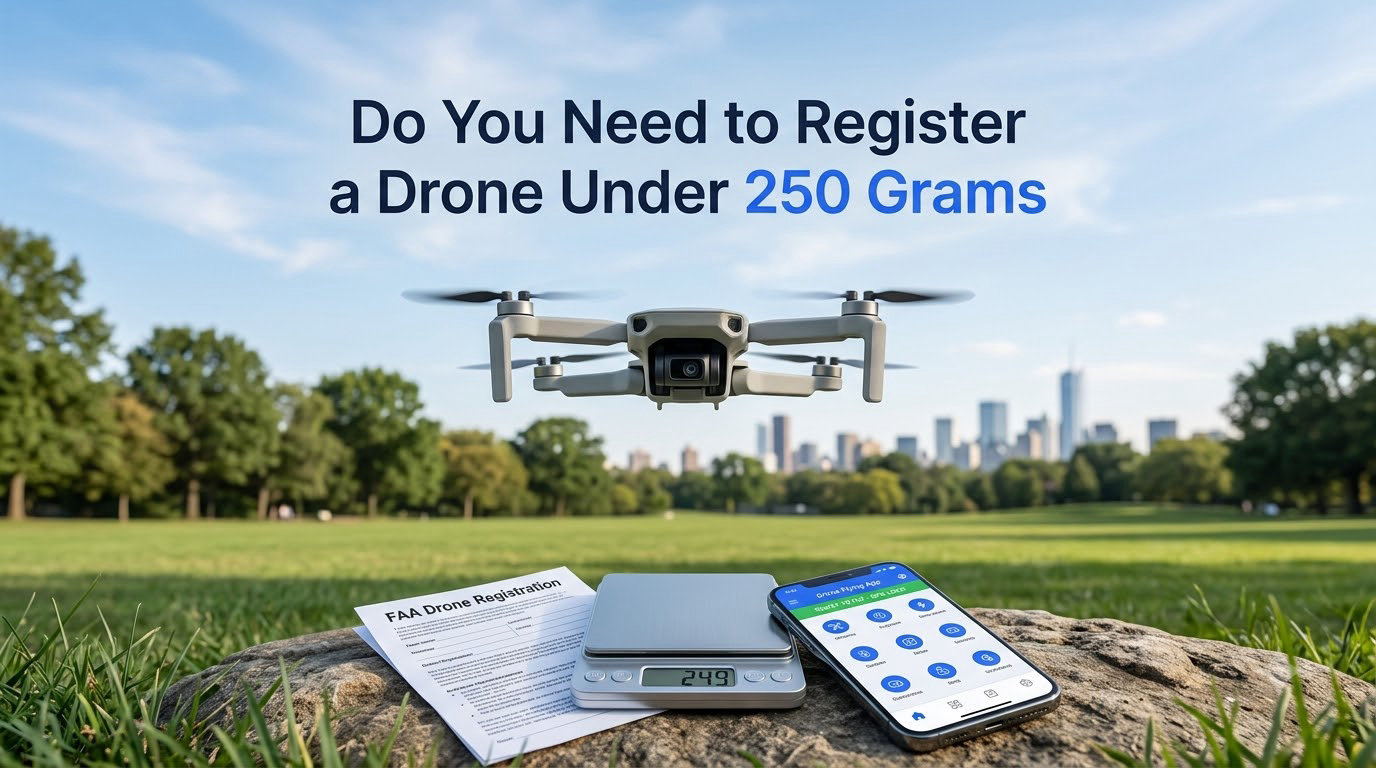
If you just unboxed a DJI Mini, a HoverAir, or another sub-250g drone, the first question most pilots ask is simple: do I need to register a drone under 250 grams with the FAA before I fly? The short answer is: not for purely recreational flights in the United States, as long as the aircraft weighs less than 250 grams (0.55 lbs) at takeoff and you follow the Exception for Limited Recreational Operations under 49 USC 44809. That exemption has a few sharp edges, though, and getting it wrong can cost you thousands of dollars in fines.
I have flown sub-250g drones for years and I still double-check the rules before every trip. In this guide I will walk you through the FAA’s weight threshold, the difference between recreational and commercial use, the TRUST test, Remote ID, airspace limits, and the 249-gram trap that catches even experienced pilots off guard. Everything below reflects the FAA’s 2026 guidance.
Table of Contents
Do You Need to Register a Drone Under 250 Grams? The Short Answer
You do not need to register a drone under 250 grams if all of the following are true: the aircraft weighs less than 250 g (0.55 lb) at takeoff, you are flying purely for personal recreation, and you follow the FAA’s Exception for Limited Recreational Operations under 49 USC 44809. As soon as you cross into commercial work, fly a drone over 250 g, or operate outside the limited-recreational rules, registration through FAADroneZone becomes mandatory.
The 250-gram figure is not a marketing number pulled from a spec sheet. It is the legal threshold written into Section 44809, and the FAA measures it as takeoff weight, meaning the drone plus everything attached to it at the moment of launch.
How the FAA’s 250-Gram Drone Weight Threshold Works
The FAA treats 250 grams (0.55 pounds) as a hard cutoff, not a suggestion. Drones that weigh 250 g or more at takeoff must be registered before flight, regardless of whether the flight is recreational or commercial. Drones under that weight can be exempt from registration when flown recreationally, but the moment you attach accessories that push the total over 250 g, the exemption disappears.
Here is how the FAA defines the threshold, in plain language:
- 0.55 lbs (250 g) or more: registration is required for any use
- Under 0.55 lbs (250 g): registration is required only for commercial operations, or if you fly outside the recreational exception
- Takeoff weight includes propellers, batteries, prop guards, gimbals, payload, and stickers
The 0.55 lb figure and the 250 g figure are the same number, just in different units. When you see both listed in FAA documents, they are not two separate rules.
Recreational vs Commercial Drone Rules for Sub-250g Aircraft
Whether you need to register a drone under 250 grams depends almost entirely on why you are flying it. The FAA splits pilots into two categories: recreational flyers and commercial operators. The rules look similar on the surface, but the registration requirement is one of several places where they diverge.
For recreational flights, a sub-250g drone is exempt from registration under 49 USC 44809, as long as you fly for personal enjoyment, stay within visual line of sight, follow community-based safety guidelines, and do not interfere with manned aircraft.
For commercial work – meaning any flight that compensates you directly or indirectly, including monetized YouTube videos and real estate photography – registration is required regardless of weight. That is where many new pilots get burned: a sub-250g drone is not automatically a “no paperwork” drone if money changes hands.
This is also why drone delivery services like DoorDash’s recent FAA certification for drone delivery have to go through full Part 107 compliance even when the delivery aircraft tips the scales at well under 250 g. The exemption is recreational only.
The 249-Gram Trap: When Accessories Push You Over the Limit
Manufacturers love the “sub-249g” label because it sells drones. Pilots get tripped up because the published weight is the bare aircraft, not the way you actually fly it. The 249-gram trap is what forum users on r/drones and r/dji call the moment a small accessory pushes your drone over the legal 250 g threshold and silently forces registration.
Common accessories that put a sub-250g drone over the limit include:
- Snap-on propeller guards
- Heavier “intelligent” flight batteries versus the stock pack
- After-market extended-life batteries
- External camera gimbals, ND filter holders, or lens accessories
- Mounted payloads, beacons, or third-party antennas
- Skin decals, bumpers, or vibration dampeners
Before every flight, weigh your drone fully loaded on a kitchen scale. I keep a small digital scale in my drone bag for exactly this reason. A DJI Mini that ships at 249 g can easily read 268 g with a prop guard and a fresh battery.
TRUST Test Requirements for Sub-250g Drone Pilots
The Recreational UAS Safety Test (TRUST) is a free online safety knowledge test that every recreational UAS pilot in the US must pass before flying, regardless of drone size. Even if your drone is 90 grams, the FAA expects you to have a current TRUST certificate before takeoff.
Key points about the TRUST test for sub-250g drones:
- It is free and online through the FAA’s approved test administrators
- It is required for all recreational flyers, no exceptions for weight
- You carry the completion certificate with you when you fly
- It is not a “drone license” – it is a one-time safety acknowledgment for recreational pilots
TRUST is not a registration. You will not get a flyer ID number from the test, and it does not replace FAADroneZone registration when registration is required. The two are separate compliance steps.
Remote ID Rules for Drones Under 250 Grams
Remote ID is the FAA’s “digital license plate” requirement. Since March 16, 2024, drones that must be registered also need to broadcast Remote ID, and that obligation cascades down to sub-250g drones whenever they cross into a registration-required scenario (for example, any commercial use).
Pilots flying a sub-250g drone purely recreationally under Section 44809 are not currently required to have Remote ID, as long as the drone stays under 250 g. The moment you register the drone, Remote ID compliance kicks in – either through a built-in Standard Remote ID broadcaster or an add-on Broadcast Module.
If you plan to use the same aircraft for both hobby and paid work, buy a drone with built-in Remote ID from the start. Retrofitting older sub-250g models is possible but adds cost and complexity.
Where You Can Legally Fly a Drone Under 250 Grams
Sub-250g drones get the friendliest airspace treatment in the FAA rulebook, but “more freedom” is not the same as “no rules.” You can fly a sub-250g drone in most Class G airspace without prior authorization, and Operation Over People is permitted under Category 1 rules when the drone is under 250 g and has no exposed rotating parts that could cause lacerations.
You still need authorization (usually via LAANC) to fly in controlled airspace around most airports. You also cannot fly over moving vehicles, near manned aircraft, above 400 feet AGL, or in restricted areas. State and local rules layer on top of federal requirements – for example, some state parks require permits and a few municipalities ban takeoff from public property outright.
For international visitors, the answer is different: you still follow FAA rules while in the US, and your home country’s drone rules still apply when you fly back. A 250g drone that is legal in one country may still need registration in the US if you plan any commercial content from your trip.
Penalties for Flying an Unregistered Drone
Skipping registration when it is required is treated seriously. The FAA can issue civil penalties up to $27,500 per violation for operating an unregistered drone, and criminal penalties can reach $250,000 and up to three years in prison. In practice, first-time recreational pilots usually see a warning or a small fine, but the ceiling is real and the FAA has been collecting on it since 2015.
Beyond fines, unregistered flights can void your insurance, give law enforcement probable cause for a stop, and complicate any post-incident investigation. If a sub-250g drone causes any property damage or injury and you were flying it commercially without registration, expect the legal exposure to multiply fast.
How to Register a Drone If You Need To
When the rules require registration, the process is straightforward. Registering a drone takes about 10 minutes through FAADroneZone.
- Create an account at FAADroneZone (the FAA’s official UAS portal)
- Select either the $5 recreational registration (covers all your drones for 3 years) or the $5 per-drone Part 107 registration
- Provide your name, address, and a valid email – there is no citizenship requirement for recreational flyers
- Receive your registration certificate and unique FAA registration number
- Mark the drone with the registration number before flight (the FAA accepts labels in a visible compartment)
Recreational registration covers every drone in your household for three years. Part 107 registration is per drone and is tied to your commercial operator certificate. Either way, the FAA registration number must be physically on the aircraft before any flight that requires it.
Frequently Asked Questions
Do I need a flyer ID for a drone under 250g?
You do not get a formal flyer ID for a sub-250g drone flown recreationally. Instead, you must pass the free TRUST test and carry the completion certificate with you when you fly. Commercial pilots need a Remote Pilot Certificate under Part 107 regardless of drone weight.
Can I fly a drone under 250g?
Yes, you can fly a drone under 250g for recreational purposes almost anywhere Class G airspace allows, without FAA registration. You still need a TRUST certificate, must keep visual line of sight, and must avoid restricted airspace, other aircraft, and crowds per the over-people rules.
What happens if I don’t register my drone?
Civil penalties can reach $27,500 per violation and criminal penalties can reach $250,000 plus up to three years in prison. Recreational pilots are usually warned first, but commercial unregistered flights are treated far more strictly.
Can I fly a sub 250g drone over people?
A sub-250g drone may fly over people under FAA Category 1 rules as long as it has no exposed rotating parts that could cause lacerations. You cannot intentionally fly over moving vehicles, and you still need airspace authorization near airports.
Do I have to register my drone if it’s under 250 g?
Not for purely recreational flights under Section 44809, as long as the drone is under 250 g at takeoff. The moment the flight is commercial, or accessories push the drone over 250 g, registration through FAADroneZone is required.
Can the FAA track an unregistered drone?
Through Remote ID broadcasts, yes, but Remote ID is only required for drones that must be registered. An unregistered sub-250g drone flown recreationally is harder to identify on the spot, though local law enforcement and the FAA can still investigate incidents and confiscate equipment.
Final Verdict on Registering a Drone Under 250 Grams
For a hobbyist flying a stock sub-250g drone purely for fun, no FAA registration is required – just a passed TRUST certificate. For everyone else, the moment money, commerce, or even a single added propeller guard enters the picture, registration is mandatory.
My recommendation: weigh your loaded drone before every flight, take the TRUST test before your first takeoff, and register the moment your use case stops being purely recreational. With the FAA steadily tightening enforcement – and big-money programs like Cambridge Aerospace’s recent defense drone funding signaling where the industry is headed – treating sub-250g compliance as a non-event is the safest way to keep flying in 2026 and beyond.