
When I first watched a surgeon control a robotic arm to remove a prostate through five small incisions, I had the same question most people ask: is the robot doing the surgery? The honest answer is no. The surgeon is doing every meaningful part of the operation. The surgical robot is an extraordinarily precise tool that translates the surgeon’s hand movements into smaller, steadier, more accurate actions inside the body.
This guide explains how surgical robots work from the ground up. I will walk you through the components, the step-by-step process, the technologies that enable sub-millimeter precision, and the limitations you should know about. By the end, you will understand exactly what happens between the moment a surgeon sits at the console and the moment a patient heads to recovery.
Table of Contents
What Are Surgical Robots and How Do They Work?
Surgical robots are computer-controlled systems that translate a surgeon’s hand, wrist, and finger movements into scaled, tremor-free actions performed by robotic arms inside the patient’s body. The surgeon remains in full control of every cut and stitch. The robot simply removes the physical limits of the human hand and turns open surgery into minimally invasive surgery.
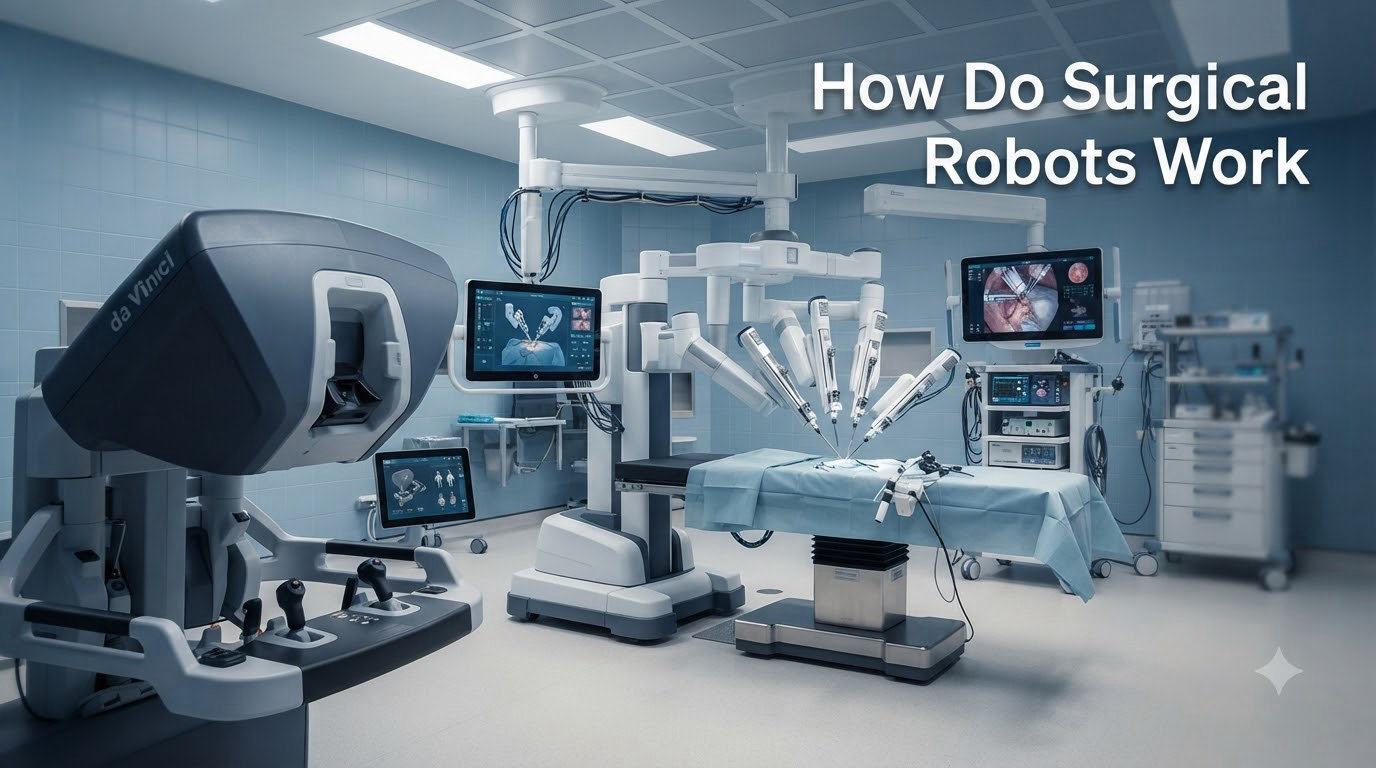
The most widely used platform, the da Vinci Surgical System, follows a master-slave configuration. The surgeon sits at a console a few feet from the patient, grips handles, and watches a magnified 3D image of the surgical field. Every movement they make is captured, filtered, scaled, and relayed in real time to robotic arms docked at the patient’s side that hold miniaturized instruments.
This setup gives surgeons three things human hands cannot deliver in tight spaces: enhanced dexterity through wristed instruments, up to 10x magnification with 3D HD vision, and motion scaling that can reduce a 1-centimeter hand movement into a 1-millimeter instrument movement. Those capabilities are why robotic surgery has become standard for prostatectomies, hysterectomies, and an expanding list of complex procedures.
The Three Main Components of a Surgical Robot System
Every modern surgical robot is built from three coordinated subsystems. Understanding them is the single fastest way to understand how the whole technology works.
Surgeon Console
The surgeon console is the cockpit of the operation. It is where the surgeon sits, looks into a stereoscopic viewer, and manipulates master controls that look like surgical instruments. The console houses a high-definition 3D display system, ergonomic armrests, and foot pedals that control energy, camera focus, and instrument exchange.
When the surgeon moves their fingers, the console captures the motion with sub-millimeter resolution. That signal is then sent to a processing unit, which filters out physiological hand tremor and scales the movement before sending it to the robotic arms. The surgeon sees the operation in true 3D because two separate camera channels feed the left and right eyes, mimicking natural depth perception.
Patient-Side Cart
The patient-side cart is the part most people picture when they imagine robotic surgery. It is a wheeled tower with four robotic arms positioned over the operating table. One arm typically holds the camera, while the other three (sometimes four) hold surgical instruments such as scissors, graspers, needle drivers, and energy devices.
Each instrument has a wristed joint near the tip that can rotate, bend, and pivot far beyond what a human wrist can do inside a small incision. This is the key feature that lets surgeons operate in tight spaces with the same range of motion they would have in open surgery. The cart is sterile-draped, and a surgical assistant stands nearby to swap instruments and manage the ports.
Vision and Computer System
The computer system sits between the surgeon’s hands and the robotic arms. It performs three jobs: image processing, motion filtering, and safety interlocks. The endoscopic camera generates two video streams, which the computer synchronizes and renders into the 3D image the surgeon sees.
The computer also enforces hard safety limits. If a movement exceeds a programmed boundary, the system clamps it instantly. This is one reason FDA-cleared surgical robots are classified as master-slave devices, not autonomous machines. The computer is a high-speed translator, not a decision-maker.
Step-by-Step: How a Surgical Robot Operates During Surgery
Here is what actually happens from the first incision to the final suture, in the order it occurs.
- Patient positioning and port placement. The patient is placed under general anesthesia and positioned on the table. The surgeon makes 4 to 6 small incisions (usually 8 to 12 millimeters each) and inserts trocars, which are hollow tubes that give the robotic arms access to the surgical site.
- Docking the patient cart. The surgical team wheels the patient cart into position and locks each robotic arm to a trocar. The camera arm is docked first so the surgeon can see the internal anatomy in 3D before any instruments enter.
- Inserting instruments. Wristed instruments are loaded into the robotic arms through the trocars. The surgeon controls these from the console.
- Console engagement. The surgeon sits at the console, places their fingers in the master grips, and places their head in the viewer. Foot pedals activate the master controls and let the surgeon swap between instrument arms and camera control.
- Real-time operation. The surgeon performs the procedure by looking at the 3D image and moving the masters. The computer filters tremor, scales motion, and relays every movement to the corresponding instrument. The rest of the team monitors the patient, swaps instruments, and assists at the bedside.
- Undocking and closure. When the procedure is complete, the surgeon undocks the arms, removes the instruments, and the bedside surgeon closes the small incisions, usually with a few sutures or surgical glue.
This entire process is performed in a regular operating room, and the surgeon is in the room the entire time. The console is typically only a few feet from the patient. For telemedicine experiments and extreme long-distance demonstrations, the console can be located miles away on a high-bandwidth network, but for everyday care, the surgeon is at the bedside.
Key Technologies That Make Surgical Robots Precise
Robotic surgery is not magic. It is the combination of four well-understood engineering breakthroughs working together.
Motion Scaling
Motion scaling is the ability to translate a large hand movement into a much smaller instrument movement. On the da Vinci system, surgeons can configure the scale factor to ratios such as 3:1 or 5:1, meaning a 5-millimeter hand motion becomes a 1-millimeter instrument motion. This is critical when working near delicate structures like the prostate, nerves, or heart valves, where 1 extra millimeter can change an outcome.
Tremor Filtering
Every human hand trembles at about 8 to 12 hertz, even when perfectly still. Tremor filtering is the software that detects and removes that involuntary micro-movement before it reaches the instrument. The result feels as if the surgeon’s hand has been steadied by a machine, and it allows precise work at magnifications where the natural tremor would otherwise be visible on screen.
3D HD Visualization
The endoscopic camera produces two high-definition video streams, one for each eye. The console viewer merges them into a single stereoscopic image, restoring true depth perception that is lost in standard laparoscopic surgery, which uses a single 2D camera. Combined with up to 10x to 15x digital magnification, the surgeon sees anatomy in greater detail than the naked eye could ever provide in open surgery.
Wristed Instruments
Conventional laparoscopic instruments are straight rods that pivot only at the handle, which severely limits the angles a surgeon can reach. Wristed instruments add a mechanical wrist near the tip with seven degrees of freedom, mimicking the human wrist. This allows suturing, knot-tying, and dissection in directions that would otherwise be impossible without a large open incision.
Benefits of Robotic Surgery for Patients and Surgeons
The advantages of robot-assisted surgery show up on both sides of the operating table. For patients, the most commonly reported benefits are smaller incisions, less blood loss, lower infection rates, and shorter hospital stays. Many patients go home the same day or the next morning for procedures that would have required 3 to 5 days of inpatient recovery with open surgery.
For surgeons, the benefits are different but equally significant. The ergonomic console reduces physical strain during long procedures, the 3D vision improves depth perception, and the wristed instruments restore dexterity lost in laparoscopy. Residents I have spoken with consistently describe robotic cases as easier on the body, though some senior surgeons note the loss of tactile feedback as a real downside.
Clinical studies have shown that for certain procedures, like radical prostatectomy, robotic surgery reduces positive surgical margin rates and shortens hospital stays compared to open surgery. For other procedures, the benefits are smaller or still under study, and open or laparoscopic approaches remain excellent choices in skilled hands.
Common Procedures Performed With Surgical Robots
Robotic surgery is now used across most surgical specialties. The most common procedures include:
- Urologic surgery: Radical prostatectomy, partial nephrectomy, cystectomy. Robot-assisted prostatectomy is currently the most common robotic procedure in the United States.
- Gynecologic surgery: Hysterectomy, myomectomy, endometriosis resection, sacrocolpopexy.
- General surgery: Hernia repair, gallbladder removal, colorectal procedures, bariatric surgery.
- Cardiothoracic surgery: Mitral valve repair, atrial septal defect closure, lobectomy.
- Head and neck surgery: Transoral robotic surgery for tumors of the tongue and throat.
As platforms become smaller and less expensive, the list keeps growing. Newer entrants are designed for single-port access, where the entire procedure is performed through one small incision, often in the belly button.
Risks and Limitations of Surgical Robots
Robotic surgery is not risk-free, and it is not always the best choice. The most honest summary of the downsides includes the following points.
First, the surgeon loses direct tactile feedback. They cannot feel tissue tension or texture the way they can in open surgery, which makes some maneuvers more difficult and requires reliance on visual cues. Second, robotic cases can take longer than open surgery during a surgeon’s learning curve, which can increase anesthesia time. Third, the equipment is expensive, and that cost is reflected in hospital bills and insurance reimbursements.
Other reported risks include instrument failure during surgery (rare but documented), port-site complications, and the need to convert to open surgery if the anatomy is unfavorable. Forums frequented by surgeons and anesthesiologists also raise concerns about overuse for cases that do not benefit from a robotic approach, and about residents training in an era where open cases are becoming rare.
The History and Evolution of Surgical Robotics
The idea of a surgical robot goes back further than most people realize. The first documented use of a robotic device in surgery was the Arthrobot, developed in Vancouver in 1983 to assist with hip procedures. In 1985, the PUMA 560 was used to perform a brain biopsy under CT guidance, an early demonstration that a robot could hold an instrument more steadily than a human hand.
The real breakthrough came in 2000, when the da Vinci Surgical System received FDA approval. The system combined the three components I described earlier in a single integrated platform, and it was the first to bring wristed instruments, 3D HD vision, and motion scaling into routine clinical use. Within ten years, da Vinci had become the dominant system for radical prostatectomy, and competitors like the Senhance, Versius, and Hugo platforms began reaching the market in the late 2010s and early 2020s.
Each generation has added features such as single-port access, integrated fluorescence imaging that highlights blood flow and tissue perfusion, and AI-assisted guidance that helps surgeons identify anatomy. If you want to understand the underlying actuation technology, our guide on how servo motors work in robots is a useful companion read.
The Future of Surgical Robots and AI Integration
The next decade of surgical robotics will be shaped by artificial intelligence, force feedback, and miniaturization. AI algorithms are already being trained to recognize tissue planes, flag critical structures like the ureter, and warn surgeons when an instrument approaches a prohibited zone. Some platforms are testing autonomous suturing and knot-tying in controlled environments, though no FDA-cleared system operates fully without a human surgeon.
Force feedback, or haptics, is the feature most surgeons say they want next. Newer systems are beginning to add sensors that translate tissue resistance back to the console, so the surgeon can feel pressure as well as see it. Combined with robotic gripper research and faster computing, this is closing the gap between robotic and open surgery.
For now, the surgeon is still doing the surgery. The robot is the most precise instrument they have ever held, but the judgment, anatomy knowledge, and decision-making all remain human. As one surgeon put it in a forum I follow, the robot is the best assistant I have ever had, and I still cannot do the operation without it being exactly where I tell it to be.
Frequently Asked Questions
What is the downside of robotic surgery?
The main downsides are the loss of tactile feedback, longer operating times during a surgeon’s learning curve, and high equipment costs. Rare complications include instrument failure and the need to convert to open surgery if anatomy is unfavorable.
How painful is robotic surgery?
Most patients report less postoperative pain with robotic surgery than with open surgery, because incisions are smaller and tissue disruption is reduced. Pain levels vary by procedure, but smaller incisions typically mean less pain medication and faster mobilization.
Can robots perform surgery on their own?
No. Currently FDA-cleared surgical robots are master-slave systems that require a surgeon to control every movement. Experimental AI features can highlight anatomy and assist with suturing in research settings, but no approved system operates autonomously.
Is the surgeon in the room during robotic surgery?
Yes. The surgeon is physically in the operating room, seated at the console a few feet from the patient, for the entire procedure. A bedside surgical team remains at the patient to assist with instrument changes and emergencies.
What is the most common robotic surgery?
Robot-assisted radical prostatectomy is the most common robotic surgery worldwide, followed by hysterectomy and other gynecologic procedures. Urologic and gynecologic surgeries together account for the majority of robotic case volume.
How long does robotic surgery last?
Robotic surgery duration depends on the procedure. A robotic prostatectomy typically takes 2 to 4 hours, a hysterectomy 1.5 to 3 hours, and simpler cases like hernia repair less than 2 hours. Operative time generally decreases as surgeon experience grows.
Why are some people against robotic surgery?
Critics cite high costs, a steep learning curve, the loss of tactile feedback, and concerns that residents are not getting enough open-surgery experience. Others worry about over-marketing of robotic approaches for cases that do not clearly benefit.
What is the failure rate of robotic surgery?
Serious mechanical failures during surgery are rare, estimated at well under 1 percent of cases. When a fault occurs, the team converts to laparoscopic or open surgery. Patient outcomes from robotic surgery are generally equivalent to or better than open approaches for approved indications.
Conclusion
Surgical robots are precision tools, not autonomous surgeons. The way surgical robots work comes down to three subsystems, a surgeon console, a patient-side cart, and a computer system, working together to translate the surgeon’s movements into scaled, tremor-free actions inside the body. Motion scaling, tremor filtering, 3D HD vision, and wristed instruments are the four engineering breakthroughs that turn that setup into something clinically powerful.
For patients, the practical benefits are smaller incisions, less pain, less blood loss, and faster recovery in many common procedures. For surgeons, the system delivers better visualization, ergonomics, and dexterity than either open or laparoscopic surgery can offer. The trade-offs are real: high cost, no tactile feedback, and a learning curve that affects outcomes during the early adoption period.
If you are considering a robotic procedure, the best next step is to ask your surgeon about their specific case volume, outcomes, and why a robotic approach is the right choice for your situation. The technology is impressive, but it is still the surgeon’s skill that determines the result. For a deeper look at the actuation hardware that makes these systems move, our piece on planetary gearboxes in robot joints is a good follow-up.