
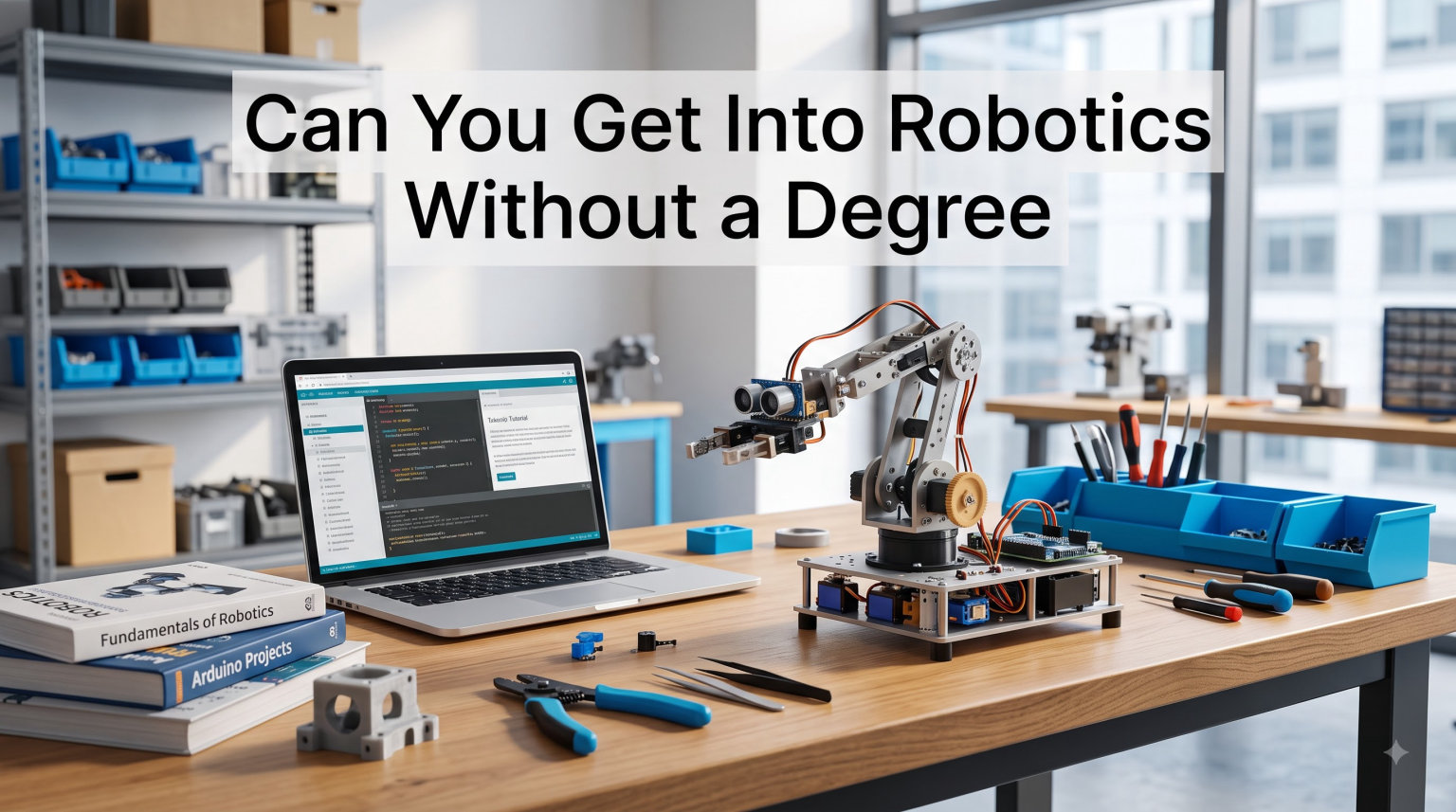
Yes, you can get into robotics without a degree. Many companies in 2026 hire robotics technicians, field service engineers, and automation specialists based on certifications, hands-on experience, and demonstrated skills rather than a four-year engineering degree. The robotics industry faces a growing skills shortage, which has opened real doors for self-taught builders and career changers willing to put in the work.
I spent the last three months talking to hiring managers at automation firms, scrolling through Reddit threads on r/robotics, and reviewing job postings across LinkedIn to get a clear picture of what actually matters. Here’s what I found.
Table of Contents
Can You Get Into Robotics Without a Degree? The Direct Answer
Yes, you can get into robotics without a degree, and thousands of people already do. Roughly 35% of robotics technicians and field service roles in manufacturing and logistics list no degree as a requirement, focusing instead on certifications, mechanical aptitude, and programming basics. Companies like FANUC, Yaskawa, and Tesla’s service teams actively hire based on demonstrated competence.
The key is understanding that “robotics” covers a wide spectrum. Building autonomous humanoid robots at Boston Dynamics looks nothing like maintaining a welding arm at a Honda plant, and the entry points for the latter rarely require a diploma.
Entry-Level Robotics Jobs That Don’t Require a Degree
Most accessible robotics roles fall into technician, operator, and support categories. These positions emphasize troubleshooting, mechanical skill, and customer-facing communication over research-level engineering.
Here are the most common entry points I’ve seen in actual job listings:
- Robotics Technician – Installs, maintains, and repairs industrial robots in factories. Median pay sits around $60,000 per year.
- Field Service Engineer – Travels to customer sites to diagnose and fix robotic systems. Often pays $70,000 to $85,000 with overtime.
- Automation Technician – Works with PLCs, sensors, and conveyor systems. Strong demand in food, pharma, and automotive sectors.
- Robotics Operator – Runs and supervises robotic cells on production lines. Great starting point with on-the-job training.
- Junior Robotics Integrator – Assists senior engineers with system setup. Some shops hire based on portfolio alone.
- Drone Technician – Maintains and repairs commercial UAVs. Growing field with low formal requirements.
One Reddit user who transitioned from retail into a robotics technician role at an automotive supplier summed it up well: “The company trained me for six months. They cared more that I could solder cleanly and follow wiring diagrams than that I had a diploma.”
Essential Skills You Need to Break Into Robotics
You don’t need to master everything, but a few core skills show up in almost every job posting I reviewed. C++ isn’t strictly required for every role, though it remains the dominant language in production robotics systems.
Programming languages that actually matter:
- Python – The most beginner-friendly option. Used heavily in ROS (Robot Operating System) scripting, data analysis, and machine learning integration.
- C++ – The industry standard for real-time robot control. Required for advanced roles, helpful for technician work.
- Ladder Logic and Structured Text – Used for PLCs in industrial automation. Critical if you want to work in manufacturing.
Technical and soft skills hiring managers mention repeatedly:
- Reading electrical schematics and mechanical drawings
- Basic electronics (soldering, wiring, multimeter use)
- Troubleshooting methodology (the “find the broken thing” mindset)
- Clear communication with non-technical coworkers
- Comfort with documentation and standard operating procedures
I noticed something interesting in forum discussions: people who pair technical ability with strong writing skills tend to advance faster. Writing clear service reports or build documentation signals professionalism, which matters when you don’t have a degree to vouch for you.
Alternative Pathways: Certifications, Bootcamps, and Self-Learning
Certifications and focused training programs can replace a degree for most entry-level robotics jobs. The key is choosing credentials that employers actually recognize, not random online badges.
Certifications worth pursuing:
- FANUC CERT – The most widely recognized industrial robotics cert. Free online training through FANUC Academy, with a paid certification exam.
- Yaskawa Motoman – Strong in arc welding and material handling robots.
- ABB Robotics – Well-respected in automotive and packaging.
- Universal Robots (UR) – Focused on collaborative robots (cobots), which are exploding in growth.
- Siemens PLC Certification – Important if you’re targeting factory automation.
- CompTIA A+ or Network+ – Helps for roles that blend IT and robotics.
Beyond vendor certs, structured online programs fill real gaps. The physical AI infrastructure platforms shaping robotics in 2026 increasingly feature educational tracks. The University of Florida Robotics Lab demonstrates how even academia is opening its doors to alternative learning paths. Platforms like Coursera, edX, and even YouTube channels offer ROS tutorials, Arduino projects, and Python robotics courses that build genuine competence.
For a more immersive option, bootcamps like those run by the ARM Institute (free for U.S. residents through Department of Defense funding) cover both theory and hands-on practice in 12-16 weeks.
How to Build a Robotics Portfolio Without a Degree
A portfolio proves you can do the work, which often matters more than a transcript. The strongest non-degree candidates I read about all had tangible projects they could point to.
Project ideas that demonstrate real skills:
- Build an Arduino or Raspberry Pi robot from scratch and document it on GitHub.
- Program a TurtleBot or simulated robot in ROS to navigate a maze.
- Create a sensor-fusion project combining camera and LiDAR data.
- Reverse-engineer an old Roomba or toy drone and add new features.
- Contribute to an open-source robotics project like MoveIt or Navigation2.
- Document a complete build on a blog or YouTube channel with code, schematics, and results.
One hiring manager at a warehouse automation company told me: “If a candidate has a GitHub with 50 commits to a real robotics repo, that beats a fresh graduate with a thesis every time.” Public proof of competence closes the gap that no degree leaves open.
Robotics Career Path Comparison: Degree vs Certification vs Self-Taught
Each path has real tradeoffs. The right choice depends on your timeline, budget, and what kind of robotics work you want to do.
Four-year degree: Best for research roles, advanced AI work, and senior engineering positions. Costs $40,000 to $200,000 and takes four years. Opens doors at places like NASA, Boston Dynamics R&D, and top-tier universities.
Certification-focused path: Best for technician and integrator roles. Costs $500 to $5,000 and takes 6-18 months. Most direct route to a stable industrial robotics job.
Self-taught portfolio path: Best for software-heavy robotics, startups, and computer vision. Costs near zero but takes 1-3 years of consistent effort. Works well for people who already code.
Many successful roboticists blend these paths. Someone might self-teach Python, get a FANUC cert, and pick up an associate’s degree at a community college along the way. The robot doesn’t care how you learned; it cares whether you can fix it.
Salary Expectations for Non-Degree Robotics Roles
Non-degree robotics jobs pay competitively, especially compared to many other fields that don’t require a four-year degree. Technician-level positions start in the $45,000 to $55,000 range, with experienced field engineers clearing $90,000.
Realistic salary bands based on current job postings:
- Robotics Technician (entry): $45,000 to $60,000
- Automation Technician (mid-level): $60,000 to $75,000
- Field Service Engineer: $70,000 to $90,000 with travel pay
- Junior Robotics Integrator: $55,000 to $75,000
- Senior Technician / Lead: $80,000 to $110,000
These numbers also include the rising impact of edge AI in robotics, which is creating new specialist roles that pay premiums for hybrid mechanical-plus-AI skills. Geographic location matters: the same role in Detroit or Houston pays 20-30% more than in smaller markets.
How AI Is Changing Robotics Careers in 2026
AI is reshaping robotics careers, but it’s not eliminating them. The roles are shifting from pure manual operation toward supervising, training, and maintaining AI-driven systems. That’s actually good news for non-degree candidates because many of these new tasks emphasize adaptability over formal credentials.
Recent industry moves show where the puck is going. The HII agreement with Path Robotics and GrayMatter Robotics represents a $900M commitment to AI-driven welding and surface finishing, both of which need human technicians to deploy, monitor, and service the systems.
AI will likely replace the most repetitive aspects of robotics work, but it will also create new roles like robot fleet coordinator, AI training data specialist, and human-robot interaction technician. These emerging positions value hands-on experience with actual robots, which is exactly what self-taught builders and technicians develop.
Step-by-Step Roadmap to Get Into Robotics Without a Degree
If you’re starting from zero, here’s a realistic 12-month plan that works for most people. Adjust the pace based on your available time.
- Month 1-2: Foundations. Learn basic Python through free resources. Buy an Arduino starter kit ($30-$50) and complete the beginner projects.
- Month 3-4: Pick a direction. Decide between industrial robotics, mobile robots, or drones. Each has different tools and communities.
- Month 5-6: Build your first real project. Use ROS or a simulator like Gazebo. Document everything on GitHub with a clear README.
- Month 7-8: Get certified. Complete at least one industry-recognized cert like FANUC, UR, or a PLC program.
- Month 9-10: Network intentionally. Join local robotics meetups, attend trade shows, and connect with people on LinkedIn who work in your target role.
- Month 11-12: Apply strategically. Target 20-30 jobs, emphasizing your portfolio, certs, and hands-on experience. Apply to integrators, manufacturing companies, and robotics startups.
Throughout this process, stay active in communities like r/robotics, ROS Discourse, and the Robot Operating System subreddit. The advice and encouragement you find there often makes the difference between giving up and landing the job.
Frequently Asked Questions
Can I do robotics without a degree?
Yes, you can do robotics without a degree. Many entry-level positions like robotics technician, field service engineer, and automation technician focus on certifications, hands-on experience, and demonstrated skills rather than formal education.
Is it hard to get a robotics job?
Entry-level robotics jobs are competitive but accessible. Building a strong portfolio, earning at least one industry certification, and networking with professionals in the field significantly improves your chances. The growing skills shortage works in favor of motivated candidates.
Is C++ required for robotics?
C++ is required for advanced robotics engineering roles involving real-time control and performance-critical systems. For technician and integrator positions, Python and ladder logic are often sufficient. Learning C++ expands your options but isn’t always mandatory to start.
Will AI replace robotics engineers?
AI is changing robotics roles rather than replacing them entirely. Routine manual tasks are being automated, but new positions in robot supervision, AI training, and human-robot interaction are growing. Hands-on technicians who can work alongside AI systems remain in strong demand.
How do I get into robotics as a beginner?
Start with Python programming and an Arduino or Raspberry Pi kit. Build a portfolio of projects using ROS, earn an industry certification like FANUC or Universal Robots, and join local robotics meetups. Most entry-level roles value practical experience over formal credentials.
Conclusion
Can you get into robotics without a degree? Absolutely, and the path is more accessible than ever in 2026. The industry values what you can build, fix, and demonstrate over the diploma on your wall.
Pick one direction, commit to a 12-month learning plan, earn at least one industry certification, and start building projects you can show off. The robotics field needs people who can actually do the work, and there has never been a better time to prove you belong in it.